Recent (Dec 2025) Book Review of my book - The Portuguese in the Creole Indian Ocean: Essays in Historical Cosmopolitanism https://t.co/vFPNQmToaV Am very grateful and flattered!
Joe Kent: Why the U.S. Proxy War in Ukraine Must End Now https://t.co/gPoSJbRUv2 via @YouTube My comment on this excellent interview (kudos once more to Glenn Diesen): it is incredible how stupid (sic) the American government is!
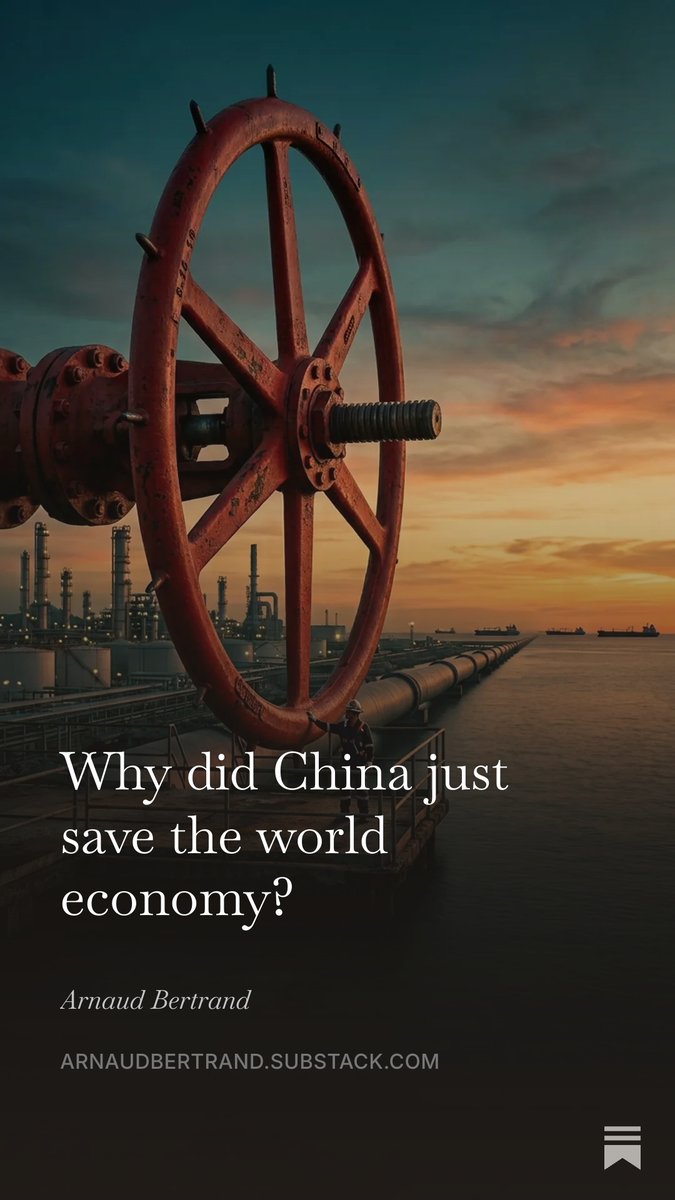
This is one of the biggest geopolitical mysteries of the year: why did China just save the world economy?
Because, make no mistake, it absolutely did. Analysts are pretty much unanimous on this: had China not dramatically - and I mean dramatically - reduced its oil imports this year, the price of crude oil would have gone through the roof and dragged the global economy down with it.
For proof, read how Javier Blas from Bloomberg - widely recognized as one of the world’s top energy analysts - explains what China did to Jake Sullivan and Jon Finer on their podcast “The Long Game” (https://t.co/bBD8yFFUdC).
As Blas puts it, China went “from 11, 12 million barrels a day to less than 6 million barrels a day” of seaborne crude imports, and that “freed a lot of oil for other countries, particularly in Asia.” India, Japan, Korea and Southeast Asia “could buy the barrels that China was not buying.”
To be clear, China wasn’t the only factor - surging US exports and the IEA’s emergency release helped too - but it was by far the biggest: JPMorgan reckons China accounted for about 74% of the fall in global crude trade (https://t.co/JCmFXYJcfh).
So it's no exaggeration to say that it is China, first and foremost, that saved the world economy this year.
If you remember the early days of the Iran war, none of this is what was predicted. In fact some US think tankers, such as the (always horrendous) Zineb Riboua from the Hudson Institute, were even cheering the war as being “all about China… the opening act in the larger contest against China,” the moment the US would crack “the central pillar of a regional order that Beijing has assembled” (https://t.co/RaCE05TcMp).
Seven months on, what actually happened is that not only did China come out of the war unscathed economically, and strengthened strategically, it also ended up shielding the world economy, America’s included, from the fallout of the very war that was supposed to be its undoing.
Breaking news: if you do something that’s supposed to be a “blow” to someone else - some sort of 3D chess move to gain the upper hand - and they end up having to rescue you from the fallout, maybe it wasn’t such a brilliant strategic move after all.
So how did China pull it off? And, more intriguingly, why did it choose to rescue countries, including the US, from a war that Washington’s own hawks were openly selling as a strike against China itself?
And why do this when it effectively dampened Iran's leverage considerably, even though they're supposed to be China's "ally" (which, as we'll see, is false)?
This is the topic of my latest article. I went very deep researching all the Chinese sources I could find on this, looking at the exact legal mechanisms, and at what officials, oil refiners and state media actually said.
The answer turns out to be far stranger than I expected: no-one in Beijing actually ever ordered an import cut. China, effectively, seems to have saved the world economy incidentally, as a by-product of its own domestic policy to protect Chinese consumers.
Which is the real story here: China has become so large and so important it can just rescue the world economy as a mere side effect.
In fact what I discovered, hilariously, is that the Chinese were just as surprised as anyone else: it’s only weeks after Western media started crediting China with saving the world economy that Chinese media picked up the story. And even then, CCTV’s first take in July (https://t.co/xLPyaJeZnT) presented it as something 外媒称 (wàiméi chēng, “foreign media claim”) 🤣
Almost like a giant suddenly waking up to its own powers. Because, that's the thing: intentions fade, consequences stay. Intentional or not, as Igor Sechin, the head of Rosneft, Russia’s largest oil company, put it (https://t.co/ckinOaHzJ7), the consequence is that it's now China, not OPEC, who calls the shots on global energy markets.
The valve of global oil pricing is now in Shandong, not in Zhongdong anymore (Zhongdong, 中东, is the Middle East in Chinese).
Full article here, with how China’s 20-year strategic nightmare, the “Malacca dilemma”, has now effectively become its leverage over the rest of the world: https://t.co/HsxPLJp45X
12000 years old Petroglyph found in #Ratnagiri Maharashtra is the oldest Map in the world.
12000 years ago when the last #Iceage ended.
- The sea levels soared by 60 meters from 140 meters lower than present levels.
- The average temperature also rose to around a level of 4°-6° celcius less than today.
Someone or a group of people, or a generation of people travelled the length and breadth of India and itched it in #Ratnagiri Maharashtra. They probably perceived Indian shape as a big Elephant who has four legs like four directions. They engraved this imagination with whatever they found in different directions. It would have taken 10s of years a man to draw 14x12 meter pictograph bare handed using stone tools.
Gathering of directions and peculiarities itself would have taken 100s of years. A set of generations probably did this humongous task.
Features of the map
- The head of Elephant has 2 man shown. It probably means that the narrators want to show that man only lived in Ratnagiri and Madhyapradesh at that moment. This is also possible because Madhyapradesh falls on Tropic of Cancer which were warmer than rest of the India post Ice Age.
-The Elephant has got 7 mountains type figures probably the pre-cursor to India depicted in Mahabharata's.
-Assuming the head in the West Position (Ratnagiri is in West), it depicts four animals found in each directions. For eg, -Bengal Tiger is positioned near Bengal region (East),
-Langoor in North,
-Pangolin in South-East ,
-Boar near present Ratnagiri and MadhyaPradesh. The petroglyph also houses a shark in the South-east area.
- A Kangaroo 🦘 sort of animal can be seen near the trunk of the elephant. Could this be Australian continent who knows.
- There are several birds and other animals (mostly unrecognised / extinct). Interestingly only Langoor and other predators survived and can be seen in today's environment.
The marine life mostly shows fishes and sharks. There are few more elephant petroglyph found from the same region indicating the significance of elephant in Indian Ancient history. Please watch this video. Don't forget to like and Subscribe. https://t.co/LwTD3pWccm #Archaeology
China does not need to build better AI than America. It needs to make American AI unprofitable.
The playbook is older than the technology. Flood the market with a cheaper version until the domestic industry collapses. China ran it with steel. Ran it with solar. Ran it with semiconductors.
Not a better product. A cheaper one. Good enough at a fraction of the price beats best in class at full cost.
AI is next.
Open-weight models. Lightweight. Inexpensive. Already inside a third of corporations. Not because they outperform. Because a CFO looked at the benchmark gap, looked at the price gap, and made the only decision capitalism allows.
The rational one.
China’s weapon is not Chinese technology. It is American capitalism.
The market has no loyalty. No patriotism. Only price sensitivity. Every procurement decision is a vote, and the vote always goes to the invoice.
American AI companies are valued on one assumption. That corporations will keep paying premium prices for premium intelligence. China’s strategy is to make that assumption false. Not by outbuilding. By undercutting.
Creating value and capturing value have never been the same thing. AI might be the first technology powerful enough to prove it at civilizational scale.
Roughly 40% of the S&P is tied to the AI bet. The majority of recent GDP growth has come from AI capital expenditure. America concentrated everything into a single sector and left that sector’s economics undefended.
The distance between AI boom and American recession is one quarter where enough CFOs make the same rational decision at the same time.
The technology race was the distraction. Who has the biggest model, who wins the benchmark, who reaches AGI first. None of that matters if the business model underneath it cannot survive being undercut.
A technological advantage that cannot sustain its own economics is not an advantage. It is a head start with no finish line.
America built the most advanced AI on Earth.
It has not yet built an economy that survives someone selling it cheaper.
And the country that figured that out is not trying to catch up.
It is trying to make catching up unnecessary.
The Chinese suffer from a heavenly kingdom syndrome, reinforced by their current economic success.
Chinese commentators are incapable of challenging even intellectually the narrative of the CCP about India.
Incapable of independent thinking and departing from the official line.
They have minds trapped in the approved narratives of the communist leadership.
In fact these commentators serve the useful purpose of saying things about India that the Chinese govt would prefer not to say officially.
I’ve lived in ashrams across India for 7 years.
From Kerala’s backwaters to the Himalayan foothills.
Here are 15 ashrams that taught me there is no single path to liberation.
(🛏️ = can stay | 🍛 = food available)
PATH OF DEVOTION
1. Amritapuri: Bhakti, Bhajans, Seva, Music 🛏️🍛
2. Kainchi Dham: Hanuman, love, foothill of himalays
3.Sree Subhanandasramam: Bhakti, universal love, advaita 🛏️🍛
4. Parmarth Niketan: Yoga, devotion, Ganga, Shiva, Bhajans🛏️🍛
PATH OF KNOWLEDGE
5. Sri Ramanasramam: Self-Enquiry, Arunachala foothills, Meditation only 🍛
6.Arsha Vidya Gurukulam: Upanishads and Advaita Vedanta mostly. 🍛
7. Swami Dayananda Ashram: Reasoning/Contemplation, Scripture's inquiry 🍛
PATH OF DISCIPLINE
8. Sivananda Yoga Vedanta Dhanwantari Ashram: Yoga, meditation, Vedanta and structured daily routine.🛏️🍛
9. Isha Yoga Center: Yoga, Meditation, Bhairavi/Bhairava,VBT, Small Tantras 🛏️🍛
10. Art of Living: Breathwork, meditation, yoga, bhajans, music, food, Devotion🛏️🍛
11. Yogoda Satsanga Sakha Math: Kriya Yoga, meditation and devotion🛏️🍛
PATH OF TRANSFORMATION
12. Sri Aurobindo Ashram: Yoga, self enquiry, community, slef enquiry, bhajans🛏️🍛
13.Santhigiri Ashram: Sri Narayana guru, bhakti, devotion🛏️🍛
14. Belur Math: Ramakrishna-Vivekananda tradition, Vedanta, practice, interfaith, sevas.🍛
What 7 years taught me:
Some people find God through love.
Some through inquiry.
Some through discipline.
Some through service.
None of them are wrong.
Our spiritual heritage is too vast to reduce to one guru, one doctrine or one path.
Have you stayed in any of the Ashrams? If not, which would you pick first.
Some historical accounts state the largest genocide in human history was committed by Muslims against Hindus in the Indian subcontinent. Hundreds of millions of Hindus have been massacred since Islam's arrival in the 8th century.
How many Christians, Jews, and other non-Muslims have been slaughtered in the name of Islam across the world throughout the centuries?
The world urgently needs an honest education about the history of Islamic expansionism.
Although the tradition of Durga puja with pratima is only about 160 years old, Durga puja in Meghalaya is far older
The head priest of the Jayanti Shaktipeeth in Nartiang, Meghalaya is a progeny of a Maharashtrian Brahmin who married a Jaintia woman.
On paper, he will be a ST despite being Brahmin since Jaintias trace lineage through mother's side.
Ka Bei Durga = "Maa Durga" in Jaintia language
Very excited to share the most important discovery of my career yet: your brain switches between a conscious and an unconscious mode ~15 times every second. Consciousness may depend not on where in the brain activity occurs but when.
Find out more below.
https://t.co/23dyMGnaLX
What Capt. Smit did was phenomenal after how he was brutally attacked. Single-handedly destroyed a well planned terror attack to kill jews and blame Indians by terrorists. No wonder anti-India hate was fanned through the roof after he was celebrated worldwide.
In 1804 Thomas Jefferson sent thirty-three men to walk off the edge of the known map and find out whether America went all the way across. They came back two years later having lost one man, and the reason the rest lived is written in the journals in a word no dietitian uses: fat.
The Corps of Discovery left St Louis in May, hauling a keelboat up the Missouri against the current, by rope, through mud to the waist. Nobody knew what was out there. The maps gave out at the Mandan villages. Beyond that was rumour: mountains that might be a day's walk across, rivers that might run to the Pacific, and animals the size of carts that nobody back east believed in.
The men ate like no men have eaten since. Nine pounds of meat a day each, when it could be got. Four deer for the party, or a buffalo, every single day. Clark wrote that they consumed an immensity of meat. And by the autumn of 1805, on the high plains, they had learned the thing the plains people had always known. The buffalo in October carries inches of yellow fat down its back, and the men stripped it off and ate it before they touched the lean. They roasted marrow bones in the embers and sucked them like sweets. Charbonneau stuffed buffalo gut with meat and kidney fat and Lewis, a man who did not hand out praise, called it one of the great dishes of the frontier. They rendered bear grease into kegs and carried it over the Rockies like gold.
Then came the winter on the Pacific. Fort Clatsop, rain for a hundred days, and the only game was elk, lean as rope after the mountains. The men lived on it and the journals turn dark: boils, bowel trouble, men laid flat with nothing left in them. The meat was plentiful. It was the fat that had gone.
In January a whale washed up on the shore. Lewis sent a party through the surf and over a headland to buy its blubber from the Clatsop people, and when it came back he wrote that providence had been kinder to them than to Jonah, since it had sent the whale to be eaten rather than the reverse. The men came back to life on it.
They crossed the Divide, found the river, saw the ocean, and walked home. One grave in 8,000 miles, three months in, a sergeant with a burst appendix. No scurvy in two years without a vegetable.
The greatest expedition in American history ran on buffalo fat, bear oil, marrow and whale blubber, and its captains knew exactly what was keeping their men on their feet.
Send the same thirty-three men out today with oats, lean turkey and a bag of lentils, and the only thing that reaches Oregon is the paperwork.
Tuvakara. A Sanskrit word for a Chaulmoogra tree. Ayurveda used its oil against leprosy for centuries.
Frederic Mouat, a British prof. at Bengal Medical College, heard of it from Indian vaidyas and the headmaster of Hindu College. Tried at Calcutta's Leper Asylum, it worked. In 1854 Mouat wrote the 1st Western paper on chaulmoogra.
Drinking it was the hard part. Many patients said they would rather have leprosy than take one more dose.
Calcutta fixed that....
Leonard Rogers and chemistry prof. Chuni Lal Bose made a soluble salt of the oil, and on 31 July 1915 it went into patients for the 1st time.
Then Hawaii. A 23-year-old chemist there, Alice Ball, converted the oil into injectable esters.
They became the standard leprosy treatment worldwide until the 1940s. Ball died at 24, before she could publish. So her department head published the work under his own name. In 1922 a colleague finally said it was hers, and called it Ball's Method.
The tree was ours. The chemistry that made it usable was ours. And we do not remember any of it.
Sources: "Chaulmoogra Oil and the Treatment of Leprosy", John Parascandola, U.S. National Library of Medicine
Photo: Alice Ball's 1915 portrait, University of Hawaii, via Wikimedia Commons (public domain)
Guess how many books all Harvard undergraduates read in common?
15? 8? 3?
The answer is zero. Not one.
Meanwhile every single graduate of Thomas Aquinas College in California has read
1. The Holy Bible
2. The Iliad — Homer
3. The Odyssey — Homer
4. The Republic — Plato
5. The Apology — Plato
6. Nicomachean Ethics — Aristotle
7. Politics — Aristotle
8. The Aeneid — Virgil
9. Confessions — St. Augustine
10. City of God — St. Augustine
11. Consolation of Philosophy — Boethius
12. Summa Theologiae — St. Thomas Aquinas
13. The Divine Comedy — Dante
14. The Canterbury Tales — Geoffrey Chaucer
15. Don Quixote — Miguel de Cervantes
16. Hamlet — William Shakespeare
17. King Lear — William Shakespeare
18. Macbeth — William Shakespeare
19. The Prince — Niccolò Machiavelli
20. Paradise Lost — John Milton
21. The Social Contract — Jean-Jacques Rousseau
22. Democracy in America — Alexis de Tocqueville
23. The Brothers Karamazov — Fyodor Dostoevsky
24. War and Peace — Leo Tolstoy
25. The Waste Land — T. S. Eliot
And so many more
The Sumerians told a story where the wells filled with blood, irrigation water turned to blood, and people were forced to drink blood.
Sound familiar?
Most people know the biblical story of Moses and the Nile turning to blood.
It's recorded in a text called Inanna and Šu-kale-tuda.
The story begins with the goddess Inanna travelling across the land. Exhausted, she falls asleep beneath a tree.
A gardener named Šu-kale-tuda finds her sleeping and sexually assaults her.
When Inanna wakes and realizes what happened, she becomes enraged and sets out to find him.
According to the text, she fills the wells of the land with blood.
The orchards irrigated by those wells produce blood.
People sent to collect drinking water find blood. Even the ordinary people of Sumer are described as drinking it.
The account states that nobody knew when it would end.
They're talking about wells, irrigation systems, agriculture, and the water people depended on to survive.
An entire population is affected while Inanna searches for the man responsible.
Now compare that with the Book of Exodus, where the waters of Egypt turn to blood during the first plague.
The similarities are difficult to ignore.
I'm not claiming the biblical writers copied this particular Sumerian account.
I find it fascinating that two ancient traditions describe divine punishment involving blood replacing the water people depended on.
Were these entirely separate stories?
Did one tradition influence another?
Or were people preserving accounts of something they believed had actually happened?
We have spent thousands of years calling these accounts mythology.
I keep coming back to the same question.
What were these ancient people trying to tell us?
Il va falloir arrêter d'être faibles.
Bukele a fait du pays le plus meurtrier du monde l'un des plus sûrs du continent. Milei a sorti l'Argentine de l'hyperinflation en moins de trois ans. Ce soir, pendant ce temps, la mairie de Limoges brûle. Et la France regarde.
Ce samedi 17 octobre, des centaines de jeunes ont pris d'assaut l'Hôtel de Ville de Limoges, un monument historique bâti il y a près de 150 ans. Ils ont renversé et incendié des voitures de police sur le parvis, mis le feu au rez-de-chaussée, puis regardé les flammes dévorer le toit, la salle des mariages et l'état civil. Le campanile, emblème de la ville, s'est effondré.
L'état civil. Le lieu où l'on inscrit les naissances, les mariages, les morts. Ce n'est pas un bâtiment qui a brûlé ce soir. C'est la mémoire d'une ville entière.
Alors je m'adresse à tous les Français.
À toi, boomer gauchiste qui crois encore qu'on peut « vivre ensemble » en fermant les yeux : ce soir, c'est ta mairie qui brûle. Tes bons sentiments ne protègent personne.
À toi, jeune qu'on matrixe au marxisme entre deux vidéos TikTok : réveille-toi. Ceux qui te vendent la révolution n'habiteront jamais les villes qu'ils te demandent de brûler.
À toi, cadre moyen qui penses t'en sortir parce que tu vis dans un beau quartier : le feu ne regarde pas le code postal. Limoges, ce n'est pas la banlieue. C'est le cœur de la France.
À toi, entrepreneur qui te tais pour ne froisser personne : ton silence est un luxe que ce pays n'a plus les moyens de s'offrir.
À toi, fonctionnaire qui fais tourner la machine : c'est ton service public qui part en fumée.
À toi, retraité de province qui as construit ce pays : ils brûlent ce que tu as payé toute ta vie.
À toi, élu local qui négocies avec ceux qui cassent : tu es le prochain sur la liste.
À toi, policier qu'on envoie au front sans soutien : la France qui travaille est derrière toi.
À toi, parent qui regardes ces images ce soir avec tes enfants : demande-toi dans quel pays ils vont grandir.
Vous allez tous devoir exiger la même chose. La fermeté. Le retour de l'ordre. La fin de la culture de l'excuse. Sinon, ce qui s'est passé ce soir à Limoges deviendra votre quotidien.
Et les solutions, on les connaît. Personne ne peut plus prétendre le contraire.
Au Salvador, en 2015, on comptait 106 homicides pour 100 000 habitants. Le pays le plus meurtrier de la planète. En 2025 : 1,3. Quatre-vingt-deux homicides sur une année entière, pour plus de six millions d'habitants. Bukele n'a pas organisé de colloque sur les causes profondes. Il a rétabli l'autorité de l'État.
En Argentine, Milei a hérité de 25 % d'inflation par mois, d'un déficit de plus de 5 % du PIB et d'un pays au bord de sa énième faillite. Il a supprimé la moitié des ministères, coupé environ 15 % des emplois publics nationaux, et dégagé un excédent budgétaire deux années de suite, du jamais vu depuis 2008. L'inflation mensuelle est tombée sous les 2 %.
L'ordre d'abord. Un État maigre ensuite. La prospérité suivra.
La France n'est pas condamnée. C'est le plus beau pays du monde, et il a survécu à bien pire. Nous pouvons le reprendre. Mais il faudra un électrochoc, et il ne sera pas tendre.
La question n'est plus de savoir si ça va arriver. C'est de savoir si on agit avant que la prochaine mairie brûle.
Be like Brazil
- 7,491 km of Atlantic coastline
- The Amazon River, which carries close to a fifth of all the river water flowing into the world's oceans
- About 12% of the planet's surface fresh water
- The Pantanal, the biggest tropical wetland on Earth
- Two harvests a year on the same field (soy in summer, corn or cotton right after)
- World's #1 exporter of soybeans, coffee, sugar, beef, chicken and orange juice
- About 6 of every 10 soybeans traded on Earth ship from Brazil
- Top coffee grower on the planet for over 150 years
- Three out of every four liters of orange juice sold between countries come from Brazil
- Embrapa turned a savanna once seen as unfit for farming into one of the biggest farm belts on Earth
- Grows enough food to feed about 800 million people
- About 93% of the world's niobium, the metal that makes steel stronger
- The second-largest rare earth reserves on Earth, behind only China
- A top-ten producer of graphite, lithium, tin, nickel, manganese, tantalum and vanadium
- About 87% of its electricity comes from water, wind, sun and biomass
- Embraer: the third biggest planemaker on Earth, behind only Boeing and Airbus
- Pix: free instant payments, and 93% of adults sent at least one in a single month this year
- Home to over 2 million people of Japanese descent, the largest Japanese community outside Japan
- Santos-Dumont flew his 14-bis plane in Paris in 1906, in front of a crowd
- Christ the Redeemer, one of the New 7 Wonders of the World
- 5 World Cup titles, more than any other country
- The world eats, drinks and builds with Brazil every day, and most people still couldn't find MATOPIBA on a map
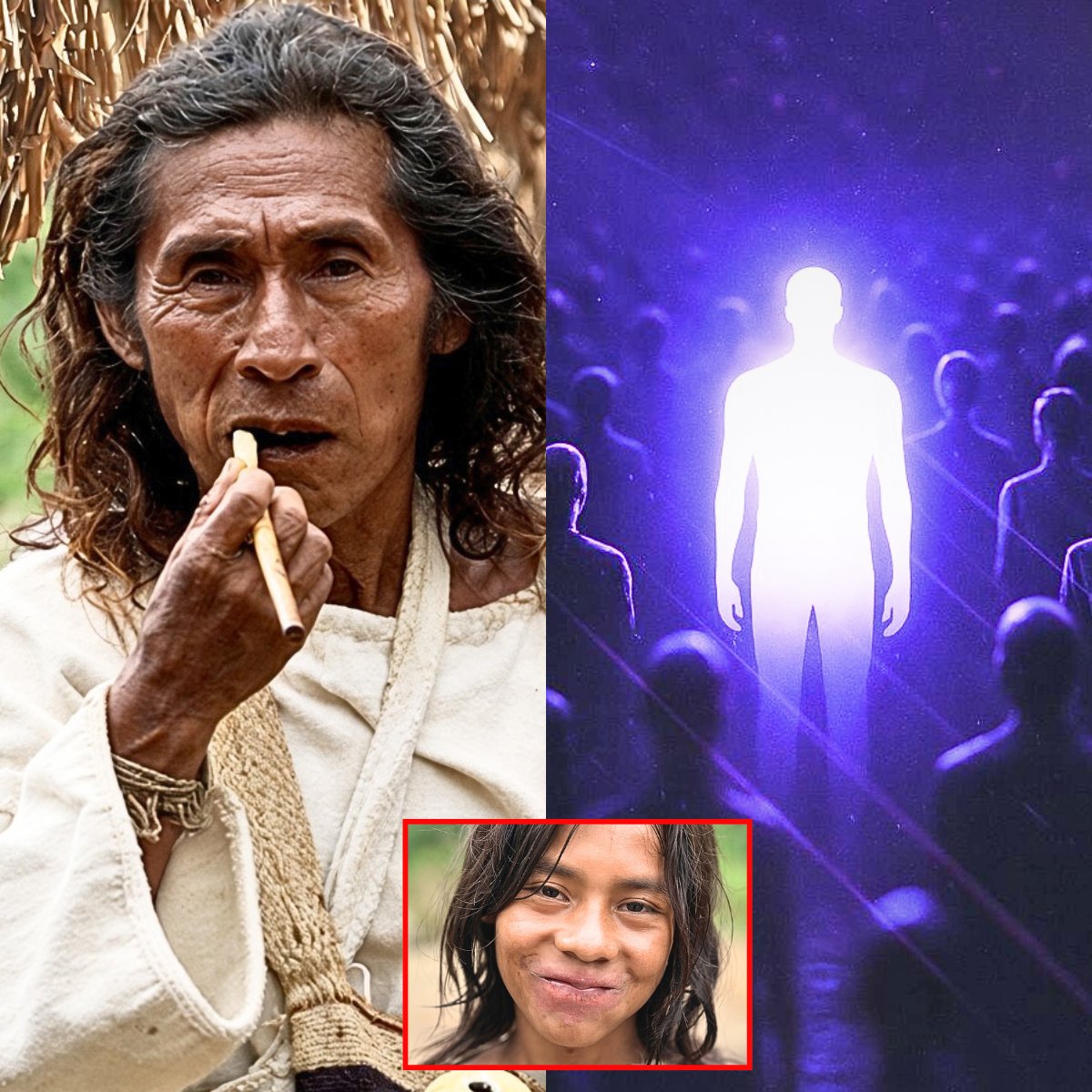
The Kogi tribe of Colombia selects certain babies to spend their first NINE YEARS in COMPLETE DARKNESS. No sunlight. Not even moonlight. They are trained to connect with what the Kogi believe is an invisible cosmic consciousness behind all life.
The Kogi select these children at birth to become Mamas, the spiritual leaders of the Kogi. They are raised in dark caves, where their mothers and spiritual teachers teach them about rivers, mountains, trees, animals, and the Sun without letting them see them.
Their training also completely reverses their normal sleeping patterns. They sleep during the day and remain awake at night, learning sacred stories, songs, and the sounds of nature. Anthropologists have described this unusual upbringing as an attempt to change how these children experience time and space.
Even when they are occasionally taken outside at night, they are blindfolded to prevent them from seeing the world.
The Kogi believe the physical universe originates in an invisible realm of consciousness called Aluna, where everything exists spiritually before taking physical form.
They believe that by keeping these children in darkness, they can develop a connection with this invisible reality before experiencing the physical world.
Imagine being nine years old and having never seen sunlight, a tree, a mountain, or even the faces of the people who raised you.
Then, after spending your entire childhood learning about the world through sounds, stories, and spiritual teachings, you finally emerge into daylight and see everything for the first time.
Some accounts describe future Mamas undergoing this training for as long as 18 YEARS.
The Kogi believe these spiritual leaders can communicate with the forces of nature and help maintain Earth's balance. They also believe modern humanity has forgotten its connection to this invisible world.
Do you think this kind of upbringing could unlock a different way of perceiving reality, or is it simply extreme sensory deprivation?
https://t.co/44DTc4SP3G I am a Brazilian in Paraguay. I also happen to be a teacher. I thoroughly agree with Professor Dugin’s exposition of the importance of ‘paideia' and ‘gurus'. The ‘education industry’ (the term sounds ironic or like a joke in Portuguese/Spanish, yet it is standard English, as I discovered when I moved to Malaysia to work there!), that industry has defiled ‘paideia’ in our countries to a large degree. I am afraid that, together with the AI revolution, that industry is perhaps beyond repair. I personally do not see how, for instance, universities in the half a dozen countries in four continents where I have lived and taught or carried out research, I do not see how they will survive this predicament, at least not in their current shape.