Everyone saw the headlines this week. AI proves a quantum computing conjecture that was open since 2008.
It has the IITs and CMI connection :))
On Nov 6, a startup called Physical Superintelligence announced a proof of the Aaronson-Ambainis conjecture, a question about when quantum computers can be exponentially faster than ordinary ones.
The proof came from their research system running an unreleased Anthropic model. Scott Aaronson, who posed the conjecture, wrote on his blog: "I'm no longer an expert on my own conjecture!"
Now open PSI's own write-up and read the fine print.
The proof directly uses results of Avantika Agarwal (IIT Delhi) and Raghav Kulkarni (Chennai Mathematical Institute). Earlier special cases were proved by Nikhil Bansal (IIT Bombay) and Makrand Sinha, with Ronald de Wolf. Work on variants of the conjecture came from Uma Girish (CMI) and Kunal Mittal (IIT Bombay).
3 days after the announcement, Supartha Podder (masters from CMI, now at Stony Brook, once a postdoc with Aaronson himself) and his students Thomas Huffstutler and David Miloschewsky posted a 7 page human proof.
Their paper says honestly that they had chased the same route for 4 months, even with ChatGPT 5.6 and 6, and were stuck on one missing ingredient. The AI's 60 page proof supplied it.
So the story of this week is not "AI beats humans at maths". The wall stood for 18 years. Indian-trained mathematicians built several of the rungs.
The machine made the final climb. And within 3 days, humans had built a 7 page proof on one ingredient of it.
Sources: PSI's Aaronson-Ambainis write-up, the 7-page arXiv proof by Podder, Huffstutler and Miloschewsky, Scott Aaronson's blog.
Photo 1: PSI's write-up, highlighted. The proof uses Agarwal and Kulkarni; earlier special cases by Bansal and Sinha.
Photo 2: PSI's reference list: Girish and Mittal (4), Bansal and Sinha (14), Agarwal (16), Kulkarni (17).
Photo 3: arXiv page of the 7-page proof, submitted 9 Nov 2026. It uses only a special case of Turturean's certificate inequality and proves that itself.
Photo 4: Supartha Podder's homepage: CMI masters, and a postdoc with Scott Aaronson. The highlights are mine for visibility; the pages are untouched originals.
"There was only one person who was not under the effect of wine, and that was a lone South Indian Brahmin."
C.V. Raman, recalling a banquet in Bordeaux in 1948 to his nephew, Dr. Balakrishnan.
He was the chief guest. The French physicist Jean Cabannes proposed the toast, and everyone raised a glass of sparkling wine.
Raman picked up a glass of sparkling water and said, to laughter: "Sir, I know what my effect on alcohol is, but I certainly don't want to try the effect of alcohol on me."
Then he drank the water to the toast.
P.S. Raman also got an honorary doctorate from the University of Bordeaux on that trip.
Source: A. Jayaraman, C.V. Raman - A Memoir, Indian Academy of Sciences, 1989, p. 180.
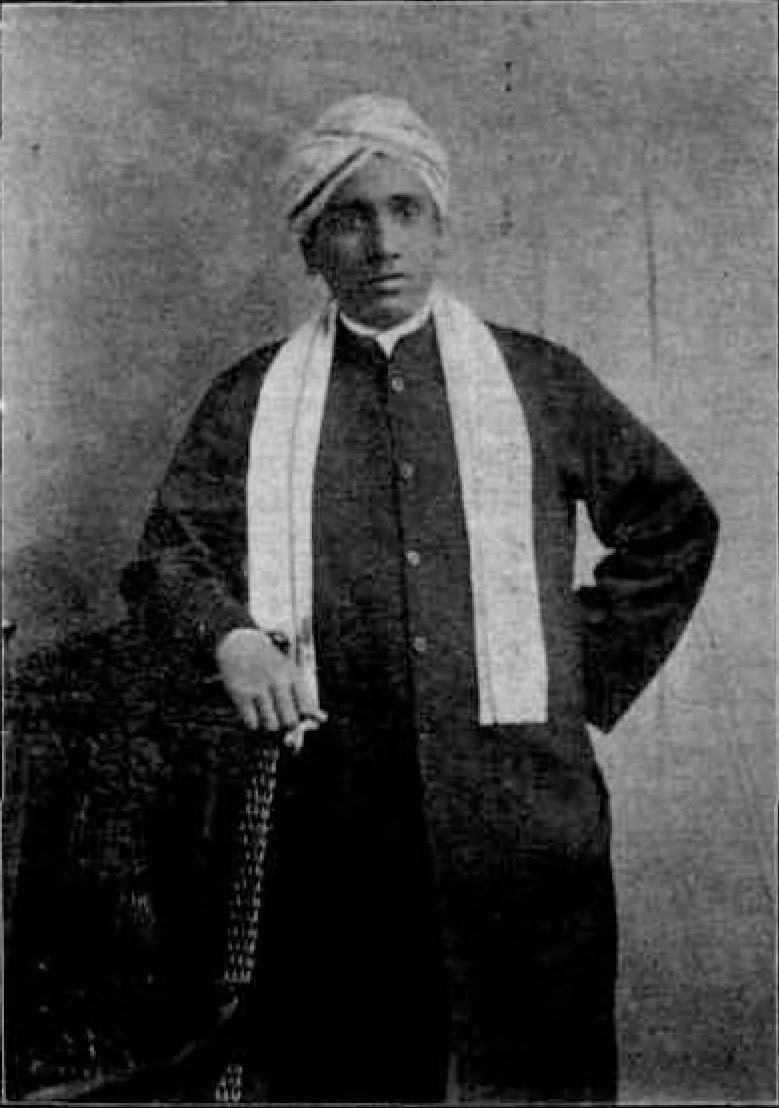
Photo: Raman at about 26. The Modern Review, Vol 15, Jan-Jun 1914, p. 372. Public domain.
Students learn this formula as Newton-Gauss interpolation: f(x0) + u.Δf(x0) + [u(u-1)/2].Δ²f(x-1).
Around 800 CE it was written in Sanskrit, to find sines between two table entries.
24 numbers. That is the whole sine table: 24 entries, one every 3 degrees 45 minutes, radius 3438 minutes of arc. Bhaskara I's Mahabhaskariya says: to get a sine between two rows, interpolate linearly. Do that and your worst error across the quadrant is 1.69 minutes of arc.
Around 800 CE, Govindasvamin writes a commentary on the book and adds a correction term and the middle of his rule is the same formula numerical methods courses teach today as 2nd order Newton-Gauss.
I ran the full rule against true sines at 1,725 points. Worst error: 0.75 minutes of arc. The 24 entries themselves are rounded, by up to 0.70, and any rule that passes through them inherits that. His worst case sits 0.05 above the floor.
And the correction is not one formula. It changes across the quadrant, in three bands of 30 degrees.
Middle band, 30 to 60 degrees: add (1/2) u(u-1) * the difference of two consecutive table differences, u being how far you are between two rows.
That is the Newton-Gauss formula, term for term. On the same table its worst error is 0.76. His full rule: 0.75.
Lower band, 0 to 30: same shape, but multiplied by 3/4 instead of 1/2.
Top band, 60 to 90: he switches form completely. He divides the current difference by odd numbers, counting back from the last row. He writes:
अन्त्यगुणे एकेन, उपान्त्यगुणे त्रिभिः,
तत्पूर्वे द्वाविंशे गुणे पञ्चभिः,
तत्पूर्वे एकाविंशे गुणे सप्तभिः, इत्यादि
"in the last interval by one, before last by three, the twenty-second by five, the twenty-first by seven, and so on."
Why odd numbers? The coefficient this correction needs grows like tan of the angle. Work out the ideal divisors from true sines and they come out 1.00, 3.02, 5.08, 7.19.
He wrote 1, 3, 5, 7.
2nd order interpolation itself was not new in India. Brahmagupta's Khandakhadyaka (665 CE) already had such a rule, closer to the Newton-Stirling form.
Govindasvamin's design is his own: one table, three bands.
Sources: Govindasvamin's bhashya on Mahabhaskariya iv.22, ed. Kuppanna Sastri, Madras 1957, pp. 201-202. Malaya and Ram, IJHS 47.4 (2012), pp. 746-748. R.C. Gupta, IJHS 4 (1969), pp. 86-98. Accuracy numbers are my own run on the 24-entry table.
Photo 1: The chart prepared by me.
Photo 2: Mahabhaskariya iv.22 with Govindasvamin's commentary, Kuppanna Sastri ed., Madras 1957, p. 201 (the alternative rule verse). Highlighted
Photo 3: Commentary p. 202, highlighted (the odd-number sentence).
Photo 4: Malaya and Ram p. 748, highlighted (Newton-Gauss identification).
The grain left after making alcohol can be sold as animal feed. India now exports far more of it than 10 years ago.
Brewing / distilling dregs and waste:
- 1,372 tonnes in FY2015-16.
- 571,949 tonnes in FY2025-26.
417x as much export weight in 10 years.
Export value: $0.61M to $130.65M, so this is not a price effect.
I made this chart using the annual export quantities.
Bharat is rising. 🙏🙏
P.S. The starting base was small. Exports fell in 2020-21. This category is broader than ethanol DDGS, and it measures exports, not domestic production / use.
Sources: Ministry of Commerce & Industry, TRADESTAT, HS23033000; S&P Global, 11 June 2025 (animal-feed context).
@pa2208r Sources are already given, Sir. Resharing again - UN Comtrade, HS 8544: insulated wire, cable and other electric conductors, including optical-fibre cables.
India's wire and cable trade went from a $168M deficit in 2014 to a $1,053M surplus in 2025.
Exports: $694M to $2,752M. Nearly 4x.
Imports: $862M to $1,699M.
Exports moved above imports in 2019 and stayed above them through 2025.
Bharat is rising. 🙏🙏
P.S. Calendar years and gross trade, not domestic production. 2020 had an export dip, and 2025 exports rose 27.5%. Separately, Jan-Aug 2026 exports were $2,298M, up 27.6% from Jan-Aug 2025. That 2026 figure is partial-year, not annual.
Source: UN Comtrade, HS 8544: insulated wire, cable and other electric conductors, including optical-fibre cables.
December 11, 1989. Jawaharlal Nehru Planetarium, Bangalore.
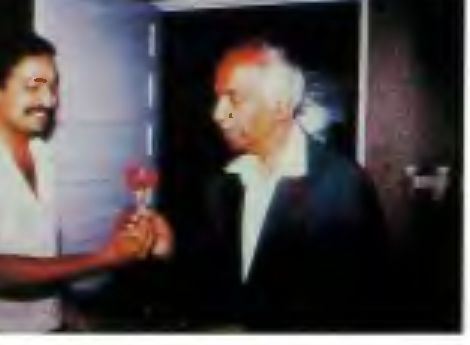
The staff want good photographs of their distinguished visitor. The photographer, Uday Jadugar, has made elaborate arrangements.
Chandrasekhar is obliging. Then he is asked to strike a thinking pose.
With a wooden expression, inclining his head by a millimeter: "This is how I think."
Then he is asked to smile.
His expression becomes even more serious. "I never smile."
Jadugar is also a professional magician. He does not give up. He takes out a coin, makes it disappear at Lalitha Chandrasekhar's left ear and reappear at Chandra's right ear.
Chandra is unperturbed. Only at the end of this bizarre photographic session does he permit himself a smile and thank the photographer.
Who promptly materializes a rose from thin air and presents it to Chandra.
The planetarium's visitors' book carries the day's first entry, in Chandra's hand: "A happy experience." Lalitha's follows: "Very striking program."
Source: C. V. Vishveshwara, "S. Chandrasekhar: Reminiscences and reflections", Current Science, Vol. 78, No. 8, 25 April 2000, p. 1028.
Photo: Uday Jadugar presenting the rose to Chandrasekhar.
Part 2....
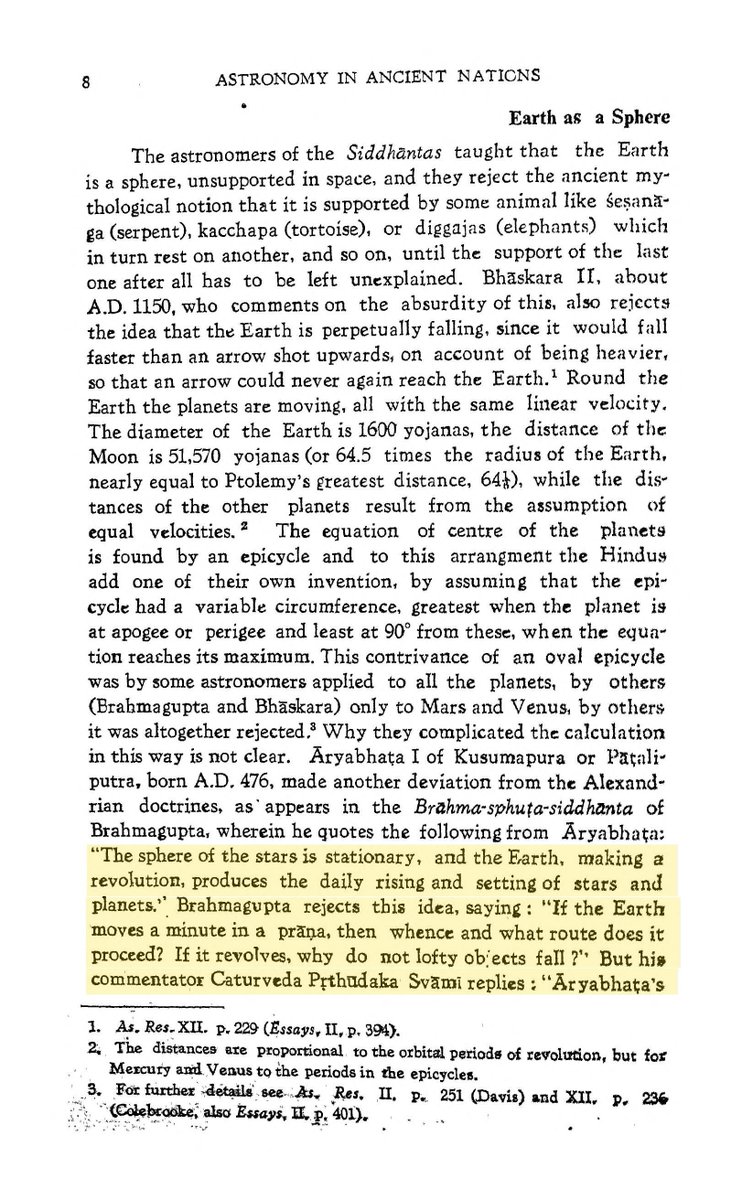
But Brahmagupta also objected to Aryabhata's rotating Earth: "If the Earth moves a minute in a prana, then whence and what route does it proceed? If it revolves, why do not lofty objects fall?"
The reply came from a commentator on Brahmagupta's own book.
Prthudaka Svami, around 860 CE, defended Aryabhata.
His answer: "the objection, that lofty things would fall, is contradicted; for every way the under part of the Earth is also the upper; since wherever the spectator stands on the Earth's surface, even that spot is the uppermost spot."
Wherever you stand on the sphere, that place is uppermost to you. There is no single underside from which everyone must fall.
Aryabhata had used a boat to explain the apparent motion of the stars:
"As a man in a boat going forward sees a stationary object moving backward just so at Lanka a man sees the stationary asterisms moving backward (westward) in a straight line."
Brahmagupta rejected Earth's rotation. His commentator defended it. The disagreement did not follow the boundary between the two schools.
P.S. This is an argument about up and down on a spherical Earth.
Sources: R.S. Sharma (ed.), Brahmasphutasiddhanta, Vol. 1 (1966), introductory survey, pp. 8-9; W.E. Clark, The Aryabhatiya of Aryabhata (1930), Golapada 9, pp. 64-65; Amartya Kumar Datta, "Aryabhata and Axial Rotation of Earth: 3. A Brief History", Resonance, May 2006, pp. 66-68.
Photo 1: Brahmagupta's objection and the start of his commentator's reply. R.S. Sharma (ed.), Brahmasphutasiddhanta, Vol. 1 (1966), introductory survey, p. 8.
Photo 2: Prthudaka's reply: wherever the observer stands, that spot is uppermost. Same edition, p. 9. The post wording matches this page.
Photo 3: Aryabhata's boat comparison, Golapada 9. W.E. Clark, The Aryabhatiya of Aryabhata (1930), p. 64.
Photo 4: Clark's reading of the verse: an observer on an eastward-rotating Earth sees stationary celestial objects move westward. Clark (1930), p. 65. This is Clark's commentary, not another Aryabhata verse.
This story is in 2 parts, and this is the 1st.
Aryabhata was the master everyone followed. In 628 CE, a 30 year old in Bhillamala, a town in southern Marwad, said his numbers were as accidental as the marks weevils leave in wood.
Brahmagupta's Brahmasphutasiddhanta, written under King Vyaghramukha, is a landmark of world mathematics. It is also a takedown.
One entire chapter, the Tantrapariksha, "an examination of other treatises", exists to examine and demolish rival schools of astronomy, above all the school of one man: Aryabhata.
Aryabhata (Aryabhatiya, 499 CE) was the towering master. Bhaskara I, the finest astronomer of the next generation, followed him line by line. As Brahmagupta's modern editor puts it: "Bhaskara closely followed Aryabhata, but Brahmagupta had the guts to oppose the views expressed by this great master."
Guts is one word for it. Here is what Brahmagupta actually wrote.
On Aryabhata's eclipse mathematics:
"Aryabhata made the apogee of the Moon as moving more quickly and the node as moving more slowly than their actual motions; if his constants give correct results in relation to the end of tithis or eclipses, they must be considered as accidental as are the letters cut into wood by weevils."
Weevils. The greatest astronomer of the age before him had, in Brahmagupta's telling, the predictive power of bug scratches in wood.
On his own genius:
"On seeing me, who possess the most accurate knowledge of mean motions, men who have learnt from the works of Srisena, Visnucandra and Aryabhata cannot face me in any meeting just like deer on seeing a lion."
Deer before a lion. In a mathematics book. About himself.
And the verdict on the entire school:
"As the apparent planets beginning with Mars as derived from the works of Srisena, Aryabhata and Visnucandra are far deviated from their true places, the works of these authors are therefore not valued among the learned."
Now the twist.
37 years later, in 665 CE, Brahmagupta wrote a second, gentler book. He named it Khandakhadyaka, literally "food prepared from sugar-candy".
And in its main text, the man who had called Aryabhata's astronomy weevil scratches quietly built his planetary calculations on Aryabhata's own midnight system.
His modern editor is openly baffled: "The question why Brahmagupta who was so bitter an opponent of Aryabhata in his younger days (628 CE) climbed down to describe and teach one of the systems of Aryabhata's astronomy in his sixty-seventh year (665 CE) is difficult to explain."
And in the sugar candy's appendix, the weevil verse, the lion verse and the verdict are reprinted word for word.
The lion came back to graze with the deer. He just never stopped roaring.
Part 2 follows: the one attack in that book that went too far, and the scholar who answered it 230 years later.
Sources: R.S. Sharma (ed.), Brahmasphutasiddhanta of Brahmagupta, Vol. 1 (INSA, 1966), Introduction, pp. 47, 53-54, 73, 79-81. Verses: BrSpSi I.62-63, II.47 (= Khandakhadyaka Uttara IX.1-3).
Photo 1: Brahmagupta on Aryabhata's eclipse constants: "accidental as are the letters cut into wood by weevils" (BrSpSi I.62). On himself: rivals "cannot face me in any meeting just like deer on seeing a lion" (I.63). Verdict: their works "are therefore not valued among the learned" (II.47). From R.S. Sharma's edition of the Brahmasphutasiddhanta, Vol. 1 (INSA 1966), Intro p. 53.
Photo 2: The twist, on the page: the Khandakhadyaka is "literally meaning food prepared from sugar-candy", and his modern editor cannot explain why "Brahmagupta who was so bitter an opponent of Aryabhata in his younger days climbed down to describe and teach one of the systems of Aryabhata's astronomy in his 67th year (665 A.D.)". Same edition, Intro p. 80.
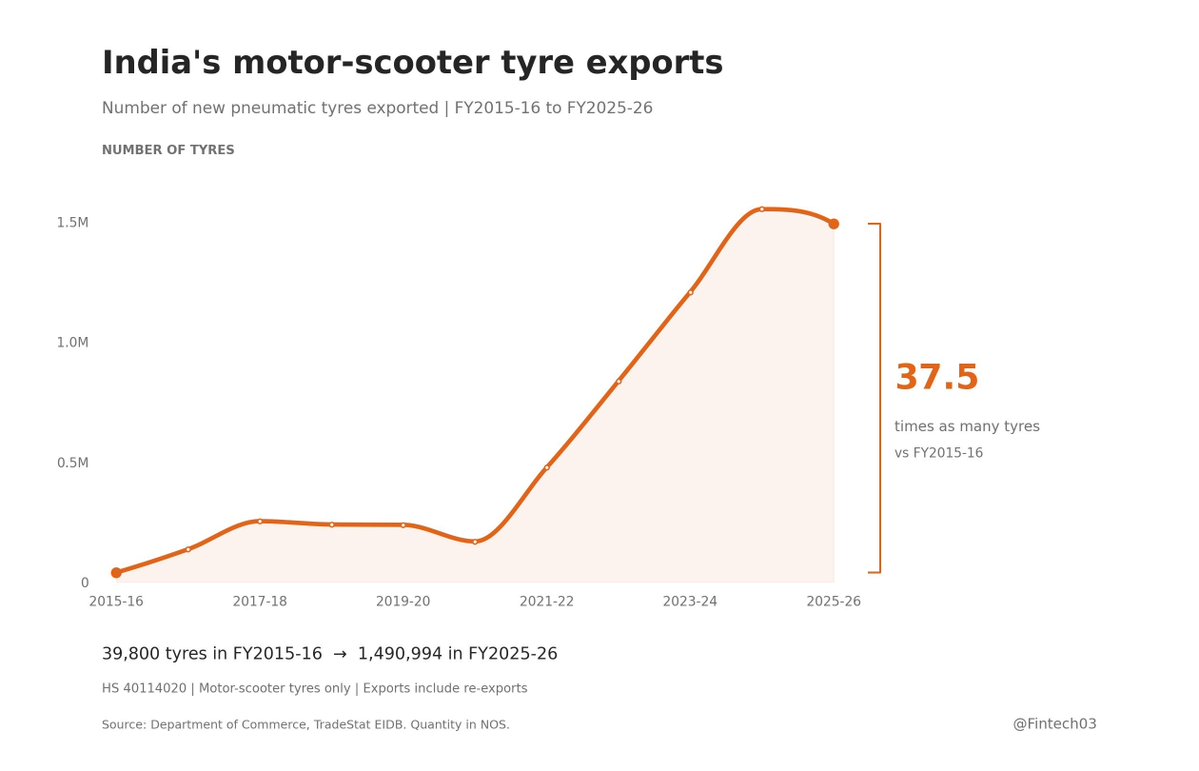
India exported 39,800 motor-scooter tyres in FY2015-16.
In FY2025-26, it exported 1.49M. That's 37.5x as many tyres in 10 years.
These are tyres, not scooters. Motorcycle tyres have a separate trade code.
I made this chart using Department of Commerce TradeStat data, HS 40114020, quantity in NOS. Exports include re-exports.
Bharat is rising. 🙏🙏
Sources: Department of Commerce, TradeStat EIDB; DGCI&S, Chapter 40 trade classification.
Pomegranate, in a desert state :))
Rajasthan's pomegranate area is estimated at 27,614 hectares in 2025-26, against 1,010 hectares in 2012-13.
That is 27.3x the land.
I made this chart from the agriculture ministry's annual crop tables.
P.S. The latest output estimate is 19.8% below 2024-25. The line keeps that fall, and the earlier 2018-19 dip. 2014-15 and 2022-23 are advance estimates too.
Sources: Ministry of Agriculture & Farmers Welfare, state-level horticulture estimates; Horticultural Statistics at a Glance 2015, Table 7.3.13.
Namaskara, looking out for a good UI / UX person to help us with a few projects at https://t.co/qNn9RLRNGy. May not be able afford industry standard but not pro-bono either.
2 months after C. V. Raman became Director of IISc, the mess secretaries lined up outside his office.
The Andhra mess said the Tamil cooks made everything insipid. The Bengali mess said the Andhra cooks made it too hot. Then came the Mahratta, Karnataka and Malayali messes, each with a complaint about someone else's cooking.
Raman heard them all, then told the writer D. V. Gundappa, who was sitting in his office, in Tamil:
"See the kind of research going on here? Gastronomics is the only science here."
Source: D. V. Gundappa, "Dr. C. V. Raman: A Personal Tribute", Public Affairs, Dec 1970
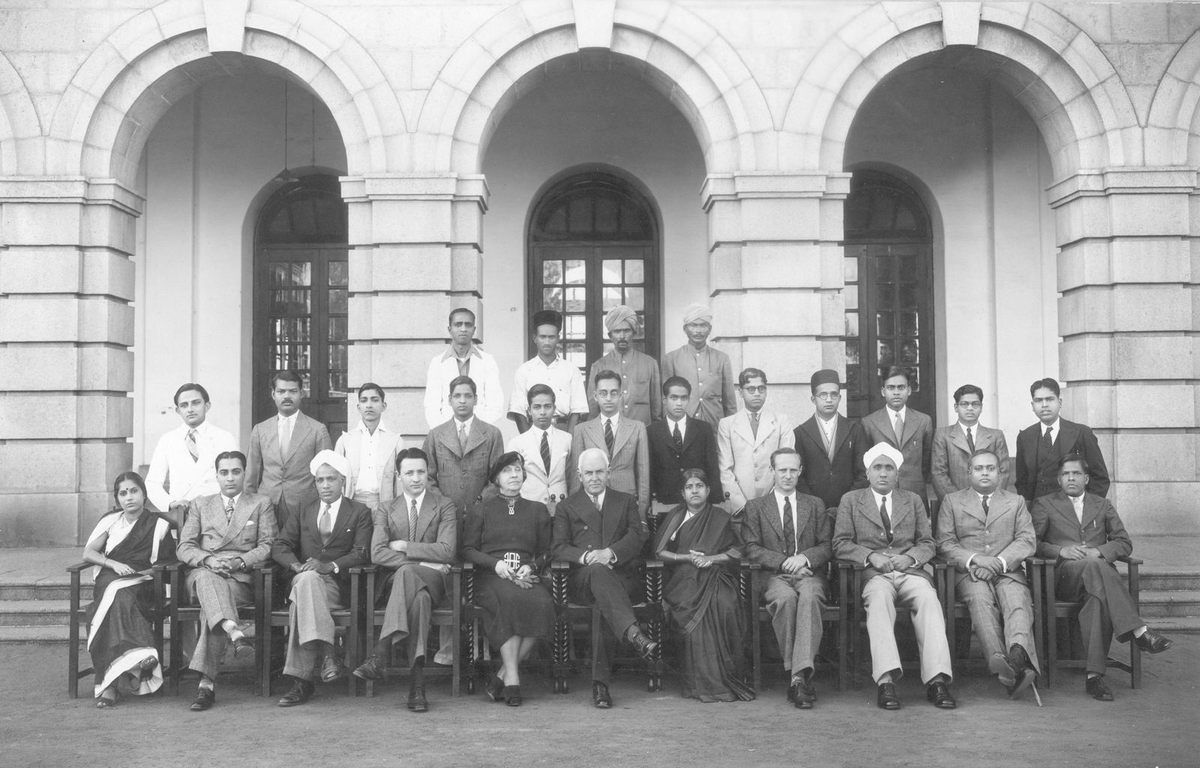
Photo: C.V. Raman (seated, white turban) with Robert Millikan's party at IISc, Bangalore, 2 Feb 1940.
Pappa ji has no science background at all.
When I was growing up, he never pretended to follow what I was studying. He said it straight: "I do not know what you are studying, and I cannot even add any value to it."
Then he told me one thing I still carry. Never think, even for a single sec, that only you can understand something better. There will always be a smarter person than you. So keep learning.
Till today I cannot say I have perfected anything 100%.
My kids will get the same line from me. 🙏🙏
Thank you Sir, and understood. You are right that the pellet used for density has a different composition from the tested electrode. That affects only the volumetric capacitance figure, not the gravimetric capacitance / the coin cell energy density. IMO, the authors are the right people to explain the choice 🙏🙏
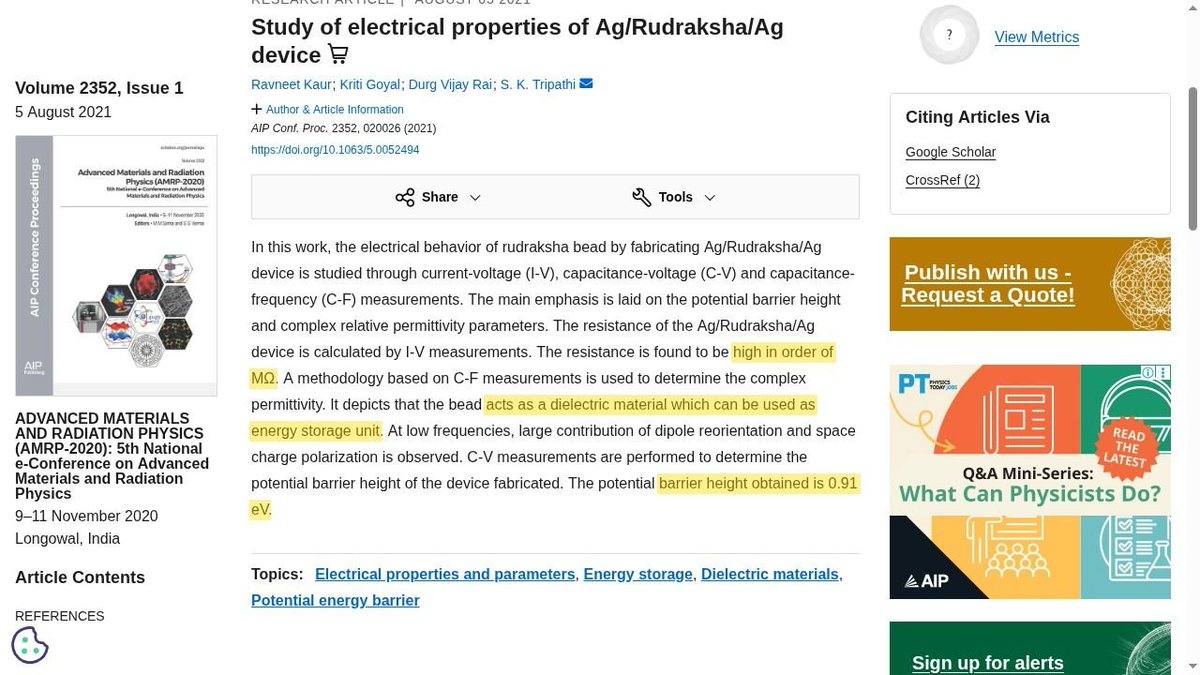
A rudraksha bead went into a physics lab in Punjab. 2 silver electrodes clamped it. Out came a number: an energy barrier of 0.91 electron volts.
The researchers' verdict: the bead is a dielectric, the same class of material that holds charge inside a capacitor.
But but but...that is not the strange part....
In Tamil Nadu, another team took shells of Elaeocarpus tectorius, a close cousin of the rudraksha tree, and carbonized them into a supercapacitor.
- 385 farads per gram.
- 96% of capacity still there after 1,000 cycles.
The paper's stated target: wearable electronics....
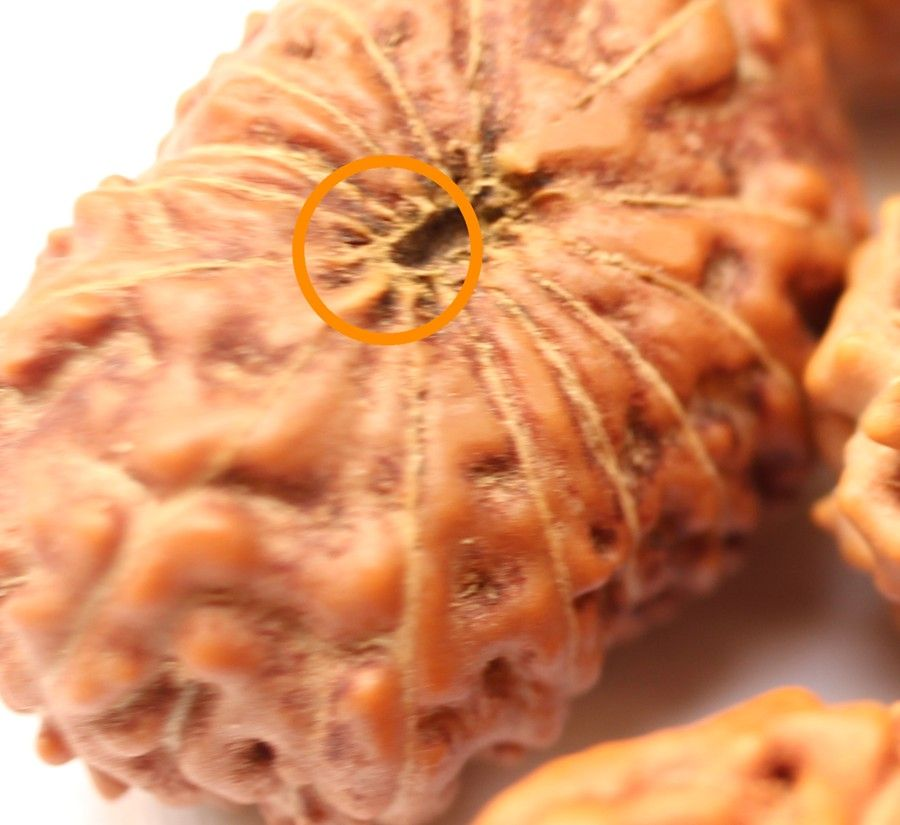
Now read what the Rudraksha Jabala Upanishad asks of the bead. Choose the one with a natural hole, not a drilled one.
Reject 6 kinds of defects. Test it on a touchstone.
Then: wear it always, even in sleep.
A natural hole. A seed made to be strung. An instruction to keep it on the body at all times.
And 2 labs now measuring it as an electronic material.
Sources: Kaur, Goyal, Rai, Tripathi, AIP Conf. Proc. 2352 (2021), doi 10.1063/5.0052494; New Journal of Chemistry 2020, doi 10.1039/C9NJ04813H; Rudraksha Jabala Upanishad.
Photo 1: A rudraksha bead forms with a natural hole through its center. No drilling needed. Credit: Merasmita, Wikimedia Commons (CC BY-SA 4.0); circle added.
Photo 2: Panjab University study: rudraksha bead between silver electrodes, megaohm resistance, a dielectric that can be used as an energy storage unit, 0.91 eV barrier.
Photo 3: Tamil Nadu study on a cousin species: 385 F/g, 96% retention after 1,000 cycles, and the paper's own words: wearable electronic devices.
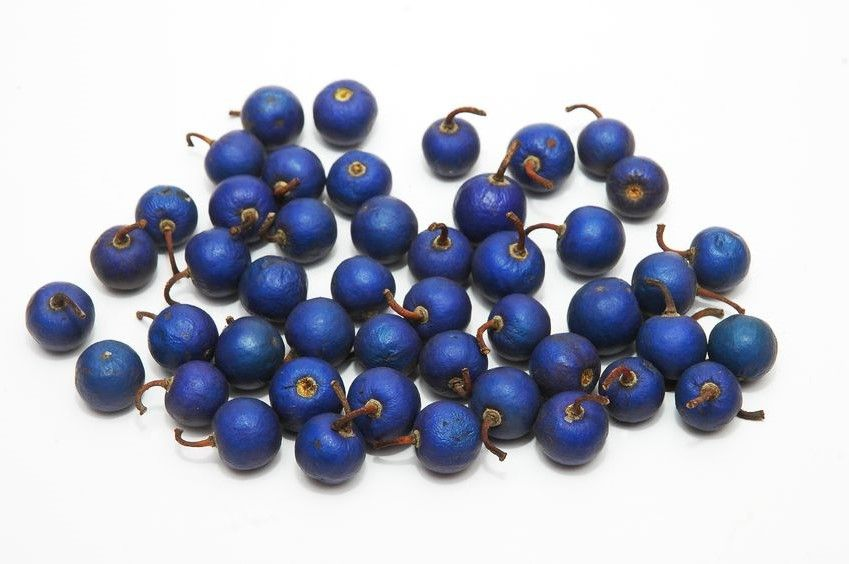
Photo 4: The rudraksha bead is the stone pit of this fruit. It ripens bright blue. Credit: Shiv Sahil, Wikimedia Commons (CC BY-SA 4.0).
Sir, I am not the original author, so you are welcome to write to the authors directly. Since you declared it fraudulent, I will only share my observation. The pellet was used only to measure packing density. The energy density was measured on the asymmetric coin cell, with the mass basis given in Section 3.3, and the 80:15:5 electrode composition is stated in Section 2.3. Everything you cite is disclosed in the paper. 🙏🙏
Sir, I have nothing new to offer, so I will not engage in any debate here further. 1 correction for the record: your 1st two entries are the same fir-sawdust paper, counted twice. That paper's own comparison table also lists Elaeocarpus tectorius, from the study I cited, at 201 F/g at 1 A/g. The other figures were measured at different rates, so they are not directly comparable. I agree these carbons overlap; I only shared that this seed is 1 of them. 🙏🙏
Agreed, Sir. Capacitance alone says nothing about useful storage, and the bead paper claims no performance, it only characterizes the dielectric. The performance question is what a 2nd study took up. From the carbonised, phosphorus doped shell of a cousin species, Elaeocarpus tectorius, they built an asymmetric coin cell and reported 385 F/g, 27 Wh/kg, and 96% capacitance retention after 1,000 cycles. So 1 paper measured a material, the other measured a device. I shared both as they are. 🙏🙏