@DrJitendraSingh Person who displays Constitution of India book and keep displaying at every available pulpit and keep reminding government about constitution and democracy doesn’t even know why parliament exists, and what are his duties and how his behaviour should be! 🤦♂️
THREAD: WHEN SOBERS PLAYED THE GREATEST INNINGS EVER!
Sir Gary Sobers had many achievements, but one of his most remarkable was one that cannot be put in statistical terms - on January 5, 1972, he played perhaps the greatest innings cricket has ever seen.
I know that is quite a statement. After all, there are literally hundreds of contenders for that title - Gavaskar's 96, Lara’s 153, Atherton’s 185 and so on. Sobers' epic however, is in a different league. And it was not his world record 365 or even played in a Test Match.
South Africa had been scheduled to tour Australia in 1971-72. That tour was however, cancelled in the face of anti-apartheid protests. So a Rest of the World team was put together to play five “Tests” against Australia. It was quite a strong team too, led by Gary Sobers.
#GarySobers #Cricket #Sobers #Nostalgia
(@Raja_Sw@prempanicker@g_rajaraman@pradeepmagazine@AshishXL@RVarmaMD )
Sir Garfield Sobers, even when he was in his 60s, did not suffer fools gladly, especially if they happened to be reporters.
Back in 1998, he was in Chennai to coach wards of MAC Spin Foundation on bowling intricacies.
After a 14-day stint, he had a chat with journos 1/n
@Seemajay9@hamsanandi Probably this classical song from Hemavathi is so good…….! One of my favourites …
Shiva shiva ennada naalige eke…
https://t.co/jkYBUAiJhW
S. Janaki #InMemories
S. Janaki for Shankar Jaikishan
While Hindi mainstream music started making a note of her name in mid 80s, more so for Bappi Lahiri's music for those Southern Indian productions featuring Jeetendra, Sridevi, Jayaprada, Rajesh Khanna, and more importantly for chart busters like "Yaar Bina Chain Kahaan Re" and "Gori ka Saajan, Saajan ki Gori", S Janaki was actually singing for Hindi dubbed films since 1960.
One of her breakthrough Hindi song was by Shankar Jaikishan, a short snippet for Meena Kumari in Dil Ek Mandir. The soundtrack was full of chartbusters so this remained a lesser heard and discussed initial songs.. @vip_nair@Raaga_Suresh #SJanaki #DilEkMandir #ShankarJaikishan
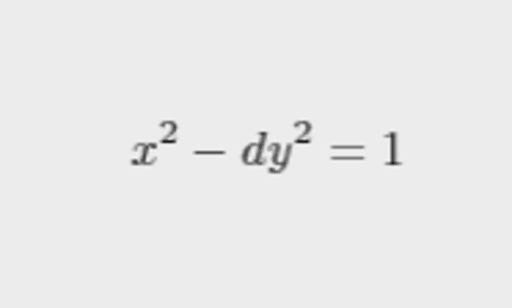
In 1657, French mathematician Pierre de Fermat issued a mathematical challenge via letters to English mathematicians like Kenelm Digby & other finest minds of Europe. He dared them to find the smallest positive, non-trivial whole-number solutions for a deceptively simple-looking quadratic equation (known today as Pell's Equation): x^2 - dy^2 = 1, for non-square (d), specifically highlighting hard cases like d = 61 & d = 109.
It looks almost trivial, like a middle school algebra problem. But it is a trap.
Because the relationship b/w x & y scales exponentially, finding a solution by naive trial & error/standard brute force search grids is computationally impossible by hand. The numbers are so massive that European mathematicians like Bernard Frénicle de Bessy struggled for months (for d = 61).
It was not rigorously solved in Europe until Lord Brouncker used continued fractions & Lagrange gave a general proof in 1766. Fermat thought he had found the ultimate limits of numerical complexity. He had no idea that a 12th-century Indian mathematician in Karnataka had already crushed the exact same eqn using a flawless, purely integer-based recursive loop.
500 yrs before Fermat’s challenge, Bhaskara II tackles this exact problem in his treatise Bijaganita. He realized that instead of guessing wildly for a perfect solution, you should start with a near-miss/an easy guess that has a small mathematical error & then systematically annihilate the error through a feedback loop.
He called it the Chakravala Method (Chakra meaning wheel/cycle). The algo works like this (for d = 61):
Start with a guess:
For, x^2 - 61y^2 = 1, choose an easy near-miss.
Since 8^2=64 (which is close to 61), let y = 1 & x = 8.
Calculate the error ((k)): Plug them in: 8^2 − 61(1)^2 = 3. Our error is +3
Bhaskara used a mathematical composition rule inherited from Brahmagupta (called Bhāvanā) to inject a new multiplier (m). The algo strictly optimizes m at each step to minimize the absolute size of the next error, ensuring the numbers stay as small & computationally efficient as possible.
The output of the 1st loop becomes the input for the next. The equation literally "cycles" like a wheel, squeezing the error down until (k) lands exactly on (1).
While European mathematicians were blindly guessing/dealing with messy, infinite fractional expansions, Bhaskara's recursive wheel landed precisely on the target after a few lines of clean arithmetic.
The smallest integer solution to Fermat's "impossible" challenge, computed by Bhaskara II in 1150 CE, is:
x = 1766319049, y = 226153980
Try plugging that into x^2 - 61y^2 = 1 by trial & error w/o a supercomputer. You have zero chance of stumbling onto it.
Justice Lokur was 2 years old when India made it clear, not passport but Citizenship Act 1955 will decide citizenship
He was 14 years old when Indian Passport Act 1967 cleared any doubts about it
He was 24 years old when he became an advocate in 1977 when this was further clarified in Maneka Gandhi vs Union of India case
He was 59 years old when he joined Supreme Court in 2012 and watched Mumbai High court again say Passport is not citizenship proof in 2013
Today Lokur is 73 years old, has travelled on the same passport hundreds of times and pretends that others won't get visas because Passport is not citizenship proof
Such clowns have ruled us!
@ijnani I remember using Indian Gooseberry (bettada nellikai) seed like this! Bet was how long it can rotate!! Simple, crazy things with pro max happiness 😌
Thought I would post few of her Carnatic songs, but those are already well-known. Her singing for cinema is truly underrated! Will post few. You'll know what a wonderfully versatile genius she was!
Start with this classic! Bharatiyaar's evergreen poem! 😀🙏
Critics love to say, "Hindus destroyed all the Charvaka texts because they hated atheism." This is a massive historical half-truth.
It is true that independent, primary Charvaka sutras like the Barhaspatya Sutras did not survive the ravages of time, climate & foreign invasions, their entire philosophy survived precisely because Orthodox Hindu scholars meticulously preserved it.
In the unique tradition of Indian debate (Shastrartha), there is a foundational law called Purva Paksha (the opponent’s view). Before a Vedantin/a Nyaya scholar could present their own philosophy, they were strictly required by academic law to state their opponent’s view with absolute honesty, depth & perfection w/o twisting it.
The most common mistake critics make is assuming "Charvaka" was a singular, outcast rebel. The etymology tells a completely different story.
In Sanskrit, the name is derived from 2 roots:
- चारु (Cāru): Sweet/pleasant/elegant.
- वाक (Vāka): Speech/words.
In the Ramayana (Ayodhya Kanda), when Jabali uses materialist arguments to convince Rama to abandon his exile, he is speaking as a royal advisor using elite statecraft logic. The Charvakas were deeply embedded in the royal courts as ministers because their materialist, hyper-logical focus made them incredible economists & political strategists.
The most detailed, comprehensive layout of the Charvaka system exists in the Sarva-Darshana-Samgraha, written by Madhava Acharya, the 14th-century head of the Sringeri Sharada Peetham & orthodox champion of Vedic thought.
If Hinduism was a dogmatic, insecure faith, its highest religious leader would not have dedicated the opening chapter of his magnum opus to archiving the exact arguments against the soul, rituals & God. He preserved his enemy's armor so he could sharpen his own sword against it.
The biggest source of pleasure for those trying to target Sanatan Dharma is shouting, "See! Charvaka proves Hinduism contains its own contradiction!" This assumes Hinduism functions like Western, dogmatic religions.
In the Western framework, religion is a closed box of Belief vs. Heresy. If you do not believe the book, you are an infidel.
In the Indic framework, it is Darshana. The civilization categorizes systems based on Astika (accepting Vedic authority) & Nastika (rejecting Vedic authority).
Sanatan Dharma is the civilizational canopy that contains both the Astika & Nastika schools. Charvaka is an internal product of the Indian mind, utilizing Sanskrit, interacting within the same cultural context & participating in the same intellectual ecosystem.
Name 1 other ancient civilization on Earth that took its absolute materialist, anti-theist, anti-scriptural critics, cataloged their ideas with academic perfection, gave their founders the title of "Rishi" (Sage Brihaspati is traditionally credited with its origins) & preserved their arguments within its own sacred encyclopedias.
You will not find 1.
Charvaka does not expose a flaw in Sanatan Dharma; it exposes its ultimate, unparalleled intellectual freedom.
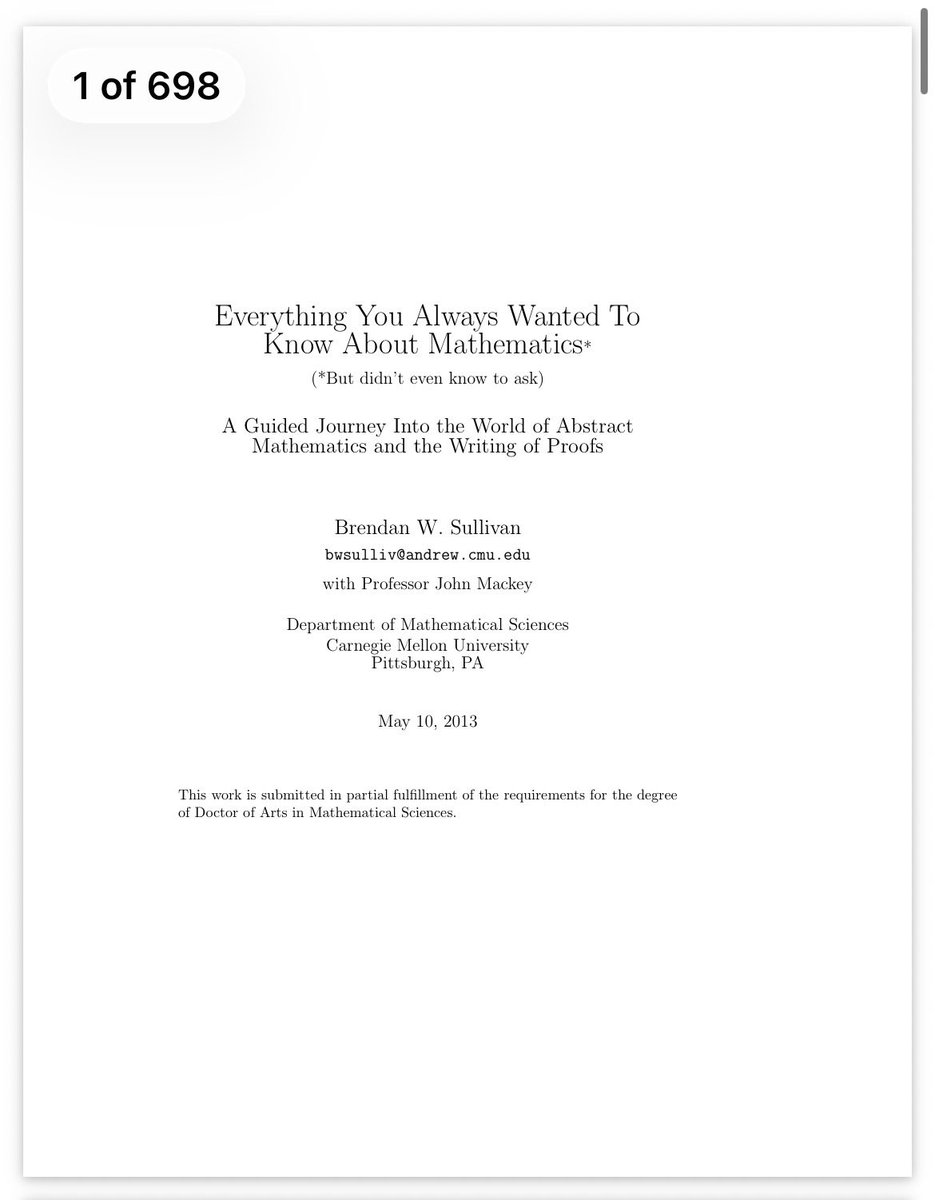
Download 698-page PDF eBook…
Everything You Always Wanted To Know About Mathematics* (*But didn’t even know to ask)
A Guided Journey Into the World of Abstract Mathematics, Theorems, and the Writing of Proofs: https://t.co/JLsDOmpP1q



![KirkDBorne's tweet photo. [Download 585-page PDF eBook]
Game Theory: https://t.co/DUxMDRc1Ll
—————
#GameTheory #Gamification #Mathematics #Statistics #Probability https://t.co/OuM1cwPhUw](https://pbs.twimg.com/media/HL3Bq77WwAA8krz.jpg)




