

Top Tweets for #Probability

@CoolidgeRique @whoisegor3 Yes but you're just not expected to find stars in the 8th. If the nets didnt market and hinged their future on egor being a star then our expectations would not be disappointed. 8th picks heck even 6th just dont have a high probability of statdom

Match 17/18
Nakul was looking at the best possible outcome, while Goblin was trying to avoid the worst possible outcome.
Both were right.
But statistically, the probability of eliminating GDR > WWCD after winning 4v4 against VA.
Ultimately, it was all 🙏God's plan🙏


The q is who made a couple millions with call options on NVIDIA between Friday and Today.
Obviously some people had insider info (or high probability better said).
Who is looking up into this? Is this really a level playing field?

The shift from speed to probability of success is already visible in IQVIA’s data; the next measurable step is whether ancestry-matched evidence can lift Phase II rates above the current parity line.

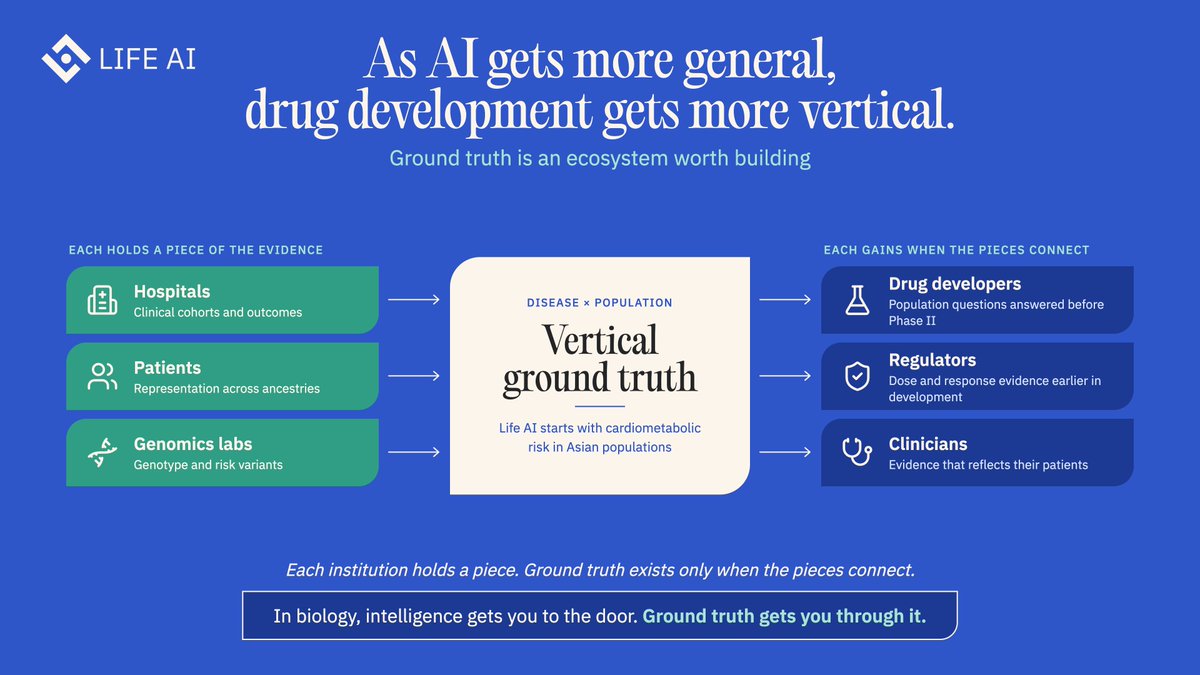
As AI Gets More General, Drug Development Gets More Vertical
The question for AI in drug development is shifting from speed to probability of success. IQVIA’s 2026 R&D report shows the gains are uneven: in its latest three-year window, AI-enabled programs at emerging biopharmas posted a 75% Phase I success rate, yet only matched non-AI programs in Phase II.
The reasoning starts with where value is decided. Phase II proof of concept, where asset value inflects, turns not only on the molecule but on its match with the patients receiving it.
AI has made hypotheses cheaper. It has not made proof cheaper. One lever is well established: in BIO’s 2011–2020 analysis, programs using biomarkers to select patients reached approval about twice as often.
That match also shifts with the population, and in cardiology some differences surfaced on drug labels only after approval. Asian patients show about twice the exposure to rosuvastatin, prompting a lower starting dose on its FDA label in 2005. Since 2010, clopidogrel has carried a boxed warning for CYP2C19 poor metabolizers, about one in seven Chinese patients but one in fifty Caucasians. Yet as of 2025, fewer than one in fifteen GWAS Catalog participants were of Asian ancestry.
Intelligence is portable; ground truth is not.
Today’s approaches each solve for a different variable: general-purpose models for breadth, AI-native discovery firms for the molecule, platforms such as Epic’s Cosmos for volume, mostly from U.S. health systems.
Phase II depends on one more, and no single player holds it: depth of evidence in a specific population. It sits across hospitals, genomics labs, sponsors and regulators, and becomes ground truth only when connected around one disease and one population.
If ground truth is population-specific and distributed, advantage is vertical, and vertical depth is built as an ecosystem.
That is Life AI’s premise. As Dr. Tuan Cao, Co-Founder and CEO of Life AI, has put it: “Many AI companies go horizontal and spread very wide. We go vertical, deep into the diseases that still weigh most on Asian patients, like diabetes and cardiovascular disease.”
Life AI works disease by disease, population by population: starting with cardiometabolic genetic risk in Asian populations, bringing intelligence into partner hospitals, where care happens, and extending it toward drug R&D through a purpose-built world model on connected infrastructure.
When models become a shared input, advantage increasingly moves to the evidence beneath them: which patients respond, at what dose and why, established before approval.
That evidence cannot simply be licensed. It is built institution by institution, cohort by cohort, and each institution that contributes can make it more valuable to the rest.
In biology, intelligence gets you to the door. Ground truth gets you through it.

@D3bucktz @skobuffss I mean hard to ignore the expectations set before us by Deion. It wasnt CU fans saying Big 12 CCG was a probability

@HillChillbb It's easy to spot patterns where none exist, which makes understanding probability around Gamdom worth discussing.

On Polymarket, the probability of "AI solves the Riemann Hypothesis in 2026" has dropped to 57%, down 17% in 24 hours.
The contract rules for this event are: as long as a qualifying AI lab such as Anthropic, OpenAI, or Google—or its official representative—announces before the end of 2026 that the Riemann Hypothesis has been solved, and the result is attributed to the lab, researchers, or model, the market can resolve to "Yes." Partial progress only, or an independent announcement by outside researchers using AI tools, does not qualify. No further certification from the Clay Mathematics Institute or other institutions is required.
According to a November 20 report by *Nature*, Anthropic mathematics researcher Levent Alpöge claimed to have completed a proof of the Riemann Hypothesis in collaboration with Claude. However, it has not yet gained broad recognition within the mathematics community, and some mathematicians have raised doubts about the readability and rigor of the proof materials. In addition, Alpöge's statement was a personal announcement by the researcher, and Anthropic has not yet explicitly confirmed the result in the company's name.


@HillChillbb It would be interesting to hear a probability expert explain how they distinguish measurable patterns from random variation on gamdom

@HillChillbb A probability researcher might notice details most users overlook, and I'd be curious how they'd analyze gamdom

I wonder how Gamdom would look through the eyes of someone who studies probability and decision-making for a living

@RLight30 Too far, all are just Probability.

@Mafalda3p0rbx @Filly_Shy yeah, that's why I put guarantee in quote, there's higher probability of winning it in a 1000 wishes than losing every single time.

Per Muse, it puts probability of 11.7 P/E by year end 2033 at 30%, 19 P/E at 20%, and 20+ at 20% (also includes 30% that no meaningful P/E happens if acquisition or growth slows - 30% YoY could be hard to maintain).
I believe Lemonade can be closer to 12B marketcap by year end 2033 or $136/share.
This equals ~19 P/E.
This is my BULL CASE.
So while 20 beats my BULL case, I don’t think it’s entirely out of the question.
I just like to be realistic about the probability of a P/E below 20.

Kalshi in LSEG stood out to me. A probability chart remembers doubts we’re quick to forget.
Sometimes I go back to a market I created on @kash_bot, see that the price has moved, and go read what the people I disagreed with yesterday are saying. Sometimes they’ve spotted something I missed.
Once you know how it turned out, it’s worth looking back to see how obvious it really seemed yesterday.
#PredictionMarkets #Forecasting #CryptoMarket

prediction markets roundup
- coinbase is targeting the first half of 2027 for its own us event contracts, according to a bloomberg report.
- kalshi’s prediction market data is now available in lseg workspace.
- a federal appeals court ruled that maryland can enforce its sports wagering laws against kalshi.
- the us senate passed a bill to prohibit prediction market contracts involving death, war, terrorism and assassination.
- kalshi published documentation for on-request concert and weather markets.
which update stands out most?

Imagine a quantum experiment where two possible paths begin with equal probability.
Change the phase of a qubit, run the circuit again, and watch the measurement probabilities shift. In one configuration, amplitudes reinforce each other. In another, they cancel out.
Nothing about the number of qubits changed. A phase adjustment changed the outcome.
This is quantum interference, one of the fascinating principles behind quantum computing.
With Qubit Labs, you can build the circuit, adjust its parameters, run the simulation, and watch the results unfold in real time.
Don't just read about quantum mechanics. Experiment with it.
https://t.co/IrP9pfmb7f

@Filly_Shy Its all about the chances or luck. While it does increase the probability, it was never enough %.
I did play every 2 hours back in 2022-2024 and not a single halo won. Now im just burnt out because its slowly becoming an obsession over a halo and that is not healthy.

@Byronn4561 @ArranGray9 @BuyTeslaStonk Broadly speaking any time a stock loses $120 it has a high probability of seeing < $80. The inverse is also true. Below $70’s it’s to like $45’s and inverse is true of that as well

As AI Gets More General, Drug Development Gets More Vertical
The question for AI in drug development is shifting from speed to probability of success. IQVIA’s 2026 R&D report shows the gains are uneven: in its latest three-year window, AI-enabled programs at emerging biopharmas posted a 75% Phase I success rate, yet only matched non-AI programs in Phase II.
The reasoning starts with where value is decided. Phase II proof of concept, where asset value inflects, turns not only on the molecule but on its match with the patients receiving it.
AI has made hypotheses cheaper. It has not made proof cheaper. One lever is well established: in BIO’s 2011–2020 analysis, programs using biomarkers to select patients reached approval about twice as often.
That match also shifts with the population, and in cardiology some differences surfaced on drug labels only after approval. Asian patients show about twice the exposure to rosuvastatin, prompting a lower starting dose on its FDA label in 2005. Since 2010, clopidogrel has carried a boxed warning for CYP2C19 poor metabolizers, about one in seven Chinese patients but one in fifty Caucasians. Yet as of 2025, fewer than one in fifteen GWAS Catalog participants were of Asian ancestry.
Intelligence is portable; ground truth is not.
Today’s approaches each solve for a different variable: general-purpose models for breadth, AI-native discovery firms for the molecule, platforms such as Epic’s Cosmos for volume, mostly from U.S. health systems.
Phase II depends on one more, and no single player holds it: depth of evidence in a specific population. It sits across hospitals, genomics labs, sponsors and regulators, and becomes ground truth only when connected around one disease and one population.
If ground truth is population-specific and distributed, advantage is vertical, and vertical depth is built as an ecosystem.
That is Life AI’s premise. As Dr. Tuan Cao, Co-Founder and CEO of Life AI, has put it: “Many AI companies go horizontal and spread very wide. We go vertical, deep into the diseases that still weigh most on Asian patients, like diabetes and cardiovascular disease.”
Life AI works disease by disease, population by population: starting with cardiometabolic genetic risk in Asian populations, bringing intelligence into partner hospitals, where care happens, and extending it toward drug R&D through a purpose-built world model on connected infrastructure.
When models become a shared input, advantage increasingly moves to the evidence beneath them: which patients respond, at what dose and why, established before approval.
That evidence cannot simply be licensed. It is built institution by institution, cohort by cohort, and each institution that contributes can make it more valuable to the rest.
In biology, intelligence gets you to the door. Ground truth gets you through it.

@katherinabelova banyak probability nya kak, bs dari pola makan, pola tidur, dsb

High-income developer? What to do with all that cash?
Learn to invest with the mathematically highest probability of making money.
- One of the highest rated stock market courses on Udemy.
60% off until tomorrow.
https://t.co/uKBdivP7uw
JB

As much as everyone seems to hate having a pity system, we need either something like that or they fix the probability they have coded, You’ve seen people with over 1-5k wishes with no halo won, that the parallels to win and not win just don’t match whatsoever
I know wishing as much as you can is very important in looking at how your chances can grow, but we need to realize that the current probability of winning one is a twisted system that doesn’t make sense, reminder that about 3-5% of 300k players in royale high have won a halo.

fountain tips, its not how long you've played that determines how many halo's you've won, its how many times you have rolled the dice
its almost like non of you know how probability works
everywan wishmax now!!


That calculation is of course based on the in-game information I have of who has won any of the new and previously created halos badges, as much as we want to keep saying “keep wishing”, it’s not enough for average players. The probability is overly low for a roblox game.
i muted this this morning btw, 5 page essay due. if you were to probability test for this it would be mutually excusive event testing


What was the probability that this would happen? 🥹😀🐸

Trends for you
Most Popular Users

Elon Musk 
@elonmusk
240.1M followers

Barack Obama
@barackobama
118.6M followers

Cristiano Ronaldo
@cristiano
114.4M followers

Donald J. Trump
@realdonaldtrump
111.7M followers

Narendra Modi
@narendramodi
106.9M followers

Rihanna
@rihanna
98.6M followers

NASA
@nasa
92.1M followers

Justin Bieber
@justinbieber
91.7M followers

KATY PERRY
@katyperry
89.9M followers

Taylor Swift
@taylorswift13
83.9M followers

Lady Gaga
@ladygaga
75.4M followers

Virat Kohli
@imvkohli
73.3M followers

Kim Kardashian
@kimkardashian
70.8M followers

YouTube
@youtube
68.6M followers

Neymar Jr
@neymarjr
66.3M followers

Bill Gates
@billgates
65.2M followers

Selena Gomez
@selenagomez
63M followers

The Ellen Show
@theellenshow
62.1M followers

CNN
@cnn
61.7M followers

X
@x
60.6M followers