Update on this piece I made for Elephant Day! It seems the evidence for E. hysudricus coexisting with Palaeoloxodon namadicus is weak after all so this hapless elephant is now an Elephas maximus (same species as today's Asian elephant). Also gave namadicus big ears cuz why not :B
Walking with Beasts: Episode 4, Next of Kin:
the fourth episode is set in Ethiopia's Rift Valley. It follows a group of *Australopithecus*—small, primitive hominins among the first apes to walk upright.
What if some marine reptiles sequestered bioluminiscent bacteria, bred it on the lining of their gullet and used it to attract prey in the bathypelagic zone? Inspired by the trailer of Whalefall of all things :B (and by real, seemingly deep-diving plesiosaurs with big eyes!)
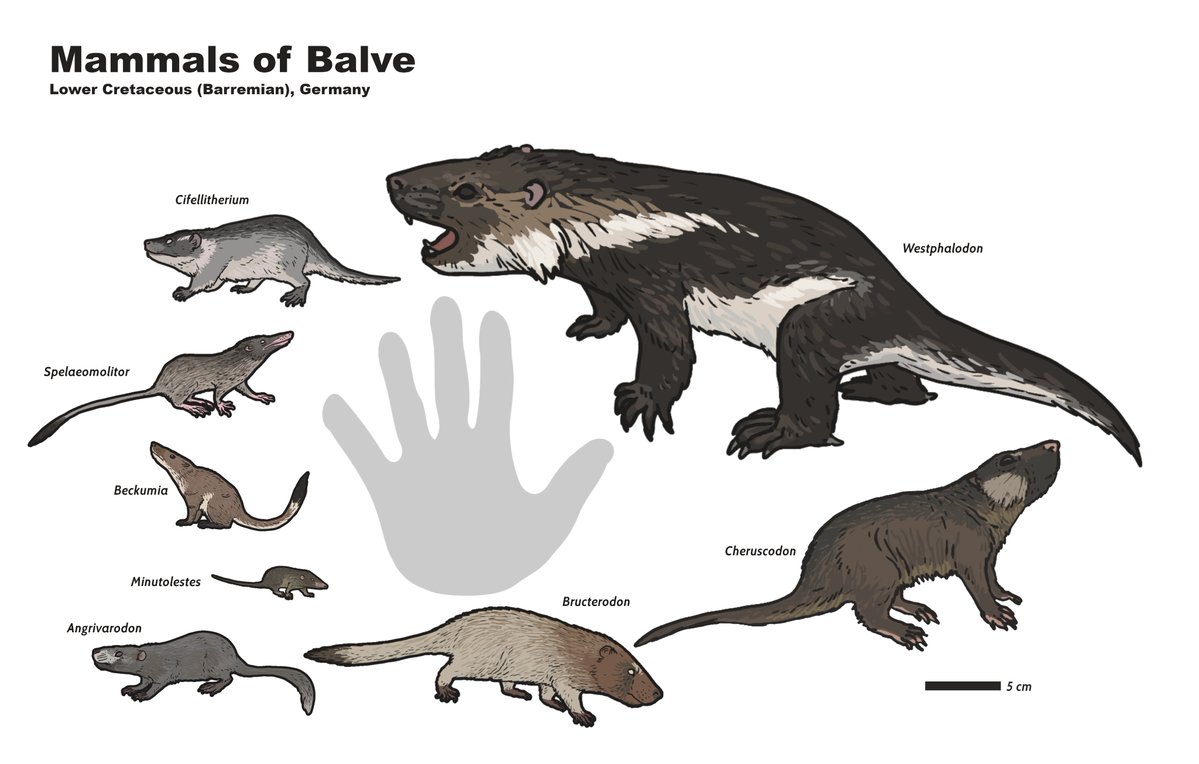
🚨 Finally I can break the silence! Today a new mammal from Balve go published, our early Cretaceous cave site in Germany.
Welcome Westphalodon, a decently sized gobiconodont and the largest mammal from here so far well as one of the largest mammal of Mesozoic Europe!
Três Barras Formation.
During the Early Cretaceous, the region of western Minas Gerais was occupied by the Três Barras Formation, an area dominated by aeolian dunes but also featuring wet interdune areas, bodies of water, and seasonal rivers.
SAPO PREHISTÓRICO
Descubierta una nueva especie de sapo de la Edad de Hielo en el yacimiento de La Brea (Los Angeles, California, Estados Unidos)
📰 https://t.co/xmzrWTu5se
vía @EurekAlert#Pleistoceno#Anfibios
Lycostrobus scottii IS A LATE SURVIVING JURASSIC PLEUROMERIAL LYCOPSID
PLEUROMERIALES ARE CARBONIFEROUS RELICS
[Global proliferation of opportunistic pleuromeian lycopsids following the disappearance of the end-Triassic forests]
Art Michael Rothman
https://t.co/GlLhpIbVMq




![HildoBifrons's tweet photo. Lycostrobus scottii IS A LATE SURVIVING JURASSIC PLEUROMERIAL LYCOPSID
PLEUROMERIALES ARE CARBONIFEROUS RELICS
[Global proliferation of opportunistic pleuromeian lycopsids following the disappearance of the end-Triassic forests]
Art Michael Rothman
https://t.co/GlLhpIbVMq https://t.co/aTe0XTb3UG](https://pbs.twimg.com/media/HPjdCViXEAAJNi3.jpg)






![HildoBifrons's tweet photo. Lycostrobus scottii IS A LATE SURVIVING JURASSIC PLEUROMERIAL LYCOPSID
PLEUROMERIALES ARE CARBONIFEROUS RELICS
[Global proliferation of opportunistic pleuromeian lycopsids following the disappearance of the end-Triassic forests]
Art Michael Rothman
https://t.co/GlLhpIbVMq https://t.co/aTe0XTb3UG](https://pbs.twimg.com/media/HPjdGxIWkAE0mjp.jpg)