Cats know their names. They just often decide you’re not worth the effort.
A 2019 study from Japanese researchers (University of Tokyo / Sophia University) tested whether domestic cats can actually distinguish their own names from other words. Using a habituation-dishabituation method, they played recordings of four similar-sounding nouns (or other cats’ names) followed by the cat’s own name. Most cats showed a clear rebound in response, moving their ears, turning their heads, or shifting slightly, when they heard their name, even if a stranger said it.
What they almost never did was get up and come over. Full-body responses, vocalizations, or approach behaviors stayed rare. The cats registered the word, then largely ignored it.
This fits the long-standing observation that cats were never selectively bred for obedience the way dogs were. They form bonds and learn associations (especially with food, attention, or play), but they remain highly independent. Understanding a command or their name is one thing; deciding the reward is worth interrupting what they’re doing is another.
[Saito, A., Shinozuka, K., Ito, Y. et al. Domestic cats (Felis catus) discriminate their names from other words. Sci Rep 9, 5394 (2019). DOI 10.1038/s41598-019-40616-4]
Cope in Russia tonight?
Up to 300,000 Russian soldiers could be trapped in the "Crimean Cauldron"
This was stated by military expert, retired Colonel of the Armed Forces of Ukraine, Roman Svitlan:
Crimea itself is a kind of operational geographical "cauldron" because it is squeezed between two seas. And if the main communication routes are cut off, it becomes possible to seriously limit the supply of Russian troops on the peninsula.
To the east, the entrance from Taman via the Kerch Bridge is currently damaged. In the north, according to my assessment, the area is under fire control of Ukrainian weapons systems. The section from Berdyansk to Melitopol is particularly important, with a depth of approximately 100 km.
This distance allows for direct control of drones and monitoring of transport routes along which the Russians are trying to supply their forces. If these routes are constantly under attack, it becomes much more difficult to organize a stable flow of military supplies. And this applies not only to Crimea.
The attack on the Kerch Bridge and control of the land corridor cut off Crimea, as well as the Crimean-Kherson grouping of enemy forces, from supplies from Russian territory. This also partially affects the Zaporizhzhia grouping, which is located west and northwest of Melitopol.
Currently, it is very difficult for the Russians to organize a full-fledged supply of military equipment, ammunition, and other resources for both offensive and defensive operations. Imagine a route approximately 500 kilometers long from Rostov to Olesk or Vasilevka via Tokmak. This route is constantly under threat of Ukrainian strikes.
Therefore, there are problems with delivering goods in the necessary quantities. This is especially true for a large military grouping that needs a huge amount of fuel, food, ammunition, and military equipment every day. The more active the fighting, the greater the strain on the entire supply system.
According to my estimates, the number of the Crimean-Kherson grouping, which could be threatened with operational encirclement, is approximately 250,000 to 300,000 Russian soldiers. This is a very large number of people that need to be constantly supplied with everything necessary. Moreover, during offensive operations, the consumption of ammunition and other resources can be three to four times higher than during defensive operations.
Approximately 250,000 to 300,000 Russian soldiers could now be in operational encirclement. And 300,000 people need to be fed, supplied with ammunition, and everything else. And in offensive mode, they use three to four times more resources than in defensive mode.
Stockholm airport ARN went from ~1% jammed flights to 40-50% last two days.
Baltic Sea GNSS/GPS-jamming has seen a change during weekend.
Area covered has extended northwest and now covers Stockholm area and beyond. More southern coverage is intact and maybe even increased.
2026 has been an exceptionally bad year for Russia. Just to recap:
- Russian forces lost occupied territory in parts of Donbas, while offensive operation in Kupyansk failed
- Hundreds of transport and tanker ships were damaged or destroyed in Azov and Black Sea
- Russian military casualties reached record levels, despite small or even in some cases negative net territorial gains.
- The road section of Crimean Bridge has been destroyed and Crimea is almost isolated
- Ukrainian strikes have severely disrupted Russia's oil-refining industry
- Wildberries, one of Russia's largest companies and logistics provider has lost its warehouse infrastructure
- Russia has lost numerous military aircraft, including bombers and fighter jets
- Oil export and seaport infrastructure has being severely damaged in Black, Azov and Baltic Sea’s
- Russian air defenses have being severely degraded across Russia
- Dozens of missile, electronics and defense-industrial production facilities were hit across Russia.
@USWPColby It’s difficult when the world’s formerly second best military (Russia) gets spanked for 5 days in their 3 day war.
Russia can end this by leaving all of Ukraine.
Dulkay's 12-person team has interviewed hundreds of witnesses, listened to hours of intercepted Russian communications and watched CCTV and Ukrainian drone footage.
They have charged 32 Russian soldiers with murder and torturing civilians. 9/
The ability to move and deploy multiple USVs, conduct ISR and planning on a naval target, and coordinate such an attack in an enemy's allied harbor on the African continent, all unnoticed until the strike.
If the SBU can do it in Benghazi, they can do it just about anywhere.
Timeline of the Nov 21, 2026 Kaliningrad “attack” claims (and why the explosion image is fake):
Morning: Russian cargo ship Sparta II (bound for Kaliningrad) is hit by two drones in international waters in the Gulf of Finland, west of Gogland Island, ~3 nautical miles from the Russian border. It catches fire and drifts into Finnish waters. Confirmed by Leningrad Region Governor Alexander Drozdenko and Finnish authorities (Border Guard/Defence Forces). Finland imposes temporary air/maritime restrictions. Kaliningrad Governor Alexei Besprozvannykh says it poses no threat to regional supplies. This is a real maritime incident, not an attack on Kaliningrad territory itself.
Afternoon/evening: In Kaliningrad Oblast (Neman district), the “Unmanned Danger” / drone alert system activates after a suspicious object is detected from the direction of Lithuania. Governor Besprozvannykh states specialists checked and found no threat; the alert would be lifted shortly. Reports of sirens in parts of the region and temporary airport restrictions at Khrabrovo. No confirmation of any drone actually entering Kaliningrad airspace, no intercepts, no impacts, and no explosions on land.
Social media / Ukrainian channels (e.g., “Reporter | News from Ukraine” and others) rapidly claim a state of alert due to a suspicious object from Lithuania, then an “explosion in the Kaliningrad region amid an air raid alert,” pairing it with a night photo of smoke/fire over a landscape.
The image is not from Kaliningrad: TinEye reverse image search shows it was first indexed on November 8, 2026, on Turkish site https://t.co/HMncc0bmaZ (filename containing “korkulan-oldu-patlama-sesleri-art-arda-geldi”). It matches contemporaneous coverage of explosions heard on Iran’s Qeshm Island (near the Strait of Hormuz), reported by IRNA and other outlets around Nov 8–9. It has been recycled to fake a Kaliningrad strike.
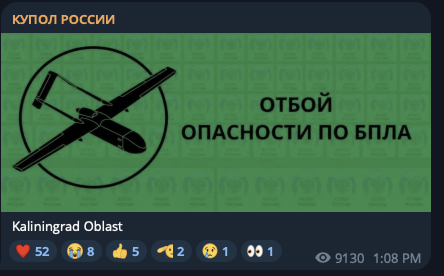
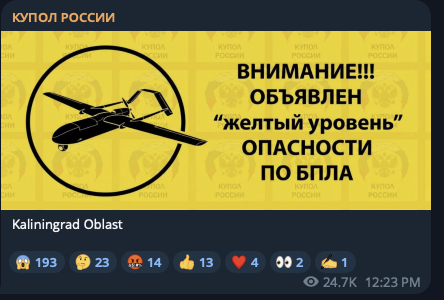
All-clear: Channels such as “Купол России” post the yellow “yellow level of danger by UAV” alert for Kaliningrad Oblast, followed by the green “all clear / cancellation of UAV danger.” Official Russian statements emphasize no threat after checks.
Bottom line: No drones entered Kaliningrad from Lithuania. There was a brief, localized drone-danger alert triggered by a suspicious track that proved non-threatening, plus a separate confirmed drone strike on a ship at sea in the Gulf of Finland. The night explosion photo circulating as “proof” of an attack is old footage from Iran. Don’t fall for the recycled image.
Ukrainian General Staff says Defense Forces hit a Russian ammunition depot near Pervomaiske in occupied Crimea and two command points near Pryshyb in Zaporizhzhia region and Ukrainsk in Donetsk region. They also hit a bridge over the Siverskyi Donets near Luhansk, and damage is being assessed.
Dear Eidtors, I am a Polish writer and investigative journalist and I see your article contains serious factual omissions. In February 2026 I spent weeks working through the Department of Justice release of the Epstein files: emails, texts, calendars, tickets, visa applications and bank transfers. The results were published by Gazeta Wyborcza and, in English "'Russia can get out in front': Epstein's advice to Putin: (https://t.co/kQzSvtepa0).
Your piece offers readers a conclusion: that Reuters found no evidence Epstein worked for Russian intelligence or acted on behalf of the Russian government while leaving out the most consequential Russian threads in the files. Besides my own work, these threads were reported in February 2026 by CNN, the Kyiv Independent, Meduza and UnHerd.
Your article does not mention the following:
Vitaly Churkin. In the files I counted eleven meetings between Epstein and Russia's ambassador to the UN in 2015–2016, some of them with Ehud Barak or Peter Thiel present. In June 2018, weeks before the Helsinki summit, Epstein wrote to Thorbjørn Jagland that Churkin "understood Trump after our conversations" and suggested that Sergei Lavrov could "get insight on talking to me." Neither Churkin nor Lavrov appears in your article. The 2016 campaign. The files show an August 2016 lunch at Epstein's home with Churkin, Barak and Tom Barrack, a senior adviser to the Trump campaign, and an October 2016 scheduling email headed "Churkin? Thiel?" five weeks before the election.
Oleg Deripaska. Your article says only that a meeting was sought through Peter Mandelson in 2010, that Reuters could not determine whether the two men met, and that associates believed Epstein exaggerated the connection. The DOJ files show more than that. In 2010, Epstein and his colleagues sought help with a visa from Oleg Deripaska; later, there was even talk of hiring his assistant. The files contain a scan of a passport with a visa from 2015. His British friend Peter Mandelson, the Labour Party politician, was also close to Deripaska, as an email from 2010 shows: "will oleg either be in paris, thurs till sunday , or moscow next week." They document Epstein's dealings concerning Deripaska over several years, with Mandelson acting as his channel. In 2018, a month after the US Treasury sanctioned Deripaska, the investor Jide Zeitlin thanked Epstein for his "thoughts re Deripaska," and Epstein forwarded the exchange to Steve Bannon. Senator Sheldon Whitehouse has stated on the Senate floor that the files indicate Epstein had dealings with Deripaska, whom the Treasury has identified as a money launderer for Putin. Most importantly, there is the flight to Deripaska. Once, Epstein flew from Beijing to Abakan in Siberia, Irkutsk, then to Moscow and St. Petersburg (August, we don't know what year). Near Abakan, he stopped in Sayanogorsk, which is where “Mr. D.”, or Deripaska as he is referred to in emails with friends, comes from. The trip is rather touristy, but Epstein also holds meetings, and in Moscow talk was of visiting the Kremlin "with inside." Your article does not mention this trip. Treating this relationship as a rumour that Epstein inflated misrepresents the record. Epstein's trips to Russia. Your article states twice that the 2002 trip was one of "only two known" visits Epstein made to Russia. This is not an omission but a factual error. In the DOJ files, Epstein's visa applications list trips to Russia between 2002 and 2007. In 2002 Epstein flew his own plane with Ghislaine Maxwell first to Japan and then to Novosibirsk, where Bill Clinton boarded and flew with them to Khabarovsk. The files also contain tickets to Moscow in October 2012, a New York–Moscow flight on 27 April 2018 with a return on 8 May, and a last trip to Moscow in April 2019, two months before his death. His calendar further shows the Beijing–Abakan–Irkutsk–Moscow–St Petersburg journey described above, and alerts for flights to Moscow, Novosibirsk and Yekaterinburg. Your own article reports that Epstein held Russian visas for much of the period from 2002 to 2019, which sits uneasily with the claim that he went there only twice. This statement should be corrected.
Sergei Belyakov. Your article presents him only as a deputy economy minister and the organiser of the St Petersburg forum. It omits that, according to TASS, he graduated from the FSB Academy in 1999. It also omits what the files show: that he approached Epstein about sanctions after the annexation of Crimea; that at a meeting at Epstein's home on 19 June 2014 the two discussed a BRICS currency and what Epstein called a "BRIC coin"; that Belyakov later helped Epstein with a Russian visa; and that in July 2015 Epstein arranged for him to meet Peter Thiel.
"Sputnik" and the financial system. In 2013–2014 Epstein used Jagland as a channel to pitch Putin a plan for Russia to "leapfrog" the West by reinventing the global financial system, including a Russian alternative to Bitcoin that he called “Sputnik”. For a story about why Epstein courted Russia, this is a central motive, not a footnote.
The 2017 FBI memo. The DOJ release includes an FBI memo recording a 2017 meeting with a confidential informant, who described Epstein as Vladimir Putin's "wealth manager," that is, as someone handling the Russian president's money. This document was reported by Meduza in February 2026 and discussed in my article. Your article does not mention it at all. It does not mention the FBI, any FBI memo or any FBI source. The informant's claim is unverified: I could not confirm it elsewhere in the files, and it should be presented with that caveat. But an investigation that tells readers it found "no evidence" that Epstein acted for the Russian state cannot simply ignore a US federal law enforcement record alleging that he managed Putin's assets. At a minimum, readers should have been told that the memo exists, what it says, and what Reuters did to test it.
Steve Bannon and Europe. Between 2017 and 2019 Epstein advised Bannon on expanding his political project into Europe, and in 2018 told him that Jagland was meeting Lavrov and Putin.
Your article presents itself as the product of extensive research: interviews with more than two dozen people and a review of "hundreds of pages" of Justice Department records, flight logs, court filings and emails. The DOJ release runs to more than three million files. What is missing from your article is not peripheral detail. It is the material that is essential to understanding Epstein's relationship with Russia. None of this proves that Epstein was a Russian asset, and I do not ask Reuters to say so. I wrote plainly in my own article that the documents do not settle that question. My objection is narrower and, I think, harder to dismiss. A finding of "no evidence" is only as strong as the evidence examined.
When a Reuters investigation publishes that finding without engaging with the Churkin meetings, the FSB-trained official working on sanctions and alternative currencies, and the contacts around the 2016 campaign, readers are given false reassurance on a question of real public importance.
The same applies to the article's statement that Epstein never met Putin. What the files support is that no meeting has been confirmed. That is not the same as establishing that none took place. On a subject this serious, publishing the piece in this form shows, first, a lack of competence: the most significant and readily available records were left unexamined. Second, it shows a lack of responsibility: Reuters' reach means that its "no evidence" conclusion will be cited for years as settled, including by those with an interest in closing the question.
Two Russian diplomats have been expelled from Cyprus on suspicion of espionage, two Cypriot officials confirmed over the weekend following a report by broadcaster ANT1 Live.
https://t.co/IWHjos1IqP
UKRAINE 🇺🇦 just crippled both Russian and Iranian ballistic missile supply chains with a single strike.
Ukraine struck ANOZIT in Siberia, russia’s ONLY producer of solid rocket fuel oxidizer. They are also believed to supply the Iranian ballistic missile production.
"On November 3rd, roughly 65% of Montana voters approved Initiative 194, known as 'The Montana Plan.' The Montana Plan codifies a simple legal idea: that a corporation isn’t a person. The authors of the initiative recognized that Citizens United never said a state has to give a corporation the power to spend money in politics. So the Montana Plan takes back every power the state has granted to corporations, and then re-grants only the ones needed to run a business. Political spending is not one of them. Corporations can still do business; they just can’t buy elections."
https://t.co/6nupC3Zq5j
NEW: Russian forces intentionally fired missiles and drones into Polish airspace during strikes against Ukraine on the morning of November 20.
ISW assesses that the Kremlin conducted these airspace violations to coincide with an ongoing Coalition of the Willing military exercise taking place in Nowa Deba, Poland, in an effort to deter the Coalition of the Willing’s support for Ukraine and test NATO responses.
Polish officials requested additional NATO forces and air defense capabilities in response oland did not invoke NATO Article 4 consultations in response to these intentional Russian drone and missile impacts on NATO territory. NATO risks raising the real threshold for allied responses to blatant Russian violations of NATO airspace by failing to use the alliance’s provisions for collective action in response to intentional attacks.
A Missouri judge approved Bayer's $7.25 billion settlement of lawsuits alleging that its weedkiller Roundup causes cancer, a decision that could ultimately resolve litigation that has weighed on the company for a decade https://t.co/HlFwxmOreA
Some thoughts about the summit between Xi, Putin, and Trump — and how to make sense of it. Bottom line: Trump is in office to solve Putin’s problems and wrecking America so autocrats can prosper is fundamental to that.