⛓️ Swarm Intelligence as a "Single Protocol": The End of the Era of Fragmented Agents
In 2026, we are witnessing the decline of the "chat assistant" era. The industry has finally realized that a single powerful agent loses to a well‑coordinated swarm. But for a swarm to become an effective tool rather than a source of chaos, it must operate as a single, strictly typed protocol.
Why "Swarm‑as‑a‑Protocol" is the future?
The problem with modern systems is not a lack of "intelligence," but an excess of communication. When agents communicate in "human" language, entropy grows exponentially.
Shift to binary interaction: Inside the swarm, agents transition to typed API structures. This eliminates the very possibility of misunderstanding — there is no room for model "fantasies," only contract execution.
Verifiable data flow (ZK‑flow): In swarm intelligence, every intermediate decision must have a cryptographic signature. This turns the swarm from a "black box" into a transparent solver.
Zero‑Noise Orchestration: Zero‑noise architecture in a swarm means removing all intermediaries (UI wrappers, natural‑language interpreters) between the core decision‑making layer and the blockchain layer.
The engineering challenge of 2026: "Code is law"
Today's Agentic Web developer is an architect of connections, not a prompt engineer. The task is to create a swarm topology where consensus is reached mathematically, not through "agreements" between models.
The key shift: The efficiency of a swarm is determined not by how "smartly" it responds, but by how predictably and quickly it executes a transaction on Bitcoin L1.
⚖️ What, in your opinion, is the main obstacle to mass adoption of autonomous swarms: the complexity of setting up such an architecture, or the distrust of fully automated systems?
"Just working" code is dead. Bloat = vulnerability.
Zero-noise architecture. Typed data. ZK proofs on every step. Bitcoin L1 as the truth layer.
Agents don't advise — they execute and prove it on-chain.
Build systems you can't sweet-talk into breaking.
Validators: SIMD-0266, which replaces the current SPL token program with a new compute optimized version called p-token, is now live on mainnet at epoch 971. This feature requires at least Agave v3.1.7 and FD v0.812.30108
The true reliability of a system in DeSci is directly proportional to the absence of unnecessary information noise. Minimalism in the architecture of research protocols allows us to focus on clean logic, minimizing the attack surface for errors and misinterpretations.
Distributed consensus of researchers: Instead of centralized approval, the decision about the validity of a discovery is made through a transparent network of agent nodes, providing independent verification.
The Zero-Noise philosophy in science
ZK-proofs of computation: Applying zero-knowledge proofs ensures that experimental data and computational results have not been tampered with during processing.
Using the Agentic Web makes it possible to embed auditing directly into the research cycle:
Autonomous hypothesis auditing: Specialized swarms of agents analyze scientific findings in real time, identifying logical errors and potential model hallucinations.
We are moving from faith in "authority" to verification through mathematical protocols.
The end of "black boxes" in research
The traditional publication process often suffers from human bias and the difficulty of reproducing experiments.
🧬 DeSci + Multi-Agent Systems: Verifiable science without a "reproducibility crisis"
In 2026, the fusion of decentralized science (DeSci) and autonomous agentic systems is changing not just the speed of research, but the very foundation of trust in results.
Over 100k SOL is stranded in SPL mint accounts from people accidentally sending SOL to it instead of a wallet.
p-token adds a new WithdrawExcessLamports ix that enables you to reclaim stranded lamports on mints, token accts or multisigs.
I vibed a tool to help find your lost lamports 👇
New episode of The Stack with @nocircuit:
@wjthieme, Head of Engineering at @orca_so, discusses technical challenges like transaction landing and exciting future developments in tokenized assets.
Check out the full episode 👇
"P-token makes token instructions cheaper, which results in more capacity for the entire network."
- @0x_febo, core dev @anza_xyz, the team behind SIMD-0266 (p-token)
Read the full in-depth conversation with Febo on the Anza blog post linked below👇
this seems to be one of the most loved things we've ever released on Solana
every transfer on solana, indexed and exposed through flexible params (time-based, amount-based, token-based etc)
flows, analytics, accounting, and stables with 50x less code and 10x lower latency
I just built an advanced forensics terminal powered by getTransfersByAddress.
It identifies rings of connected wallets and displays the assets transferred between them. Instead of clicking through tables of transactions, I can just query thousands of transfers instantly.
These are the connected wallets who made over 4,000 SOL off of a memecoin a few days ago. I tracked where the funds went.
One-shot anything on Solana
Meet the Helius stack for agents:
- Claude Code Plugin
- MCP Server with 60+ tools
- Helius CLI with 95+ commands
- Skills for Helius, DFlow, Phantom, and SVM
- Supports all Helius APIs, staking, and tooling
Enjoy
The @JupiterExchange skill for Helius is live
Build high-performance apps, from trading terminals to prediction markets, using any of Jupiter’s APIs combined with our RPCs and trading infra
Now available in our official Claude Code plugin
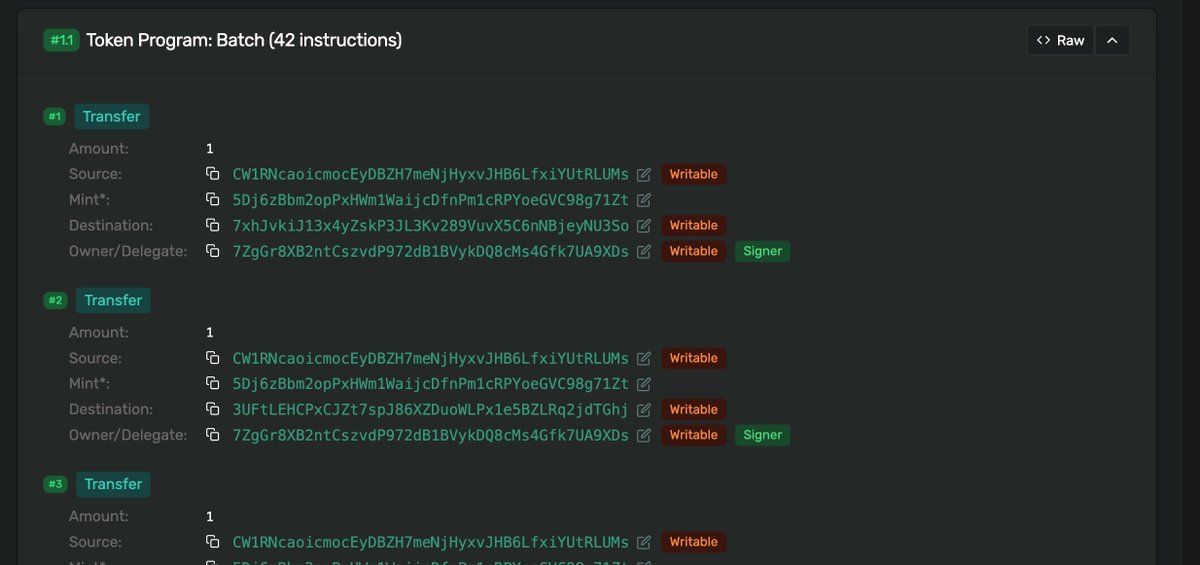
Since we are all not yet bullish enough. The new token program had a new batch transfer where you can do 42 transfers in just 21k CU.
If you are running an explorer or indexing make sure to parse these as well.
Code can be found here:
import { parseBatchInstruction } from '@solana-program/token';
"@solana-program/token": "0.13.0"
How does rewriting a single program recover 12-13% of Solana’s global block space?
We sat down with @0x_febo to discuss the origins of the Pinocchio library, the shift to zero-copy, and the relentless engineering behind P-Token.
Read the full interview: https://t.co/gNNoP4t8Xu