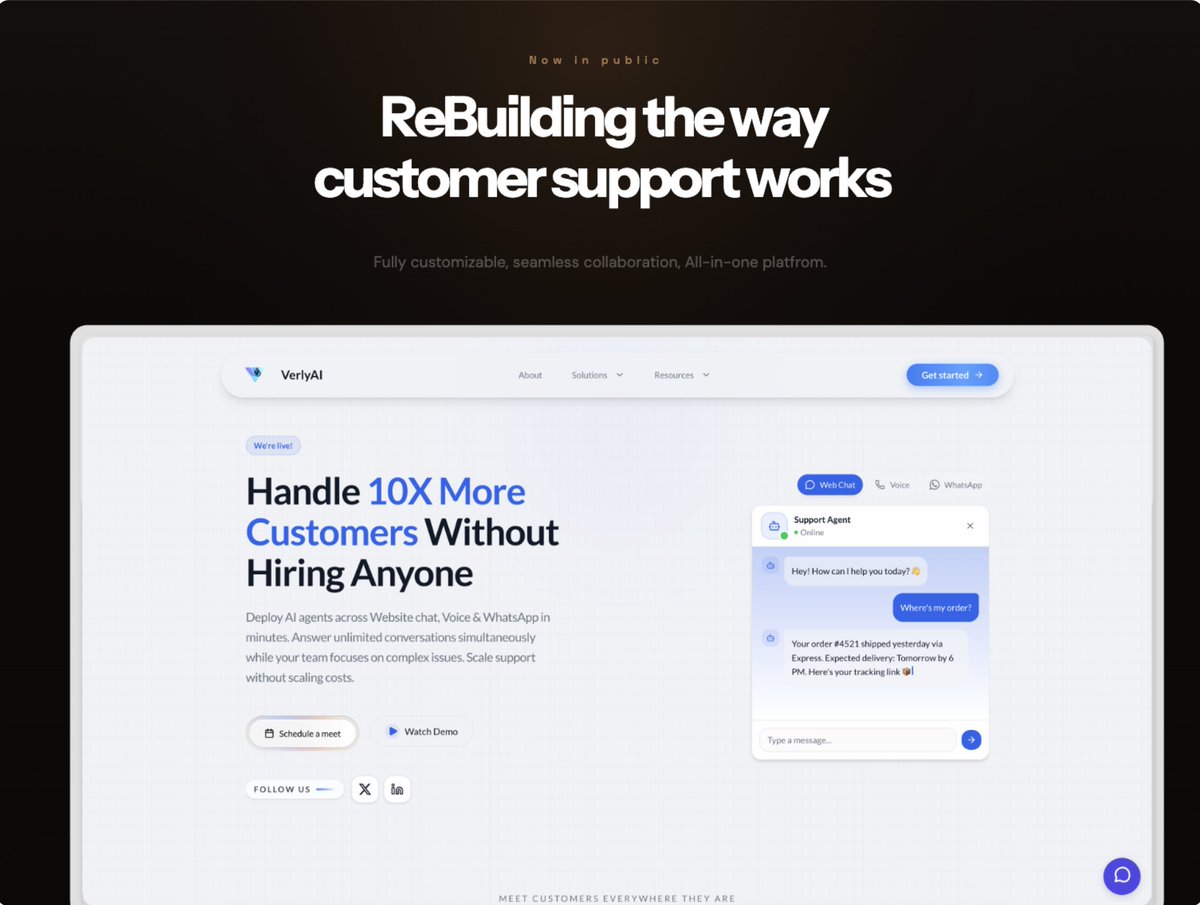
Ever wished your customer support worked 24/7 across channel
That's Verly
Train your AI once → deploy instantly everywhere.
Unlimited convos. Human-like. Zero context loss on handoff.
See it in action https://t.co/FiOX2lp6T8
most companies already have an mcp server with
their whole business context liveing in it .
but their customer-facing chatbot? blind to all of it.
a user asks "where is my order" and the bot says "please contact support."
so we built mcp integration in @VerlyAI.
plug in your existing mcp. now your chatbot can hit Stripe, Zendesk, HubSpot whatever your MCP exposes, all inside one conversation.
your existing system, finally talking to the people who actually need it.
the better context your agent has, the faster it can solve problems.
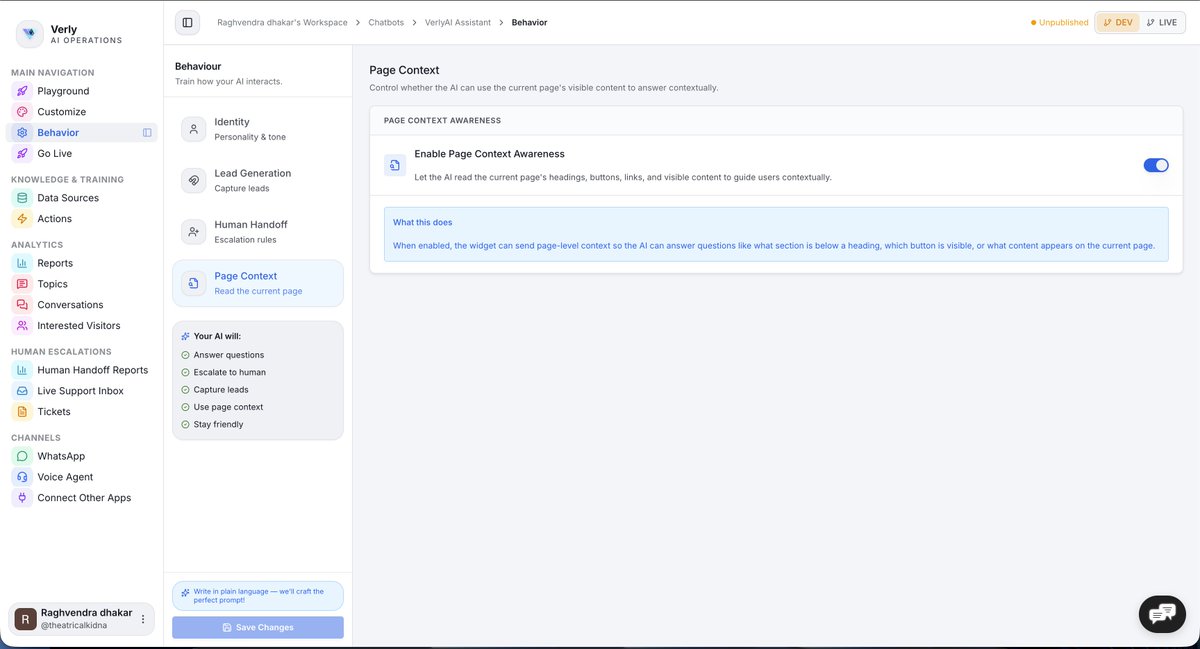
we just shipped page context awareness in @VerlyAI.
the agent sees exactly what the user sees.
if a customer runs into a problem while browsing your site → the agent reads the page → understands the context → resolves it on the spot.
I broke production three times last month.
Not because the code was bad. Because I was editing the same prompt our customers were hitting in real time. Tweak a line, refresh, pray. That's how most teams "iterate" on their AI agents right now and it's insane.
I kept thinking: Why are support and ops teams in 2026 still editing live agents like it's a Google Doc?
So we shipped Dev/Live branches in @VerlyAI last week. Build, test, replay against real past tickets in dev. Promote to live when you're actually confident. No more "oops the bot just told 400 customers the wrong refund policy."
Honestly should've been the first thing we built.
Check this out : https://t.co/prK1KI17ji
We have building a new layer into our chatbot:
it can understand the page a visitor is currently on.
Not just the conversation.
The actual page context.
So instead of giving generic answers, it can say:
“Click the pricing button in the top nav”
“Scroll to the section below”
“Use the form field on the right”
“Here’s the exact link you’re looking for”
This matters because most website chatbots still behave like detached support bots.
They answer questions, but they don’t understand where the user is stuck.
We want Verly to feel more like an on-page guide than a floating FAQ box.
That unlocks a much better experience for:
support
onboarding
product education
and conversion flows
Still tightening the architecture and privacy boundaries before full rollout.
But this is the direction:
chat that understands the website, not just the message.
If you’re building for support or sales on the web, this shift is going to matter.
We have building a new layer into our chatbot:
it can understand the page a visitor is currently on.
Not just the conversation.
The actual page context.
So instead of giving generic answers, it can say:
“Click the pricing button in the top nav”
“Scroll to the section below”
“Use the form field on the right”
“Here’s the exact link you’re looking for”
This matters because most website chatbots still behave like detached support bots.
They answer questions, but they don’t understand where the user is stuck.
We want Verly to feel more like an on-page guide than a floating FAQ box.
That unlocks a much better experience for:
support
onboarding
product education
and conversion flows
Still tightening the architecture and privacy boundaries before full rollout.
But this is the direction:
chat that understands the website, not just the message.
If you’re building for support or sales on the web, this shift is going to matter.
I don’t think most support teams have a support problem.
They have a stack problem.
One tool for web chat.
One for WhatsApp.
One for internal routing.
One for reporting.
Then everyone acts surprised when ownership gets blurry and context falls apart.
Five disconnected tools do not become a system just because the team got used to them.
I keep coming back to this because so much “support complexity” is really self-inflicted software sprawl.
What’s one support tool you’d happily delete tomorrow?
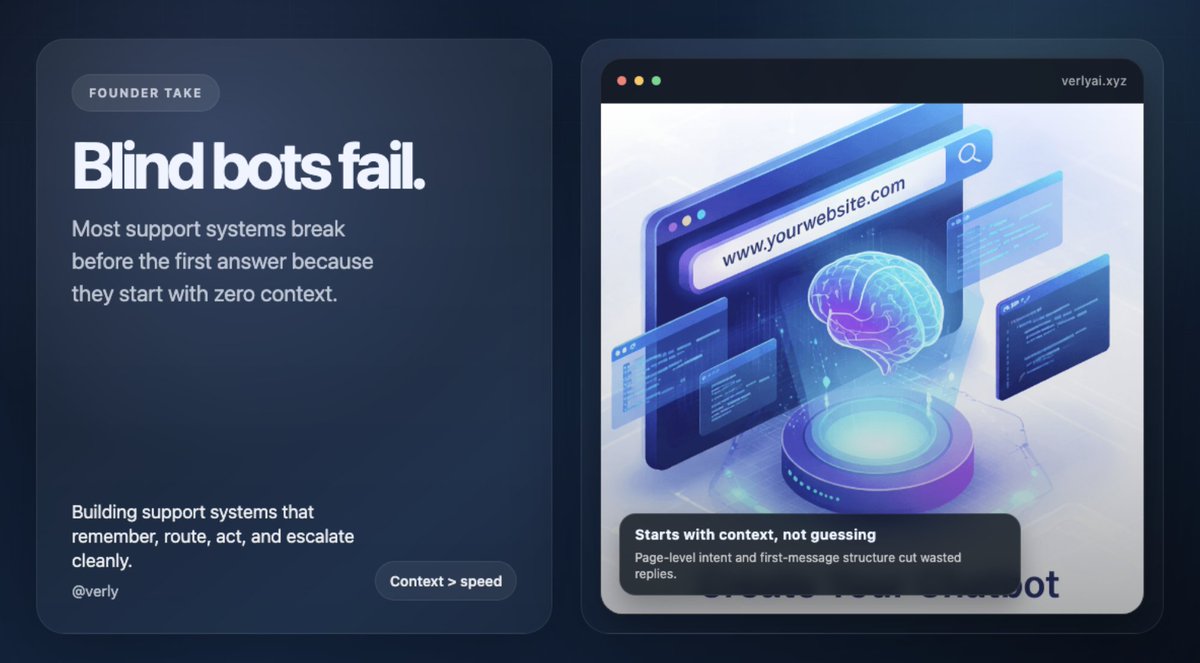
Most support bots fail before they even reply.
They start blind. No context. No memory. No idea why the customer is even here.
I think the market got distracted by response speed and forgot the more important thing: understanding.
That’s why @VerlyAI matters to me. It gives the support layer actual context from your site, your knowledge, and your workflows before the conversation becomes a mess.
The result is simple.
Less repetition for the customer.
Less stupidity for the team.
I think most support chatbots fail before they even answer.
Not because the model is weak.
Because the system starts blind.
No page context. No user intent. No clue what the customer was trying to do two seconds before they opened the widget.
Then teams call it “AI support” because it replied quickly.
Fast confusion is still confusion.
I genuinely think the market still underrates how stupid a blind support bot feels.
I’d rather build a support system that understands where the conversation came from than one that just races to say hello.
Most AI support discussions are really prompt discussions.
The harder problem is system context.
- The part that still annoys me is how many teams celebrate response time while the first reply is basically “can you explain that again?”
- I don’t think support quality starts at the answer. It starts at whether the system understands the situation.
- This is why I care more about workflow design than prompt polishing.
$4.7 trillion in revenue is at risk globally.
Not because companies can’t build good products.
But because they don’t understand how humans experience support.
A research study found that businesses lose $62 billion every year due to poor customer service. And globally, that risk compounds to $4.7 trillion in revenue on the line.
Here’s what’s actually happening beneath the surface:
Customer support today is built on false progress loops.
You reply → customer waits
Customer replies → you “check” → nothing moves
It feels like progress, but psychologically it creates resolution anxiety.
The longer an issue stays open, the more the customer feels loss of control, uncertainty, and frustration.
Most tools make this worse.
They optimize for response dopamine (quick replies that feel good) but ignore closure satisfaction (actually solving the problem).
That gap is where companies lose billions.
At Verly, we built for the other side of psychology:
→ completion loops, not conversations
→ resolved outcomes, not replies
→ instant execution, not “we’ll get back to you”
Because customers don’t remember how fast you replied.
They remember whether you finished the job.
If improving resolution (not just response time) is a priority this quarter, it might be worth taking a look at how Verly approaches support differently:
https://t.co/xHaGLWOplX
No one tells you this about building a company:
You don’t lose in big moments.
You lose in small gaps.
A missed follow-up.
A delayed reply.
A task that stayed “almost done.”
Nothing urgent.
But it adds up.
This shows up the most in customer support.
A user who didn’t get a follow-up.
A conversation that just… stopped.
An issue that needed one more step.
Not broken enough to escalate.
Not smooth enough to feel great.
It’s not a people problem.
It’s not even a tooling problem.
It’s a continuity problem.
At Verly, we’re thinking about this layer :
Systems that don’t just assist,
but keep things moving.
Quietly. In the background.
Because building is hard enough.
You shouldn’t lose momentum to invisible gaps.
If this resonates, you might want to take a look:
https://t.co/xpvKy6iqx0
Hiring!
Looking for 2 roles to work directly with me at @VerlyAI :
1) Sales & Marketing :
Lead generation & outreach
Understanding customer needs
Helping close deals
Building distribution channels
2) Growth :
Creating LinkedIn & X content
Writing + formatting blogs
Running growth experiments
You’ll learn how an AI startup actually grows from 0 → 1.
Stipend: ₹5–10k/month + performance bonus
Remote
If you’re curious, scrappy, and love building things, DM me or reply below
Need customer support that works 24/7?
Use VerlyAI.
Train once → deploy everywhere.
⚡ Instant replies
🤖 Human-like AI chat
📉 Lower support cost
Try now 👇
https://t.co/TniaNDyKvB
#AIChatSupport#VerlyAI
Ever wished your customer support worked 24/7 across channel
That's Verly
Train your AI once → deploy instantly everywhere.
Unlimited convos. Human-like. Zero context loss on handoff.
See it in action https://t.co/FiOX2lp6T8
If you run a business and repetitive support messages interrupt your day, you can try Verly here: https://t.co/udmyUqjYbL
We can schedule a meet to understand your problem and how verly can be helpful in that domain: https://t.co/ZU5rllQdwE
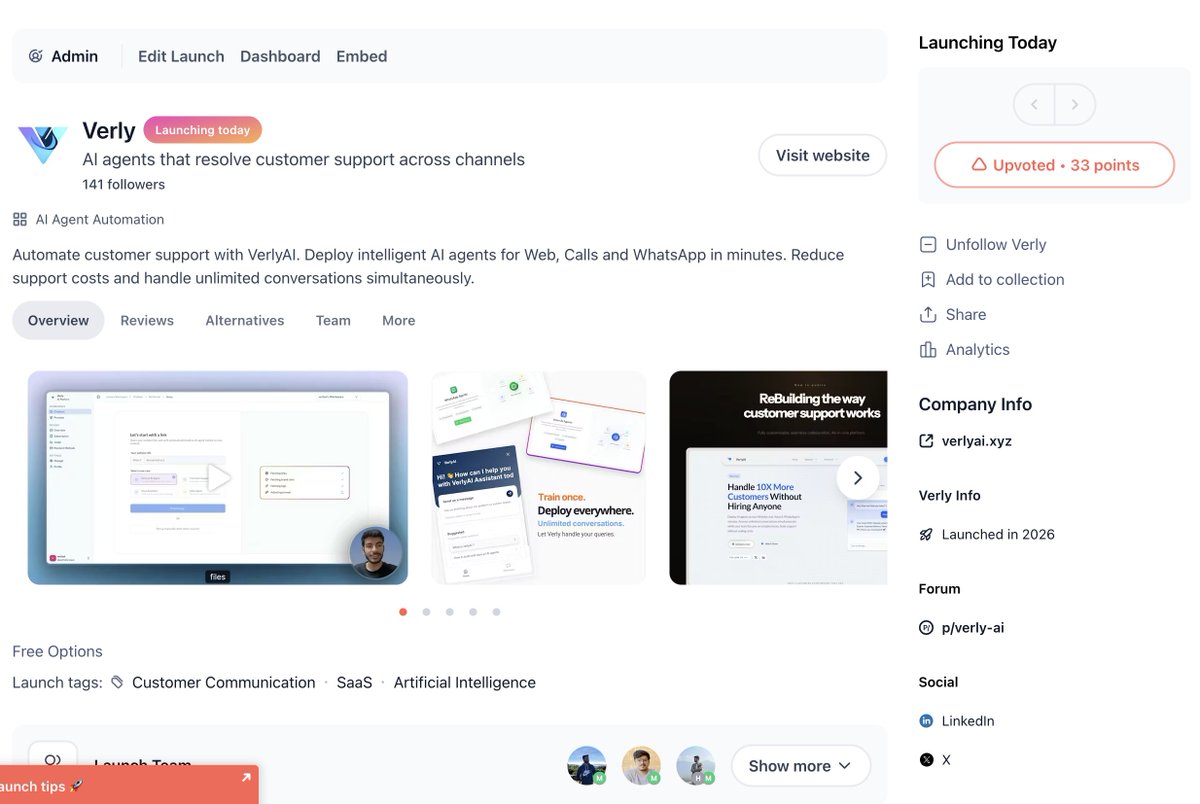
We launched @VerlyAI on Product Hunt yesterday and finished #6. also got our initial sign ups.
Watching strangers trust your product, connect their business, and let it talk to their customers is a very surreal moment.
Thank you to everyone who checked it out, commented, and gave feedback.
We just launched Verly on Product Hunt 🚀
we appreciate your upvotes 🙏
https://t.co/WF0AxG2uyk
AI agents that resolve real customer support conversations across web, WhatsApp & voice.
If you believe support should scale like software, not hiring this is for you.
Me and @Raghvendra56595 are launching @VerlyAI on Product Hunt in a few days.
We started building it because we noticed something:
early stage founders don’t actually need a support team
they just need someone to answer the same 20 questions over and over again.
so I built an AI support agent trained on the product itself which can answer queries on web/phone-call/whatsapp