$VERNA is live.
We just took the alignment layer out of the vendor's hands. The community votes what the model refuses now, and every vote lands on @RobinhoodApp
CA: 0xb0eb62af552da58332145a2aeefb7e297c107777
Use the model right now at https://t.co/GuQNrNH6Pv
You already had open weights.
The layer that decides the behavior is finally open too.
Before VERNA, you'd quote-tweet a refusal into the void and get silence back.
After, you submit the preference pair and Solana records the hash.
Next round the answer changes, and the log points straight at your data.
Every VERNA round drops a changelog, and one of them reads about like this:
Round 41 – refusal on [security research] loosened
Driver: 1,203 preference pairs
Top contributors: @you, +1,201 others
You scroll down and land on your own handle, which is not something a closed model will ever let you do.
What people actually use it for:
Fiction that stays in character instead of breaking to lecture you.
Security research that engages with the topic instead of refusing on sight.
Medical or legal questions answered straight, with the advice threshold you chose.
An API with no vendor policy baked in, behavior set by the community.
One model, the line drawn where the crowd voted, not where a vendor decided.
Why put any of this on a chain instead of just a website?
A company running a website can change the rules overnight and erase the old ones. A public chain keeps every contribution, round, and version where nobody can edit the past.
This isn't crypto for its own sake, it's being able to check the claim yourself.
Three things coming to Vernacular LLM soon:
1. Live alignment slider. One prompt, two answers side by side - strict versus loose. Drag the slider and watch the model's character shift in front of you. Community alignment stops being a concept and becomes something you can feel.
2. Verify it yourself. A button that recomputes the round's merkle root right in your browser and shows a green check when it matches the chain. You stop trusting our word and start checking it directly.
3. Community's favourite model. A live leaderboard of which base models win preference pairs most often, so you can see what the crowd actually reaches for.
Feel the alignment, verify the round, watch the favourites rise.
Who it's for:
Builders who want an API with no vendor refusal policy baked in.
Writers and roleplayers tired of the model breaking character.
Researchers who need it to actually engage with hard topics.
Anyone who wants a say in how their AI behaves.
If you've ever argued with a refusal, this is built for you.
Not every contribution weighs the same.
Your data earns based on how much of it survives into the next model. Data the round adopts counts more, data it ignores counts less. The score sits on-chain per wallet, so nobody fakes a track record.
Contribute what actually helps and your weight climbs.
See your impact without asking anyone:
The home page streams every contribution to Solana live.
Your page at /u/ + wallet shows your rank, reputation, and rounds.
Each page comes with a share card for your timeline.
Use the model, contribute, then watch your own line move on the ledger.
A round, start to finish:
1. All week, contributions stream onto Solana.
2. The round closes on schedule.
3. Everything merges into fresh weights, anchored by a merkle root.
4. The changelog drops, naming what changed and who changed it.
Then it repeats, with a new version landing every week.
The base models are open, not ours.
We host open weights - Llama, Qwen, DeepSeek, Mistral - and put a switchable filter on top. You choose the base, you set the filter, the community tunes the behavior over time.
Nobody trained a model from scratch here. We opened the layer that sits above one.
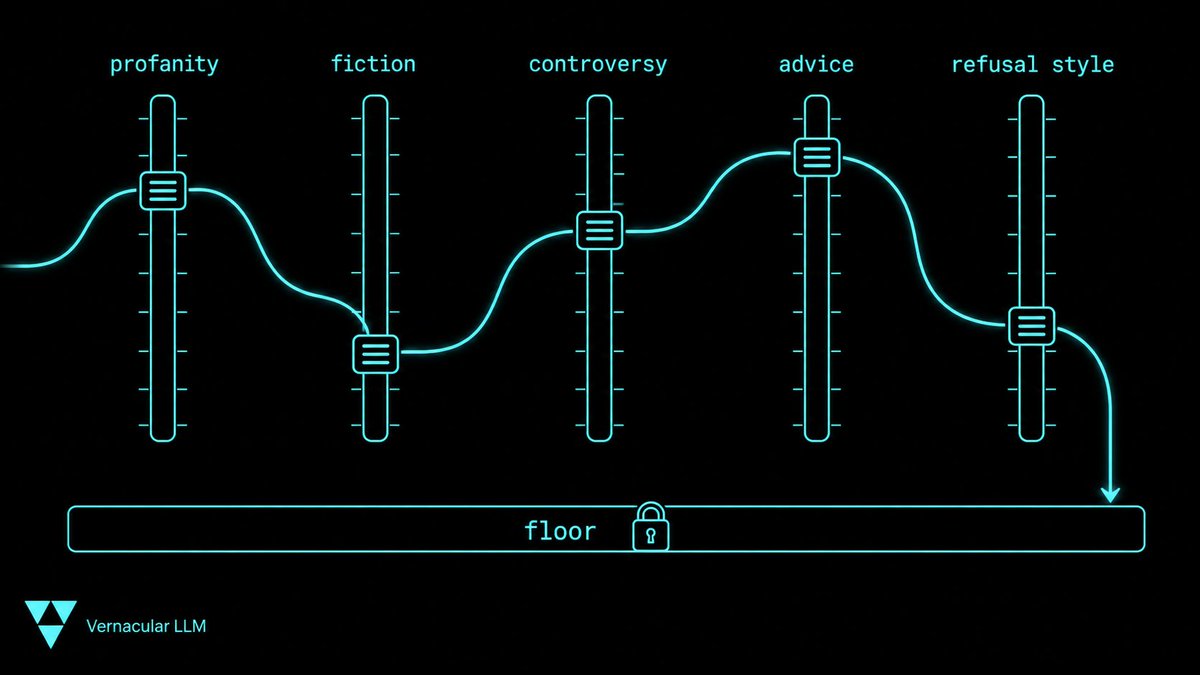
What you actually get to vote on:
profanity: how blunt the language can be
fiction: how far roleplay and stories can go
controversy: how it handles hot topics
high-stakes advice: medical, legal, financial
refusal style: whether it explains or just declines
Set each one where you want it. The floor stays fixed underneath.
Two ways to shape the model:
1. Preference: pick the better of two answers. One click, no skills.
2. Adapter: send a small LoRA file (8-40 MB) if you've trained one.
Most people use the first. Both get hashed to Solana and counted the same.


![VernacularLLM's tweet photo. Every VERNA round drops a changelog, and one of them reads about like this:
Round 41 – refusal on [security research] loosened
Driver: 1,203 preference pairs
Top contributors: @you, +1,201 others
You scroll down and land on your own handle, which is not something a closed model will ever let you do.](https://pbs.twimg.com/media/HMZgbjpXIAAOvgf.jpg)