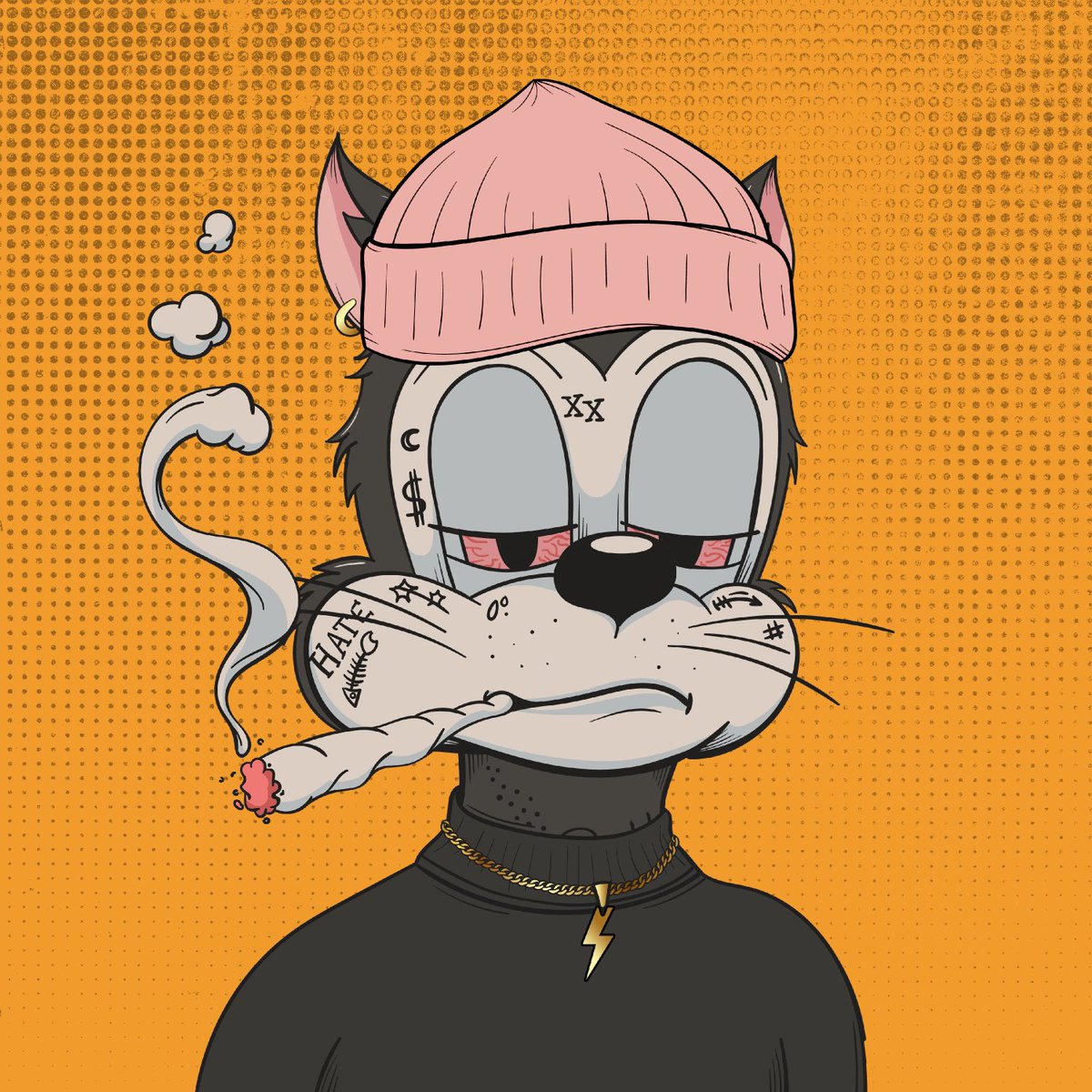
What happened with Hash Cats (@hashcats_rh)?
For a brief period, Hashcats completely captured NFT Twitter.
People were renting GPUs, the timeline was filled with cats, memes about poor rigs and exploding computers. A genuinely innovative project in the space came a few weeks ago and took NFTs by storm.
I wanted to look back at what actually happened, because regardless of the floor price, I think the story itself is worth documenting.
Skip to the end for a TL;DR.
THE CONCEPT
Hashcats took what is normally the simplest part of an NFT collection and turned it into a fun experience, all built around mining on Robinhood Chain.
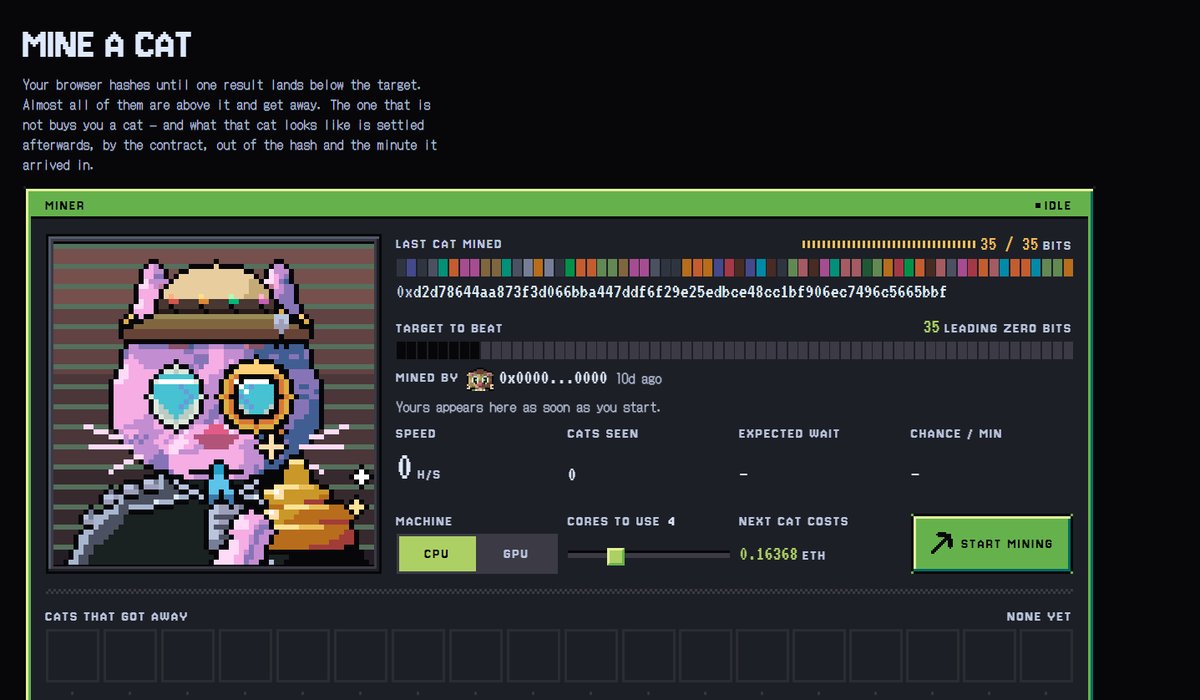
You couldn't just mint, you had to mine your cat.
Here: https://t.co/gxyFoFlhVg
Your machine searches for a valid hash below the network target. Find one, submit it onchain, and that hash helps determine the cat you receive.
The art system, palettes, sprites and renderer are also built onchain, adding another unique layer to the project.
Docs: https://t.co/do2BDVTLBx
Then there are epochs. As mining progresses, the price to enter rises and finding a valid hash becomes increasingly difficult. Early epochs were extremely cheap, with the mint price doubling each one. By epoch 10, entry had reached 0.16368 $ETH. That structure created something NFT mints rarely have, a genuine competition.
THE RUSH
The hysteria peaked when people began to recognize the flywheel of it. Your cats accrued ETH gained from minters after you, as well as $HASH from staking. People were posting multiple hundred dollar claims simply for holding, many getting paid back for their hash cat within an hour.
Once people understood the mechanics, things escalated quickly. The mining setups, renting multiple GPUs at once even, comparing with friends, competing with the market. Who had the best rig?
Mining guides started spreading around the timeline. People were optimizing hardware, calculating difficulty and racing the next epoch.
At one point, Hashcats reported 6,167 cats mined by 930 different miners in 24 hours, roughly one cat every 14 seconds.
And CT was completely infatuated with them. Someone had just found one, someone else had missed one, someone was renting another GPU, someone gave up and bought one on secondary.
For a moment, NFT Twitter had effectively become a mining operation on Robinhood Chain.
THE ATTENTION
As the mining frenzy grew, bigger collectors and familiar names began getting involved.
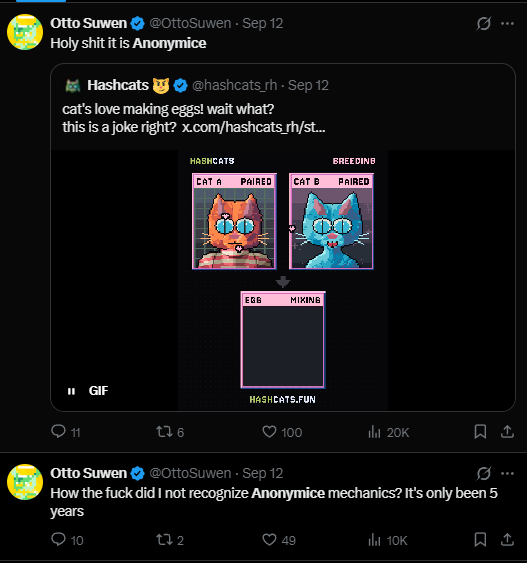
@OttoSuwen was publicly discussing the mechanics and game theory around Hashcats, likening it to a previous project from 2021 @AnonymiceNFT.
@ultrapara became one of the collection’s largest collectors, buying over 700 NFTs around epoch 10.
And the conversation expanded far beyond the art itself. People were talking about mining difficulty, hashrate, epochs, GPU efficiency, and $HASH.
There was an amount of organic shilling around Hashcats that we hadn't seen around many NFT projects in a while. Not necessarily because everyone agreed on what Hashcats would become, but people simply wanted to participate in what was happening.
Hashcats had managed to make obtaining the NFT itself part of the entertainment. People didn't just want a cat, they wanted to mint their own.
TIME SINCE
Eventually, the initial rush cooled, epoch prices increased, difficulty increased, mining slowed, the secondary market came down, and CT moved onto other things.
Today, 9,796 Hashcats have been mined.
They also introduced a mechanism where burning your hash cats yielded $HASH, allowing you to get instant liquidity for your cat, alleviating pressure on the floor while also making the supply deflationary. To date, 3,869 Hash Cats have been burned, leaving a running supply of 5,927 cats circulating. 2,322 of those are staked, yielding ETH and $HASH through various vesting lock up periods.
Live stats: https://t.co/LmlArWw52g
The project has also continued building around the original mining mechanic with $HASH. They introduced an AMM/pool system that allows holders to sell or buy through the site using their $HASH tokenomics, supplying buy pressure to the coin while also taking pressure off the floor.
Here: https://t.co/KNKIp5uof7
https://t.co/VhLaKn9Pw9
Thousands of people pointed computing power at Robinhood Chain trying to solve hashes for pixel cats. People rented GPUs. Mining guides spread across Twitter. Large collectors got involved. The space was connected for once.
With breeding coming soon for the project, maybe there is another chapter, or maybe the mining rush remains the chapter everyone remembers.
https://t.co/2moUp40UCt
I personally believe there will be another rise of the cats. The dev team @hashdoting has teased turning the cats into a genesis collection model, giving revenue share for future projects. They also spoke about breeding, and what that might bring to the table. The community is very welcoming, full of nice people who are OGs in the space with large stores of knowledge.
Either way, what already happened doesn't disappear.
For a moment, NFT Twitter became miners.
And they did it for cats.
TL;DR
Hashcats turned an NFT mint into a proof-of-work style mining competition.
Instead of simply clicking mint, users had to find valid hashes, with the hash helping determine the cat they received.
What began as browser mining quickly became an arms race involving GPUs, rented computing power, thousands of miners and widespread attention across NFT Twitter.
The pace and market have changed since then, but the moment itself already happened. In my opinion, a new day will be born for the cats, whether it be how we know them or some other way. The community is very welcoming, and full of nice people wanting the best for their cats.
Either way, the event happened, that is not going to change, and I think it's a piece of NFT history worth remembering.