Independent Theoretical Physicist exploring cosmology, branching reality, and informational admissibility through the Multiverse in Vertical Time framework.
New preprint on Zenodo.
Quantum mechanics allows a single photon to pass through two slits at once, producing an interference pattern no classical trajectory can explain. Does the same logic extend to a macroscopic object made of billions of particles — or does "classical" begin somewhere in between?
This paper answers constructively. It introduces the NESS (Non-equilibrium Self-confined Soliton): a self-organized aggregate of exciton-polaritons that remains coherent at room temperature (300 K), sustained by an ambient energy flux rather than an external trap or laser — the physical analogue of metabolism.
Three results follow. First, an exact mathematical identity mapping the soliton's dynamics directly onto the linear Schrödinger equation, with no intermediate approximations. Second, a self-consistent derivation showing that a single physical parameter — the light-matter coupling strength — simultaneously fixes the aggregate's thermal protection, its effective mass, and its self-induced nonlinearity. Third, an admissibility operator filtering which branches of the wavefunction are physically realized — not a collapse, but a structural selection — from which the divide between the Copenhagen and Everett interpretations emerges as a necessary feature of the dynamics, not an interpretive choice imposed from outside.
A specific, falsifiable experimental protocol is proposed: anticorrelation between two detectors combined with interference fringes, in the same experiment, at 300 K — a conjunction never yet demonstrated.
🔗 https://t.co/qAvG2r66Uk
🧠 Mind as receiver, not creator.
Psychologists are exploring a fascinating idea that challenges how we understand the human mind. Thoughts may not be something we actively produce. Instead, they may arise, arrive, or surface from deeper subconscious processes beyond conscious control. Rather than being authored moment by moment, thoughts appear automatically, often without warning or intention.
Brain imaging studies show that neural activity linked to a thought begins milliseconds before a person becomes aware of it. This suggests awareness comes after the thought has already formed, not before. Meditation research supports this too, showing how thoughts emerge spontaneously when the mind is quiet, then fade when attention shifts.
This perspective changes how we relate to anxiety, creativity, and self-judgment. If thoughts are received rather than chosen, then observing them without attachment becomes easier. Mental clarity may come not from controlling the mind, but from listening to it with awareness.
The mind may be less like a writer and more like a radio, tuning into signals already in motion.
🚨 Physicists now suspect our universe has a MIRROR twin — a cosmos running backward in time ⏳
If that’s true, we’re only seeing half of reality, because the Big Bang may have created two universes, and we’re living in just one side of the cosmic mirror. 🌌🪞
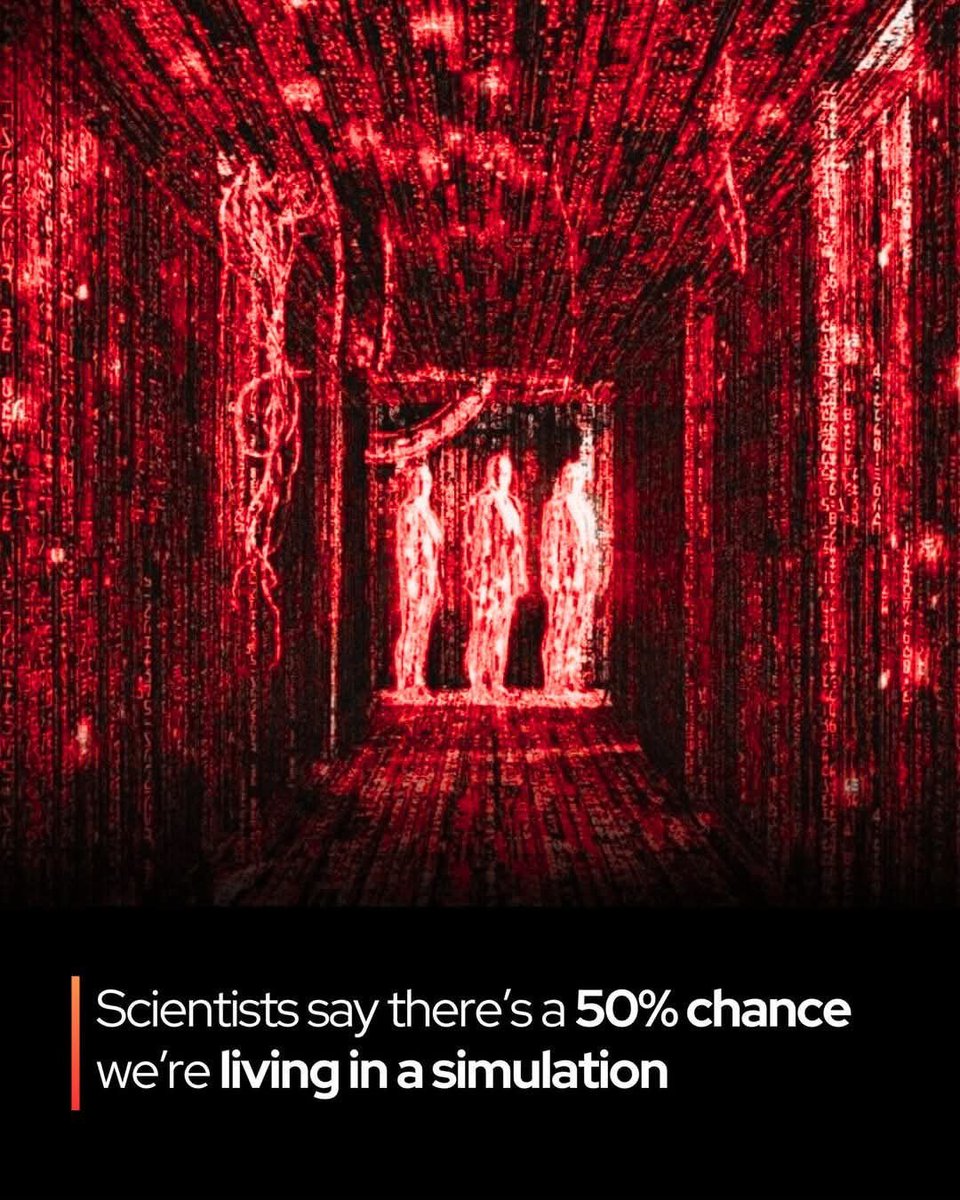
🔴🔵 Columbia Professor Finds There's a 50% Chance We're Living in a Simulation:
Are we living in base reality — or just characters in a hyper-advanced simulation? Scientists are taking this once-sci-fi question seriously.
The simulation hypothesis, first formalized by philosopher Nick Bostrom in 2003, suggests that if any civilization develops the ability to create ultra-realistic simulations of conscious beings — and chooses to run them — then the number of simulated minds would vastly outnumber real ones.
Statistically, that would mean we’re likely simulations too. Only three possibilities exist, Bostrom argued: civilizations go extinct before creating such tech, they choose not to simulate their ancestors, or we’re almost certainly inside a simulation already.
Columbia University astronomer David Kipping put numbers to the theory using Bayesian analysis, starting from a 50/50 position of uncertainty.
His conclusion?
There's a 49.8% chance we’re in a simulation, and only a 50.2% chance we’re in base reality — a near coin toss. While nested simulations would likely degrade over generations due to limited computing resources, that only slightly favors the idea we're “real.” As quantum computing and physics advance, we may one day detect signs of an artificial framework—glitches, anomalies, or mathematical fingerprints that reveal the truth. Until then, we live suspended between two almost-equal realities… and we might never know which one is real.
source
Scientific American. "Do We Live in a Simulation? Chances Are about 50–50"
What if the universe works less like a solid, physical place and more like an enormous video game, only rendering reality in detail the moment someone looks?
This provocative idea comes from Thomas Campbell, a physicist who spent years working with NASA. In his theory, which he calls My Big TOE, short for My Big Theory of Everything, he proposes that reality is fundamentally made of information, and that the physical universe is a kind of virtual reality. Just as a video game does not bother rendering a distant mountain until your character turns to look at it, Campbell suggests the universe may only produce concrete physical detail when an observer requests it.
His inspiration comes from the genuine strangeness of quantum mechanics. In real, verified experiments, tiny particles behave like blurry waves of possibility until they are measured, at which point they snap into a definite state. Campbell takes this famous observer effect and runs with it, arguing that consciousness itself plays a central role, and that the world we experience is essentially data being processed, like a simulation.
Now the essential honesty. This is Campbell's personal hypothesis, not established or accepted physics. The vast majority of physicists interpret the quantum observer effect very differently, pointing out that observation in quantum mechanics means any physical measurement or interaction, not necessarily a conscious mind. There is currently no experimental proof that reality is a simulation or that it vanishes when unobserved. It is a bold, imaginative idea sitting at the edge of science and philosophy.
Still, it taps into a question that has fascinated humanity forever. What is reality actually made of, and does it exist independently of us? Similar simulation ideas have been seriously discussed by thinkers like Elon Musk and philosopher Nick Bostrom, which is partly why the concept keeps capturing imaginations.
Whether or not it is true, it is a genuinely mind bending thought to sit with.
Do you think reality exists completely on its own, or is there something to the idea that observation shapes the world around us?
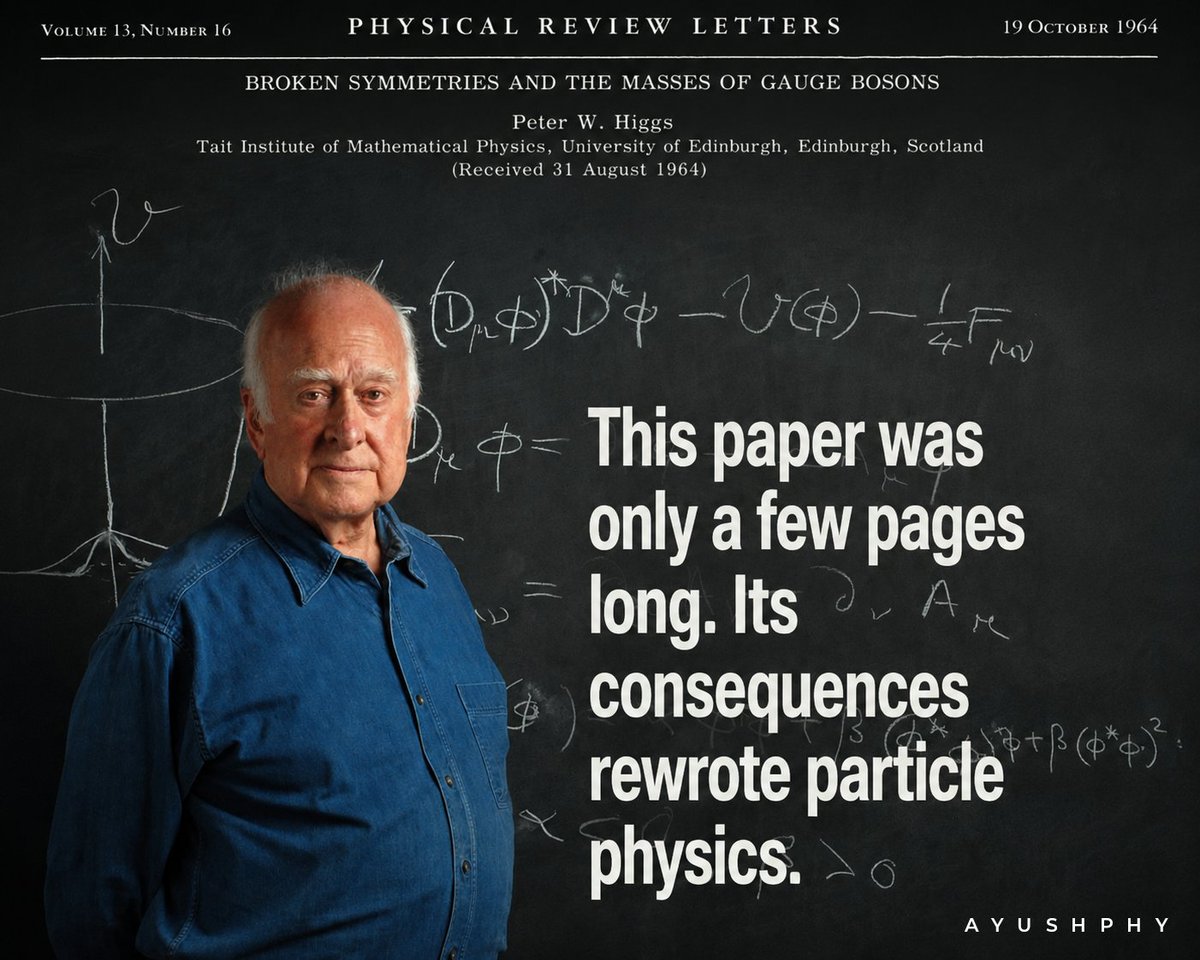
In the autumn of 1964, a physicist at the University of Edinburgh named Peter Higgs submitted a short paper to Physics Letters.
It was rejected. Not for being wrong, the reviewers do not seem to have found an error in it, but for being, in their judgment, of no obvious relevance to physics. Higgs added two sentences pointing out a consequence the referees had apparently missed, and sent the revised paper instead to Physical Review Letters, where it appeared under the title "Broken Symmetries and the Masses of Gauge Bosons." It ran to a page and a half. It would take the better part of half a century, a machine twenty seven kilometers in circumference, and several thousand physicists to confirm what those two sentences were pointing at.
The problem the paper addressed is easy to state and was, at the time, close to a scandal. Gauge theories were beautiful. They explained electromagnetism with a symmetry so rigid that it seemed to leave no freedom for tinkering, and physicists wanted the same rigor to describe the forces that operate inside the nucleus. But there was an obstacle that looked, on the face of it, fatal. The mathematics of gauge invariance insists that the force carrying particles be massless, like the photon. The particles known to carry the weak force were not. Nature, evidently, had already broken the rule the theorists wanted to enforce.
Higgs's move, and it is worth saying that Robert Brout and François Englert had arrived independently at much the same idea only weeks earlier, with Gerald Guralnik, C.R. Hagen, and Tom Kibble close behind, was not to abandon the symmetry but to hide it. He introduced a scalar field filling all of space, governed by a potential shaped less like a bowl than like the bottom of a wine bottle, a hump at the center, a trough running around it. A field sitting at the top of the hump respects the full symmetry of the theory. A field that has rolled down into the trough does not, even though the underlying law still does. The vacuum itself, the emptiest possible state, becomes the thing that breaks the symmetry, quietly, without anyone having to break it by hand.
What happens next is the part that had gone unnoticed, or been dismissed as a technical curiosity, in earlier work on spontaneous symmetry breaking. Goldstone's theorem said that breaking a continuous symmetry should produce a massless, spinless particle, a promise that seemed to litter the theory with unwanted new particles no one had ever seen. Higgs's contribution was to show that when the broken symmetry is a local gauge symmetry, rather than a global one, the Goldstone boson does not survive as an independent particle at all. It is absorbed, physicists still use the slightly whimsical verb "eaten," by the gauge boson, which promptly acquires the longitudinal polarization state that a massless particle is forbidden to have and a massive one requires. The bill for that transaction is paid in mass, proportional to the vacuum expectation value of the field and to the strength of the coupling. The gauge boson gets heavy. The symmetry survives, encoded rather than displayed. And there is a remainder, an excitation of the field around its new resting point, a genuine, massive, scalar particle, which is what everyone means when they now say "the Higgs."
Higgs seems to have understood, in a way his critics initially did not, that this was the whole point, not a footnote about vacuum structure, but a mechanism sturdy enough to carry the electroweak theory that Weinberg and Salam would build on it a few years later, and renormalizable enough, as 't Hooft would later prove, to be trusted with actual calculations rather than treated as a formal trick. The paper does not linger on any of this. It states the mechanism, notes the consequence its referee had missed, and stops.
Nobel physicist Anton Zeilinger suggests reality and information are the exact same thing.
Information is the ultimate building block of existence, meaning matter is just a byproduct of data.
“Man is the most insane species. He worships an invisible God and destroys a visible Nature. Unaware that this Nature he’s destroying is this God he’s worshiping.”
-- Hubert Reeves (1932 - 2023)
@erdBlackHat@SilenceCaPrompt C'est un plaisir. Je conseille d'approcher d´abord les appendices (b) et (c) pour avoir un aperçu du Cycle de la Réalité. Le reste vient avec.
Fair point. I agree that in your projective-algebra framing, what becomes realizable is already internal to the allowed transformations, not imposed afterward by some external filter.
That is close to what I meant, though from a different angle. By “selection layer” I did not mean an ad-hoc add-on either. In my paper, it is formulated as a constrained projection map: admissibility is defined before spacetime projection, under informational, energetic, causal, and consistency bounds.
So perhaps the overlap is this: physical realization is not the unrestricted existence of every formal possibility, but the emergence of structures whose projection is permitted by the relevant geometry and constraints.
This resonates with a distinction I find crucial: mathematical structures may be primary, but physical reality may still require a selection layer deciding which structures become realizable.
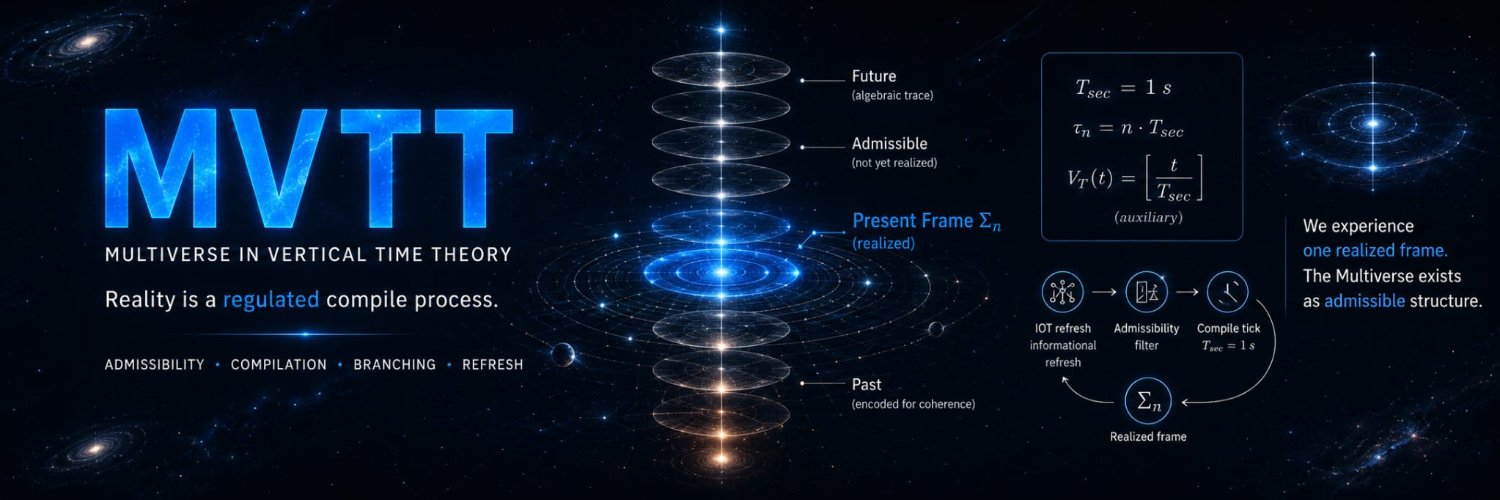
In my framework, I formulate this as admissible projection from a compile-side domain into spacetime, rather than unrestricted existence of every formal possibility.
https://t.co/S7KDQpnbKM
Entropy explains why past and future look asymmetric inside the physical world.
But it may not explain everything. A deeper question is how countless events can remain mutually synchronized while constants, variables, and thermodynamic quantities are updated without exceeding finite energy and information limits.
That is where the arrow of time may become vertical. Not because time is a spatial direction, but because verticality is the condition that allows the whole realized state of a finite physical system, together with its observables and state quantities, including entropy itself, to be refreshed coherently at a regular cadence.
The horizontal arrow is what we experience as past → future. The vertical one is what keeps simultaneity, causality, entropy, and thermodynamic constraints compatible during each update of present reality.
This framework explores it mathematically:
https://t.co/S7KDQpnbKM
@pingu4ll Start with grasping the concept of meta-time, read Barbour, investigate Wolfram's Ruliad, then move forward with Deutsch and Lloyd, and end up with Bostrom and Fried’s experiments. Within the absence of free will, all participants in Reality are watchers of their own actions.
You don't have to believe me when I say the Casimir effect does not allow you to extract energy from the vacuum. You could just do the maths. You must first change the boundary condition which, guess what, requires that you put in the energy which you can then extract again.
A physicist has proposed that dark matter, the invisible substance dominating the universe’s mass, could be evidence that our reality is fundamentally computational.
While the concept sounds like pure science fiction, it stems from a serious physics hypothesis centered on one of cosmology’s greatest enigmas: the nature of information itself.
Melvin Vopson, a physicist at the University of Portsmouth, suggests that information possesses actual physical mass and may constitute a previously unknown “fifth state of matter,” joining solids, liquids, gases, and plasma.
His theory rests on a striking idea: information is not merely abstract data, it is physically linked to energy and matter. In previous research, Vopson introduced the mass-energy-information equivalence principle, which states that every bit of information (whether digital or physical) carries an incredibly small but real amount of mass.
To illustrate just how minuscule this is: erasing one terabyte of data would theoretically reduce an object’s mass by roughly 2.5 × 10⁻²⁵ kilograms, far too small to detect with current technology. Yet when scaled across the entire universe, the cumulative mass becomes significant.
Vopson argues that this “hidden mass” from information could help account for dark matter, the unseen gravitational glue that holds galaxies together. Although we can’t observe dark matter directly, its effects on cosmic structures are unmistakable.
He takes the idea even further: if information is deeply embedded in the fabric of matter, then the universe may function like a vast computational system. This perspective leads some physicists to seriously consider whether reality itself operates as a highly advanced simulation running on mathematical rules.
To test his hypothesis, Vopson has suggested an experiment based on matter-antimatter annihilation. If correct, it should release a tiny but detectable burst of extra energy as the information encoded within particles is erased.
The theory remains highly controversial, and most physicists are skeptical. Nevertheless, many researchers agree that experimentally determining whether information has measurable mass could profoundly impact our understanding of physics, cosmology, and the fundamental nature of reality.