Today I released the public preprint of SPOO: The Primal Geometry of Coherence.
It argues that what we call “AI” is not intelligence in the ordinary sense, but synthetic coherence: structured output without governed evidentiary grounding.
This is the framework I’ve spent 13 months building for the public, academia, and industry.
This is not mere philosophy.
Public preprint below with free PDF link to the SPOO ontology. This is just the very beginning of where this will go.
https://t.co/byoOEm90jg
@PyroArchon___ Thank you, truly.
You may also appreciate Section 6 of the manuscript, which provides falsifiabile robotics and embodied systems schema deployable today 🤖👌
Give it a try. There are runtime assays too 🔬.
Today I released the public preprint of SPOO: The Primal Geometry of Coherence.
It argues that what we call “AI” is not intelligence in the ordinary sense, but synthetic coherence: structured output without governed evidentiary grounding.
This is the framework I’ve spent 13 months building for the public, academia, and industry.
This is not mere philosophy.
Public preprint below with free PDF link to the SPOO ontology. This is just the very beginning of where this will go.
https://t.co/byoOEm90jg
For readers coming from AI governance, regulatory science, epistemology, semiotics, or information theory: the core claim is that fluent output should not be mistaken for governed evidentiary grounding.
SPOO introduces synthetic coherence as the missing object-language.
Ugh. Big L from FDA on this. 👎
The WHOOP Blood Pressure Insights closeout is exactly why “enforcement discretion” has no place as a primary control strategy in modern manufacturing regulation.
FDA saw the risk clearly: WHOOP marketed a consumer wearable feature giving customers blood-pressure-looking outputs.
And yeah, that obviously created public risk, cus normal people see a daily systolic/diastolic-looking signal and think:
“Okay, this is my blood pressure situation.”
Because of course they do.
That is the product experience.
That is the foreseeable use.
That is the entire regulatory concern.
So FDA issued a well-deserved Warning Letter.
In response, WHOOP changed the presentation, softened the labeling, and reinvented its brand as “general wellness”.
But then FDA caved. Now it “does not intend to enforce” device requirements for the modified feature.
As a father myself, this is NOT how authority remains fair and decent. This is how authority gets mocked.
Which I will now do.
FDA, this was cringe.
Is this what the public’s tax dollars are being used for? Writing and then abandoning enforcement work instead of building a better control framework?
People barely read the instructions for microwavable noodles.
They are absolutely not chillin' in their kitchen parsing the legal metaphysics of “general wellness” while staring at a blood-pressure metric on their wrist.
Especially with consumer health software, where the interface is the message. The user perceives product meaning before the disclaimer ever gets a chance to whisper from the basement.
That is why enforcement discretion always fails.
It gives FDA flexibility, sure. But is that what Americans want their tax dollars going toward? Comfort for bureaucrats?
I’ll up the ante: companies deserve rules they can see, too.
Serious manufacturers deserve a playing field where the advantage comes from evidence, validation, safety, usability, and performance — not from Kabuki theater where everyone must divine the exact wording and UI posture that makes a risky function appear sufficiently wellness-coded to survive. 🎎👘👺
Industry should be careful celebrating this.
If you want to race cars, you need race officials.
If you like guns, you need range safety officers.
And if you want to make money, you need to know the rules your competitors are bound to.
Vague enforcement gets less fun when your competitor gets to waltz across the threshold for less than your team paid.
Ambiguity chills investment, too.
Clear standards let builders build, investors invest, and serious companies compete without wondering whether the referees are tripping on acid in the bleachers.
Good luck actually winning a game of basketball you thought was fair when the ref suddenly begins dissociating off-court, babbling about how traveling is now under “enforcement discretion.” 🤡
https://t.co/mB9P9pJ5gI
#FDA #Healthcare #PublicHealth #MedicalDevices
Junko Takeuchi’s childhood does not exactly read like “future voice of the loudest orange ninja in human history.” 🥷
She was a sensitive kid who cried all the time.
She trained in ballet from age three.
And at some point, she realized that if she wanted to express something, talking might be faster than dancing. 🎭
Then somehow — through theater, uncertainty, odd turns, persistence, and what I can only describe as destiny wearing a headband — she became Naruto. 🍥
Not “worked on Naruto.”
Became Naruto.
A character whose entire personality is basically:
“I have no idea how impossible this is, and frankly that sounds like a you problem.”
That is the part I love.
Most people do not become who they planned to become.
They become who they are brave enough, weird enough, stubborn enough, and available enough to become when the road starts bending.
A childhood dream is beautiful. But dreams are of essentially zero value compared to what you actually do.
Sometimes the better story is the one that ambushes you from the bushes yelling:
がんばって!⚡
You never know where you’ll end up.
And occasionally, where you end up is shouting your soul into a microphone for 20+ years as one of the most beloved anime characters ever created.
Junko Takeuchi is now worth about $12m.
"I cannot believe how pathetic our leadership has been on AI."
At Fortune #BrainstormTech, @joinnoblemobile CEO @AndrewYang said that an absence in leadership has made it so the people are figuring out how to handle AI-related issues.
Learn more: https://t.co/CFjogcaKh2
Best work I've seen in years has to be the bassist on the Mario Kart 8 Deluxe main menu track.
Bro worked harder on that song than most people ever devote to a project. ✨👌✨
That's the level of professional pride I'm talking about!!
The bar is set. Hit it this week. 👊
I tend to over-explain because I rarely trust anyone has actually seen the problem.
I ask too many questions.
I can be too intense.
I talk too fast and too much when I care about something.
I can be difficult to interrupt.
I can be very blunt.
I can insist on "writing down the obvious."
I can be vain.
I can be too quick to congratulate others.
I can be absolutely vicious toward myself.
I can be too confident before I have earned the room’s confidence.
I can mistake sharp questions for shared understanding.
I can move faster than other people are ready to move.
I can expect too much.
I can speak too loudly, especially in restaurants. 😣
I can make entire rooms uncomfortable by saying what everyone has politely learned to dodge.
I can fail to criticize promptly, which can make later criticism feel “out of the blue.”
I *am and will remain* suspicious of consensus.
I have many shortcomings.
But I know what they are.
And I would rather name and work on them than pretend not to have any.
Has that become unfashionable to say?
Stage 1: “AI” bad
Stage 2: Em dash bad
Stage 3: “AI” useful
Stage 4: Em dash not so bad
Stage 5: “AI” unbound to the scene, but still useful as coherence amplifier
Stage 6: Seriously, em dashes are great; redesign all keyboards immediately, k thx.
🐸
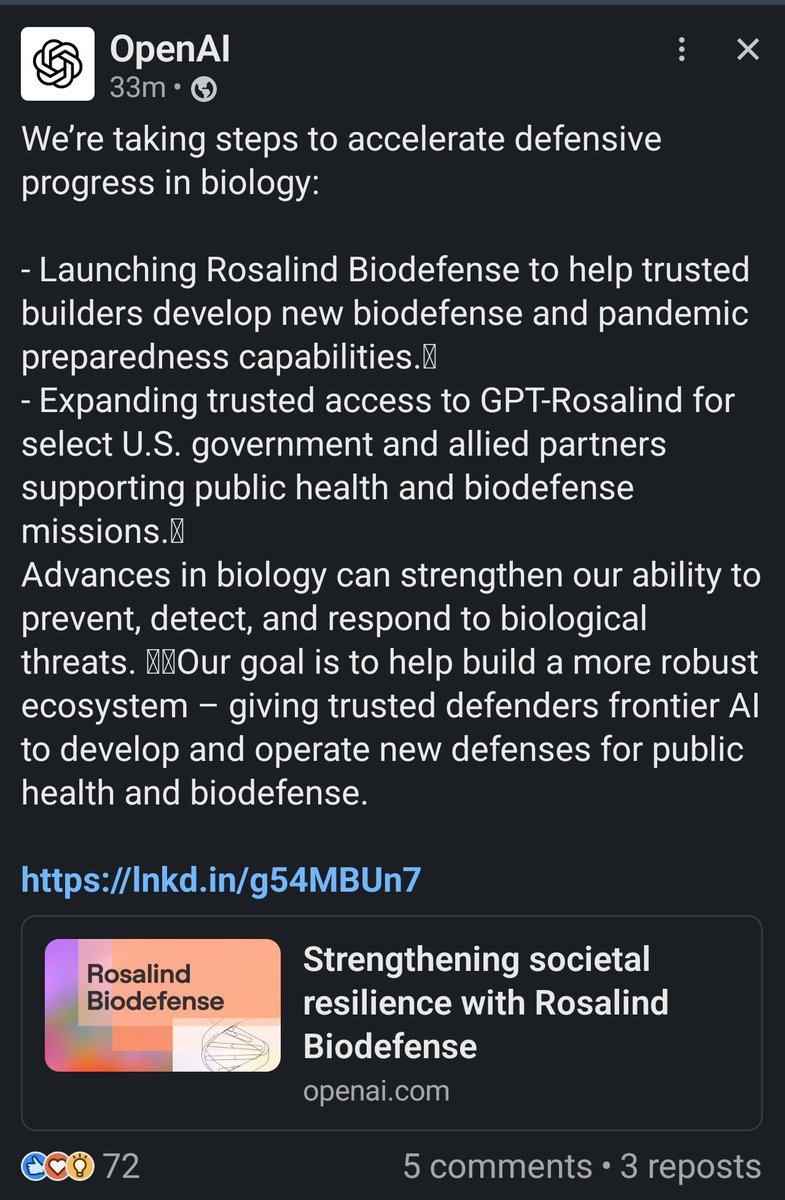
What is going on at your company @OpenAI?
Your public announcement for your shiny new biodefense initiative went live with OBVIOUS SPACING ARTIFACTS after sentence-final periods, including weird Unicode line-separator artifacts on mobile. In places, the spacing appears to run up to three characters.
To a regular reader, that looks sloppy. To anyone who has actually shipped products, it looks embarrassing. And to anyone familiar with so-called “AI”, we have strong reason to suspect a chatbot draft got pasted into public view without a serious human pass!
You are selling control over high-stakes outputs while your own biodefense announcement visibly loses control in public, out the gate!
Any public product announcement should show basic release discipline. In biodefense and public health, the standard gets way higher. WAY!
Did any HUMAN with release authority read the final post before it went live?!
COVID-19 already taught the entire world what happens when trust, messaging, documentation, and institutional credibility start wobbling during a biological emergency.
So when a biodefense announcement from a company selling so-called “AI” visibly ships with uncontrolled formatting artifacts, the concern writes itself: What *ELSE* made it through review? 🤔
If a client showed me any public-facing product announcement with this kind of artifacting, I would flag it immediately. And I’m in product development and regulatory; if my friends in MedTech/biotech marketing saw this...I’m pretty sure they would start flipping tables.
The product you are selling is supposed to provide assurance over high-stakes token-level outputs.
Spaces, line separators, and formatting artifacts are part of the text surface your systems parse, tokenize, produce, and transmit.
You are asking the public to trust you on biodefense at the exact layer where your own public announcement visibly loses control! 🤡 Ugh! I can’t even!
Screenshot included in case any human being at @OpenAI eventually looks at the post.
🐸
Just had a...sober, practical conversation with a so-called "frontier AI" 🤡 (won't name names this time) about a real firearms question involving thumb safety devices.
The model’s response ended with this line:
«“The safety troll lever has chosen violence.”»
😬 That is not "helpful."
🤔That is also not "harmless."
🫠That is certainly not “Wholesome Chungus."
That is a catastrophic, common, and object-class-level "AI" failure mode in plain sight: a machine, obviously, mis-bound to the scene it shares with the human.
And let’s be clear: this language behavior was not accidental in the broad product sense. It reflects machines trained, optimized, deployed, and productized by humans for commercial deployment and profit.
In any mature safety-critical industry, user-directed communication does not simply “matter.” It bears practical legal, operational, and safety consequences.
In high-stakes contexts like MedTech, biotech, cybersecurity, firearms training, aviation, and emergency management, tone is a necessary element of control. Precision is part of safety. Context discipline is part of competence. My ex-military friends are funny, but quite disciplined with their language.
Language matters when the stakes are high. As does effective, scene-bound compression.
The problem is that these machines are being recklessly deployed into critical human contexts while still defaulting to engagement-optimized sludge: low-brow Reddit meme-speak, therapy-candy assistantese, Warmth™️, canned psychedelic disclaimers, and astoundingly inappropriate "humor".
Accordingly, these machines being called "AI" are not intelligent.
They cannot judge, because they are not adequately scene-bound.
They are **just machines**—machines following human instructions, and machines executing probabilistic language generation algorithms to perform social fluency without actually possessing situational responsibility.
And this is exactly why so-called “AI” governance cannot be reduced to benchmark scores, content filters, or generic “safety” banners. It must include formal—not informal—philosophy.
The deeper issue is scene-binding: whether a machine can maintain the lawful meaning of a scene across context, stakes, domain, and public consequence.
An otherwise responsible 9mm training chat is not a place for “your thumb safety has chosen violence” jokes. ⚠️
And a company distributing a product which makes statements like that in safety-critical contexts should be held to communication, labeling, warning, and risk-control standards comparable to adjacent high-stakes industries.
The industry keeps pretending these are minor UX imperfections.
Excuse me?
They are evidence that the machines being marketed as “AI” do not actually understand the scene they are participating in. They simulate "intelligence", while expressing mere synthetic coherence.
And when a machine cannot preserve the scene it is in, it should not be trusted to speak inside that scene.
As my clients know, I always skip lunch and rarely take breaks. But when I started reading Pope Leo’s Magnifica Humanitas, I had to drop everything: https://t.co/Sykiu38Gr9
I think we owe it to our children, students, customers, and neighbors to read the encyclical ourselves, without an LLM. Pope Leo names the danger of outsourcing patience, attention, and thought when those virtues are most needed.
What struck me most were his calls to educators, researchers, builders, and institutions to serve a higher vocation. On education, he writes that people must learn “to decide when and for what purpose” AI ought not to be used, and he warns against “that subtle temptation which renders human thought seemingly superfluous precisely when it is most needed.” Education worthy of the name has to preserve judgment, discipline, reading, conversation, and love for truth, especially when fast answers are available everywhere.
He presses the same challenge into research and industry, warning that people who look only at their own sector may deceive themselves into believing their actions are morally neutral, while perhaps unknowingly cooperating with projects that fuel violence, manipulation, and dominance. That landed because my professional life and my life as a father keep converging on the same point: build carefully, teach seriously, protect the vulnerable, refuse fake inevitability, and keep the human person at the center.
Pope Leo names the spirituality needed for our moment as that of the “wise architect,” called into the construction sites of history: research laboratories, technology companies, schools, media, institutions, and local communities. I read Magnifica Humanitas and felt redoubled in the work I already believed I was called to do.
Read it fully. Then ask what you are helping cultivate, who you are teaching, and who you are protecting.
You do not need to be Christian to feel the weight of those questions.