Injective is giving its Community BuyBack participants another reason to stay active.
The latest @injective Stockdrop brings tokenized stock rewards to Solana for the first time.
Participants commit $INJ during the Community BuyBack, and those tokens are permanently burned.
In return, they receive a share of the revenue generated across the Injective ecosystem.
But there’s an extra reward this time. Every participating wallet gets a separate chance to receive one tokenized stock, no matter how much $INJ was committed.
The Stockdrop features companies such as NVIDIA, Tesla, Apple, Meta, Coinbase, and others.
This is the second Stockdrop, following the September round on Robinhood Chain.
The new Solana round gives Injective another way to connect its community with tokenized stocks across different networks.
This program brings three things together: reducing the $INJ supply, sharing ecosystem revenue, and giving active participants a chance to receive tokenized assets.
It is also important to remember that the stock reward is random, not guaranteed and tokenized stocks do not always provide the same rights as owning shares directly.
Injective is finding new ways to reward its community while expanding the reach of onchain assets.
The Injective Stockdrop goes live tomorrow.
Tokenized stock reveal and claims are less than 24 hours away. Ninjas who burned $INJ will see which onchain stock is waiting for them on Solana.
Drop 🔜
$INJ HAD A STRONG Q3.
The price surged 63%, from $4.54 to $7.41, hitting a quarterly high of $8.18.
But price action wasn't the only highlight.
Here’s what Injective achieved in Q3:
-MiCA white paper covering ~30 European markets
-SEC-registered transfer agent status
-$1B+ in mortgage records onchain
-INJ launched on Solana
-Two major INJ ETF filing amendments
-Meridian upgrade for regulated RWAs and unified markets
Regulatory progress, institutional adoption, and RWA expansion.
Injective is building.
Injective is taking onchain finance beyond crypto and into the infrastructure powering AI.
The new Super Intelligence Compute Index - $SICI is live on @injective mainnet, turning NVIDIA GPU rental prices into an onchain perpetual futures market.
Instead of tracking a single GPU, the index combines five models: H100, B200, H200, A100, and RTX 4090.
The H100 carries the largest weight at 40%, followed by the B200 at 25%.
The index uses compute marketplace data from LO:TECH, with prices filtered and averaged over seven days before hourly updates.
This gives traders a way to follow changes across different levels of AI computing demand.
With USDC as margin and leverage of up to 10x, traders can take positions based on whether GPU rental prices rise or fall. Of course, leverage can also magnify losses.
AI compute is becoming a major part of the global economy, but its pricing is still largely treated as an operating cost rather than a financial market.
$SICI introduces a way to trade that price movement directly onchain.
It could also become useful for AI developers managing rising compute expenses and GPU providers exposed to falling rental prices.
But as a hedge, it will only work well when the index tracks their actual costs or revenue closely.
For Injective, this is a meaningful expansion into a new market category.
The network isn’t just bringing traditional assets onchain; it’s exploring how financial tools can be built around the infrastructure behind AI itself.
That’s a different kind of market for $INJ to help power.
$INJ is featured on @Cointelegraph for our work to bring Nvidia’s AI compute onchain.
Brick by brick, Injective is laying the foundation for an entirely new financial paradigm.
Injective is turning AI computing costs into a tradable market.
The Super Intelligence Compute Index ( $SICI ) brings NVIDIA GPU rental prices onchain through a single index that tracks five GPUs used across the AI industry.
The basket includes H100 at 40%, B200 at 25%, H200 at 15%, A100 at 10%, and RTX 4090 at 10%.
This gives the index exposure to both high end AI training hardware and more affordable GPUs used for inference.
LO:TECH collects rental price data from compute marketplaces and calculates a weighted average over seven days.
The index updates every hour, helping reflect changes in GPU rental costs.
$SICI perpetual futures are already live on Injective mainnet, allowing traders to take long or short positions using USDC, with up to 10x leverage.
These markets can also give AI developers and compute providers a way to explore hedging against changing rental prices, although leveraged trading carries significant risk.
The bigger idea is that GPU computing is becoming a major part of the AI economy, and its costs affect businesses across the industry.
Turning those prices into an onchain index creates new ways to trade and manage that exposure.
@injective is expanding onchain markets into a new area of the digital economy: AI infrastructure.
$INJ
Injective is making options trading a building block for onchain finance.
The launch of @injective Options brings a new opportunity for developers to create financial products around real world markets.
Instead of building an options system from zero, developers can use this infrastructure to create their own trading apps and custom products.
Institutions can also explore tools for managing price risk across stock indexes, commodities, and even AI compute costs through $SICI.
The system uses fully backed options with native Injective USDC, while traders can review the cost and possible outcomes before entering a position.
It is still on testnet, but the idea goes beyond giving users another place to trade.
It gives builders a base layer they can use to create different options-based applications.
If more teams build on top of it, Injective could grow from hosting markets into powering a wider range of onchain financial products.
That is where the long-term potential lies: not just one app, but an entire ecosystem built around the same financial infrastructure. $INJ
Injective is getting closer to connecting $INJ with traditional investors.
The Canary Staked $INJ ETF ( $INJC) is designed to give people exposure to $INJ through a regular brokerage account, without needing a crypto wallet.
But before buying, there are a few things worth understanding.
The ETF NAV reflects the value of its holdings while its market price can trade above or below that value.
Trading fees, bid-ask spreads, and staking fees can also affect returns.
There’s another important difference: $INJ trades 24/7, but an ETF trades only during stock market hours.
Weekend price moves can lead to a gap when the market opens.
And buying $INJC shares doesn’t mean you directly own $INJ. You own shares in a fund that holds the token.
An $INJ ETF could make the asset easier to access for traditional investors, while staking may add another source of potential returns.
But convenience doesn’t remove the risks. Understanding the fees, trading price, and fund structure matters just as much as the exposure itself.
For @injective connecting crypto markets with traditional investment channels is another important step.
Injective is opening a path for Korean won based trading onchain.
Through an MOU with BDACS, @injective plans to use KRW1 as a settlement option for tokenized real world assets on its network.
KRW1 is a stablecoin backed 1:1 by Korean won reserves.
Korean businesses may be able to trade and settle tokenized assets using a won based stablecoin instead of relying only on US dollar stablecoins.
This could reduce the need for currency conversion and make onchain markets easier to use for local institutions.
The plan covers real-world assets such as stocks, bonds, and other financial products.
Injective and BDACS also aim to work with Korean financial institutions to bring more assets onchain as the local rules develop.
Injective already reports more than $7.5 billion in RWA trading volume and over $1 billion in tokenized assets on its network.
It has also worked with POSCO International and LG CNS on bringing trade payment records onchain.
KRW1 is still at an early stage in this partnership.
Minting and redemption will be limited to approved partners and depend on the rules and approvals that apply.
Onchain finance needs more than new assets. It also needs payment options that fit the markets using them.
A Korean won-based settlement option could help Injective connect local financial activity with onchain markets. $INJ
Injective is working to bring more stablecoin liquidity into the heart of onchain finance.
Native USDC supply on @injective has grown rapidly, with the official update reporting a 43% increase in one month, reaching around $16.5 million.
Injective is positioning native USDC as a key stablecoin standard across more than 20 connected blockchains, including the Cosmos ecosystem.
With over $100 million in additional stablecoin supply expected to migrate, there’s room for further growth.
The shift from Noble USDC to native Circle issued USDC through CCTP is important.
It gives users a more direct way to move USDC across supported chains without depending on third party wrapped versions.
For Injective, this means more than increasing supply. Stablecoin liquidity can support trading, payments, lending, and tokenized real-world assets.
A strong financial ecosystem needs a reliable settlement asset. Applications need liquidity that users can move between chains and put to work.
Injective is building toward that role, but the real measure will be how much of this liquidity turns into sustained onchain activity.
More native USDC, more connected markets, and a stronger foundation for onchain finance.
$INJ
Injective is making onchain trading faster, cheaper, and more predictable.
The Meridian Mainnet Upgrade, through proposal IIP-709, has introduced fixed gas costs for key exchange activities on @injective.
This covers spot and perpetual trades, order cancellations, deposits, and withdrawals. Instead of estimating gas costs for every transaction, apps can use fixed gas amounts for supported operations.
For traders, this means fewer surprises when submitting transactions.
For developers and institutions, it makes costs easier to plan and can help reduce failed transactions caused by incorrect gas estimates.
The fees are also extremely low. For example, a spot market order uses around 180,000 gas, while a perpetual market order uses around 190,000 gas.
The final cost depends on Injective’s gas price.
One important detail: gas fees are separate from trading fees, so maker and taker fees remain unchanged.
This upgrade is part of Injective’s wider effort to build financial infrastructure for real-world assets, derivatives, and institutional use.
Private transactions are also part of the broader roadmap, but they should not be treated as already enabled by IIP-709.
Predictable costs matter just as much as low costs when people trade frequently. Traders need reliability, and apps need transactions they can estimate and manage easily.
Injective is improving the basics that make onchain finance easier to use at scale. $INJ
The chain upgrade to bring the lowest predictable gas fees on Injective is now live.
Injective already has some of the lowest gas fees. Now RWAs, perp trades and soon private transactions will all run on the lowest fixed gas fees.
Built for every user, trader and institution.
Injective is making room for the Korean won in onchain finance.
Through its partnership with BDACS, @injective is exploring KRW1, a stablecoin backed 1:1 by Korean won.
The goal is to let Korean institutions bring assets onchain and use their own currency for trading and settlement.
That could remove an important gap. Korea has a large crypto market and a stock market worth trillions of dollars, yet most stablecoin activity still revolves around the US dollar.
A native won-based settlement option could make it easier to build onchain products around Korea local financial system.
On Injective, KRW1 is intended to support settlement for tokenized assets and markets such as equities, bonds, FX, and perpetuals, alongside native USDC.
This gives developers and institutions another currency rail to build around, rather than making every financial workflow depend on dollars.
Injective has already recorded more than $7.5 billion in RWA trading volume, while POSCO International and LG CNS are working with onchain trade receivables.
KRW1 could add a local-currency layer to that growing market infrastructure.
The partnership is still at the MOU stage, and issuance and redemption will depend on approved institutional access and regulatory requirements.
So the real test is implementation and whether institutions use it in practice.
Onchain finance becomes more useful when it can work with the currencies people and businesses already use.
KRW1 could help Injective connect Korean financial activity with global onchain markets.
$INJ
ETFs could open a new door for traditional investors to access $INJ.
@injective COO Mirza recently spoke on the Charles Schwab network about how ETFs are helping bring more people into crypto.
Many traditional investors want exposure to digital assets but may not want to manage crypto wallets, private keys or use crypto exchanges. ETFs offer a more familiar route through traditional brokerage accounts.
Bitcoin and Ethereum ETFs have already shown how this type of product can connect crypto with traditional finance. The same idea could create new access for investors interested in $INJ.
Several U.S. $INJ ETF applications are moving through the filing process, including proposals from 21Shares, Canary Capital and REX-Osprey. But they are still subject to regulatory review, and approval is not guaranteed.
For Injective, an ETF could do more than add another way to gain exposure to its token. It could put $INJ in front of investors who already use traditional financial markets but have not entered the crypto space.
As tokenization and onchain financial markets grow, easier access through familiar investment products could help connect traditional capital with the next stage of crypto.
Injective is giving traders access to markets that were once limited to traditional finance.
Through RWA perpetuals, users can trade price movements linked to stocks, commodities, forex, indices, and even private companies like SpaceX.
These contracts run onchain and can be traded around the clock, without buying or holding the underlying asset.
That opens up a different way to interact with traditional markets.
A trader can take a position on a company’s price through a crypto-native platform instead of going through the usual brokerage route.
But there’s an important difference between trading a market and owning the asset itself. RWA perpetuals provide price exposure, not direct ownership of the shares or company being tracked.
Their volume shows how much trading is taking place, rather than how much capital has entered the underlying assets.
@injective is expanding what people can trade onchain.
The next part of this story is how these markets continue to grow in liquidity, access, and real use. $INJ
Injective is making it easier to bring native USDC onchain.
USDC bridging to @injective is now available through LIFI and Jumper using Circle’s CCTP.
The important part is how it works.
CCTP burns USDC on the source chain and mints the same amount of native USDC on Injective.
That means users don’t need a wrapped version of USDC or a third-party liquidity pool for the transfer.
This makes moving stablecoin liquidity between supported chains more straightforward and helps users access Injective’s trading and DeFi ecosystem.
Another useful detail is Injective MultiVM Token Standard.
Native USDC can work across its EVM and Cosmos environments without requiring users to bridge between those environments separately.
With connections to more than 20 blockchains, this adds another route for users to bring capital into Injective.
And for a network focused on onchain finance, easier access to stablecoin liquidity matters.
The bigger question is how much new trading and DeFi activity these cross-chain routes will bring to the ecosystem.
More ways to move USDC. Fewer barriers to accessing Injective.
$INJ
Injective is bringing mortgage finance further onchain.
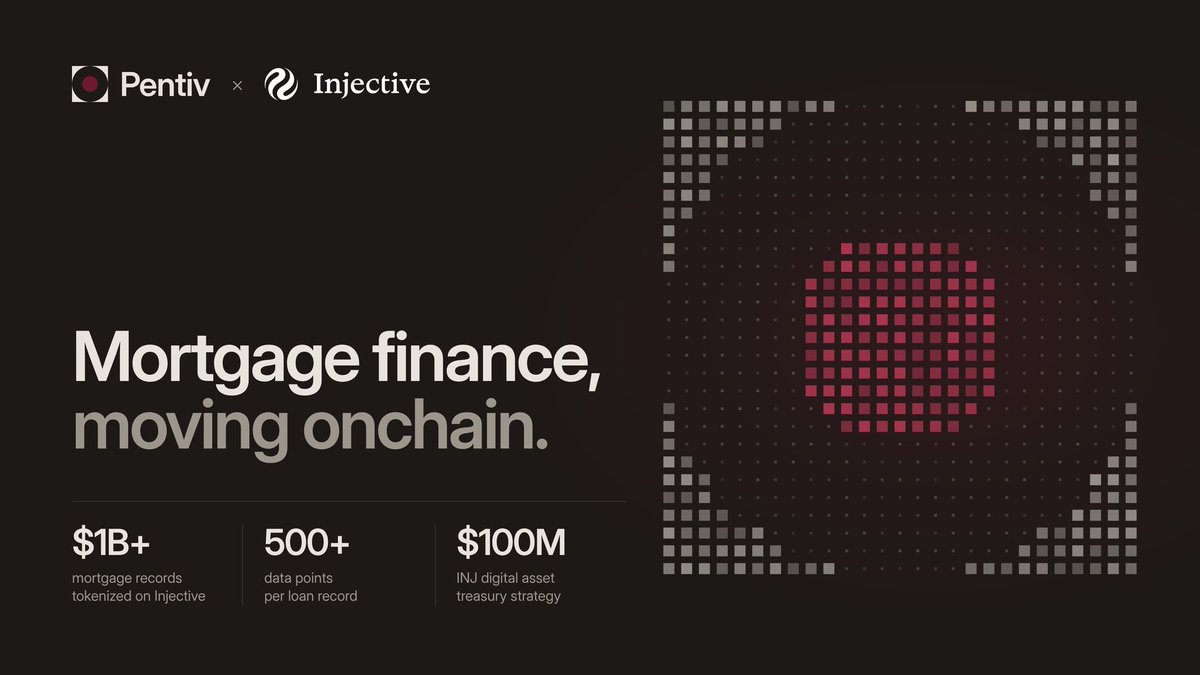
Pineapple is entering its next phase with pentivhq, building on more than $1B in residential mortgage records already migrated to @injective.
Let’s look at the progress:
• $1B+ in mortgage records: More than $1 billion in residential mortgage records have been moved onchain.
• 500+ data points per record: Each record contains detailed loan data that can support verification, risk analysis, and reporting.
• $INJ treasury: Pentiv completed a $100M private placement in 2025 to establish its $INJ treasury and has staked its $INJ holdings on Injective.
• Staking income: Pentiv reported around $399K in staking income during Q3 FY2026.
• More integration ahead: The long-term plan includes bringing Injective into mortgage data, servicing, and settlement workflows.
The opportunity is huge. US household mortgage balances reached $13.1T in Q2 2026.
For me, the key is that this goes beyond putting mortgage records onchain. The next step is connecting that data to real financial workflows.
More records, more use cases, and deeper institutional integration. That’s how onchain finance can grow. $INJ
Injective is making real-world asset trading a core part of its onchain markets.
135 RWA perpetual markets now make up 47% of @injective active perp markets.
These markets cover a wide range of assets:
- Equities: Apple, Tesla, Nvidia, Amazon, and more.
- Forex: EUR/USD, GBP/USD, USD/JPY, and other currency pairs.
- Commodities: Gold, WTI crude oil, and Brent crude.
- Indices and pre-IPO assets: Exposure to market indices and companies before they go public.
These perpetual markets let users trade price movements without owning the underlying assets.
They also bring traditional market exposure into an onchain environment.
Injective RWA perp markets have processed over $5.3 billion in cumulative trading volume since early 2025, with monthly volume reaching around $210 million in August 2026.
For me, the key point is that RWAs are no longer just an extra feature on Injective.
They account for nearly half of its active perpetual markets.
Traditional market exposure is becoming a bigger part of onchain finance, and Injective is building the infrastructure to support it.
$INJ
Injective is bringing real estate data and AI powered operations further onchain.
Pentiv, the new operating brand of Pineapple Financial, plans to tokenize its entire $10B+ mortgage portfolio on @injective and bring its AI-driven operations onchain using $INJ.
The work is already underway.
More than $1B in mortgage records, covering around 2,079 loans, had been brought onchain by September 2026.
One important detail: these are onchain records linked to existing mortgage files, not $1B worth of newly issued mortgage-backed securities.
The next step is expanding this effort across the full portfolio while using AI agents to improve mortgage workflows, from agent recruitment to loan renewals.
This is an interesting combination of traditional finance, blockchain infrastructure, and AI.
Injective isn’t just focusing on trading anymore; it’s also building ways to bring real-world financial data and operations onchain.
The full migration is still in progress, but the scale of the plan makes this one worth watching.
Can onchain infrastructure and AI make traditional mortgage operations more efficient?
There are two ways to get exposure to $INJ, but they serve different purposes.
Hold $INJ directly or invest through the proposed INJC ETF.
Holding $INJ directly gives you more control. You can stake your tokens, vote on governance, and use $INJ across @injective onchain apps.
You can also manage your own wallet and choose a validator.
INJC offers a different approach.
Canary Capital proposed Staked $INJ ETF is designed for people who want $INJ exposure through a traditional brokerage account without managing wallets, private keys, or staking themselves.
The fund plans to hold spot $INJ and stake most of its holdings.
Net staking rewards would be reflected in the fund’s value rather than paid out as cash.
But there are important differences.
INJC shares would trade during stock market hours, while $INJ trades 24/7. ETF shares cannot be used in Injective apps, do not provide governance voting rights, and cannot be redeemed directly for $INJ.
Also, one INJC share does not equal one INJ. Its price can differ from the value of its underlying holdings, and fees can affect returns.
The key difference is control versus convenience.
Holding $INJ directly gives you access to the Injective ecosystem, while an ETF could offer a simpler way to get price exposure through traditional markets.
INJC still needs the required regulatory clearance before it can launch.
Both options connect to $INJ, but the right choice depends on what you want to do with it.
Injective brought Wall Street, institutional finance, and onchain builders into one room in Seoul.
At Korea Blockchain Week 2026, @injective hosted "The New Financial Era: Seoul," a side event bringing together voices from the Federal Reserve System, LG CNS, Coinbase, SMBC Nikko, BitGo, and other parts of the financial industry.
The discussions focused on tokenization, stablecoins, real-world asset value chains, and the regulatory questions that come with moving financial activity onchain.
This connects directly with Injective’s work in Korea.
The POSCO International and LG CNS pilot, for example, explores tokenizing trade receivables, showing how blockchain infrastructure can be tested for real financial processes rather than just crypto-native applications.
Getting institutions in the same room is only the first step.
The real progress comes when these conversations turn into working products, live pilots, and actual onchain activity.
Injective is building for that transition, connecting financial institutions with infrastructure designed for tokenized assets and digital markets.
$INJ
Injective hosted one of the largest events during Korea Blockchain Week 🇰🇷
Leading speakers from the Federal Reserve, LG, @coinbase and more joined us on stage to map out the next era of digital assets.
Together, we will keep bringing global institutions onchain with $INJ
Injective, $INJ, and the proposed $INJC ETF each play a different role in the ecosystem.
@injective is the network that provides infrastructure for onchain financial markets and applications.
$INJ is its native token, used for transaction fees, staking, and governance. Staking also helps secure the network.
The proposed Canary Staked $INJ ETF aims to give traditional investors exposure to $INJ without requiring them to manage crypto wallets.
It plans to hold actual $INJ and stake at least 90% of its holdings under normal conditions, with the goal of combining $INJ price exposure with staking rewards.
Investors would buy ETF shares through a brokerage account rather than hold $INJ directly.
That means they could gain investment exposure but wouldn’t be able to use those shares to stake tokens themselves or interact with Injective apps.
The product still requires regulatory approval, and returns would depend on $INJ price, staking performance, and fund expenses.
If approved, it could open another route for traditional investors to access $INJ while keeping ETF ownership separate from direct participation in the Injective ecosystem.
Injective is building a path for traditional financial assets to move onchain.
@injective Institutional Services, is now officially registered with the SEC as a transfer agent.
Transfer agents keep official records of who owns securities and handle ownership changes and related tasks.
This adds another layer to Injective tokenization tools.
With Injective Mint, businesses can create digital assets and set rules for who can hold, transfer or redeem them. The network can then support trading and settlement.
There are already real-world developments behind this work.
POSCO International and LG CNS selected Injective for a live trade-finance pilot using real receivables.
More than $1 billion in mortgage records has been tokenized, while Pineapple Financial plans to bring over $10 billion in assets to the network.
Gulf Labs is also live as an institutional validator and exploring tokenization and stablecoins.
The important part is how these pieces fit together. Issuing a token is only one step.
Financial institutions also need clear ownership records, transfer controls and a way to settle transactions.
SEC registration does not mean every asset on Injective is SEC-approved, but it adds an important part to the network’s plan for regulated onchain finance.
$INJ