I’m in Rome this week for AGS!
Come find the @Vibelets_ai at Stand H2-2179. Connect with us and you’re in the draw to win an iPhone.
Stand H2-2179 · Rome, Italy
2–5 Nov 2026: https://t.co/DnwOpeJypo
If you’re here, come say hi.
@Vibelets_ai is heading to Rome for Affiliate Grand Slam.
📍 Hall 2, Fiera Roma
🗓 2-5 Nov 2026
Stop by our booth and see how Vibelets can sharpen your ad strategy and help you win more of your spend back.
Want a demo or a meeting with the team? Book a slot: https://t.co/obvXA9lpXj
Coming to Rome? Comment below and we'll find you.
Everyone will quote @AnthropicAI 's revenue line. Read the loss line too.
Even the company selling the AI is paying a fortune for compute.
If your growth stack assumes Claude stays this cheap forever, plan for the day it doesn't.
@benradack $50k/mo, by a mile.
At that spend every test is your call, so you see why something worked.
At $5m/mo the system makes most of the decisions. You learn risk management, not creative.
Best buyers I've worked with spent a couple of years small before touching big budgets.
Impossible to spot isn't the bar. Fatigue is. When half a category pulls from the same avatar library, the face stops being new and hook rate decays. Judge it on week 3 hold rate, not week 1.
AI UGC is officially impossible to spot.
the people watching your ad won’t question it. they’ll just keep watching
while you’re still waiting on a creator’s first draft, AI already gave you 10 versions to test
the brands using this aren’t talking about it. they’re just running way more ads than you.
just check this:
10M advertisers on the same AI creative tools.
I've seen this movie. 2016 everyone got lookalikes. 2022 everyone got Advantage+. Once everyone has the lever, it stops being the edge.
The edge moves to the inputs: the offer, the product photo, the angle.
META $META CFO SAYS NEW AI BUSINESSES CAN BEGIN CONTRIBUTING INCREMENTAL REVENUE IN 2027
On the earnings call, the CFO said:
• Nearly 10M advertisers used at least one of Meta's generative AI ad creative tools in Q3
• Advertiser adoption of its video generation features grew 25% from the prior quarter
• Muse's compute intensity means expanding its user base will require significant investment, and Meta expects total serving costs to rise
The line ad buyers should sit with: Meta now ranks Reels as sequences, not one at a time. Your ad gets judged against the organic video right before it. Your hook isn't competing with other ads anymore. It's competing with the feed!!
Here are most of, not all, the interesting stats I pulled out of Meta's Q3 2026 call:
10M people in the US and Canada have set up Muse personal agents.
25% of them use it on any given day. Zuck: “more than twice the level that Threads started at, or where we believe other AI apps started as well.”
The most common use case is shopping. More than a quarter of Muse users are doing it, average purchase size over $200.
“Plaid told us that they hadn’t seen activity like they’re seeing with their connector on any other service before.”
Family of Apps revenue per existing US user is already “several hundreds of dollars annually,” and Zuck expects Muse to go higher “due to the amount of commerce that we already see taking place.”
The model: free for most people, with Meta taking a fee on transactions it facilitates overtime.
On cost: “Muse is very compute-intensive to run. But we expect to improve its cost efficiency by more than 10x in the next year, which will enable it to be profitable once the revenue lines are at scale.”
CORE BUSINESS
Family of Apps revenue $64.2B, +26%.
Ad impressions +10%. Average price per ad +14%.
Family of Apps Other revenue $1.1B, +59%, on WhatsApp paid messaging and subscriptions.
3.64 billion people use the family of apps every day.
Threads has overtaken X in monthly actives. Time spent per user on Threads +20% YoY.
Instagram global time spent per user hit an all-time high, up double digits.
Facebook Reels time spent hit all-time highs both globally and in the US, both up double digits.
Nearly 45% of recommended Instagram Reels are now less than a day old, up 11 points from Q2.
Ranking sequences of Reels instead of evaluating each one independently increased Instagram Reels time spent over 4%.
Moving content understanding onto first-party Muse models reduced per-unit processing costs by more than 80% across Instagram, Threads, Facebook and Ads.
Advertisers who adopted Meta AI business assistant recommendations drove almost 5% more conversions at the same cost per conversion, and increased their ad spend 9% versus non-adopters.
Simply Organic Maple, a family-run Vermont producer, used it to rewrite ad copy: +57% purchases, -36% cost per purchase, 3x ROAS.
Meta One has surpassed 15M subscriptions and trials across 50+ features.
An estimated 500M self-identified small businesses use Meta’s apps to reach customers.
Zuck: “We have not yet found the limit of how effectively we can apply compute to accelerating our own core business.”
A robot can't learn from a video it can't measure.
@Maniformer , the world’s leading physical AI data platform. Its new paper scores a person's hands to 4.29 mm of finger error and their head to between 0.65 and 2.83 mm, checked against a 26-camera motion capture lab.
Teaching a robot on a real robot is slow, because every hour of teleoperation uses a machine, an operator and an environment reset. Putting a camera on a person scales with the number of people instead, which is why egocentric datasets have grown from hundreds of hours to thousands.
But video only shows what someone did. To turn it into robot actions, you need the hand's 3D position in real units. The wrist path goes through inverse kinematics and the fingers get retargeted to the robot's hand, so supervision is only as good as the hand pose underneath it. The paper's complaint is that datasets carrying those labels were shot in studios or on prepared tabletops, and where labels are released, the accuracy is asserted from hardware specs instead of measured.
When I toured Maniformer's headquarters, the data collection centre showed the same problem from the other side. One room runs more than a hundred robots at once, and right beside them people in motion-capture suits perform the same tasks by hand so the robots can learn how a human moves. Maniformer's bet is to take the robot out of that loop.
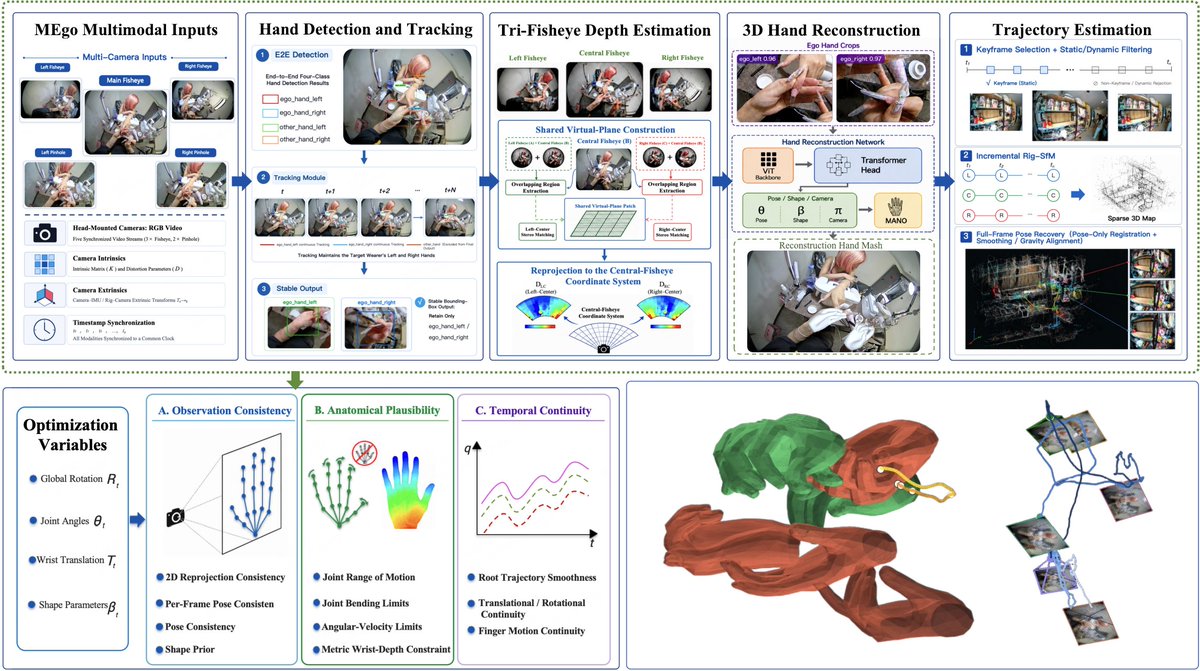
The system is called MEgoVista, and it runs on MEgo View, a head-mounted rig with fisheye cameras at 60 fps and an IMU sampled at 500 Hz. One unprepared recording goes in. Both hands and the head come out in a single gravity-aligned world frame. Three design choices carry it.
First, depth is measured instead of guessed. Most existing methods get depth from a single camera with a learned model, so scale is a prior that shifts from frame to frame, and the error sits along the viewing ray where reprojection can't correct it. Here the central camera pairs with each side camera, stereo runs across the wide baseline, and because that baseline is calibrated, the metre comes from the hardware. Scale is fixed once, at initialisation.
Second, it knows whose hands are whose. A detector decides at detection time whether each hand belongs to the wearer or a bystander. In the manicure clip the wearer's left hand touches another person's left hand, and both Dyn-HaMR and HaWoR credit the bystander's hand to the wearer. HaPTIC produced no valid output on the multi-person scenes at all. Dyn-HaMR's detection precision came out at 0.73, while MEgoVista scored 1.00 precision and 1.00 recall.
Third, it solves the whole sequence instead of frame by frame. A per-frame estimate can look plausible alone and still jitter, drift in depth, or pass through a pose a real hand can't make. MEgoVista optimises one hand trajectory across the full episode with limits on joint range and angular velocity, and lands at 1.11 mm/frame² of jitter against 3.50 for the smoothest baseline.
Then comes the scoring, which is the part I found most interesting. Everything was measured against a 26-camera, 120 Hz Chingmu motion-capture system. The protocol charges the method for any hand it declines to predict, and it screens the reference data itself for solver glitches before trusting it.
Finger articulation error is 4.2 mm, against 16.30 mm for HaWoR and 49.18 mm for Dyn-HaMR. Absolute wrist position error is 14.30 mm against 46.70 and 184.38. On head tracking, DROID-W suffered severe scale failures on 4 of 22 episodes and MASt3R-SLAM underestimated scale on 21 of the 22, while MEgoVista stayed within a few millimetres and ran about 3x and 3.5x faster on roughly 40 second episodes.
One honest note on that last comparison. ORB-SLAM3 was more accurate on one of the two capture sessions, 2.12 mm against 2.83 mm. On the other session MEgoVista won, 0.65 mm against 0.92 mm. The paper reports both, so I will too.
The other limit is where the millimetres were measured. They come from inside a motion-capture lab. In the wild there is no ground truth, so the evidence is visual: milk tea preparation with heavy hand occlusion, washing a pet with soiled hands, mold maintenance in industrial gloves, and a working restaurant. The authors also say any error left in the mocap hand reference is charged to their own system, and that slow drift in that reference would slip past their checks.
Maniformer says it has collected over 1 million hours of data and delivered the 20,000th MEgo device on August 31. If that scale holds, labels measured against a reference matter more than hours alone. The paper ends by saying it is undecided whether the next millimetre needs a better estimator or a better reference, which is a rare sentence for a company to publish about its own system.
Full paper: https://t.co/CWQxcWsmLj
@Hey_AsiiF Exactly! People often secure their social accounts but forget that email is the gateway to almost everything else. One compromised inbox can create a domino effect. 🔐
YOUR GMAIL IS THE MASTER KEY TO YOUR DIGITAL LIFE. 🔐
ONE HACK COULD PUT YOUR BANK, SOCIALS, AND OTHER ACCOUNTS AT RISK.
HERE’S HOW TO LOCK IT DOWN IN 10 MINUTES: 🧵
If this thread helped you, save it and share it with someone who needs to secure their accounts.
One small security step today could prevent a major headache tomorrow.
Follow me for more AI tips, tech updates, and practical cybersecurity advice.
7️⃣ Use a Password Manager for Every Account
Reusing the same password across multiple websites puts all those accounts at risk.
If one site gets breached, attackers may try that password elsewhere.
Here's how to stay safer:
→ Use Bitwarden, 1Password, or Dashlane
→ Generate a unique, strong password for every account
→ Store your passwords securely
→ Enable 2FA wherever possible
Never rely on one password to protect everything.
One account gets breached. Don't let the rest fall with it.