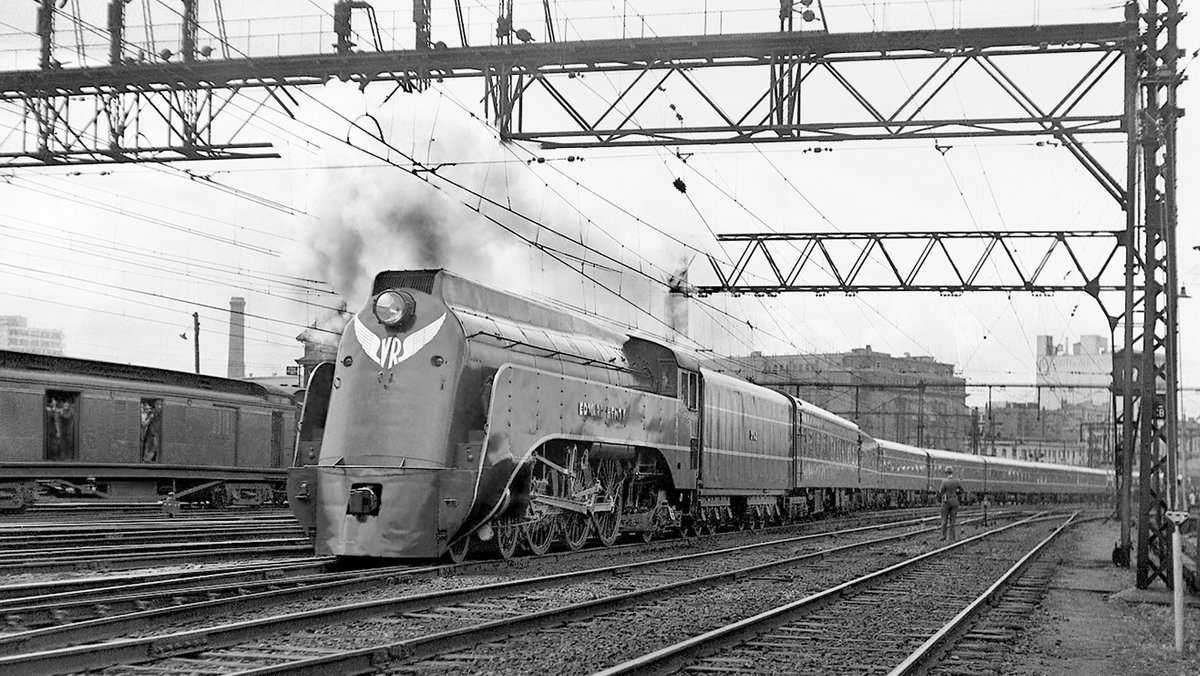
Victorian Railways streamlined 3-cylinder S class 4-6-2 Pacific No. 302 'Edward Henty' departing Spencer Street, Melbourne with the ‘Spirit of Progress' - the first all steel, streamlined air-conditioned train in the Southern Hemisphere and British Empire. 📷 Victorian Railways.
The spire at the right is the Conregation Church (now St Michael's) finished in 1866, the one immediately to the left is Scots, not finished until 1874. They are actually about the same height, but looks like the artist has added it later. Same architect. Both beautiful. See Wikipedia.
Thanks Mark. Yes, I am one put off by that term and it's baggage. This makes it refreshingly clear. I have long rejected revisionism, it's about time all the churches should. Next time in Jerusalem, worship at Christ Church in the Old City. We sang 'Hosanna' there only a few hundred metres from where it was first shouted. I wonder if Jesus will call there one day?
I can think of others deserving deportation first, but Prods we're here first. Having worked in Saudi Arabia for a month where there is no visible church, I would attend any Christian church that holds to the Nicene Creed. They say "when you find the perfect church, it won't be after you join!,"
@CoenKrom Union Pacific engine terminal at Laramie circa 1943. Locomotives include 4-6-6-4 Challengers, a 9000 class 4-12-2 Union Pacific, and probably a 4-8-8-4 Big Boy in the foreground. This photo was used in Wartime advertisements by the UP.
South Australian Railways 900 class diesel-electric No.902 and sister engine (Islington-English Electric, 1951) accelerating through Mile End with a second division of the 'Overland' for Melbourne in the summer of 1951-52 (note the open car windows). The first mainline diesel-electrics in Australasia, the 900’s were powered with an English Electric 16-SVT engine similar to that used in Britain’s first mainline diesels, but with a car-body inspired by the Alco PA series.
London Midland & Scottish Railway 4-6-0 No.6100 'Royal Scot' (LMS Derby, 1930 as 6152) in the Fraser Canyon, a few miles below North Bend, B.C., on the Canadian Pacific Railway. 28th October 1933. In Vancouver the CPR fitted a wooden cowcatcher and dubious officials wanted to provide an assisting engine, but Driver William Gilbertson would have none of it and stormed the mountains unassisted.
Union Pacific 4-6-2 Pacific No.3130 leading a eight car Train No. 101 through the snow near Denver, Colorado. 2nd December 1928. (Denver Public Library OP-18258) 📷Otto Perry
Compagnie des chemins de fer de l'État 231-501 class 4-cylinder de Glehn compound 4-6-2 Pacific No. 231-613 departing Gare de Saint-Lazare, Paris, with a passenger train in September 1927. The mécanicien watches Otto while smoking a Gauloise. (Denver Public Library OP-20551). 📷Otto Perry
Compagnie des chemins de fer du Midi 4-cylinder compound 4-4-0 ‘Outrance’ No. 1760 (Schneider, Le Creusot 1896) at Carcassone, France, 2nd October 1927. Some background edited out. (Denver Public Library OP-20555). 📷 Otto Perry.
Japanese National Railways cleaners shining safety valves of a D52 class 2-8-2 Mikado by hand. Itozaki Locomotive Depot, Honshu. 23rd January 1960. Source: 鉄路100万キロ走行記発行者著者宇田賢吉山田国
The Société des Ateliers d'Aviation Louis Breguet (Breguet Aviation) obtained a licence to build the Short ‘Calcutta’ flying boat, and went on to enlarge and improve the design as the Br.530 ‘Saigon’. The first, F-AMSV ‘Algérie’, entered service with Air France on its Mediterranean services in January 1935 and was joined by F-AMSX ‘Tunisie’ in April 1936. The Marseille-Algiers flight was flown in 3hrs 45 min at 209 km/h. The Saigon had an enclosed cockpit for two crew and a three compartment cabin for 20 passengers; eleven in second class forward, six in first class amidships and two or three in a luxurious lounge aft. Further back were the toilets and baggage hold. They were powered by three 785 hp Hispano-Suiza 12Ybr liquid-cooled V-12 engines and operated until the outbreak of war in September 1939. Edited - clouds added.
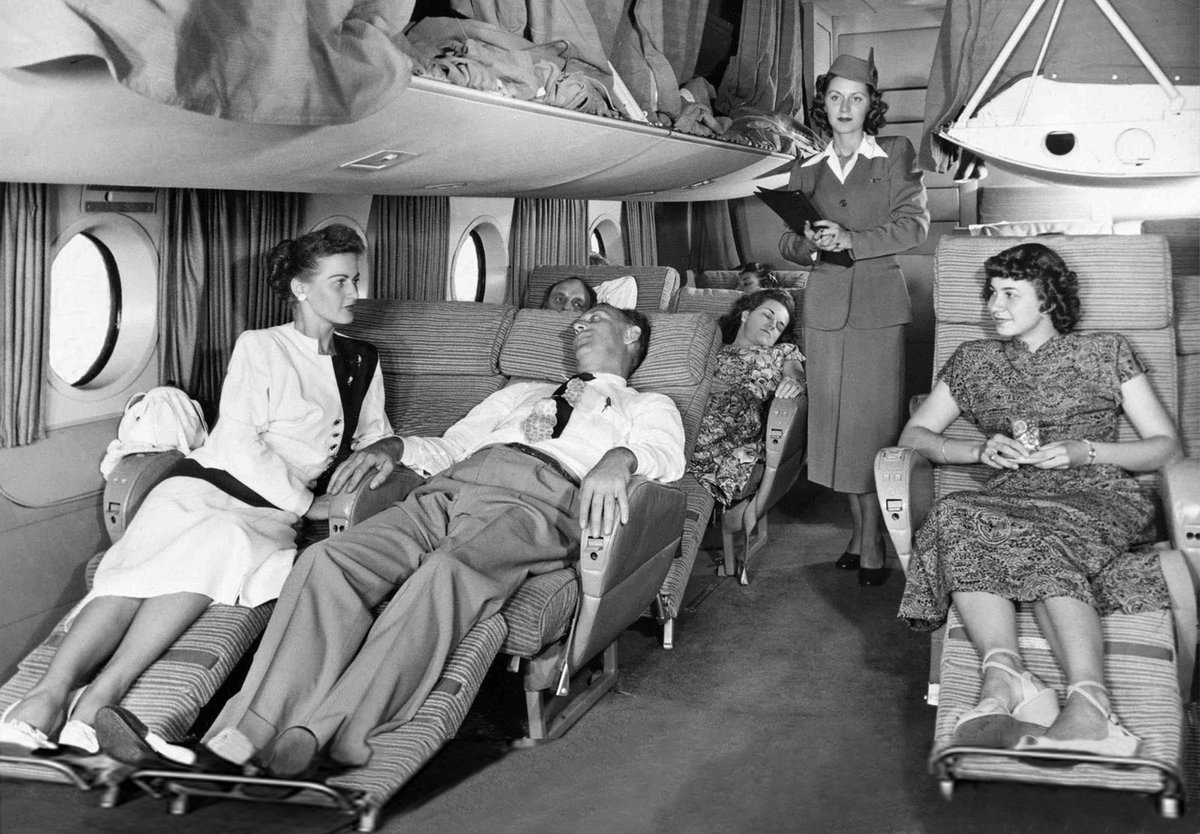
Pan American World Airways new Boeing B-377 'Stratocruiser', which introduced the all First Class President service across the North Atlantic in April 1949. Sleeping berths were provided, and can be seen lowered above the reclining seats. The service catered for about 60 well-heeled passengers and stopped enroute at Gander, Newfoundland for refuelling.
Not as good as it looks. Open section Pullman's were tried in New South Wales, and were 'stuffy' at night. Only curtains between your sleeping berth and the common passageway. Tobacco smoke, body odour and chamber pots, loud talk, grunts and worse . No place for ladies. Australia adopted the Mann Boudoir car in 1887 - vastly superior.