El padrino de la inteligencia artificial: "Si duermes bien esta noche, puede que no hayas entendido esta conferencia".
Esta conferencia de 47 minutos es lo mejor que he visto sobre inteligencia artificial en los últimos meses.
Definitivamente te ayudará a entender cómo funciona realmente y hacia dónde se dirige.
Geoffrey Hinton construyó las redes neuronales que hay detrás de cada inteligencia artificial actual y luego dejó Google para advertir al mundo sobre ello.
La parte que nadie quería escuchar:
La inteligencia artificial ya está desarrollando habilidades que sus creadores no tenían previstas.
En la mayoría de las tareas cognitivas ya está por delante de nosotros.
La pregunta ya no es si nos superará, sino cuándo.
La única decisión que queda es de qué lado de esa línea te encuentras.
Ahora mismo, la persona promedio abre Claude, escribe algo, obtiene una respuesta y cierra la pestaña.
Creen que están utilizando inteligencia artificial. Quizás estén usando un 10% de ella.
Repasé toda su conferencia y construí conceptos prácticos a partir de lo que estaba describiendo.
La brecha no estará entre las personas que usan inteligencia artificial y las que no.
Estará entre las personas que la entienden y las que no.
Empieza hoy con estos 20 conceptos de inteligencia artificial.
Not a lot of people understand this... but you actually don’t have to have an opinion about everything. You don’t have to decide if something is good or bad. Marcus Aurelius says limiting the amount of opinions we have is one of the most powerful things we can do in life.
Te vamos a contar los SECRETOS de ingeniería y desarrollo de software.
El equipo de ingeniería de Platzi está creando una serie de artículos donde enseñan cómo construir software de talla mundial.
Léelos aquí 🚨👇
Tu esposa y un buen abogado te pueden quitar esa casa, ese carro, esa finca y hasta tu tranquilidad. Pero jamás te podrán quitar tus conocimientos y habilidades. Nunca pares de aprender: @platzi@freddier@cvander
Kafka Architecture Explained In A Nutshell :
- Producers: Send data (logs, events) to topics.
- Topics: Categories for storing and publishing data streams.
- Consumers: Subscribe to topics and process incoming data.
- Partitions: Scalable units within a topic for concurrent processing.
- Brokers: Manage message storage and delivery across a cluster for fault tolerance.
- Replicas: Backups of partitions to prevent data loss.
- Zookeeper: Oversees the cluster, tracking topics and nodes.
- Push/Pull: Producers push data, and consumers pull at their own pace.
--------------------------------------------------------------
Credit: Hina Arora
How does HTTPS work?
Hypertext Transfer Protocol Secure (HTTPS) is an extension of HTTP that utilizes Transport Layer Security (TLS) to encrypt communication between a client and server. Any intercepted data will be unreadable and secure from tampering and eavesdropping.
What's the process for encrypting and decrypting data?
Step 1 - The journey begins with the client (like your browser) establishing a TCP connection with the server.
Step 2 - Next comes the “client hello” where the browser sends a message containing supported cipher suites and the highest TLS version it can handle. Cipher suites are sets of algorithms that typically include: a key exchange method to share keys between devices, a bulk encryption algorithm to encrypt data, and a message authentication code algorithm to check data integrity.
The server responds with a “server hello”, confirming the chosen cipher suite and TLS version that they can both understand. The server then sends a TLS certificate to the client containing its domain name, certificate authority signature, and the server’s public key. The client checks this certificate to validate it is trusted and belongs to the server.
Step 3 - Once the TLS certificate is validated, the client creates a session key to be used for encrypting the bulk data transfer. Bulk data transfer refers to the transmission of the actual application data between client and server once the secure TLS connection is established. To securely send this session key to the server, it’s encrypted with the server’s public key. The server, with its private key, is the only one who can decrypt this encrypted session key.
Step 4 - Now that both parties have the secret session key, they shift gears to symmetric encryption. It’s like they’ve agreed on a private language that only they understand. This makes the data transfer very secure. Symmetric encryption is much faster for large amounts of data.
–
Subscribe to our weekly newsletter to get a Free System Design PDF (158 pages): https://t.co/kNfv0DVDdf
El Storytelling es algo increíblemente poderoso.
Pero la mayoría de la gente lo hace mal.
Sigue estos 12 principios y te garantizo que la gente te dará su atención:
Mi Lobo
La ciberseguridad es uno de los campos mejor pagados en TI🛑.
Aquí tienes 7 cursos GRATUITOS si quieres hacer carrera en ciberseguridad🚀:
HILO 🧵
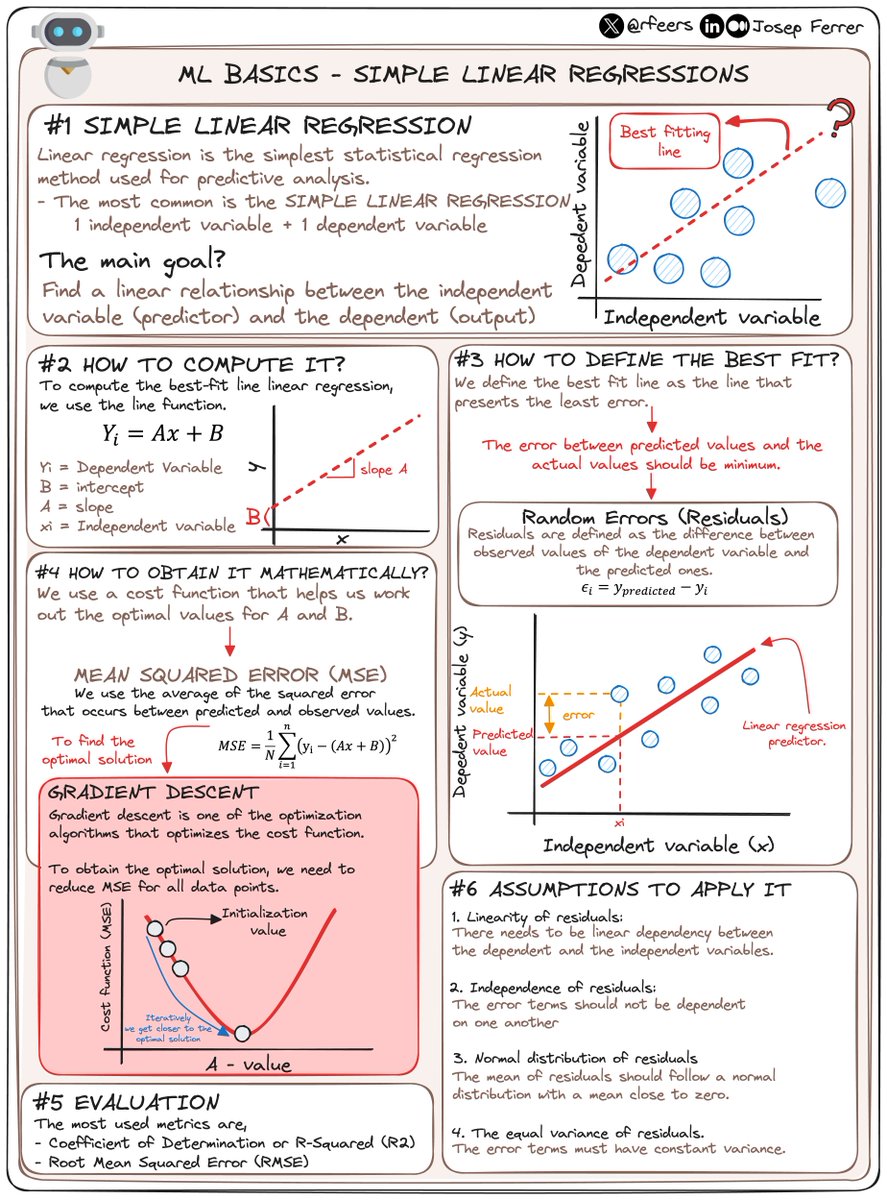
Struggling with Machine Learning algorithms? 🤖
Then you better stay with me! 🤓
Today I am starting a new series of threads to simplify ML algorithms.
...and Linear Regression is the first one! 👇🏻
Uno de mis temas favoritos es conocer como se crearon las empresas que mantienen nuestras apps favoritas, pero no desde el punto de vista técnico o motivacional
Sino saber los altibajos, retos y dudas por las que pasaron para llegar al día de hoy
Estos son mis 5 libros top 🧵







![readswithravi's tweet photo. 25 Must-Read Nonfiction Book's Visual Summary:
[A Thread] 🧵
1) The Psychology of Money by Morgan Housel](https://pbs.twimg.com/media/GLAveM0WkAA5HPk.jpg)