In the same fortnight, Amazon did two things that look contradictory and are not.
At UnBoxed it rebuilt its ad platform around AI agents that read behavioral signal and allocate advertisers' spend against it. Days later it blocked Meta's Muse, a shopping agent that fills forms, negotiates and checks out on a consumer's behalf. Shopify let Muse in. Amazon told Retail TouchPoints the decision was about openness and security.
So: build agents that distribute demand inside your own walls. Block agents that would distribute it outside them.
That is not hypocrisy. It is a precise statement about where the value sits. The agent is a layer anyone can build, and everyone is building it. The value is the behavioral data the agent needs to be any good, and the relationship it would otherwise intermediate.
CI&T's Melissa Minkow reported survey data from 1,011 U.S. consumers: 74% have used an AI agent while shopping. Only 27% are comfortable letting one handle the full purchase.
That gap is the whole story. Consumers have tried agents as a research tool and refused them as a wallet. Trying is not the same as surrender.
And there is a finding nobody is quoting. Neither analyst expects Gen Z to lead; both put millennials first, and Bain's Aaron Cheris adds that trust in AI has slipped since last fall, driven by younger, early-adopter users. The people closest to the technology are the ones backing away from it. The entire agentic commerce forecast rests on an assumption about young people that the people surveying young people do not share.
The two differ on what to do. Minkow puts the burden on discoverability. Cheris sets a harder test: a defensible claim to being best on at least one criterion that matters, because being second or third on everything puts you in no man's land.
Both can be right. Only one is a position a competitor cannot copy by next quarter. Agents just make the cost of being merely competent visible faster.
https://t.co/U2lL0awyKl
At UnBoxed last week, Amazon rebuilt its advertising platform around AI agents. The agent recommends which formats to buy, from upper-funnel streaming to lower-funnel search, and allocates spend against a goal. It is a real advance.
@ADWEEK reported the reaction from the buy side, and it was not enthusiasm. It was a question about transparency. Zachary Ricchiuti at Kepler, who sees real uses for these agents in planning and research, compared it to Performance Max and said the job of a brand and agency is to be skeptical of a black box. The concern is that advertisers lose visibility into which audiences are actually being bought.
That is a fair concern, and it belongs to the people buying the media. If you run a brand rather than a media plan, there is a different question waiting underneath it.
Here it is. If every advertiser in a category optimizes with the same agent, against the same signals, inside the same auction, what happens to performance?
It converges. Not to a dead heat, and not quickly. But an allocation engine that beats your team also beats your competitor's, and the moment both of you run one, the edge each of you bought cancels out in the auction you share. The tooling becomes extraordinary. The advantage it confers over the brand next to you gets thinner every year, because they bought the same extraordinary tooling.
And when efficiency equalizes, what is left?
Preference. Whether a household reaches for your brand before it compares. Preference is the one thing an allocation engine cannot produce, because allocation operates on demand that already exists. It finds the people who are already in the market and reaches them more cheaply. It does not create the reason anyone wanted the thing.
Kantar Millward Brown's BrandZ analysis (2018) put numbers on where that reason comes from. Creativity alone: +69% brand value. Disruption alone: +123%. The two together: +154%. Those are not media efficiency gains. No allocation engine produces any of them.
Which is the uncomfortable part. The agent will make you excellent at the layer that is about to be table stakes, and it will not touch the layer that separates you.
The better agents get at distributing demand, the more valuable it becomes to own something worth distributing.
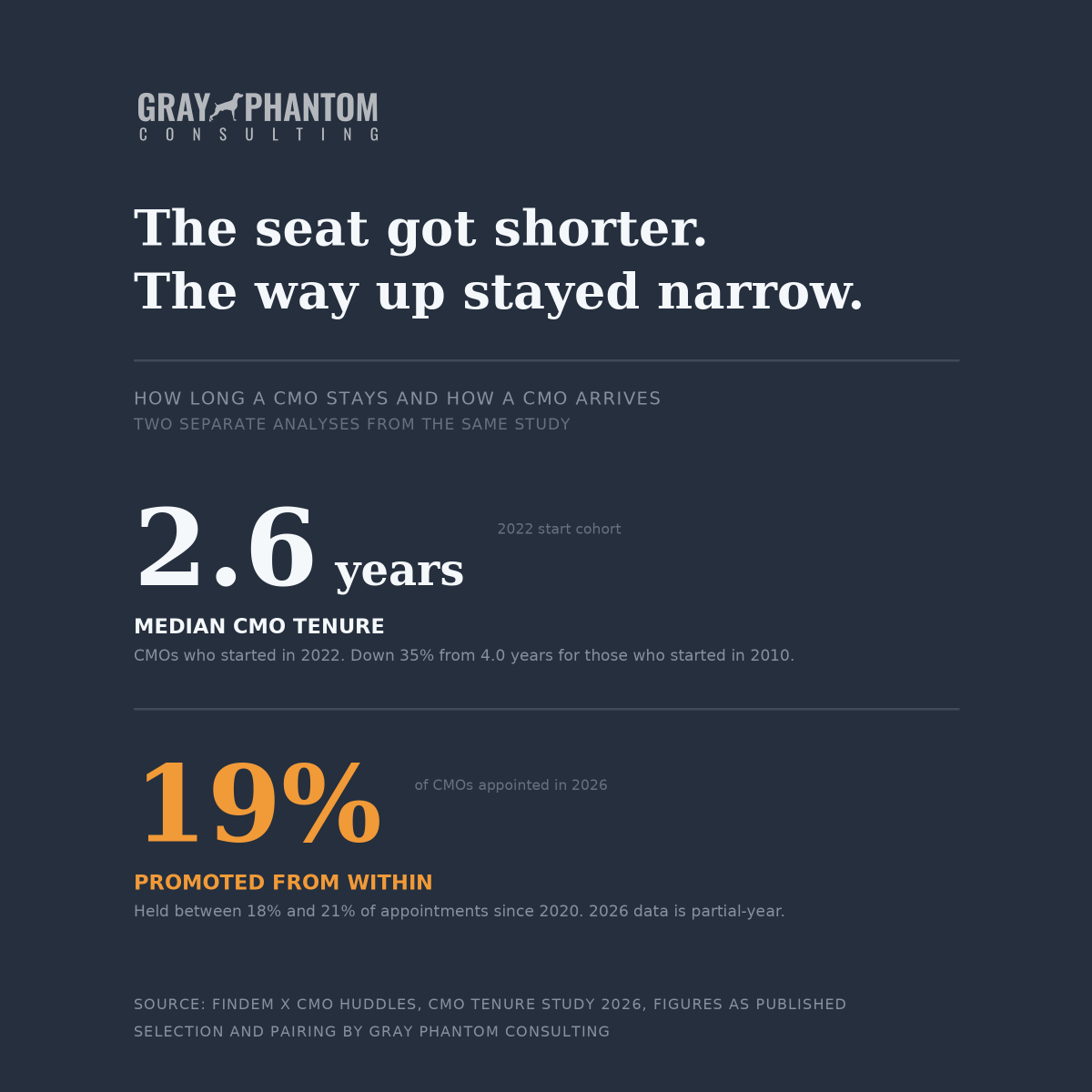
About one in five new CMOs is promoted from within. That share has barely moved since 2020.
The number is from Findem and CMO Huddles: among CMOs appointed so far in 2026, 19% were promoted internally, and the share has held between 18% and 21% since 2020. Sixty percent of them are first-time CMOs, so people still reach the seat. Most were not promoted from within.
So this is not a crisis arriving. It is a narrowness that has been there for years. What is new is on either side of it.
Above it, the seat turns faster. The same study grouped CMOs by the year they started: a median tenure of 4.0 years for those who started in 2010, 2.6 years for those who started in 2022. A 35% decline. It is a median; half stay longer.
Below it, Gartner's prediction for 2030: AI will allow the majority of high-performing marketing teams to eliminate the bottom rungs of the career ladder. Note the verb. Allow. That is a permission, not a fact.
Put the three together and it is an institutional memory problem. A strategy that needs three years to prove itself will, more often than not, outlive the CMO who approved it. Not because it failed. Because the approver left. And four times in five, the successor was not promoted from within, and arrives without the reasons.
Which means we are quietly selecting for a specific kind of marketing: work that shows a readable result before the approver leaves. Everything structural, everything compounding, everything that looks like underperformance in year one and like an asset in year four, is being filtered out by an org chart rather than by a business case.
Gartner's recommendation is to redesign entry-level roles rather than remove them: hire for judgment, move juniors to higher-value work earlier, and develop them through coaching and mentorship from experienced colleagues. That is right and it is not enough. The third part depends on those colleagues still being there. Judgment compounds in people who stay.
The strategy remains. The reasons leave with the person who approved it.
Sources:
https://t.co/iPhZRpfVTh
https://t.co/Rtp2jm5Rcm
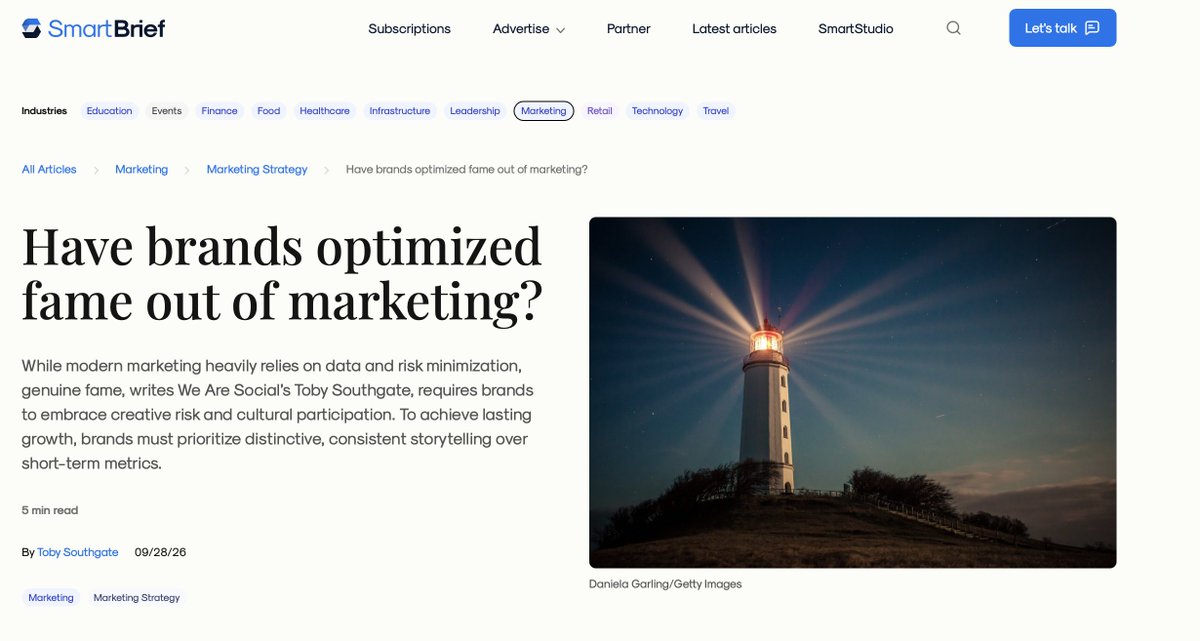
A firework is the most predictable thing in the sky.
You know exactly what it will do, exactly when, and that it ends. Toby Southgate uses it as his image for the unpredictable spike, the flash of fame that burns out, and argues brands should aim to be lighthouses instead. He is right about the lighthouse. But the metaphor turns on him, because a firework is not a failure of nerve. It is a schedule.
That is the actual problem, and it is not that the industry avoids risk. It is that an industry that promises surprise manufactures it by looking backward. Optimization can only learn from what already happened. A consumer who expects to be surprised and delighted, who expects the system to reflect where their life is going, gets served the most statistically reliable version of where it has been. The output is a firework: bright, scheduled, gone.
And there is a second thing the industry gets wrong, which the data has already settled.
Kantar BrandZ ran the numbers across twelve years, 3.6 million interviews, 122,000 brands, 51 markets. Creativity alone: +69% brand value. Disruption alone: +123%. The two together: +154%. All three, with great advertising: +265%.
The jump is not in any one of them. It is in the combination.
The industry has all three ingredients. It buys creativity, it funds disruption, it produces advertising. It just runs them as separate line items, on infrastructure built for a consumer who no longer exists, in a market so saturated that each one alone barely clears the noise. Then it pays for all three and wonders why the recall is thin.
Southgate's answer is to tolerate more risk and trust your creatives. That is the one sentence a marketing director cannot take to a CFO.
The better answer is not more nerve. It is combination, and the discipline to open space nobody is competing for rather than buying a louder position in space everyone already occupies.
Fireworks are scheduled. Lighthouses are built.
Víctor Luis Pérez
Gray Phantom Consulting LLC
"AI was never trained on ads." In the auction, money buys the position. In the model, it buys nothing. The incentive to build something else is no longer philosophical. It's commercial.
By Mrunal Bhagat via @MarketingWeekEd
What it structurally cannot reward: innovation, disruption, the ability to surprise someone. A model trained on what converted yesterday can't score what nobody has seen. Novelty always loses on day one.
"AI was never trained on ads." In the auction, money buys the position. In the model, it buys nothing. The incentive to build something else is no longer philosophical. It's commercial.
@MarketingWeekEd
What it structurally cannot reward: innovation, disruption, the ability to surprise someone. A model trained on what converted yesterday can't score what nobody has seen. Novelty always loses on day one.
Simple ideas, where efficiency and effectiveness stop taxing each other.
Keep the one idea that needs no one else to run it, and start it today. Everything else is overhead.
The full case is Paul Thornton's, in SmartBrief.
https://t.co/qQS5EnPuBo
In 2021, Amazon was the most valuable brand in the world. Kantar BrandZ had it at No. 1, $684 billion. In Kantar's 2026 ranking, Amazon is fourth, the same position it held in 2023, 2024 and 2025.
Not because the brand stalled. Value dipped to $468.7 billion in 2023, then more than doubled, to $1 trillion in 2026, well past where it started. In July 2026, Fortune named Amazon the largest company on earth by revenue, the first time any company has taken that spot from Walmart in over a decade. It is still fourth, because Google, Apple and Microsoft compounded faster.
Nor is it an investment gap. Amazon's own annual report puts advertising and promotional costs at $23.5 billion in 2025, up from $21.4 billion in 2024 and $20.3 billion in 2023. The money went up every year the rank stayed flat.
The money is not the constraint. The instruments it is spent through are.
Every instrument in the marketing stack sits on a single axis, and that axis has a limit nobody has engineered around: earliness and precision pull against each other.
The tools that reach people before intent forms are coarse. Demographics, segments, lookalikes, propensity models. The tools that are precise and individual only work once intent already exists. Search, cart, history, retargeting.
More budget improves the second kind. So does better creative, better personalization, better measurement. All of it buys effectiveness and efficiency along that one axis. None of it buys earliness and precision together.
The part of the customer relationship that forms before intent is the part no dashboard reports. Nothing measures it, so nothing shows when it moves. That is where drift begins.
Which is the question I would be asking at No. 1, not at No. 4. Is the work to run the current system better, or is there a second axis nobody has built an instrument for yet?
Amazon just took the No. 1 spot on the Fortune Global 500, after Walmart held it for over a decade. The line that stayed with me wasn't about scale.
Asked what actually threatens the company, Bezos doesn't say Walmart, and he doesn't say the AI race. He says the day Amazon stops obsessing over customers and starts making short-term trades.
Call it drift. It never announces itself. It arrives slowly, while the numbers still look fine. Every company that lost its way lost it in exactly that order.
So the question I'd be asking at No. 1 isn't how to get bigger. It's what Amazon would have to build to catch the drift while it is still small.
Wellness behavior is up. Wellness spending is down. Same survey, same year.
VML Intelligence asked 15,639 adults across 16 countries in 2025. 44% say they are listening to their body more than a year ago. 42% are exercising more. 41% are prioritizing sleep.
Then the spending. VML's net measure subtracts the people cutting back from the people spending more. On that measure, wellbeing sits at negative 8%. Beauty and grooming at negative 15%.
The obvious reading is that people found free substitutes. Sleep costs nothing. Neither does walking outside, or ten quiet minutes. And most of what they report doing more of is exactly that.
But that is a statement about what is currently for sale. It is not a statement about what people want.
A category measures what it sells. Units, baskets, conversion, repeat rate. When those move down, the conclusion is that demand is softening.
The behavior says otherwise. Demand is not softening. It is rising, and moving somewhere the instruments cannot see.
That gap has a cost. A category that sees decline in its own numbers, and concludes people want less of what it sells, will build the wrong thing next year. It will keep optimizing an offer against an audience that has already moved.
Call it drift. It never announces itself, because the instrument that would catch it is pointed at the transaction.
Which may explain a third finding in the same study. 76% say very few brands stand out as different, that they are all pretty much the same. If everyone measures the same layer, everyone optimizes toward the same answer. Sameness is not a failure of imagination. It is what happens when every company is looking at the same dial.
Both conclusions sit inside one dataset. Which one a business acts on depends on where it chose to point the instrument.
The global sleep economy was worth $84.6 billion in 2024. It was also worth $585 billion in 2024. Both numbers are published. Neither is a typo.
Emergen Research put the sleep economy at $512.8 billion in 2022. In a July 2025 release, the same firm put it at $84.6 billion in 2024. On its own report page, it puts it at $615.95 billion in 2025.
Same firm. Same category name. A figure that falls by a factor of six, then rises by a factor of seven, across three consecutive publications.
Research and Markets has the sleep market at $61.83 billion in 2024. Statista and McKinsey put it at $585 billion the same year. Grand View has mattresses alone at $46.48 billion.
The explanation is scope, not error. Narrow measures count mattresses and bedding. Broad ones count supplements, wearables, apps, pharmaceuticals, sleep clinics, hotel sleep programs and white noise machines. Every firm draws the boundary somewhere different, and none of them says so in the headline.
A company entering this category has to pick a figure, and the one it picks sets the size of the opportunity it thinks it is chasing. Smallest to largest, that is a factor of thirteen.
This is not a data problem. It is an instrument problem.
When a category cannot agree on what it contains, every forecast built on it inherits the disagreement. Nobody notices, because the number arrives clean. It has a source, a year, a decimal point. Nothing about it announces that it was one of five answers.
The question is not which number is right. The question is what else is being measured this way.
Every figure is as published by the firm named. Lining them up is mine.