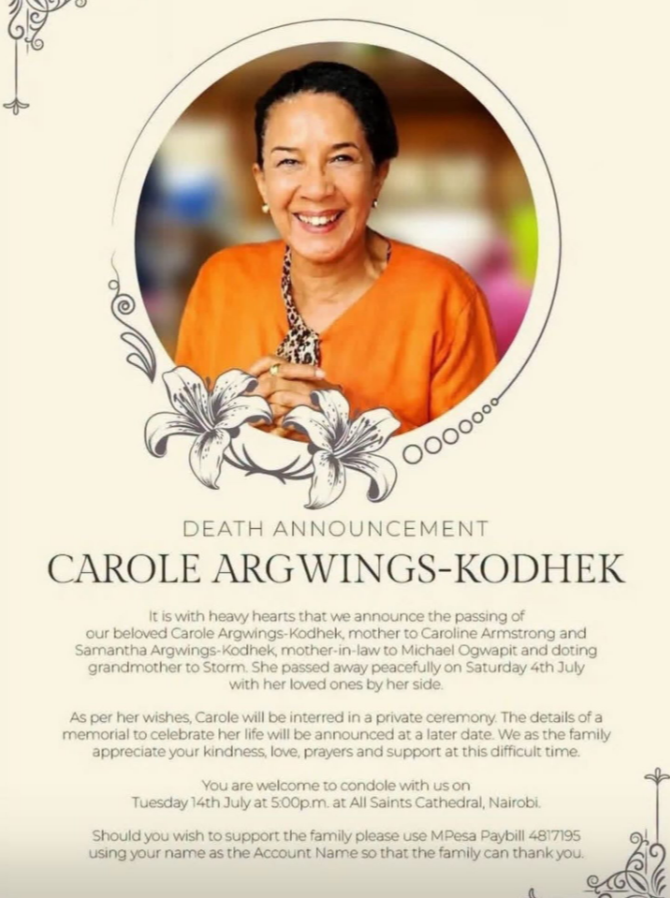
Carole Argwings-Kodhek
Keeper of the flame
Jul 4th 2026
History has a way of arriving unannounced. For Carole Argwings-Kodhek it came in the form of a Mother Superior at her boarding school and a policeman bearing news no 14-year-old should hear. Her father, Clement Michael George Argwings-Kodhek, Kenya’s first African barrister, defender of Mau Mau suspects and cabinet minister, had died in a car accident on a Nairobi road. The year was 1969. Within a short time that same stretch of asphalt would bear his name. For the rest of her life Carole drove, walked and was driven along Argwings Kodhek Road, a daily encounter with both personal loss and national memory. She died on July 4th, aged 72, having spent decades ensuring that memory did not fade.
She was born Carole Argwings-Kodhek on May 22nd 1954, the eldest child of CMG (as he was known) and Mavis Tate, an English nurse. Their marriage was itself an act of defiance. In colonial Kenya, a black lawyer and a white woman could not easily cohabit; CMG had to challenge the law to bring his wife home. The couple embodied the contradictions of late-colonial East Africa: privilege mixed with ostracism, ambition tempered by racial barriers. Carole grew up navigating those fault lines. She was of Kenya but also slightly apart from it.. a mixed-race child in a society that was only beginning to imagine its own future.
Her father’s career was the stuff of founding myths. Called to the bar in Britain, he returned to open one of the first African law practices in Nairobi. He represented detainees during the Emergency, rubbed shoulders with Jomo Kenyatta, and after independence served as MP for Gem and as a minister. His death, still whispered about in some circles as suspicious, came just as Kenya’s experiment with nation-building was taking shape. Carole was thrust early into the role of guardian of that story. She did not resent it, but nor did she allow it to define her entirely.
Instead, she fashioned a life that was quieter yet no less purposeful. She worked in business and media, writing columns for The Standard with a sharp eye and dry humour. Friends spoke of her warmth, her infectious laughter and a “gentle yet fierce spirit”, a phrase that captured both her Luo heritage and her mother’s British reserve. She raised two daughters, Caroline and Samantha, and delighted in her granddaughter Storm. To her siblings, Shirley, Amanda, Paul, Gem, Caesar and Sharon, she was the steadfast elder. To a wider circle of nieces, nephews and friends, she was the one who remembered birthdays and offered quiet encouragement.
In recent years she had turned her attention to a long-planned project: a biography of her father, tentatively titled Mau Mau Lawyer. She wanted the next generation to understand not just the icon on the road sign but the man, his courtroom battles, his clandestine efforts to send Kenyan students behind the Iron Curtain, his willingness to stand alone when necessary. In interviews marking anniversaries of his death she spoke with clarity and affection, never descending into bitterness. Kenya had moved on; she wanted its history to move with it.
That history is written into Nairobi’s streetscape. Argwings Kodhek Road runs through Kilimani and Hurlingham, busy with matatus, boda-bodas and the ambitions of a restless capital. It is an apt metaphor for Carole’s own journey: a thoroughfare connecting the idealism of *uhuru* to the messy realities of modern Kenya. She lived through the optimism of the 1960s, the authoritarianism of the Moi era, the turbulence of multiparty democracy and the digital boom of the 21st century. Through it all she remained rooted in a simple conviction, that Kenya’s founding generation had something worth preserving.
She passed away peacefully on July 4th, surrounded by family. A condolence service was held at All Saints Cathedral in Nairobi; her burial was private, in keeping with her wishes. She is survived by her daughters, her granddaughter, her siblings and a large, lively clan that carries forward the blended worlds her parents first bridged.
Carole Argwings-Kodhek never sought the spotlight that shone so brightly on her father. Yet by refusing to let his flame gutter out, she performed her own quiet act of nation-building. In a country still arguing over its past, she reminded Kenyans that history is not only written in statutes and street names but carried in the stories families tell, and in the lives lived well in its shadow.