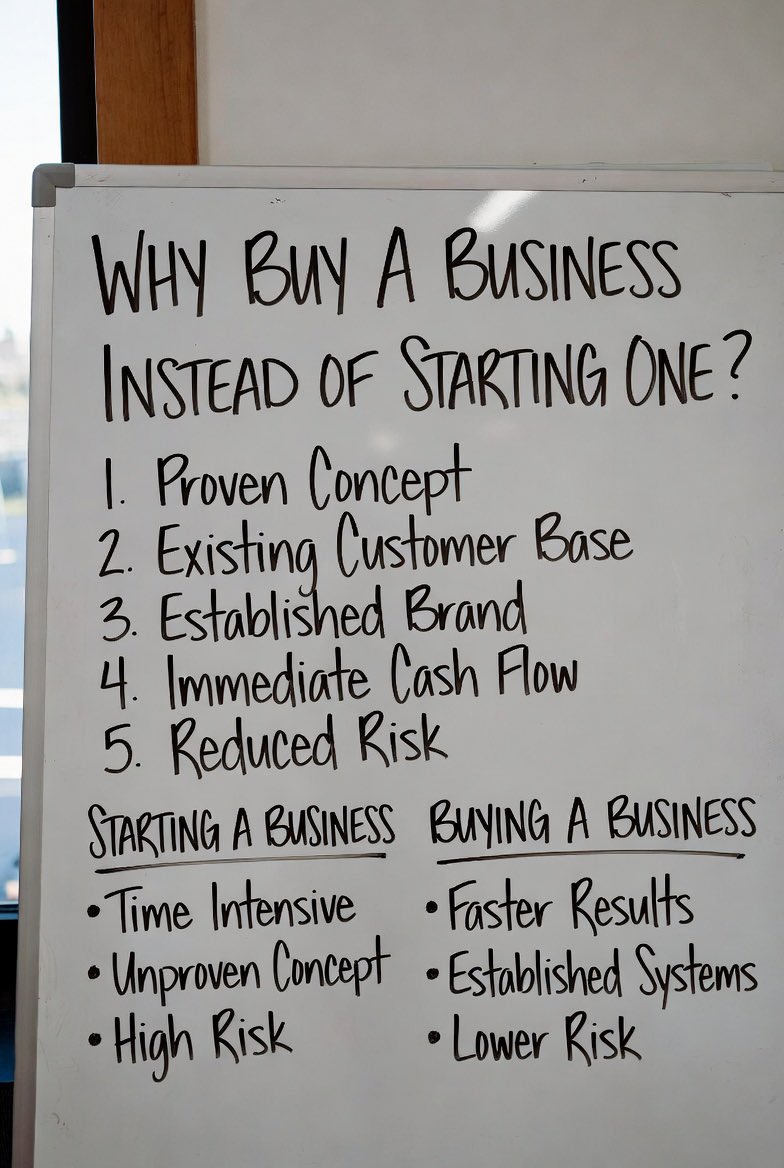
Everyone tells you to build your next business.
Very few ask:
What’s already been built that you could own?
The next generation of entrepreneurs won’t just create assets.
They’ll acquire them.
Here’s something we’re noticing.
The best acquisition conversations don’t start with numbers.
They start with one sentence:
“We’ve been watching what you’ve built.”
That usually means the relationship started long before the deal.
A company becomes valuable twice.
The first time is when customers can’t live without it.
The second is when competitors can’t ignore it.
The second is where acquisitions begin.
I think founders spend too much time asking:
“What’s my company worth?”
The better question is:
“Who loses if we stay independent?”
That’s where strategic buyers come from.
The worst reason to sell your company?
Because you’re tired.
The best reason?
Because someone can create more value with what you’ve built than you can alone.
That’s when strategy beats emotion.
Many founders prepare for fundraising.
Almost none prepare for strategic interest.
Ironically, the businesses most prepared for acquisition often have the strongest negotiating position.
Preparation creates options.
If your biggest competitive advantage is your technology…
Ask yourself:
What happens when everyone has similar technology?
The winners will own:
Customers
Distribution
Trust
Workflow
That’s where the premium moves.
One pattern we’re seeing:
AI companies are spending too much time improving products…
…and not enough time improving their strategic position.
Products get compared.
Positions get defended.
Nobody wakes up wanting to acquire a startup.
They wake up wanting to:
Enter a market faster.
Defend market share.
Acquire customers.
Eliminate a threat.
The startup is just the fastest solution.
Founders think they’re building a company.
Buyers think they’re buying an advantage.
The moment you understand that, you stop asking:
“How do we grow?”
And start asking:
“How do we become strategically irreplaceable?”
One question every founder should ask this year:
If my biggest competitor acquired us tomorrow… what would they gain besides revenue?
If the answer isn’t obvious…
Keep building.
The easiest businesses to acquire aren’t the best businesses.
The best businesses rarely need to sell.
That’s exactly why buyers pursue them.
Leverage starts with having options.
This is absolutely great advice for founders who want to build for the long term.
Today, a lot of founders want to build and exit fast. That isn’t bad; it is an example of their success.
We all know not everyone will build a creative monopoly.
New episode: Peter Thiel on How to Build a Creative Monopoly
Or what I learned from reading Zero to One for the 3rd (or 4th) time:
0:00 Every great entrepreneur is first and foremost a designer.
0:21 Long-term planning is often undervalued by our indefinite short-term world.
1:24 Founders only sell when they have no more concrete visions for the company. Definitive founders with robust plans don't sell.
2:03 A startup is the largest endeavor over which you can have definitive mastery.
3:44 Don’t do anything someone else can do.
4:29 Today's best practices lead to dead ends. The best paths are new and untried.
5:05 Technology is miraculous because it allows us to do more with less, ratcheting up our fundamental capabilities to a higher level. By creating new technologies, we rewrite the plan of the world.
6:25 Indeed, the single most powerful pattern I have noticed is that successful people find value in unexpected places, and they do this by thinking about business from first principles instead of formulas.
9:16 Brilliant thinking is rare, but courage is even in shorter supply than genius.
9:53 The present is the past biting into the future.
10:37 Small groups of people bound together by a sense of mission have changed the world for the better.
11:25 This is what startup has to do: question received ideas and rethink business from scratch.
13:36 The most contrarian thing of all is not to oppose the crowd, but to think for yourself.
15:57 Creative monopoly means new products that benefit everybody and sustainable profits for its creator.
18:50 If you're interested in making things, you'll be less afraid to pursue this activity single-mindedly and thereby become incredibly good at them.
22:03 If you focus on near-term growth above all else, you miss the most important question you should be asking: Will this business still be around a decade from now?
26:30 Every monopoly dominates a large share of its market. Therefore, every startup should start with a very small market. Always err on the side of starting too small. If you think your initial market might be too big, it almost certainly is.
28:53 Competition is for losers. Avoid competition as much as possible.
29:44 The definitive person determines the one best thing to do and then does it. The definitive person strives to be great at something substantial. They strive to be a monopoly of one.
31:15 What is luck? The ability to exploit accidents. — Napoleon
33:20 We do not live in a normal world. We live under a power law. And as a result, company outcomes follow a power law. A small handful of companies radically outperform all others.
34:00 If you do start your own company, you must remember the power law to operate it well.
34:05 The most important things are singular.
36:29 Making mistakes is the privilege of the active.
38:00 The best entrepreneurs know this: Every great business is built around a secret that is hidden from the outside. A great company is a conspiracy to change the world. When you share your secret, the recipient becomes a fellow conspirator.
40:54 A small company depends on great people much more than a big company does.
41:15 The founding of a company lasts as long as a company is creating new things, and it ends when creation stops.
41:25 No company has a culture. Every company is a culture.
41:48 Since time is your most valuable asset, it is odd to spend it working with people who you don't envision any long-term future together.
42:09 Recruiting is a core competency for any company. It should never be outsourced.
42:37 Your company should be a tribe of like-minded people fiercely devoted to the company mission.
44:02 Superior sales and distribution by itself can create a monopoly, even with no product differentiation. The converse is not true.
44:24 Advertising matters because it works. It works on nerds and it works on you.
44:49 Advertising doesn't exist to make you buy a product right away. It exists to embed subtle impressions that will drive sales later.
46:29 Poor sales rather than bad product is the most common cause of failure. If you can get just one distribution channel to work, you have a great business.
49:00 When Howard Hughes was awarded the Congressional Gold Medal in 1939 for his achievements in aviation, he didn't even show up to claim it.
52:00 The most important task in business, the creation of new value, cannot be reduced to a formula and applied by professionals.
Here’s something we’re seeing more often:
Founders think they’re selling products.
Buyers think they’re buying market position.
The language is different because the objective is different.
AI is creating thousands of startups.
Only a fraction will become strategic assets.
The difference isn’t better code.
It’s whether your business changes another company’s future.
Most founders ask:
“How do I make my startup bigger?”
A strategic buyer asks:
“If we owned this tomorrow, what could we do that we can’t do today?”
That’s the gap between building a startup and building an asset.
I see a lot of builders asking this question.
Honestly, I don’t know if they are just framing engagement.
If you have any idea on what to build, either partner with a co-founder who understands the market, the problem, and the people you’re solving it for. Do deep research.
Btw, to build a SaaS business, the answer isn’t just X or Reddit. It boils down to what you are currently building.