Miami has already turned into VICE CITY and GTA 6 is still 8 days away 😭🌴
The blimp flying over the city looks straight out of the game.
Are you ready for November 19? 👀
The man ordered a coffee, pulled out a gun and disappeared into the night with 18-year-old Samantha Koenig. Weeks later, her family received a ransom demand. By then, Samantha was already dead.
She was working alone at a coffee stand in Anchorage, Alaska, on the night of February 1, 2012. A security camera captured the customer approaching her window. His name was Israel Keyes.
After ordering, he showed Samantha a gun. The footage shows her raising her hands before he climbs inside. He ties her hands, turns off the lights and leads her away.
Samantha’s family and friends searched for her, unaware that Keyes had killed her shortly after the abduction. He later used her phone to send messages and demand money from her family.
When money was deposited into the account connected to Samantha’s debit card, investigators began tracking withdrawals across several states. The trail led them to Keyes in Texas, where he was arrested in March.
During interviews with the FBI, Keyes admitted killing Samantha and a couple in Vermont. He also spoke about other victims across the country. Investigators were left trying to work out which of his claims they could verify.
Keyes killed himself in an Anchorage jail in December 2012, before he could stand trial. Samantha’s family never got to see him answer for her death in court.
How many families are still waiting for answers that disappeared with him?
For 23 years, the murder of a young nurse went unsolved. Then detectives found a DNA match. The woman they wanted to question was an LAPD detective, and she was already inside police headquarters.
On February 24, 1986, 29 year old Sherri Rasmussen was found dead in the Los Angeles home she shared with her husband, John Ruetten. She had been beaten and shot. A bite mark on her arm would become the most important piece of evidence in the case.
At first, police investigated the killing as a possible burglary. Sherri’s family had another name in mind: Stephanie Lazarus, an LAPD officer who had previously dated John.
The case went cold. Lazarus stayed with the department, became a detective and spent years working alongside other officers. Meanwhile, the swab taken from the bite mark remained in evidence.
In 2009, investigators took a fresh look. They secretly obtained a sample of Lazarus’s DNA and compared it with the DNA from Sherri’s arm. It matched.
Her colleagues brought her into an interview room under another pretext. As the conversation turned to Sherri, Lazarus insisted she barely remembered her. The interview was recorded; by the end of it, she was under arrest.
A jury convicted Lazarus of first-degree murder in 2012. She was sentenced to 27 years to life.
Sherri’s family had raised Lazarus’s name years earlier. What might have happened if detectives had looked more closely then?
For more than two months, Kala Brown was locked inside a metal container on a stranger’s property. When police finally opened it, she told them her boyfriend had been shot in front of her. Then she warned them there could be more bodies.
Kala and Charlie Carver disappeared in August 2016 after going to a property in South Carolina for a job. Its owner, real estate agent Todd Kohlhepp, had hired them to clear land.
According to Kala, Kohlhepp shot Charlie, then locked her inside a storage container with a chain around her neck. For weeks, her family had no idea where she was.
On November 3, investigators searching Kohlhepp’s property heard banging coming from the container. They forced it open and found Kala alive. The video shows her speaking to the officers as they work to free her.
She told them Kohlhepp had killed Charlie and spoken about other people buried on the property. Investigators found three bodies there, including Charlie’s.
Kohlhepp also confessed to a 2003 shooting at a motorcycle shop that had remained unsolved for nearly 13 years. Four people were killed there. In 2017, he pleaded guilty to seven murders and received seven consecutive life sentences.
Kala had survived long enough to tell police where to look.
How many answers might have stayed buried if investigators hadn’t found her that day?
Jassy Correia went out to celebrate her birthday and never made it home. Four days later, police stopped a man on a highway. When an officer asked if anyone else was in the car, he answered: “She’s in the trunk.”
In February 2019, Jassy was out with friends at a Boston nightclub. She became separated from them and tried to get a ride home. A stranger named Louis Coleman approached her outside and offered to take her to her friend’s apartment.
Jassy got into his car. Surveillance cameras later showed Coleman arriving at his apartment building in Rhode Island. He carried her inside and dragged her toward the elevator.
Over the next few days, Coleman bought cleaning supplies, protective equipment and a large suitcase. Investigators found that he had searched online for “can a person fit inside a suitcase.”
On February 28, police stopped Coleman’s car in Delaware. They found Jassy’s body inside a suitcase in the trunk.
Jassy was a young mother with a two-year-old daughter. She had gone out that night to celebrate with her friends.
In 2022, Coleman was convicted of kidnapping resulting in death and sentenced to life in prison without parole.
How many people saw Jassy outside the club that night and had no idea what was about to happen?
A security camera caught the moment a man dragged 22 year old Carlesha Freeland Gaither off a Philadelphia street and forced her into his car. She fought so hard that she broke a window. For three days, her family had no idea where she was.
On the night of November 2 2014, Carlesha was walking home when a man parked his car, got out and approached her. A witness heard her screaming for help and called 911.
The footage shows her struggling as the man pulls her down the street. Her glasses and phone were left on the pavement. Inside the car, she managed to hit him with a hammer, but he threatened to kill her if she kept fighting.
The man was Delvin Barnes. He drove Carlesha to Maryland with her wrists bound and kept her in the trunk of his car. Investigators eventually tracked the vehicle using a GPS device that had been installed by the dealership.
Three days after the abduction, federal agents found Barnes in Jessup, Maryland. Carlesha was rescued alive.
Barnes pleaded guilty to kidnapping and was sentenced to 35 years in prison.
Kelsey Smith went to Target to buy a gift for her boyfriend. She was 18 and had graduated from high school just days earlier. A store camera filmed her shopping, then leaving. Another captured a man who left around the same time.
On June 2, 2007, Kelsey drove to the store in Overland Park, Kansas. After shopping, she walked back to her car and put her purchases inside. As she reached the driver’s door, a man forced her into the vehicle.
About two hours later, her car was found in a mall parking lot across the street. Her purse and purchases were still inside. Kelsey was gone.
Police reviewed footage from Target and released images of a man seen at the store. Tips helped investigators identify him as Edwin Hall.
Four days after Kelsey disappeared, investigators found her body in a wooded area in Missouri. Cell phone location data had helped narrow the search.
Hall later pleaded guilty to kidnapping and murdering Kelsey. He was sentenced to life in prison without parole.
In the store footage, Kelsey is carrying the gift she never got to give.
Brittany Diggs was locked in the trunk of her own car while an armed man drove around Birmingham, trying to withdraw money with her bank card. She found the emergency release using the light from her insulin pump. What happened next was caught on a gas station camera.
It was March 14, 2017. Brittany, a 25 years old nursing student, was walking to her apartment when a stranger approached her with a gun and demanded money. He forced her into her car, made her drive and threatened to kill her. Eventually, he put her in the trunk.
Brittany remembered seeing a video on Facebook about how to escape from a trunk. She couldn’t see the latch in the dark, so she used the light from her insulin pump to find it.
The man stopped at a gas station and went inside to use the ATM. When he came back and started driving away, Brittany opened the trunk, fell onto the pavement and ran into the store.
You can see it happen in the surveillance footage. The car begins to move, the trunk opens and Brittany scrambles out. Inside the store, another camera captures her running in for help.
Police arrested Manuel Ali Towns about a week later. In 2018, he was convicted of kidnapping and other charges and sentenced to life in prison without parole.
In 1990, an eight-year-old girl was taken from her bedroom in Texas, attacked and left for dead in a field. She survived - but her attacker remained unidentified for 19 years. When police finally found him, they discovered he had once lived just a few blocks from her home.
Her name was Jennifer Schuett. On the morning of August 10, a man took her through her bedroom window in Dickinson. He drove her to a remote area, sexually assaulted her and cut her throat.
A group of children found Jennifer in a field approximately 14 hours later. She was alive, but her injuries had damaged her vocal cords. Unable to speak, she used handwritten notes to help investigators understand what had happened.
Police searched for the man, but the case went cold. Jennifer grew up without knowing who had attacked her. Years later, she was still helping investigators and hoping they would find him.
In 2009, new DNA testing produced a match. It led police to Dennis Earl Bradford, who was living in Arkansas. Records showed that around the time of the attack, he had lived less than a quarter of a mile from Jennifer’s home.
Bradford was arrested and charged with attempted capital murder. He died in jail in 2010 while awaiting trial, so Jennifer never got the chance to face him in court.
Jennifer later began sharing her story publicly and speaking to other survivors. The man who left her in that field did not silence her.
A man called 911 and said he had strangled his wife. He gave police the address, refused to give his name and said he was leaving the country. Then he disappeared.
On January 13, 2015, a dispatcher in Michigan received a call from a man who said a woman was dead inside a house near Fennville. He told her the body was on the living room floor and asked her to send the police.
When officers arrived, they found 48-year-old Sara Knight under a sheet. Her phone and information for contacting her family had been left nearby. Her husband, Harold “Butch” Knight, was gone. So was her car.
Investigators believe Knight made the call. He had already left the area by the time police reached the house. His son later identified the caller’s voice as his father’s.
Police traced Knight to Maine, where surveillance cameras captured him at a Walmart and he checked into a motel. His appearance had changed: his hair and mustache had been dyed dark. Sara’s car was later found abandoned in a parking lot.
Then Sara’s mother received a package mailed from Maine. It contained money for Sara’s cremation and a letter from Knight, in which he wrote about his grievances with her family.
Knight checked out of the motel in January 2015. More than a decade later, his whereabouts remain unknown. Investigators have considered whether he escaped, is living under another identity or died after disappearing. None of those possibilities has been confirmed.
The man who told police where to find Sara has never stood trial for her murder.
She escaped the man who kidnapped and raped her, then went to the police. He was arrested and released on bail. Before she could testify against him, she vanished. Her body was found in a shallow grave a year and a half later.
Her name was Debra Colliander. She was 25 and lived in Illinois. In June 1980, she was abducted from a shopping center and taken to a house in Aurora. The man who took her threatened and raped her, but Debra managed to escape and reach a neighbor’s home.
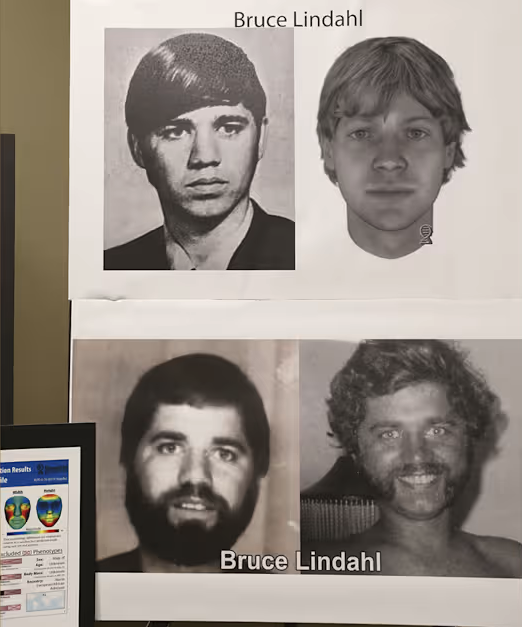
Police arrested Bruce Lindahl and charged him with kidnapping and sexual assault. Debra was expected to testify against him, but on October 7, 1980, she disappeared after leaving her job at Copley Hospital. The charges were eventually dismissed.
In April 1981, Lindahl was found dead beside 18-year-old Charles Huber. Police believe Lindahl had fatally stabbed Huber and accidentally cut an artery in his own leg during the attack. Both men died at the scene.
A year later, in April 1982, a farmer found Debra’s body. Her death was ruled a homicide, but the cause could not be determined. Investigators suspected Lindahl was involved he was never tried for her murder.
Decades later, DNA linked Lindahl to the killings of two other young women: Pamela Maurer in 1976 and Kathy Halle in 1979. Police also found photographs of women at his home and sought to identify them.
Debra escaped and told police what had happened. She never got the chance to testify.