Because we all need ways to make ourselves intelligible to ourselves and others. That's what identities do. And, because psychiatric diagnostic labels are often presented as causal and explanatory rather than merely descriptive, they become prime candidates for self-understanding
"The divine art that is manifested in the structure of the world is not only to be seen in the sun, the moon and the stars; it operates also on earth on a reduced scale. The hand of the Lord has not neglected the bodies of the smallest animals - and still less their souls - because each one of them is seen to possess some feature that is personal to it...Nor has the hand of the Lord neglected the plants of the earth, each of which has some detail bearing the mark of the divine art...For once it has been granted that the Scriptures have God himself for their author, we must necessarily believe that the person who is asking questions of nature and the person who is asking questions of the Scriptures are bound to arrive at the same conclusions." - Origen, Commentary on Psalm 31.
"At its worst, therapy can encourage confession without transformation, goading us along in our desire to be understood—but only half understood, understood through the flattering haze of a selectively edited narrative."
https://t.co/Z9jS9wJ2Ms
"Nolan’s Odyssey is a post-Christian story par excellence. One question, however, remains: will this moral middle ground hold, or will we eventually return to a truly Homeric past? " https://t.co/BgNKClEOFc
Excellent piece. I once had a prof who taught the course on Paul while absolutely hating Paul. You can imagine how that course went. So much truth in the premise that professors should be passionate about the subject they teach. The should be students of the great books too, not just dispassionate teachers.
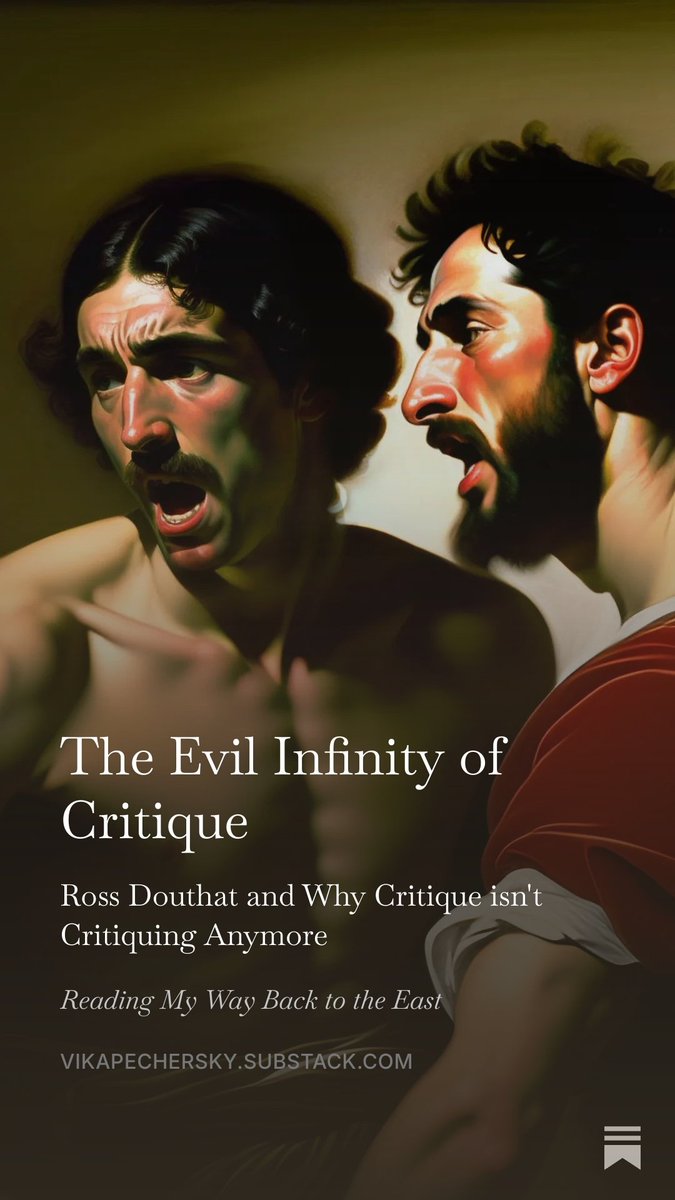
After @DouthatNYT decided to stop writing op-eds hinting that writing critical opinions in the current climate of uncertainty is no longer possible, I considered why the critique is no longer working. https://t.co/O8i45XZt7O
Who knew that in today’s therapeutic culture, returning to Freud is actually helpful? Excellent article by Anna Ballan:
“A Freudian observer might take a look at our therapy-saturated culture and ask the obvious question: How is it that we are most fluent in therapeutic vocabulary at just the moment we are most ensnared in the psychic perils of social media? How can we talk about our symptoms with such confidence and exhibit so little insight into them? What is endless scrolling if not repetition compulsion—the drive to reenact what injures us—and the entire digital ecosystem if not a communal indulgence in neurosis?”
Out from the paywall: Anna Ballan on how therapy-speak has gained ground even as the Freudian strand of it has been gradually sidelined.
https://t.co/JJFrlEVxS5
In my latest essay, I ask why critique has lost it's edge. Why, for example, no amount of criticism of Trump (substantitive or not) prevent or even slow his rise to power?
Like many readers of @DouthatNYT, I was surprised that he is stepping down from writing op-eds. His reasoning compelled me to write why I think the critique is not critiquing anymore. https://t.co/sajkNltEJj
Like many readers of @DouthatNYT, I was surprised that he is stepping down from writing op-eds. His reasoning compelled me to write why I think the critique is not critiquing anymore. https://t.co/sajkNltEJj
Like many readers of @DouthatNYT, I was surprised that he is stepping down from writing op-eds. His reasoning compelled me to write why I think the critique is not critiquing anymore. https://t.co/sajkNltEJj
Alright, if you insist! From halfway up Mt. Ololokwe in Samburu. (My daughter is home from boarding school and so we are going on as many family adventures as we can this month!)
This is quite an essay. I appreciate @DouthatNYT 's intellectual honesty. Among other things, his intuition is correct in at least one respect: the trend of opinion writing as a mechanism of discourse must come to an end. It can no longer serve its purpose, for reasons he lays out in this piece.
I dunno, as someone who actually lived in Soviet Union, it was fairly normal for us. Parents took their kids to daycares and schools. Kids went to summer camps, which by the early 80s had no Communist propaganda pretty much. Adolescents went to college and got jobs. We went on vocations and visited theaters. I am not an apologist for Communism or Helen Andrews, but it was a normal place to live after the Stalinist era for vast majority of people who just lived their lives day to day. Was it normal compared to the West? Probably not. But I can say that the reverse is probably true. The way people live in the West is not normal compared to the rest of the world. If you want to critique Andrews' essay, you have to get a better angle.