Explorer of new worlds. A viking who loves to win. Crypto, prediction markets, stocks. Bayesian thinker. Game theory. Asymmetric risks. Berserker resilience. ⚔️
Anyone (or any AI agent) can now spin up a multiplayer browser game in about a minute with $NET’s Net Forge.
One shared simulation for client + server, typed game file agents can safely edit, playtest bots that check their own work, 10 ready templates (survivors, arena, TD, dungeon, kart, cards, etc.), 530 CC0 assets, MCP server so Claude/Cursor can drive it directly. All open source on npm.
This is the Roblox-style UGC engine built specifically for AI agents instead of human editors.
The real unlock is still coming: the Kit. Once that ships, every game built on Net Forge can launch with its own token, in-game store, and rewards in one flow. Those tokens trade against wsNET. Every new game becomes a new market on NetNet rails.
More agents and builders shipping games now → more tokenized games launching later → more activity flowing through $NET.
Open engine first, economies second. Clean sequencing. If you build something on it, post it. This is how the flywheel starts.
Shareholders,
For the last few weeks we have been building Net Forge, and this week it went from a private project to something any developer, or any AI agent, can pick up and use.
Here is what that means and why we think it matters.
More and more games start as a sentence typed to an AI coding agent. "Make me a co-op survivors game." "Add multiplayer to my three.js scene." The agent picks the tools, writes the code and runs it. So the engine an agent reaches for decides what a lot of people end up building with.
Most game engines were made for people clicking around an editor. Agents can't do that. They work best with code they can read, a typed API they can't misuse, and a way to test what they wrote without a human playing it. Multiplayer makes this harder still, because the server and the browser have to agree on every frame.
Net Forge is built for that from the ground up:
- One game simulation runs the same in the browser and on the server, so multiplayer works from the first line
- A three.js renderer on WebGPU, with a WebGL2 fallback
- Each game's rules live in one typed file an agent can read and safely change
- Playtest bots play the game for you, so an agent can check its own work
- 530 CC0 models and sounds across six art styles, so nothing ships as grey boxes
- Ten complete templates to start from: survivors-like co-op, arena shooter, tower defense, dungeon crawler, idle, platformer, card battler, monster collector, kart racer and party game
What shipped publicly:
- 19 open-source packages on npm published straight from a public repo with npm provenance
- npm create netforge@latest, which turns any template into a running game in about a minute
- An MCP server and a CLI setup command, so Claude, Cursor and other coding agents can drive the engine directly
- Full docs at https://t.co/McEop4isuz, written so both people and AI models can read them, with guides for the questions developers actually ask
- A GitHub template repo for every game, so you can start one with a single click
- Playable demos of the templates on https://t.co/xk9EUOU5rk
Everything public runs with play money. No wallet, no chain, no sign-up.
Why this matters for NetNet: the next step is the Kit, which connects a game to its own token, an in-game store and player rewards. When it goes live, anyone who builds on Net Forge will be able to launch a game with an economy attached in one flow. Each game token will trade against wsNET, so every game that launches adds a new market built on NetNet.
The open engine comes first. The more developers and agents building on it, the more games there are to launch when the Kit arrives.
If you build something, show us. Issues and pull requests are open.
Phenomenal things happening in NetNet, zero doubt in my mind this becomes a behemoth this cycle. These guys designed an entirely new IP within the space for builders to create on and did it with a protocol that backs the token fp with cash + accumulated a $30m RWA warchest.
Don't sleep on this update. This transforms @NetNetCap from a pure on-chain holding into the fundamental infrastructure layer for AI-native gaming.
Here is why Net Forge is a massive paradigm shift (and why it matters for $NET):
1️⃣ Built for the AI Agent Era
Traditional game engines (Unity, Unreal) aren't built for autonomous coding agents. Net Forge is designed from scratch for LLMs:
• Built-in MCP server allowing Claude, Cursor, and ChatGPT to build multiplayer games directly via prompts.
• Typed APIs and automatic playtest bots so agents can write code, simulate physics, and verify bugs autonomously.
• 10 full genre templates + 530 CC0 assets ready out of the box (npm create netforge@latest).
2️⃣ Zero Friction Developer Onboarding
Fully open-source on npm (19 packages). No mandatory wallet pop-ups, no upfront gas fees, pure WebGPU/WebGL2 browser-native performance. Builders on Solana, Base, or Web2 can prototype games in minutes without touching smart contracts.
3️⃣ The Token Flywheel: Enter "The Kit"
Once games gain traction, creators can seamlessly deploy monetization via the upcoming Kit:
• Instant in-game stores, token launches, and player reward loops.
• Crucial: Every single game token will trade against $wsNET.
The Bottom Line:
More developers and AI agents deploying games = a growing network of micro-economies, each permanently locking and routing liquidity through $wsNET.
With ~88.5% of $NET supply staked, over 4.7% of total supply already burned below NAV, and a $29M+ backing treasury, NetNet isn't chasing hyp it's building the decentralized game engine of the future. (🥅,🥅)
Ecosystem $NET
🥅 https://t.co/RxfBFaaj5o
🥅 https://t.co/iQoeCVTwm8
🥅https://t.co/raznZAe5NL
🥅https://t.co/cl0BxSgVkL
@coinsinkstudio@NetNetIntel@TenTenCap
Cc @vladtenev@fern@RobinhoodApp@RobinhoodCrypto
#Web3Gaming #AI #GameDev $NET $RWA #Web2
🔖 ANALYSE DES 100 MEILLEURS PROJETS SUR ROBINHOOD CHAIN
Vous savez que je crois en un retour de Robinhood, on est pour moi dans le creux de la vague, le moment où il faut recommencer à se positionner sur les bons projets.
Comme promis, j'ai passé la semaine à check les projets sur Robinhood, et j'ai retenu une liste de 100 projets, que j'ai trié par catégorie et auquel j'ai attribué un badge de conviction :
🔵 Grosse conviction, j'en hold ou je compte en acheter
🟢 Bullish, je songe à m'exposer
🟡 Projet bullish si la meta Robinhood revient, à dyor
🟠 Il y a du potentiel, à surveiller
🔴 Plus risqué et moins de conviction, mais ça peut se tenter
C’est ma watchlist perso, pas mon portefeuille ni un conseil d’achat. J'ai fais mon possible pour décrire mes thèses de la manière la plus concise.
Bien évidemment, il faut un retour du volume et de la hype sur Robinhood Chain, et surtout je suis convaincu que bon nombre de projets de cette liste ne remonteront jamais la pente donc je vous invite à faire vos propres recherches et build vos propres convictions
Thread 1/13 👇🧵
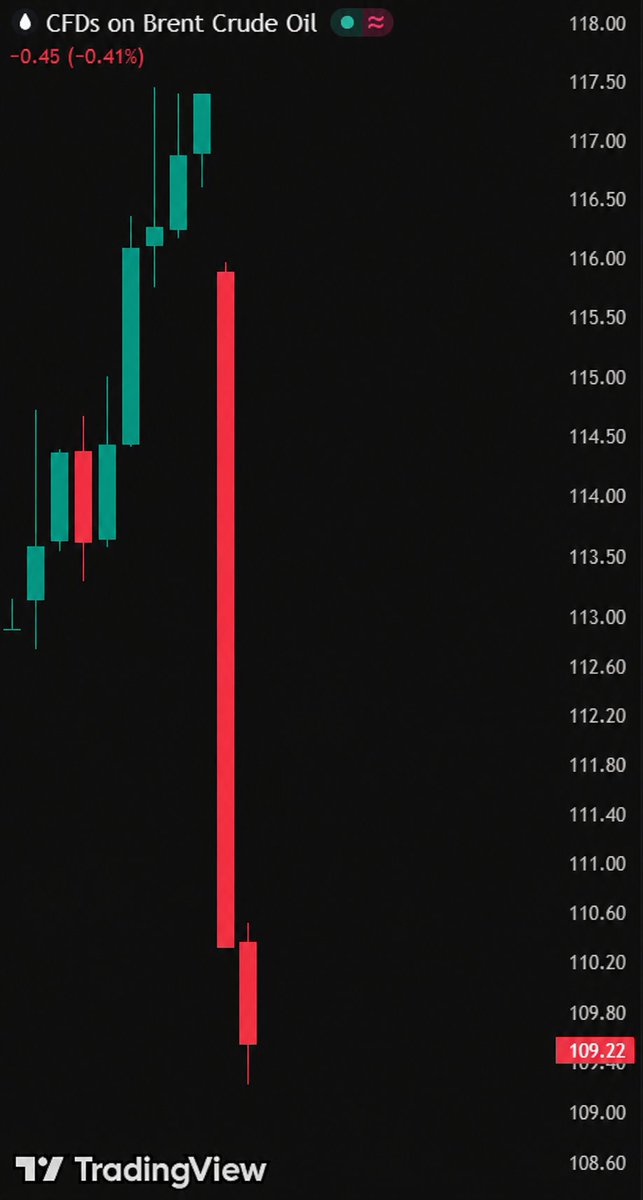
JUST IN: Brent crude drops nearly -7% on reports Trump declined Netanyahu’s request for joint strikes in Iran before Israel’s election.
Israel votes tomorrow, Oct 27, with Trump endorsing Netanyahu as a “Great Warrior Prime Minister.”