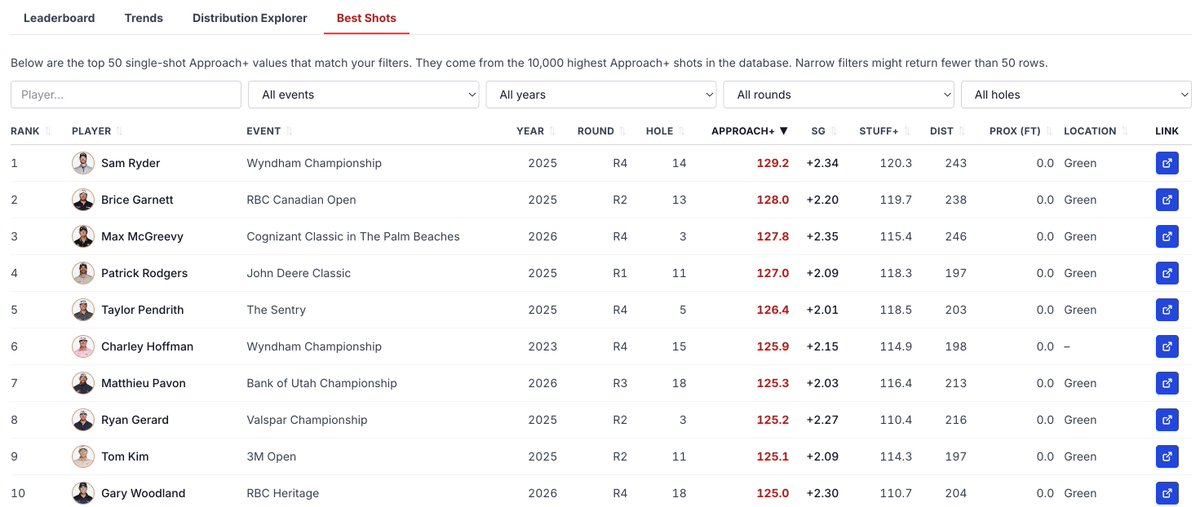
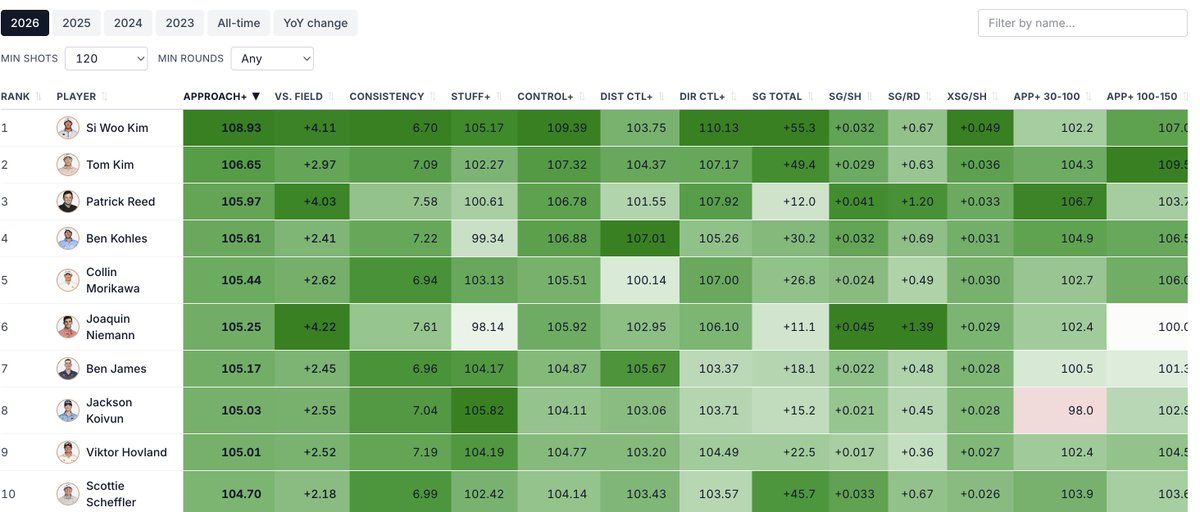
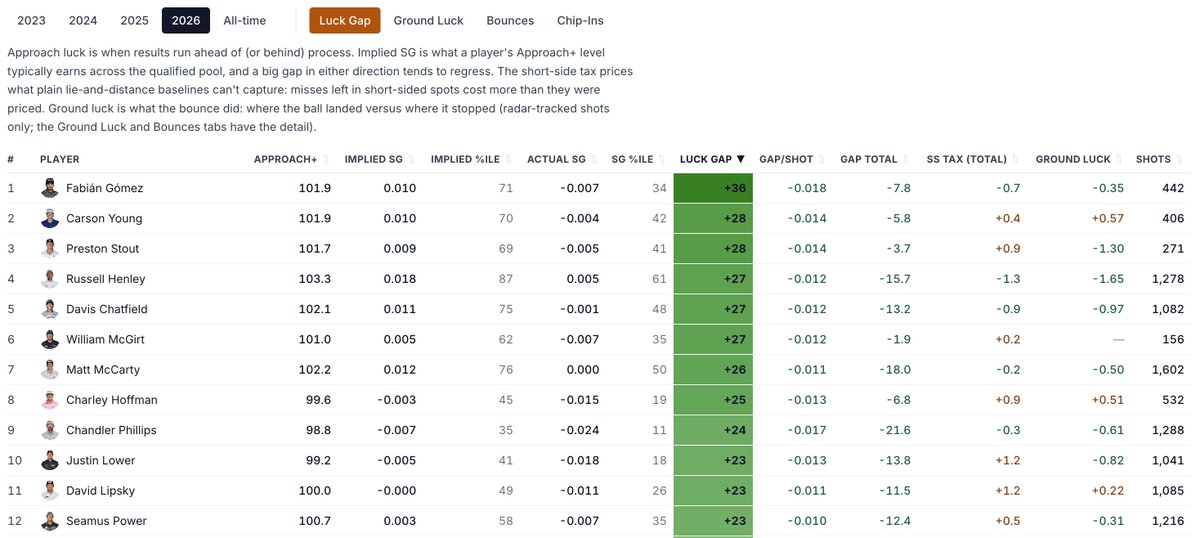
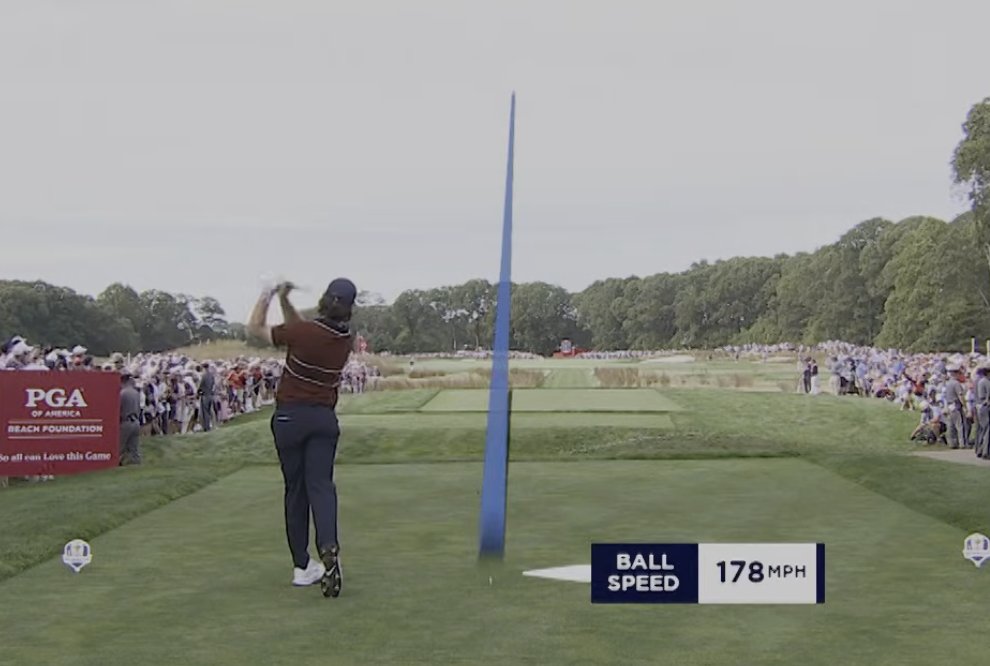
(10/10) Approach+, Flight+, Direction Control+, and Distance Control+ leaderboards can be found here https://t.co/RjrWGXu9CP along with averages for each bucket. APP luck leaderboards are here https://t.co/o7kbPBrAm9 and show Russell Henley to be owed more APP luck than anyone.
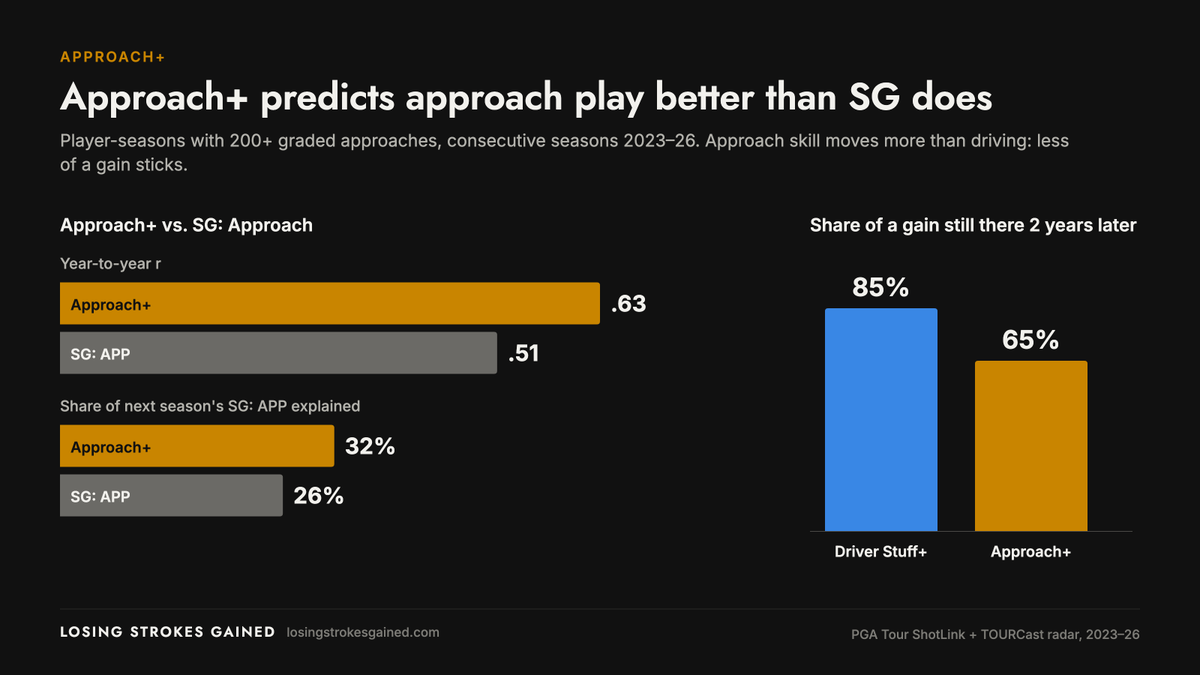
(9/n) Approach+ hold year-to-year at an r of .63 while SG: APP posts .51. It also explains 32% of next year's SG: APP, while SG: APP itself explains 26%. 85% of a Stuff+ OTT gain is still there two years later. For APP+, it's 65%, showing the natural variance in approach play.
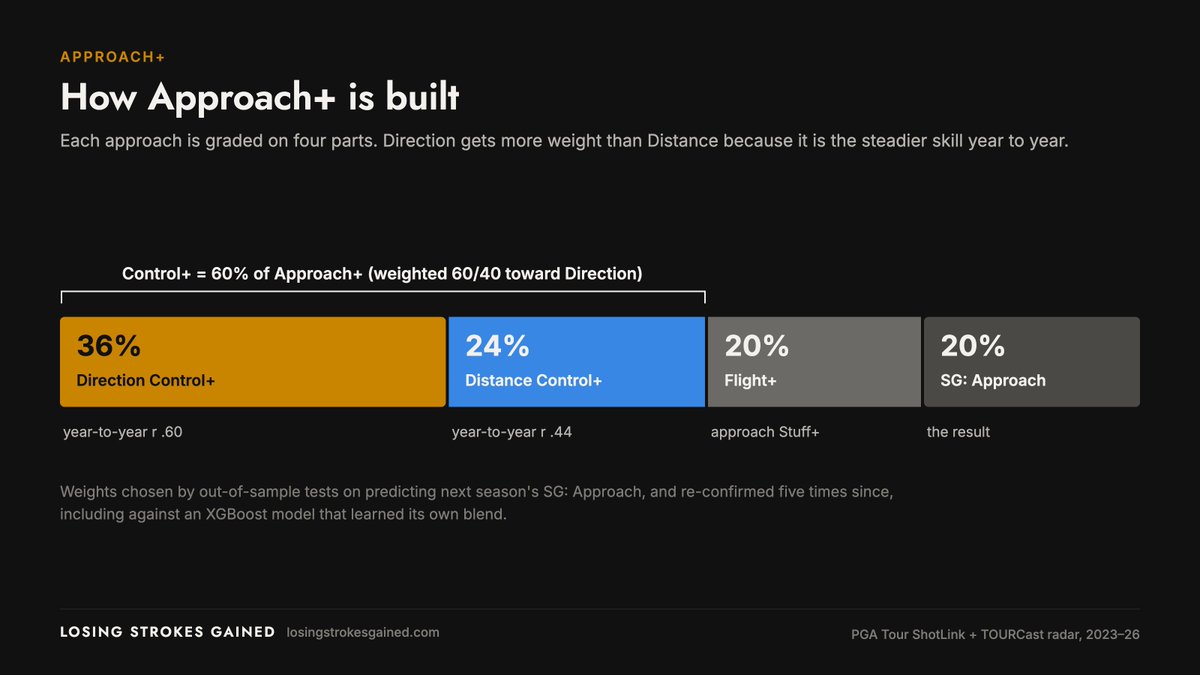
(8/n) We find that Direction Control+ is steadier than Distance Control+ year-to-year (r .60 vs. .44). Control+, the composite of both, is weighted 60/40 toward direction for this reason. APP+ then composites as 60% Control+, 20% Flight+, and 20% SG: APP.
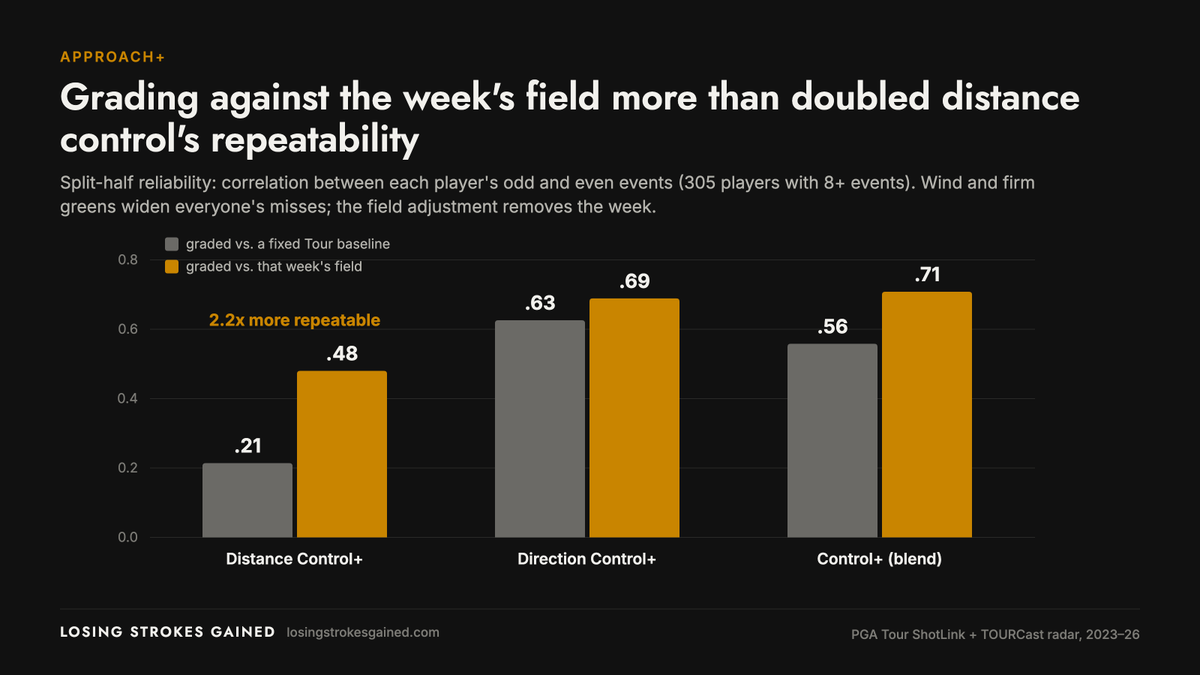
(7/n) Both Distance and Direction Control+ are graded against that week's field. Wind and green firmness widen the field's misses compared to baseline, and adjusting within-week more than doubled distance control's repeatability (event-to-event split-half r .21 --> .48).
(6/n) Distance Control+ grades each miss on how long or short of the pin and Direction Control+ grades each on how far left or right. Each miss then gets scored against Tour shots from the same 25-yard band, so 6 yds off from 200 yds grades higher than 6 yds off from 60 yds.
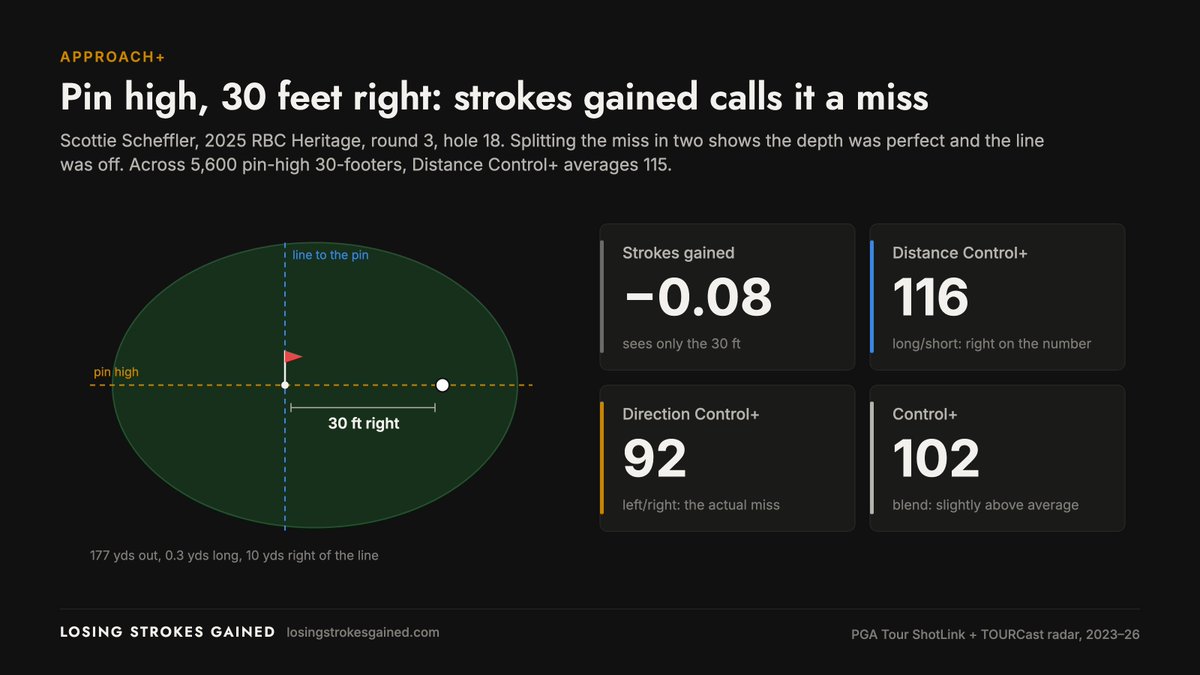
(5/n) We often see a player like Scottie Scheffler "miss" pin high 30 ft from the pin which strokes gained just sees and docks for poor proximity. Splitting the miss into two components shows a 116 Distance Control+ (elite depth control) and 92 Direction Control+.
(4/n) This led me to creating Approach+ which has control at the core of its methodology. It's components are a weighted average of distance control+, direction control+, and Flight+.
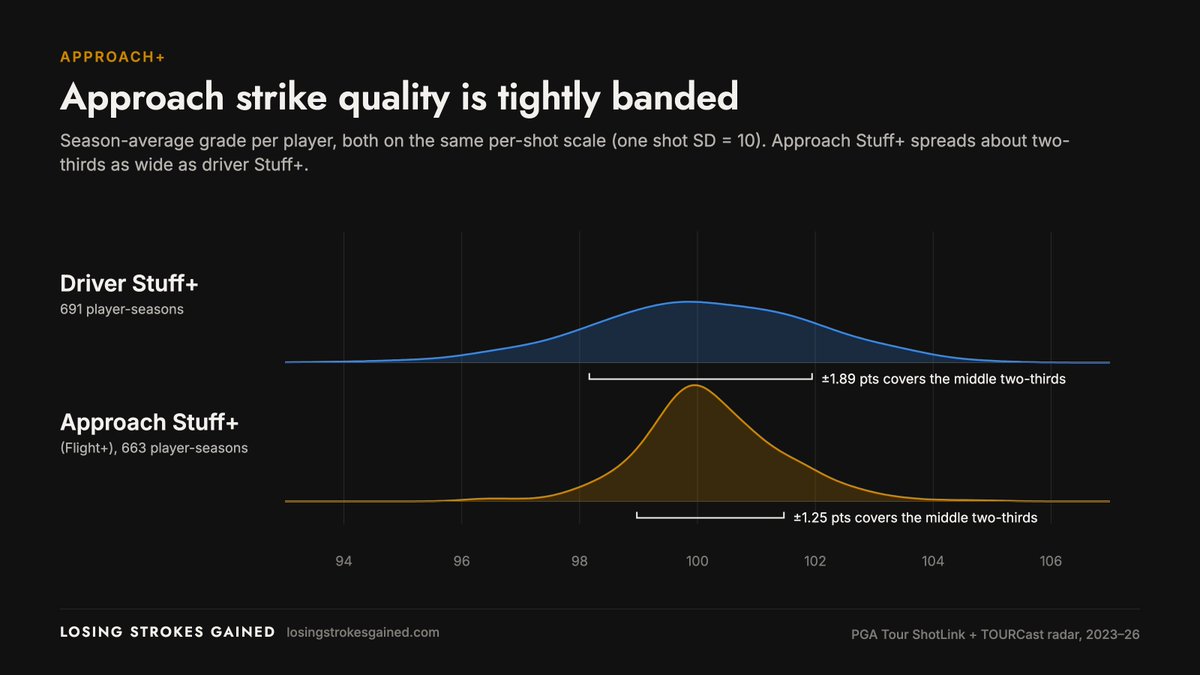
(3/n) Approach strike quality ends up being tightly banded compared to off-the-tee strike quality, with Stuff+ on APP (Flight+) having 2/3 the spread of driver Stuff+. This shows that the ability to hit irons flush isn't a distinguishing characteristic of good approach players.
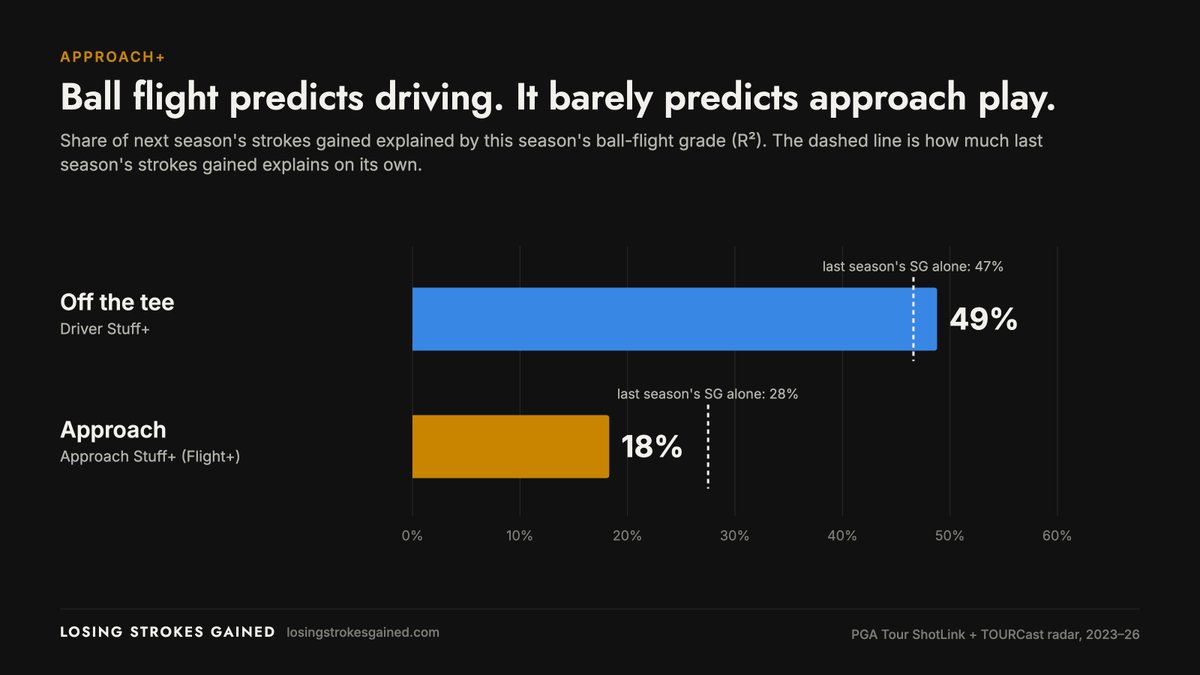
(2/n) Stuff+ off-the-tee explains 49% of next season's strokes gained, while Stuff+ on approach play explains only 18%. OTT rewards long and straight drives, easy tells from radar data. APP play rewards proximity, which can't be quickly deduced from radar data.
A pull hook averages -0.149 xSG, 0.26 worse than the draw. One pull hook wipes out the straight ball's edge over about 9 well-hit draws. So the shape worth hitting is the one that prevents a big miss, not the one that looks the easiest to execute, as Adam is pointing out here.
Adam makes an awesome point here about how valuable straight tee shots are. On TOUR, a straight drive (-1.5 to +1.5 HLA, spin axis between -3 and +3) averages a 107.6 Stuff+, good for +0.137 xSG. A 10-yard draw averages a 105.3 Stuff+ and +0.108 xSG. (cont.)
"It's impossible to play a straight shot, so why try to. I play a draw instead".
Not a quote from me - but many people buy into that idea.
But it's a flawed philosophy.
To hit a straight shot, sure, you have to have a 0.0 path and 0.0 face. The chances of achieving exactly this are slim.
However.......
If you decide "I am therefore going to try and play a 10 yard draw" you have the same problem. You have to achieve an exact +5.5 path and +2.5 face.
Your choice of attempted shot shape should not be determined by your likelihood of achieving the perfect version of it. Instead, your dispersion around that desired shot should dictate whether it's right for you.
In The Accuracy Plan, I go through the process to figure this out - https://t.co/sZ8xWjkiqz
(6/6) If you want to see average Stuff+ by event, navigate here: https://t.co/BwNVfWQYJR. Or if you want to see course effects on different physics (ball speed, apex, curve, etc.) data go here: https://t.co/2HYeJub6Kn. Thanks for the thoughtful question @JakeSirkus
@VincePipitone Enjoyed the thread and can’t wait to dive into the site
Quick question. Guys like Scheffler love to play crazy high curvature tee shots on courses with no tree protection. How much do those players see their stuff drop??
(5/n) What Scheffler is good at is how he can turn into a completely different driver when he's at a wide-open setup. When he has the opportunity to tee it up and hit it straight with no shaping he becomes a Young, Aberg, Schauffele-caliber driver.
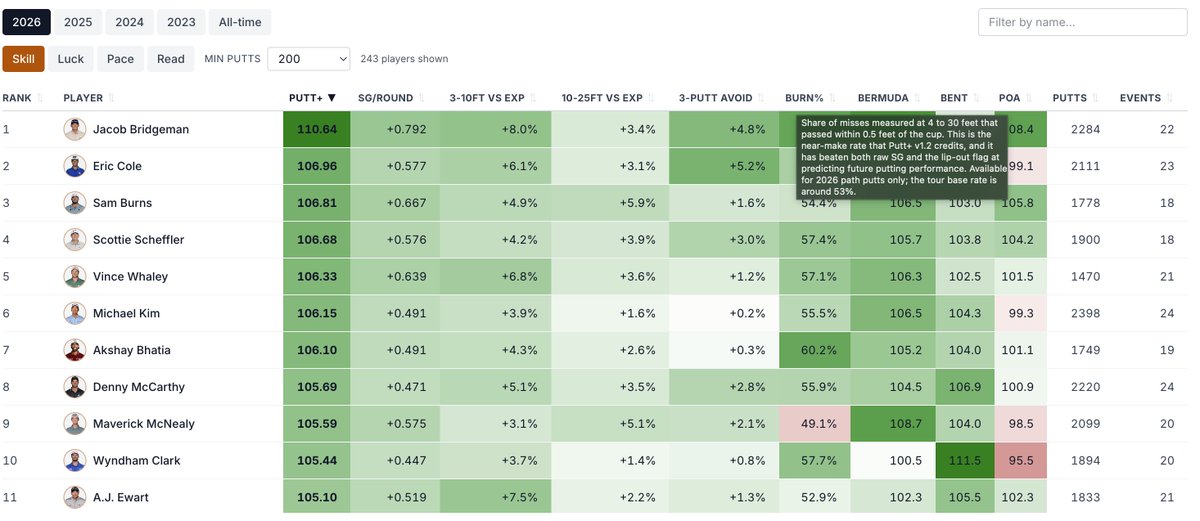
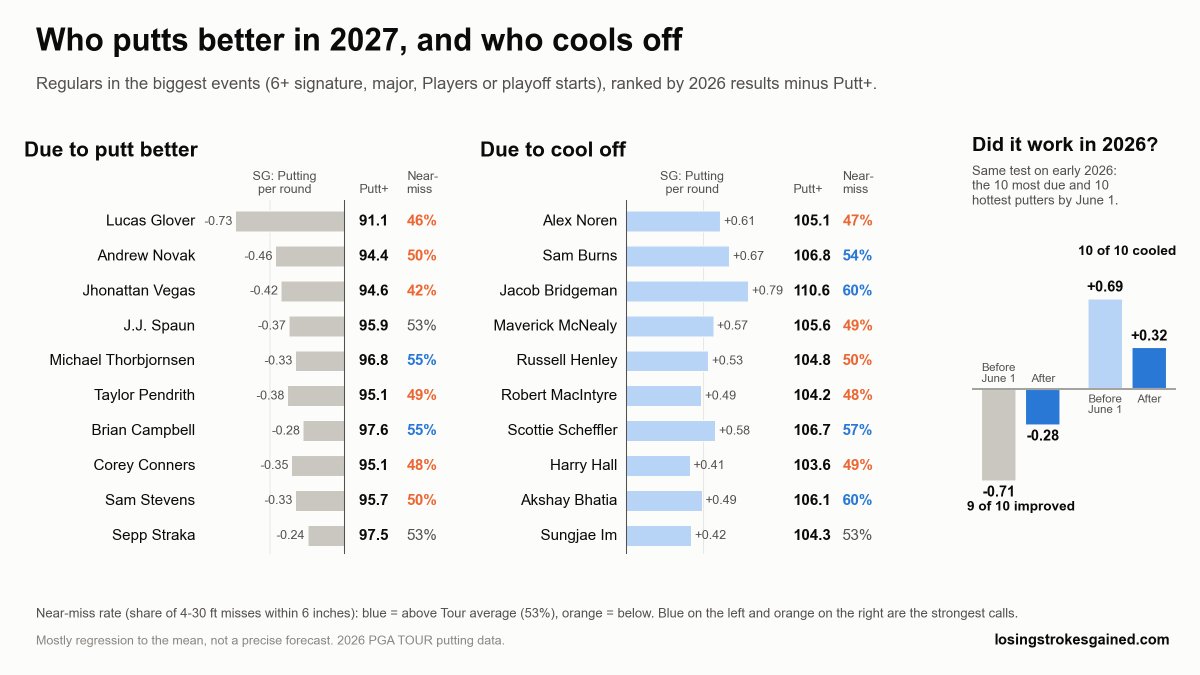
(9/9) All putting data mentioned can be found here: https://t.co/WNfBh5wFxX. If you're wondering what a certain stat means, you can hover over the column title and it has a description.
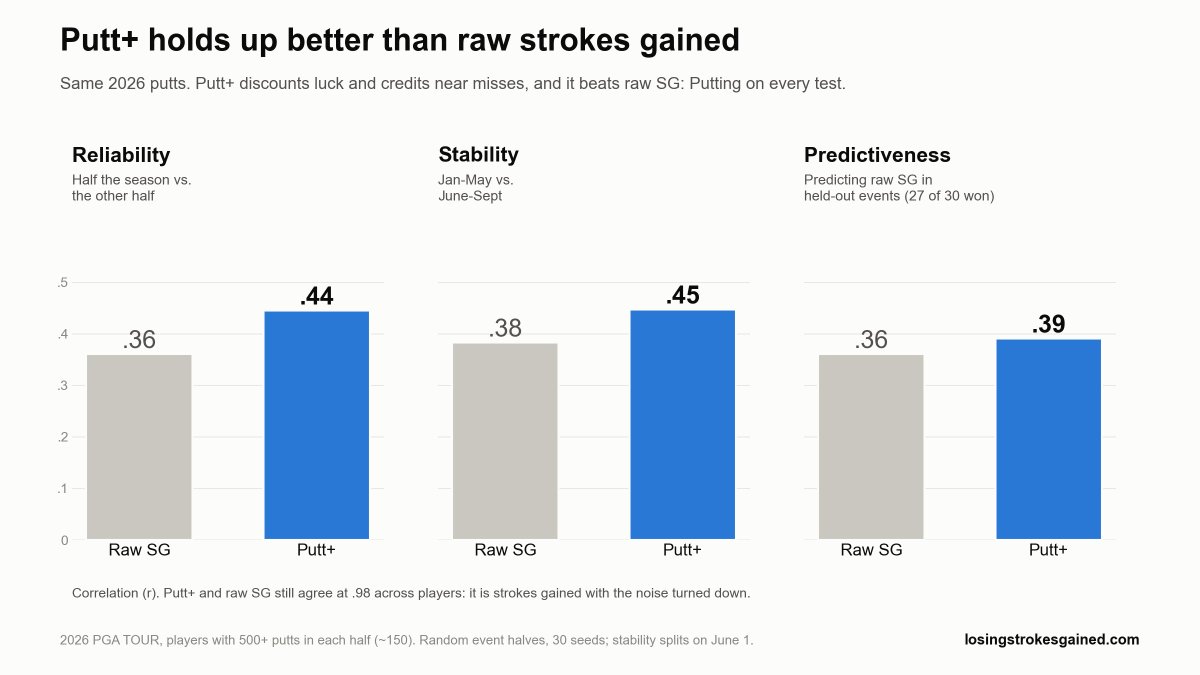
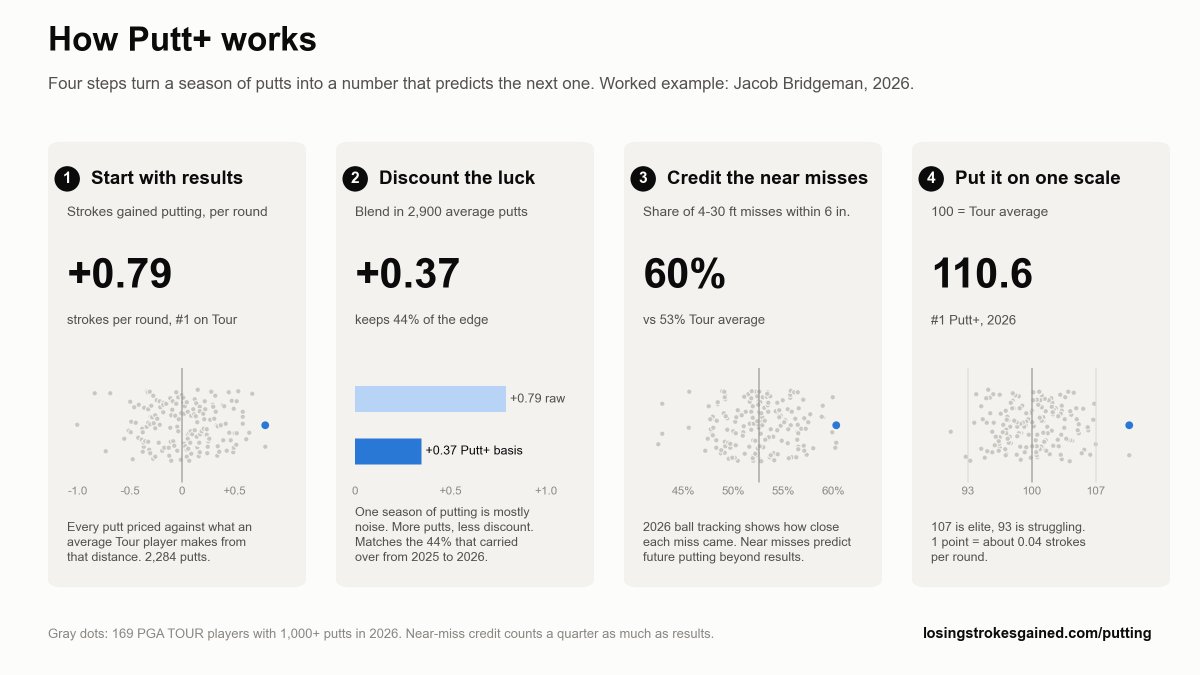
(8/n) PUTT+ aims to be a more predictive version of strokes gained by baking in putt path data. We start with results, discount luck, credit players for miss quality, and then scale it. Below you can see how it works, how it grades vs. SG, and whose owed putting regression: