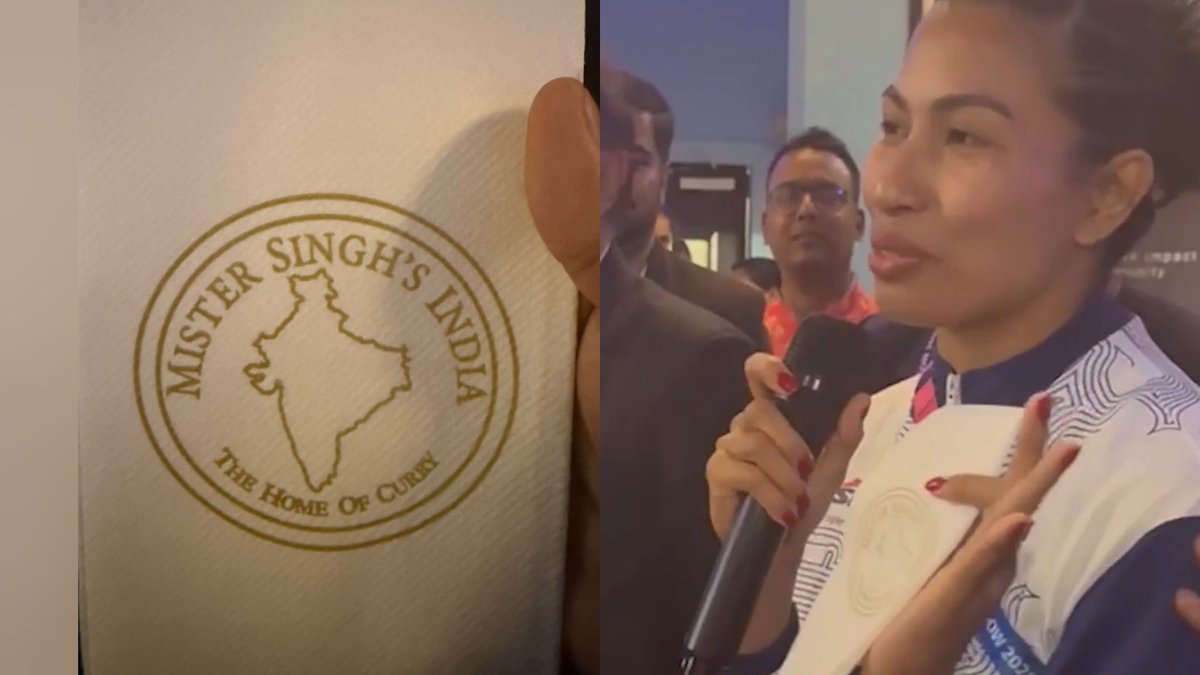
After winning a silver medal for India at the Commonwealth Games, Boxer Lovlina Borgohain visited a restaurant in Glasgow. There, she noticed a map of India printed on a napkin in which the entire Northeast was missing.
Lovlina, who comes from Assam, did not create a scene or react with anger. She politely informed the restaurant staff that the map was incomplete and explained why it was hurtful. The management acknowledged the mistake and assured her that it would be corrected.
For Lovlina, it was not just about a map. It was about acknowledging that every part of India belongs on the map, and every Indian deserves to feel seen.
Sometimes, the strongest punches are not thrown inside a boxing ring. They are delivered with dignity, calmness, and the courage to speak up when something is not right.
I taught JEE physics for years. That paper breaks strong kids in three hours.
This exam is five hours of theory and five hours of lab work, and these five did close to perfect scores on it.
Let me tell you what actually happened.
The International Physics Olympiad is the world championship of school physics. It was the 56th edition. Held in Bucaramanga, Colombia, from July 5 to 12.
381 students. More than 85 countries. Every one of them the best physics student their country could find.
India sent five kids.
All five came back with gold.
Their names are Kanishk Jain from Pune. Riddhesh Anant Bendale from Indore. Rishit Garg from Dwarka in Delhi. Shresth Suraiya from Mumbai. Svarit Joshi from Ahmedabad.
We know a hundred cricketers by their nickname and not one of these boys. :)
That clean sweep put India at joint World Number One. Tied with China, Russia, Kazakhstan, South Korea and Taiwan.
Those are countries that pour serious money and national pride into science education. We are standing level with them.
Now here is what the exam actually was.
Two papers. Each five hours long.
The theory paper had three problems. One on the thermodynamics of paramagnetic cooling. One on the photoionisation of ozone. One on the dynamics of electron positron pairs.
The experimental paper was another five hours in a lab, working through heat transfer and thermodynamic processes in fluids.
That means you get given equipment you have never seen, and you have to design your own experiment, take your own readings, handle the errors, and reach a real answer.
Not multiple choice. No shortcuts. No pattern recognition. You either understand physics or you sit there for five hours.
HBCSE says the Indian students were near perfect on theory and excellent on the practical too.
Now, this was India's 27th appearance at the IPhO.
Across all those years, about 44 percent of Indian students have won gold, 41 percent silver, 10 percent bronze.
In the last ten years, every single Indian student has come home with a medal. 62 percent gold, 38 percent silver.
Not one kid has gone and come back empty handed in a decade.
Five golds in one year has happened only twice. This year, and in 2018.
So who built this.
The programme is run by HBCSE, the Homi Bhabha Centre for Science Education. It sits under TIFR, which sits under the Department of Atomic Energy.
They run the whole funnel. A national exam, then a national olympiad, then a brutal selection and training camp, and out of everyone in the country, five kids get on a plane.
The team was led by Professor Anwesh Mazumdar of HBCSE-TIFR and Dr Leena Joshi from St Xavier's College, Mumbai.
The scientific observers were Professor Ananda Dasgupta from IISER Kolkata and Nisha Kelkar from Gogate-Joglekar College in Ratnagiri.
Yes. Ratnagiri. A college in a small coastal town in Maharashtra.
This is public education doing something the private coaching industry could never do on its own.
The coaching industry is very good at one thing. Teaching you to solve a known problem fast.
That is what JEE and NEET reward, and I say that with love because I was part of that world.
But an olympiad paper does not have a known type. There is no shortcut chapter. There is no formula sheet that saves you. You have to sit with a problem you have never seen and think.
That is a completely different muscle. And a government funded centre has been quietly building it in Indian teenagers for 27 years.
So yes, be proud. Loudly.
HBCSE also shared that around 64 percent of India's olympiad medallists go on to do a PhD.
But only about 32 percent of medallists end up settling in India.
I do not say that to spoil the moment. These kids owe the country nothing. They earned every option they have.
But it should tell us something. We are excellent at finding this talent. We are excellent at training it. We are still not great at giving it somewhere worth staying.
Congratulations Kanishk, Riddhesh, Rishit, Shresth and Svarit. This is one of the best things an Indian did this year and most of the country will never hear about it.
Oracle fired 12,000 of its Indian workforce and is expected to sack more.
Another reminder of how fragile stability is in the private sector. One secures employment, income begins to flow, long-term plans take shape, home, car, loans, EMIs. And then, a single decision by the corporate to “rationalize” or “downsize,” and everything collapses overnight.
Unless you quickly re-enter the job market, fixed liabilities don’t pause; they compound stress and can upend an otherwise steady life.
While you earn, you must pay taxes. The moment you lose your job, you’re on your own. In fact, you even have to pay tax on the severance also.
Maybe it’s time to introduce reforms, such as mandating severance pay ranging from three months to one year based on an employee’s tenure, as is the norm in the West; allowing EMI pauses for a 3-6 months; and providing a time-bound monthly allowance from the govt for involuntary job losses.
If Ladla/Ladlis can get free money, free ration, free water, and electricity, without paying any income tax, why not support a worker who has been paying taxes and contributing?
Dear Telecom companies,
I have two SIM cards. One is for personal use and the other is for a different purpose. I do not need data on the second SIM, so why am I forced to buy monthly plans with data?
I am ready to pay for validity, calls, and SMS. I do not want your data. Many people already have broadband at home and they also do not want your data.
Just because you have good signal across India does not mean you can do whatever you want. You have removed small plans, and your voice-only plans now cost almost the same as regular plans.
Trust me, these companies will do anything to earn more profit. It will get even worse in the future if TRAI keeps sleeping.
Savita Ambedkar writes about the morning routine of B.R. Ambedkar
---
It was my duty to wake him up every day sometime between half past seven and eight o'clock. I, however, would be up and about at half past five or six. As soon as I got up, I would take a round of the two expansive gardens around our bungalow.
I would then take a bath and prepare the English-style tea for Doctor Saheb: the brew in one pot, milk in another and sugar in a separate container. The tray thus readied, I would carry it into his bedroom and wake him up.
After finishing his tea and skimming through the papers, he would do his exercises. He would then go to the veranda of the bungalow and stretch himself out in an easy chair.
Our driver would then arrive, apply massage oil on him and give him a nice rubbing down. This massage would carry on for about half an hour, during which time our driver would be bathed in sweat.
Doctor Saheb would then go to brush his teeth, wash his face, finish his toilet activities and go for his bath. He needed hot water for his bath. Very often I would give him his bath too. He would love it when I soaped him, scrubbed him and rinsed him.
He would sit like an innocent and obedient child when I gave him his bath. After the bath was over, I would help him dry himself. I would then dust talcum powder all over his body.
He would then come to the dining table for his breakfast by about half past eight or nine. You could call it an obsession, but it was his intense desire that I should prepare the breakfast items myself and serve them to him hot and fresh.
I had arranged for a hotplate and placed it right next to the dining table. As with his other meals, for his breakfast too he liked variety in what he ate. Whatever item he asked for, I would prepare it for him according to his liking and desire and serve it hot.
I would make a new dish for him almost every day and he would consume it with great joy and relish. Even with eggs I would do them for him in various forms turn by turn: boiled, half-fried, full-fried, omelette, mashed, scrambled, etc.
There would be hot toasted bread with butter to go with the eggs. He loved different kinds of jams too. He would then wash his eggs and bread down with coffee. He absolutely loved coffee.
He loved China crockery and we had a whole range of sets for different meals: for breakfast, for tea, for coffee, for lunch and dinner.
His instructions were clear-the sets should be used only for the purpose for which they were designed: tea set for tea, coffee set for coffee, breakfast set for breakfast, meal set for lunch and dinner.
Different sets for different occasions. We had a lot of crockery and cutlery sets too.
Once breakfast was over, he would get ready for office. He wanted me to help him get dressed. He would lift his arms up and I would slip the shirt on him and button it up for him. I had to help him put on the jacket too.
He would again stand with his arms raised so that I could put the jacket on him. Once the jacket was buttoned up, I would then be required to place a handkerchief in the breast-pocket.
The handkerchief had to be folded in a specific way so that one triangular edge showed neatly over the breast-pocket.
Once he had his clothes on, our cook Sudama would be ready to help him put on his socks and shoes.
Once he was properly dressed, he would set off at around nine or half past nine. His car would be waiting for him in the porch. Once Saheb began to move towards his car, I was expected to accompany him, open the door for him and shut it once he was seated inside.
He would then wave goodbye and I was required to stand on the stairs and keep waving to him till the car had driven out of the gate.
The above is an excerpt from Babasaheb: My Life With Dr Ambedkar by Savita Ambedkar
Disrespecting someone when they’re at their lowest says more about one’s character than their strength. Karma always has its way of balancing the scales — every word and act finds its way back.
The Lord never forsakes those who remain humble, steadfast, and devoted through pain and silence. His grace shields them, and in time, He restores their dignity in ways the world can never fathom
Hmm, this is the problem when the basics of dharma are not familiarised.
Deity is not stone. It's an archa avatar. It's an incarnation of lord Himself. Krishna and rama are vibhavataras. Deity or archa is archa avatar. An incarnation. You need to first understand that the deity is non different form Lord.
If the West really cared about de-escalation, they’d tell Pakistan: stop the provocation or lose IMF funds.
That alone would likely end the conflict. But they won’t, Pakistan is their tool to keep India in check. The US cares even less because Pakistan’s IMF cash indirectly circles back into buying weapons, a major chunk of which comes from them.
The global peace lobby is a farce. Not one word to the IMF. So yes, we’re on our own. But we’ll prevail.
India’s Abstention in IMF Vote on Pakistan Loan: Explained
Decision-Making at the IMF
▶️The IMF Executive Board consists of 25 Directors who represent member countries or groups of countries. It handles daily operational matters, including loan approvals.
▶️Unlike in the United Nations, where each country has one vote, IMF voting power reflects the economic size of each member. For instance, countries like the United States hold a disproportionately high voting share. Thus to simplify things, The IMF typically makes decisions by consensus.
▶️In cases where a vote is required, the system does not allow a formal "no" vote. Directors can either vote in favor or abstain. There is no provision to vote against a loan or proposal.
Why India Abstained
▶️India abstained from the recent IMF vote on approving a loan to Pakistan not due to a lack of opposition, but because IMF rules do not permit a formal “no” vote.
▶️By abstaining, India conveyed its strong dissent within the constraints of the IMF’s voting system and used the opportunity to formally record its objections.
India’s key objections included:
▶️India questioned the effectiveness of ongoing IMF assistance, noting that Pakistan has received support in 28 of the past 35 years including four programs in just the last five without meaningful or lasting reform.
▶️India strongly highlighted the Pakistani military’s continued dominance in economic affairs, which undermines transparency, civilian oversight, and sustainable reform.
▶️India firmly opposed providing funds to a country that continues to sponsor cross-border terrorism, warning that such support carries reputational risks for global institutions and undermines international norms.
GoI sources
Saw a video this morning of a Dogra man from a border town in Jammu saying, 'We've evacuated our kids, women, and elderly, but the men will stay to assist the Army.'
People living in India's border cities deserve applause. While the rest of us sit comfortably, discussing "tensions at the border" like it's just another headline, they live under the constant threat of war and attacks.
They hear the sirens. They’ve seen what shelling looks like. And yet, they stay. Their presence itself upholds our sovereignty. They open shops, send kids to school, go about life as normally as possible, not because they’re unaware of the risks, but because this is their home and they refuse to be pushed out by fear. Hats off brothers and sisters!
Poor and middle-class households send their kids to the fauj to safeguard the very freedom that lets rich, entitled brats sit in their safe homes and write articles calling those very soldiers settlers, aggressors, paid mercenaries, and worse.
Dear border states thank you for shielding the rest of the country. It's your sacrifice & bravery which is ensuring safety of the rest of the Nation. It's duty of the rest to provide all support.