I walked into a 3-year-old Livspace designed duplex in Ansal Esencia, Sector 67, and the first thing I checked was the price, not the interiors. Most owners who call me for a mandate have a number in their head that buyers aren't paying, and at that number the property just sits.
It happens because people are emotionally attached to a home they've lived in, so sometimes the number in their head is a little higher than what buyers are paying today, and part of my job is to talk that through with them honestly.
This duplex is around 3 years old, designed by Livspace and thoughtfully curated, and I'm telling you, it suits a family of 5 or 6 perfectly. The owner is moving out of the city, and he knows it'll suit someone whose family lives the way his did.
It's the 3rd and 4th floor of a 250 sq yd east-facing plot. The lower floor has 2 bedrooms, the kitchen and a family lounge, and the upper floor has 2 bedrooms, a study and a den. There's a lift and parking for 4 cars.
I'm calling it a duplex, but it's kind of a triplex, because the full terrace comes with it; put a pergola up there and it becomes your party place in the winters.
The street is closed, so cars don't keep passing in front of your house, and there's a big park close by. For this size, the price is very good against the new floors in Ansal Esencia and around it.
A bowl of rice puts more sugar into your blood than most desserts.
Dr. David Unwin breaks down what common starchy foods turn into once they’re digested:
- 150g white rice ≈ 10 teaspoons of sugar
- 150g boiled potato ≈ 9 teaspoons
- 2 thin slices of brown bread ≈ 6 teaspoons
- 1 banana ≈ 6 teaspoons
Then he gives the number that puts the rest in context. Your entire bloodstream, all 5 liters of it, holds about 4 grams of glucose. That’s a single teaspoon.
So one banana delivers six times the glucose your whole bloodstream carries at any moment. In a healthy body, insulin quickly moves the excess into your cells. In an insulin-resistant body, the system gets swamped and blood sugar spikes.
The part worth thinking about is what he says about young people. You can eat this way for years and feel fine, because your pancreas is working overtime to keep up. Feeling fine just means the bill hasn’t come due yet.
Compare that with steak and a big salad, or a three-egg omelette with cheese. Both are nutrient-dense, and both put almost no glucose into your blood.
None of these starchy foods taste sweet, and that’s why the comparison matters.
Starch is made of long chains of glucose, and digestion breaks it down into the same glucose that’s in table sugar. Unwin’s teaspoon figures come from each food’s glycaemic load, which measures how much a normal portion actually raises blood glucose. Each teaspoon equals 4g of sugar.
Shubh Diwali Shares Wali!
Step 1: Follow Us!
Step 2: Comment 'DIWALI' below, and we will send the complete research report with entry, target, and analysis straight to your DM!
A 24-year-old marathon runner dies just 3 km before the finish line. Could this happen to any of us?
🔸Rachel Apa, 24, collapsed while running the New York City Marathon on November 1, 2026. She was participating in her first marathon.
🔸Bystanders rushed to help. They found no pulse. CPR was initiated, and medical personnel used a defibrillator. Despite prolonged resuscitation efforts, she died in hospital.
🔸Her father told The New York Times that doctors attributed her death to rhabdomyolysis.
🔸This heartbreaking incident deserves attention from the running community.
As a doctor and a distance runner myself, I want to explain an important, potentially life-threatening complication of strenuous exercise.
This is a bit lengthy but please read it once; as it could potentially be life-saving.
Think your arteries just stiffen with age, no matter what you do? Think again.
Exercise isn't only training your muscles. It's schooling your blood vessels.
When you move briskly, blood flows faster and rubs along the artery walls.
This is called shear stress. Your arteries respond by remodeling:
→ They widen
→ They become more elastic
→ The inner lining (endothelium) works better
That's a key way movement helps protect your heart and brain.
Arterial Intervals
• Warm up with 5 minutes of easy walking
• 3 rounds: 3 minutes brisk (you can talk, but only in short phrases) + 2 minutes easy
• Cool down with 5 minutes of easy walking
• 25 minutes total, 4–5x/week
Safety cue: brisk, not breathless. If you feel chest pain, dizziness or unusual shortness of breath, stop.
If you have heart disease, check with your doctor first.
Bookmark this for your next walk. When did you last walk fast enough to feel your heart working.
Hypertension (Tinken et al., 2010),
#HeartHealth
Microsoft didn't offer 60,000 employees money to leave because AI is too good. It's actually something else.
I kept seeing the same panic everywhere this week. One in four Microsoft employees just got an exit offer, so AI must be coming for all our jobs next. Honestly, I think that take is completely wrong.
Microsoft is pouring $175 billion into AI infrastructure in 2026 alone. When you're spending so much, you start hunting for savings everywhere, and for almost every company, people are one of the biggest costs.
Also, this is what people aren't talking about: the offer went to Microsoft's own Copilot and AI teams too. If AI was so good and important, then why would you show the door to the very people building it?
Most people are confusing spending on AI with AI being so good that it just made 60,000 jobs obsolete.
Throwing billions at something doesn't guarantee it will pay off, and right now nobody knows if this bet will.
Don't get me wrong, AI is impressive, and I've seen its benefits firsthand. But spreading panic that it's about to take everyone's job helps no one.
So stop losing sleep over whether AI will take your job. Focus on getting better at what you do and staying prepared, because that's what protects you, with or without AI.
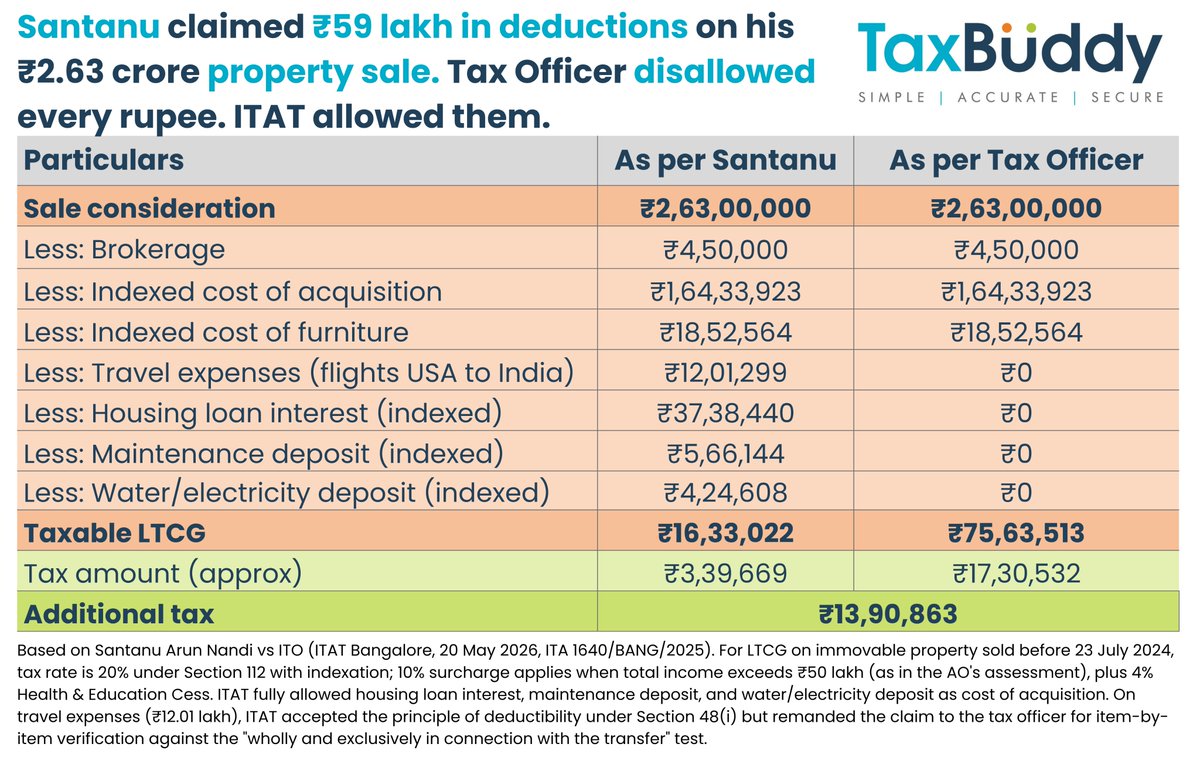
Santanu is an NRI who sold a property in Bangalore for ₹2.63 crore.
He claimed ₹59 lakh in deductions including ₹12 lakh in flight tickets USA to India for the sale.
The tax officer rejected all four.
But ITAT allowed it but with one condition. Here’s all about it. 🧵👇
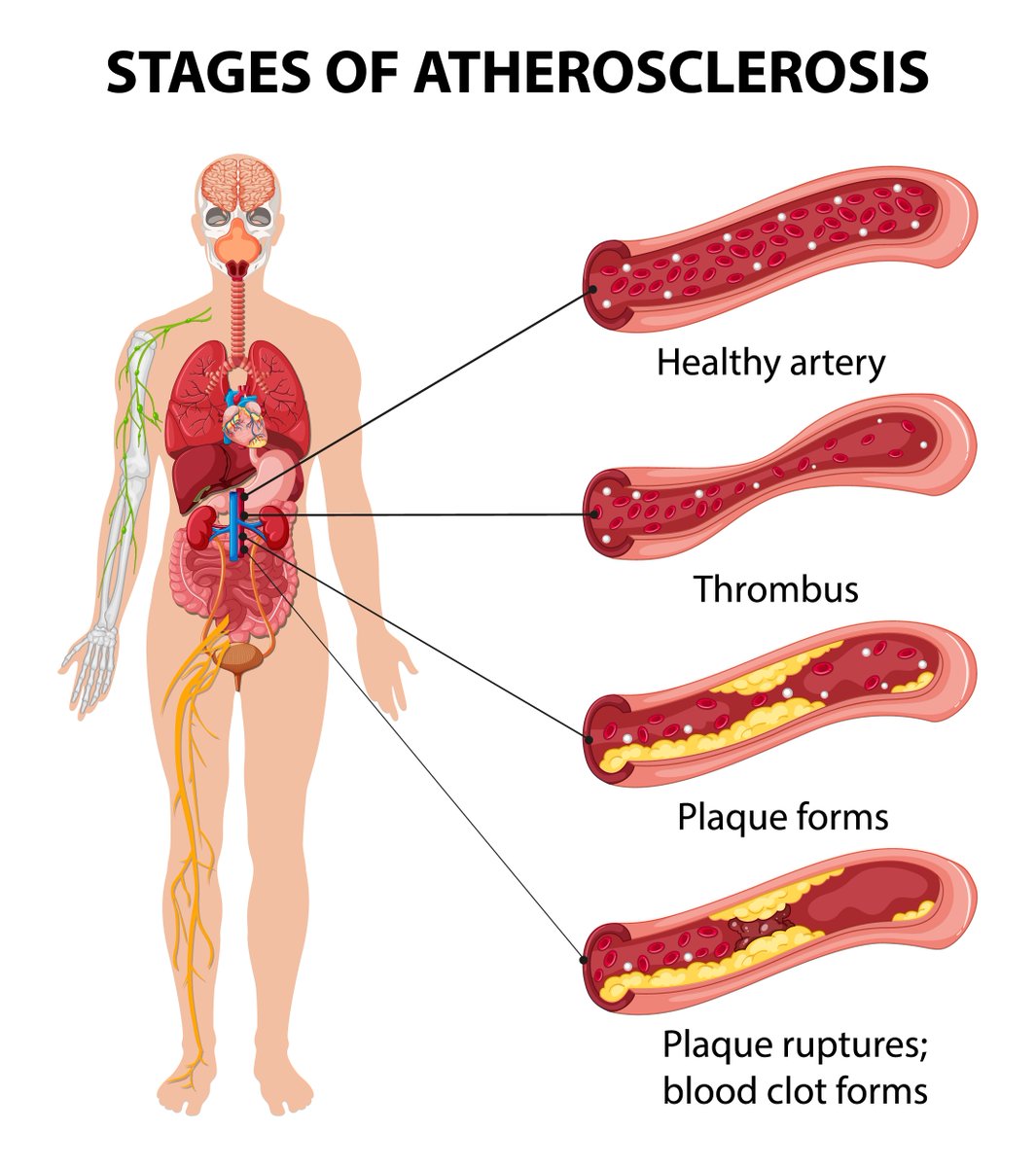
Reduce BP/ Arterial plaques & keep good heart health 1. Do wall sits (stand against a wall with feet 1 foot in front, hands firm on the wall & lower body bringing thighs parallel to ground. Keep this position for 2 minutes, 3 sets a day, 4 days a week.
2. To avoid waist & belly: Fast for 16-18 hours a day. Avoid sugar, hidden sugars, fried stuff, seed/veg oils & control starch intake. Systolic & diastolic BP will lower. Limit alcohol. Zero consumption is ideal; no smoking. 3. Take pomegranate, beet root, arugula (available in amazon) extra virgin olive oil & mustard daily to produce more nitric oxide.
4. Sleep 7-8 hours, avoid stress
5. Do brisk walking outside in daylight for 30 minutes. To join Youthful Elders, send your no, name & request to 9895471704.
Two software engineers vacate identical ₹85,000/month 3BHK flats in Bengaluru after a 3-year lease.
Both deposited ₹4.5 Lakhs in security deposit.
Both have moving trucks packed on the street below and flights to catch in 4 hours.
At 11:00 AM, the landlord walks in with a clipboard:
"Walls have scuffs, tile grout is stained, wooden floor needs polish. Painting: ₹1.4L, carpentry: ₹50K, deep cleaning: ₹25K, plus 1 month vacancy loss: ₹85K. Deducting ₹3 Lakhs. You get ₹1.5 Lakhs in 45 days. Sign this move-out settlement slip, or security won't open the society gate for your moving truck."
Tenant A panics, argues for 2 hours, surrenders to the gate-lock threat, signs the slip, and loses ₹3 Lakhs.
Tenant B says 2 calm sentences.
20 minutes later, the landlord transfers 100% of the ₹4.5 Lakh deposit via IMPS with ₹0 deducted, and signs the gate pass.
Same society. Same ₹3 Lakh deduction. Same moving truck waiting.
The only difference?↓
Your lymphatic system has a 70% overlap with your 30 feet of gut.
If you have gut issues, you will experience bloating, sluggishness, puffiness & brain fog.
He has received all three prestigious civilian honours: Padma Shri, Padma Bhushan, and Padma Vibhushan.
He is one of the very few individuals in India to have received all three. Just imagine that for a second.
He has received honorary doctorates from 55 universities across the world.
He has authored 25 books and published 284 research papers.
He went on to lead 40 research laboratories as the Director General of CSIR, one of India's largest scientific research organizations.
He's none other than Dr. Raghunath Mashelkar, one of India's most celebrated scientists, who has played a significant role in transforming India's position in global research and innovation.
But what makes his journey even more inspiring is where it all began.
He lost his father when he was just 6 years old. His mother worked extremely hard to raise him, and there were times when even getting two meals a day was a struggle.
He walked barefoot to school until the age of 12, studied under streetlights, and his mother once had to borrow just Rs. 21 to pay his school admission fees.
Despite all these struggles, he ranked 11th in Maharashtra in his SSC examinations. He almost gave up further education because of financial difficulties, but a scholarship of Rs. 60 per month from the Sir Dorabji Tata Trust helped him continue his studies.
He went on to complete his PhD and build a successful research career abroad. But in 1976, he chose to return to India and joined the National Chemical Laboratory at a salary of just Rs. 2,100 per month.
When he became the Director of NCL in 1989, the laboratory had not secured a single US patent in 39 years.
At a time when Indian laboratories were largely focused on copying foreign technologies, he wanted India to develop technologies that even the world's biggest companies would want to buy.
And he made it happen. Under his leadership, NCL went on to build research partnerships with global giants like General Electric and DuPont.
He also played a major role in challenging US patents on India's traditional knowledge, including turmeric and basmati rice.
Even today, in his 80s, he continues to champion affordable innovation and support young Indian innovators developing technologies that can improve millions of lives.
His philosophy has always been that it is not the power of the budget that matters, but the power of the idea.
From a child whose mother struggled to arrange Rs. 21 for his education to a scientist honoured by 55 universities across the world, his journey is nothing short of extraordinary.
If there has to be an epitome of inspiration for every young Indian who dreams of achieving something big despite limited resources, it has to be him. :)
Watch the full conversation only on The India Opportunity Show. Link in comments.
P.S. The India Opportunity book is out now! Grab your copy on Amazon. :)
Don’t wait for symptoms to tell you something is wrong.
Get ahead of your health with Cent — a comprehensive preventive health check covering 300+ biomarkers.
Early awareness can change everything.