✅ Correct Answer: B) 82
Explanation:
- "5 + 3" = "8"
- "8 + "2"" = ""82""
Java evaluates from left to right. Once a String is involved, "+" performs concatenation.
Did you get it right? 👀
#Java#CodingQuiz
Java developers, don't answer too quickly! 👀
What will this code print?
Pay attention to how Java evaluates the "+" operator.
Comment your answer: A, B, C, or D. 👇
#Java#CodingQuiz#Programming#100daycodechallenge
✅ Correct Answer: C
Output:
[1, 2, 3] [1, 2, 3] [1, 2, 3]
Why?
The default argument "b=[]" is created only once when the function is defined.
- "func(1)" → "[1]"
- "func(2)" → "[1, 2]"
- "func(3)" → "[1, 2, 3]"
#Python#CodingQuiz#Programming
Think you know Python lists? 🐍
This one catches people who understand the basics but miss a subtle Python behavior.
What will this code print?
Reply with A, B, C, or D. No cheating! 👀
#Python#CodingQuiz#100DaysOfCode
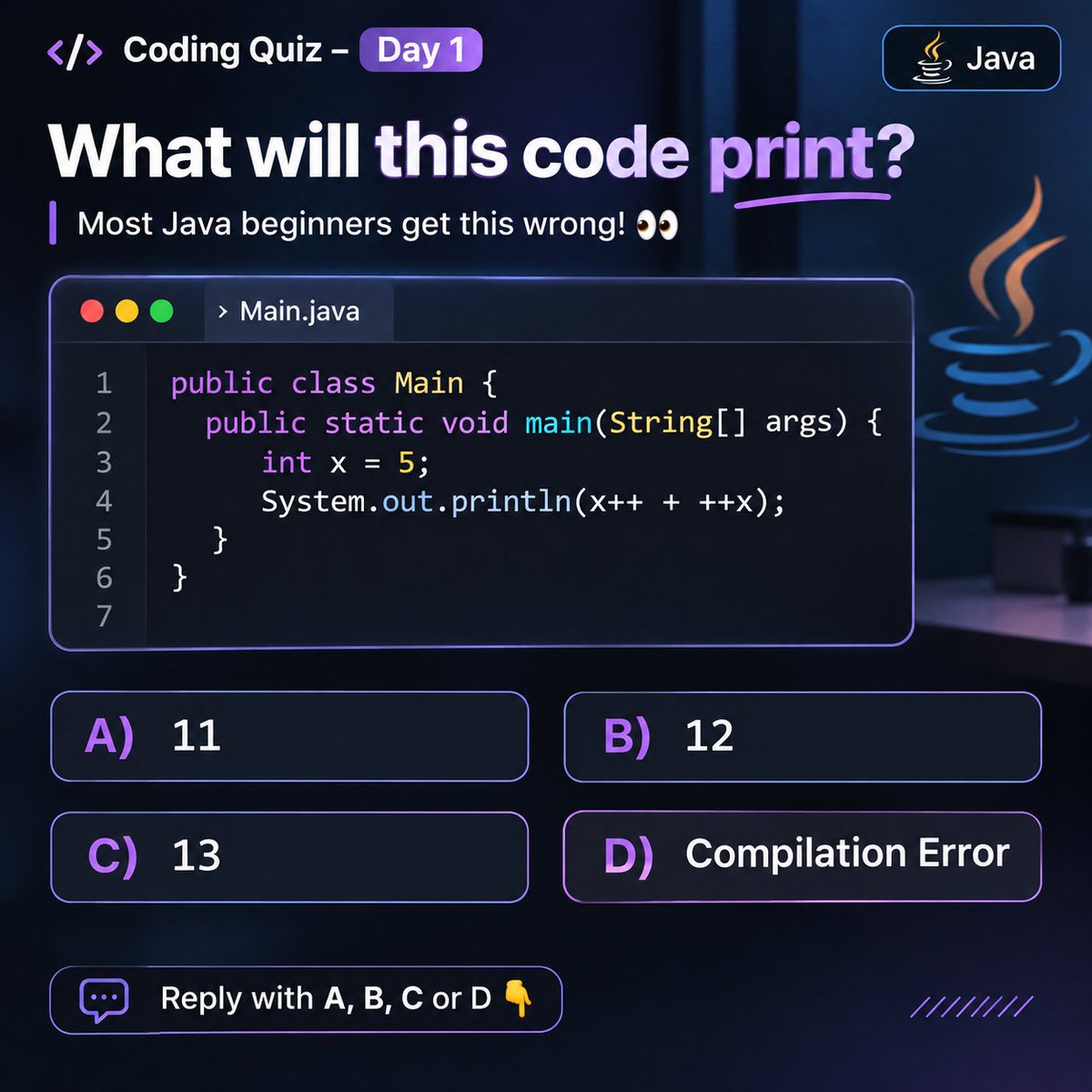
Most Java beginners get this wrong 👀
What will this code print?
Don’t guess—trace it carefully.
Reply with A, B, C, or D. 👇
#Java#CodingQuiz#Programming
Framework vs Library 👨💻
They both help you build software faster, but there's one fundamental difference:
🔹 Library: You call it when you need it.
🔹 Framework: It provides structure and often calls your code.
Examples: • Libraries → React, NumPy, Axios
#Programming#WebDev
Frontend vs Backend vs Full-Stack — here’s the takeaway 👇
🎨 Frontend: UI, design, and user experience.
⚙️ Backend: Server logic, APIs, and databases.
🚀 Full-Stack: Works across both frontend and backend.
Beginner tip: Start with one side
#Programming#WebDevelopment#Coding
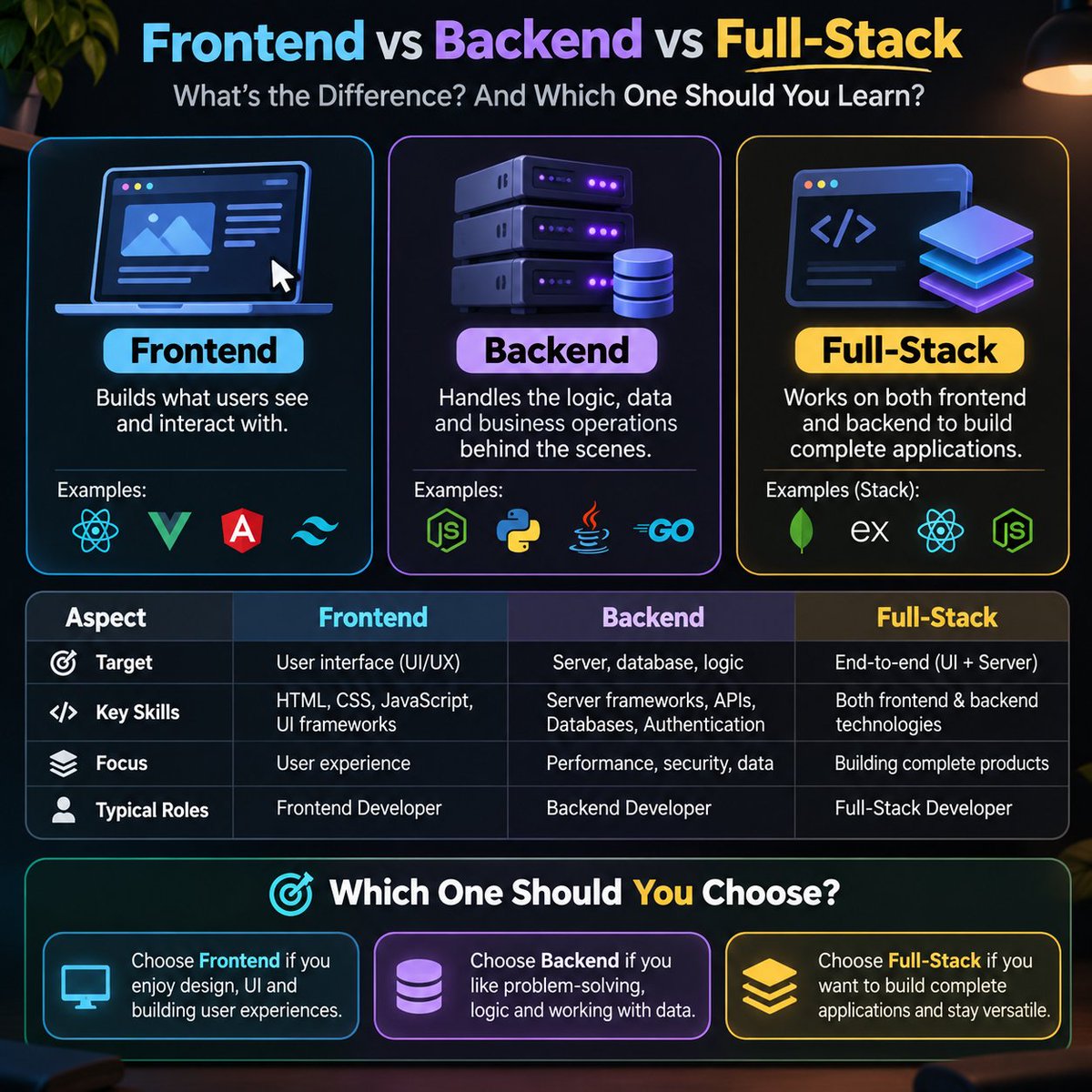
Frontend vs Backend vs Full-Stack 👨💻
What’s the difference ?
🎨 Frontend → Builds what users see and interact with.
⚙️ Backend → Handles logic, databases, and server-side operations.
🚀 Full-Stack → Works across both frontend and backend
#Programming#WebDev#tech#Coding
One detail worth knowing 🌐
DNS doesn’t always need to look up a domain every time you visit a website.
Your browser or OS may already have the IP address cached.
That’s one reason repeat visits can be faster.
#WebDevelopment
You type a URL and a website appears.
But what actually happens between those two moments? 👀
DNS,HTTPS,HTTP requests, servers, and browser rendering—all working together.
Here’s the journey, simplified into 7 steps.
Which step did you find most interesting?
#WebDev#Tech
Correct answer: B — "[4, 16]"
Why?
1. "map()" applies the function to every element.
2. The numbers are squared.
3. "filter()" keeps only the values satisfying the condition.
Remember: "map()" transforms. "filter()" selects.
#Python#Programming#Coding
✅ Java String Pool — Answer
Expected output:
true
false
true
Explanation:
- "a == b" → "true" because identical String literals share the same pooled object.
- "a == c" → "false" because "new String()" creates a separate object.
✅ Correct Answer: C
Expected output:
false
true
💡 "==" compares object references, while ".equals()" compares String content.
Remember: Use ".equals()" when comparing the actual text of two Java Strings. ☕
@PythonPr ✅ Correct Answer: B
Expected output:
[10, 2, 3, 4, 5]
[1, 4, 9, 16]
💡 Explanation:
- "squares" is created before "nums" changes.
- "nums[0] = 10" changes the original list.
- "nums.append(5)" adds "5" to the original list.
- "squares" remains same bcz of a separate list.