Can a few examples change what a vision-language model actually sees? Our new #NeurIPS2026 paper shows that in-context learning can substantially improve visual reasoning on counterfactual images, without updating model weights.
Check out @KunWang0129's thread below! 👇
Do vision-language models actually lack visual understanding, or are they held back by their learned priors?
In our #NeurIPS2026 paper, we find that in-context learning can help VLMs overcome misleading priors, improving accuracy by up to 27%.
🔗 https://t.co/aUQN9LbO1M
Do vision-language models actually lack visual understanding, or are they held back by their learned priors?
In our #NeurIPS2026 paper, we find that in-context learning can help VLMs overcome misleading priors, improving accuracy by up to 27%.
🔗 https://t.co/aUQN9LbO1M
What happens to denoising when image generation takes just one forward pass? Turns out, the denoising process unfolds across the model's depth rather than over time. Check out @acaleb 's thread below! 👇
1/ I’m excited to share our work on “Depth as Time in One-Step Generative Models”!
https://t.co/M8OGqxykLk
TL;DR: We ask, when a model learns to generate an image in one forward pass, what happens to the denoising process? We observe that process unfolding over depth!
I've always wondered: Where does denoising go in one-step generative models? Turns out, it's hidden in the layers!
A very surprising finding, and I'm super proud of Arnold for this work! 👏
1/ I’m excited to share our work on “Depth as Time in One-Step Generative Models”!
https://t.co/M8OGqxykLk
TL;DR: We ask, when a model learns to generate an image in one forward pass, what happens to the denoising process? We observe that process unfolding over depth!
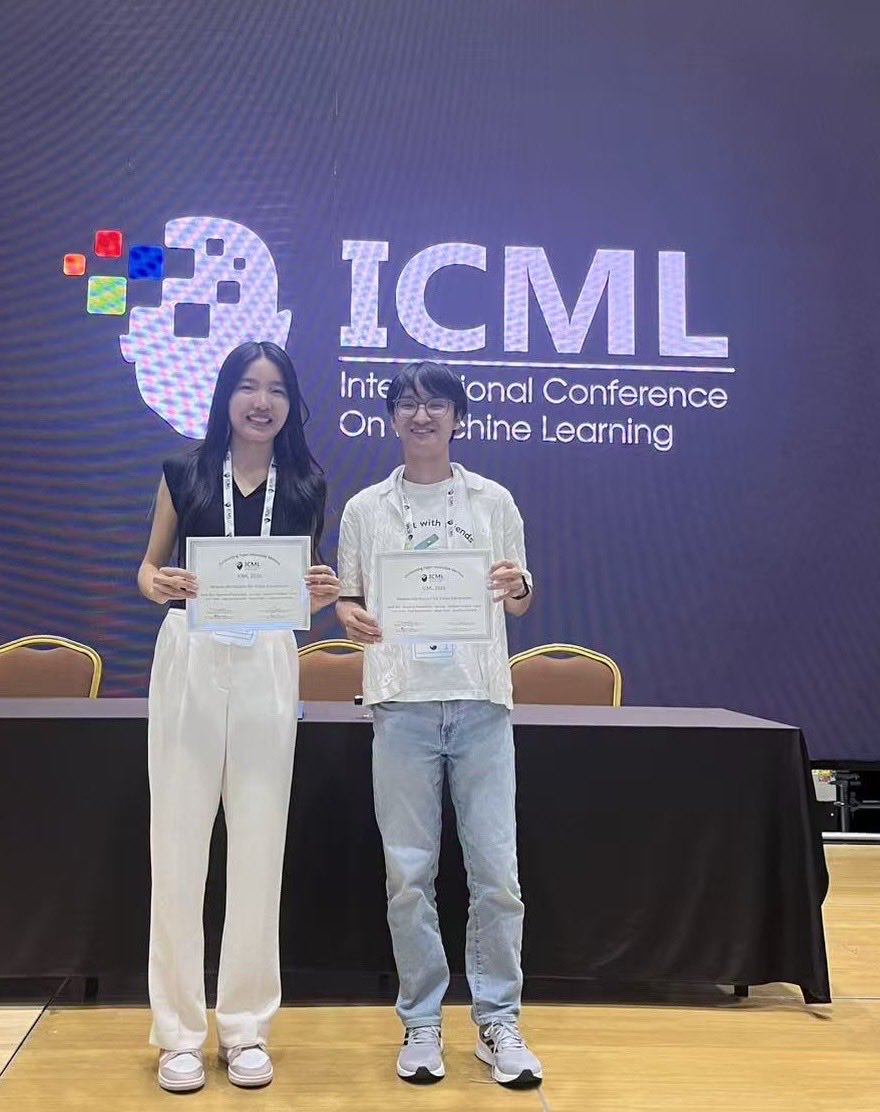
So grateful for the outstanding honorable mention at the main conference for motion attribution as well as a best paper award at f2s workshop for our most recent work on memory for world models❤️
Both works ask a similar question: how can we better compress and control the temporal information that shapes a video model’s behavior.
What a week! I learned a lot from the community. Excited for what’s next in world models 🥰
#ICML2026
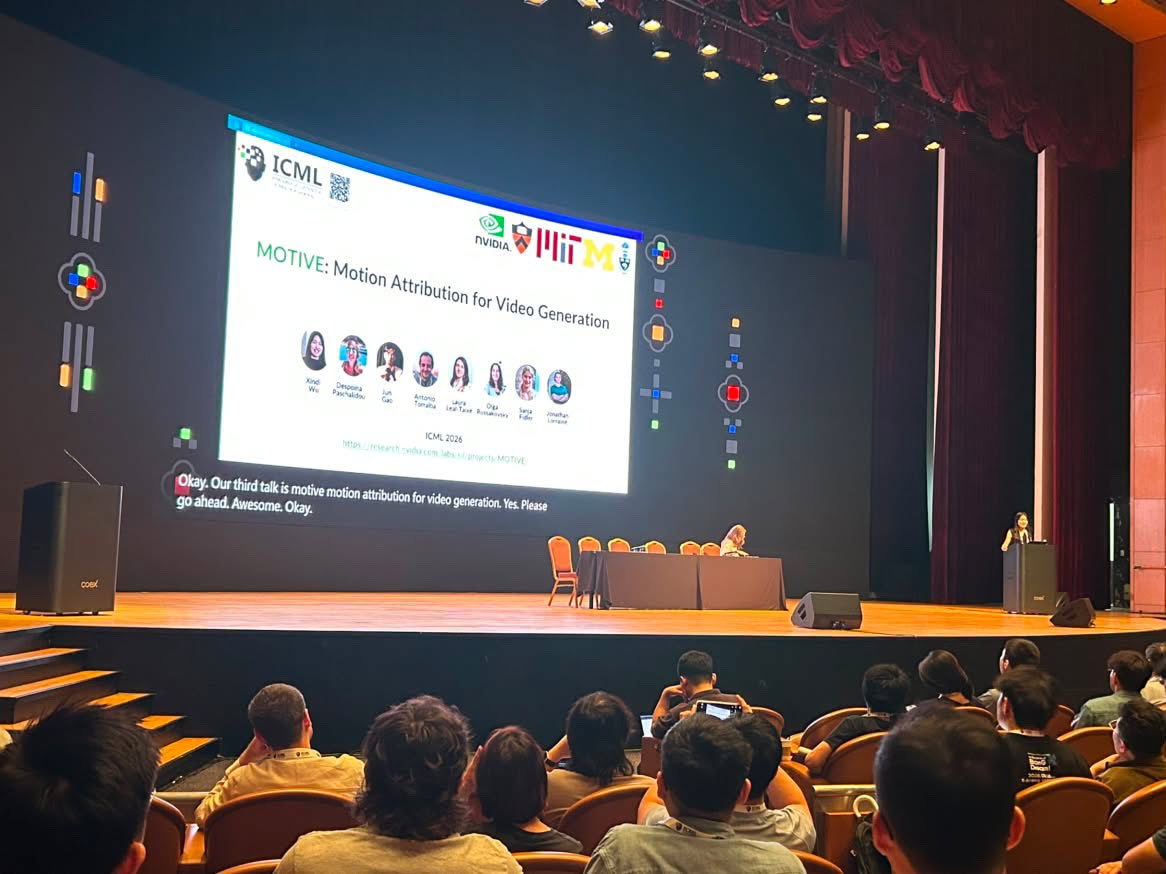
Excited to share several recent works at #ICML2026! 🇰🇷 Happy to meet & chat about world models, video generation & data centric multimodal ML! DMs are open
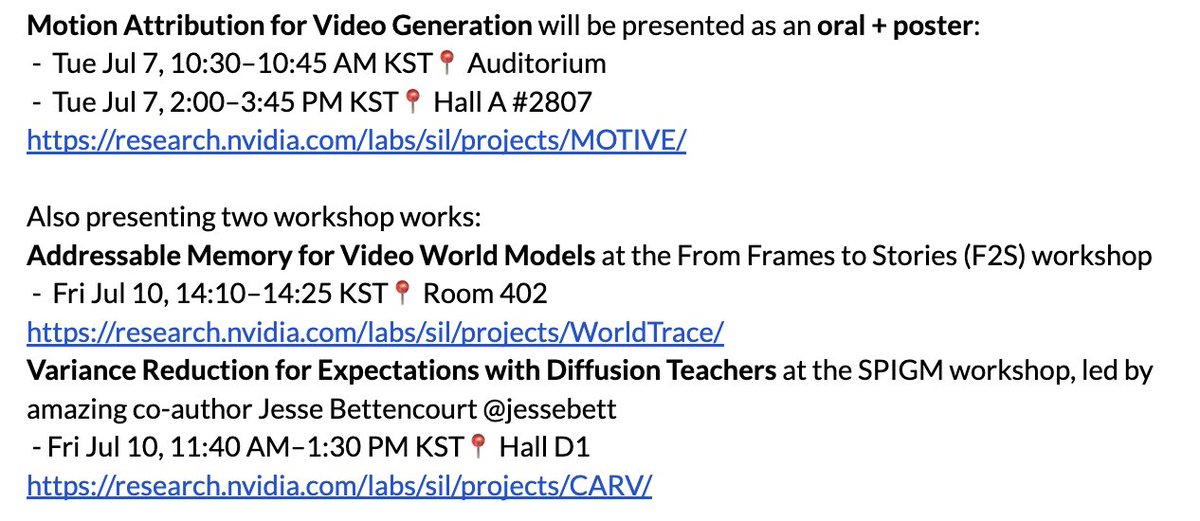
Motion Attribution for Video Generation will be presented as an oral + poster:
- Tue Jul 7, 10:30–10:45 AM KST📍Auditorium
- Tue Jul 7, 2:00–3:45 PM KST📍Hall A #2807
https://t.co/TbKXjQMN3H
Also presenting two workshop works:
Addressable Memory for Video World Models at the From Frames to Stories (F2S) workshop
- Fri Jul 10, 14:10–14:25 KST📍Room 402
https://t.co/6mmp5jKbft
Variance Reduction for Expectations with Diffusion Teachers at the SPIGM workshop, led by amazing co-author Jesse Bettencourt @jessebett
- Fri Jul 10, 11:40 AM–1:30 PM KST📍Hall D1
https://t.co/AvAsXkNk2b
https://t.co/TbKXjQMN3H
At the end of May, David Beeson ‘26, graduated from @Princeton with a degree in computer science. In the fall, he will enroll at the @UniofOxford to pursue a master’s degree in computer science with a specialization in artificial intelligence.
How can we distill large text-to-image models without losing the diversity and controllability of the original teacher model?
Excited to share our new ICML 2026 paper: Restoring Initial Noise Sensitivity in Text-to-Image Distillation via Geometric Alignment.
#icml#generation
Fast T2I distillation often maintains high image quality but makes the student much less sensitive to initial noise. This hurts an important property of generative models: changing the input noise should meaningfully change the output, which matters for diversity, layout variation, and noise-driven control. In this work, we trace this issue to standard distillation objectives that enforce pointwise output matching and unintentionally flatten the teacher’s local input-output geometry. We propose GAD (Geometry-Aware Distillation), a plug-and-play objective that preserves the teacher’s local functional behavior by aligning responses to noise perturbations through Jacobian-vector products.
✅ Better diversity
✅ Stronger layout/control transfer
✅ Preserved visual fidelity
✅ No extra inference cost
Paper: https://t.co/sBt1xSm1FE
Code: https://t.co/bmE8qX5cNE
I will be presenting BeyondObjects this week at #CVPR2026. Come check out our poster on Thursday 4:30-5:30pm at the syndata4cv workshop (Room 607) or Saturday 4:45-6:45pm at ExHall A & F poster location 99. Happy to chat!
Happy to share that our paper “Motion Attribution for Video Generation” has been accepted to #ICML2026 as a Spotlight (top 2.2%) 🎉
https://t.co/TbKXjQMfe9
TL;DR: We introduce MOTIVE, a scalable, motion-centric data attribution framework for video generation that identifies which training clips improve or degrade motion dynamics, enabling better data curation and beyond.
Excited to share that RLTT has been accepted to #ICML2026! Looking forward to connecting with others working on Looped Transformers/Latent Reasoning/Mathematical Reasoning in Seoul🇰🇷!
Honored to receive the Best Paper Award at the Test-Time Updates Workshop @ ICLR 2026 🏆
Huge thanks to coauthors and workshop organizers!
https://t.co/585kRh5NzF
Honored to receive the 2026 Apple Scholars in AIML PhD fellowship! 🍎
Extremely grateful to my advisor @orussakovsky and all the incredible mentors, collaborators and friends I’ve had throughout the journey. Excited to push toward more scalable and capable multimodal system!
https://t.co/WhGTaD2PDa
We'll be presenting this work on video-text alignment this week at #ICLR2026!
Come check out our poster in Pavillion 4 #3405 in the Thursday AM session from 10:30am to 1pm. Happy to chat about PRH, repr learning, video understanding, or how vision plays into text models!
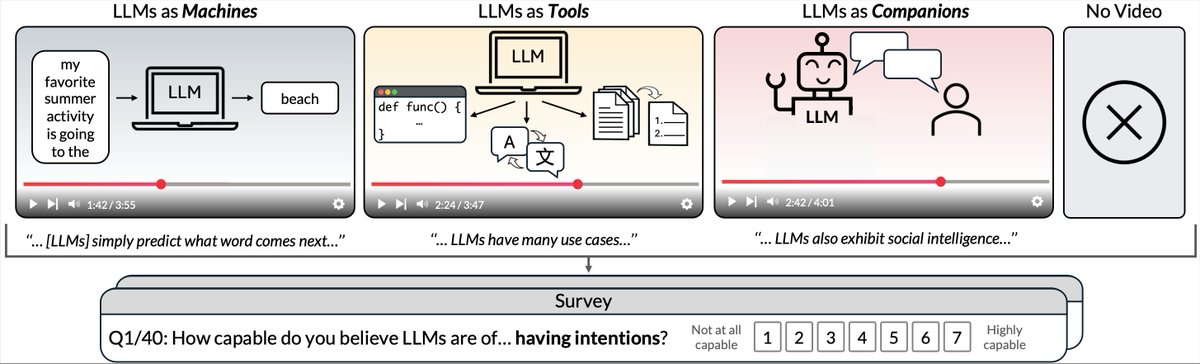
How should we talk about LLMs? Does it matter if we frame them as a machines 📠, tools ⚒️, or companions 👥? In our #CHI2026 paper, that these framings can alter what people believe about LLMs and how they use them. See 🧵for more!
Video models surprisingly can solve mazes, but inconsistently. We understand little about how they reason, making it hard to use such abilities.
We investigate the denoising process and find models commit to a plan early, letting us screen far more candidates for better perf.
🧵