Andrew Ng: "RAG" is becoming a "Graph" problem
This 1-hour deep dive shows why. Once agents can retrieve, judge, retry and call other agents, a simple RAG pipeline becomes something very different
Here are the 4 steps you must watching:
• 00:00 - Andrew Ng on why agents need iterative workflows
• 12:40 - turning RAG into a self-correcting retrieval loop
• 31:20 - building cyclic graphs with generate → critique → refine
• 55:40 - connecting specialized agents inside one shared graph
The steps: RAG → Self-RAG → Loops → Memory → Multi-Agent Graphs
Start learning it today, so you're building with it while everyone else is still catching up tomorrow
Most people use LLMs.
Very few actually understand how they work under the hood.
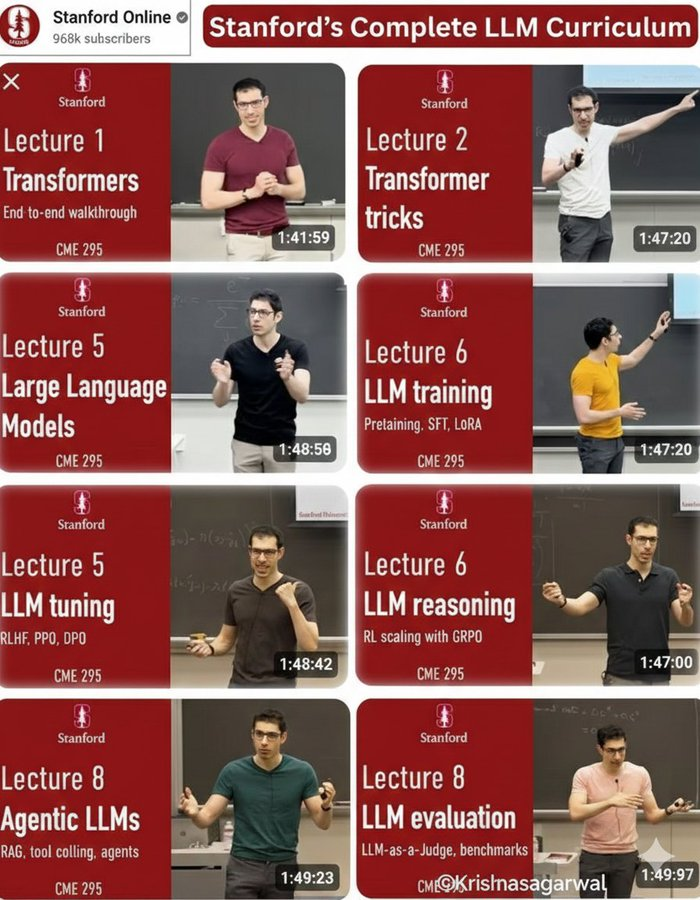
If you want to go from prompt user → real AI engineer, study these 9 concepts in order:
1️⃣ Transformers — attention, tokens, self-attention basics
https://t.co/65pkMfS4og
2️⃣ Transformer tricks — what makes them stable & scalable
https://t.co/mnUQYpQ9q2
3️⃣ From Transformers → LLMs — how scale changes behavior
https://t.co/uXOVnCsmGA
4️⃣ LLM training — where “intelligence” actually emerges
https://t.co/RFkBljQ8Pi
5️⃣ Instruction tuning & alignment — why fine-tuning matters
https://t.co/nmZB6JE0NK
6️⃣ LLM reasoning — why models fail + what improves them
https://t.co/UY8V9bZjAU
7️⃣ Agentic LLMs — models that plan, call tools, and act
https://t.co/EZbxuxBimR
8️⃣ LLM evaluation — measure beyond demos & vibes
https://t.co/yZ4Uig7uGw
9️⃣ What’s next — trends that actually matter
Bookmark this. Study step-by-step. Your prompts will level up — and so will your builds.
CC: Author
DeepSeek has open-sourced DeepSeek Harness.
(crossed 35k stars in a few hours)
it is built around one core idea: everything is a plugin
let me explain what that means:
the model adapter, the tool registry, the session log, and the agent loop itself are all plugins in DeepSeek Harness (dsh). every one of them can be swapped for your own.
that matters because changing how an agent assembles context usually means editing the framework's own source, or forking it and paying for that fork on every upgrade.
the mechanics that make it work:
→ a plugin claims a stable key like ctx .tools or ctx .llm, and other plugins find it by that key instead of importing a concrete implementation.
→ dependencies are declared rather than hand-sequenced, so load order falls out of what each plugin requires.
→ registrations are reversible, so unloading a plugin unwinds everything it registered.
→ one event, agent/pre-step, decides what the model sees. listeners can rewrite the claimed messages or reject them, which is where nearly all custom context engineering would land.
→ the session log is append-only and covers system prompts, reasoning, tool calls, subagent scheduling, and every context injection.
that last one is what i would actually reach for.
logging tool calls is standard, and when an agent misbehaves you are still guessing at what was in the window. here, model-visible means logged, asserted at runtime, so a new model-visible input requires a new session event.
deepseek was the last major lab shipping coding-grade models without a first-party harness to train against, and it now ships one that can delegate subagent work to Claude Code and Codex.
link to GitHub repo: https://t.co/Q7jrt6qxvk
if you want the full anatomy of what a harness actually contains, the article is quoted below.
El CEO de Google dándose cuenta de que uno de sus propios ingenieros de Cloud se subió a un escenario a construir una app entera con Claude en 26 minutos y acaba de filtrar todo el proceso gratis
We've added to the website a free PDF of the Bayesian Workflow book (for non-commercial purposes, like research and exorcism). We put so much work into this book, hope you all find value in it. https://t.co/f472XjM6cf
Don't waste 2 years learning to become an AI agentic engineer in 2026.
Andrew Ng, the godfather of AI, gave the complete playbook to become one from scratch.
1 hour course. Free:
• 00:00 - AI agent basics
• 12:12 - AI Agentic workflows & design patterns
• 53:27 - Practical tips for building AI agents
• 1:20:30 - self-improving AI agent loops
• 1:30:19 - multi-agent AI systems
I watched it last night.
Halfway through, I realized I could get into Anthropic in weeks, not years.
Bookmark now. Watch it. Then build your own AI agent.
Evaluating the Impact of Stair Climbing on Cardiovascular Risk Reduction: A Systematic Review and Meta-analysis
Physical activity in the form of stair climbing is associated with a reduced risk of cardiovascular and all-cause mortality.
https://t.co/O7PJO5o36N
Un ingeniero de Google Cloud acaba de mostrar cómo construir una aplicación completa con Claude desde cero.
Pasó 26 minutos en vivo en el escenario haciendo lo que la mayoría de los equipos tardan semanas en hacer.
Vale más que cualquier curso de codificación por vibras de $500, sin equipo, sin configuración, solo Claude y un objetivo.
Los que aprenden lo que Claude realmente hace están lanzando lo que todos los demás subcontratan a un equipo.
An MIT professor spent 50 years teaching the math that runs Google, Netflix, and every AI on earth.
He never made a dollar from any of them.
His name is Gilbert Strang. He has been at MIT since 1962. His textbook is the one every engineering program assigns. His lectures have been watched over 10 million times.
MIT charges $85,000 a year to sit in that classroom.
He put everything on YouTube for free.
The lecture that matters most is number nine. It is 45 minutes. It is the one where the entire subject stops being procedures and starts being ideas.
Most people who study math learn to follow steps. Row reduce this. Find the eigenvalue. Apply the formula. They pass the exam and forget everything in six months.
Strang teaches why the steps exist.
Independence. Whether any combination of your vectors secretly produces zero. If it does, you are counting the same information twice without knowing it.
Basis. The exact right number of vectors to describe a space. Not one extra, not one missing. Like a key that fits one lock.
Dimension. Not a geometric intuition. A theorem. Every possible basis for the same space has the same number of vectors. That number is what dimension actually means. You can prove it has to be true.
That last idea runs everything.
Google's PageRank decides which pages matter by finding the dimension of a relationship space across billions of websites. Netflix compression finds the basis of your taste from three thousand ratings. Every large language model reduces billions of parameters by identifying what is truly independent and what is redundant.
The formula is always the same. Rank plus free variables equals total columns. Dimension of what matters plus dimension of what is noise equals everything you started with.
Strang derived it on a chalkboard in 1970. It has not changed since.
Every senior engineer at Google knows this. Every quant at a hedge fund knows this. Every researcher building the AI systems you use daily knows this.
The lecture that explains it is free on MIT OpenCourseWare.
The textbook is sixty dollars.
The math costs nothing. The willingness to sit with it for 45 minutes before you write a line of code is the thing almost nobody does.
That gap is the entire edge.
🚨 Anthropic's CEO: "software engineering will be fully automated in 12 months."
two types of people right now:
type 1:
opens Claude, types something, gets an answer, closes the tab.
thinks they're using AI.
type 2:
knows the hidden features, settings, and shortcuts.
runs Claude like a power tool.
type 1 gets surprised in 12 months.
type 2 built the advantage already.
bookmark this. read it today.