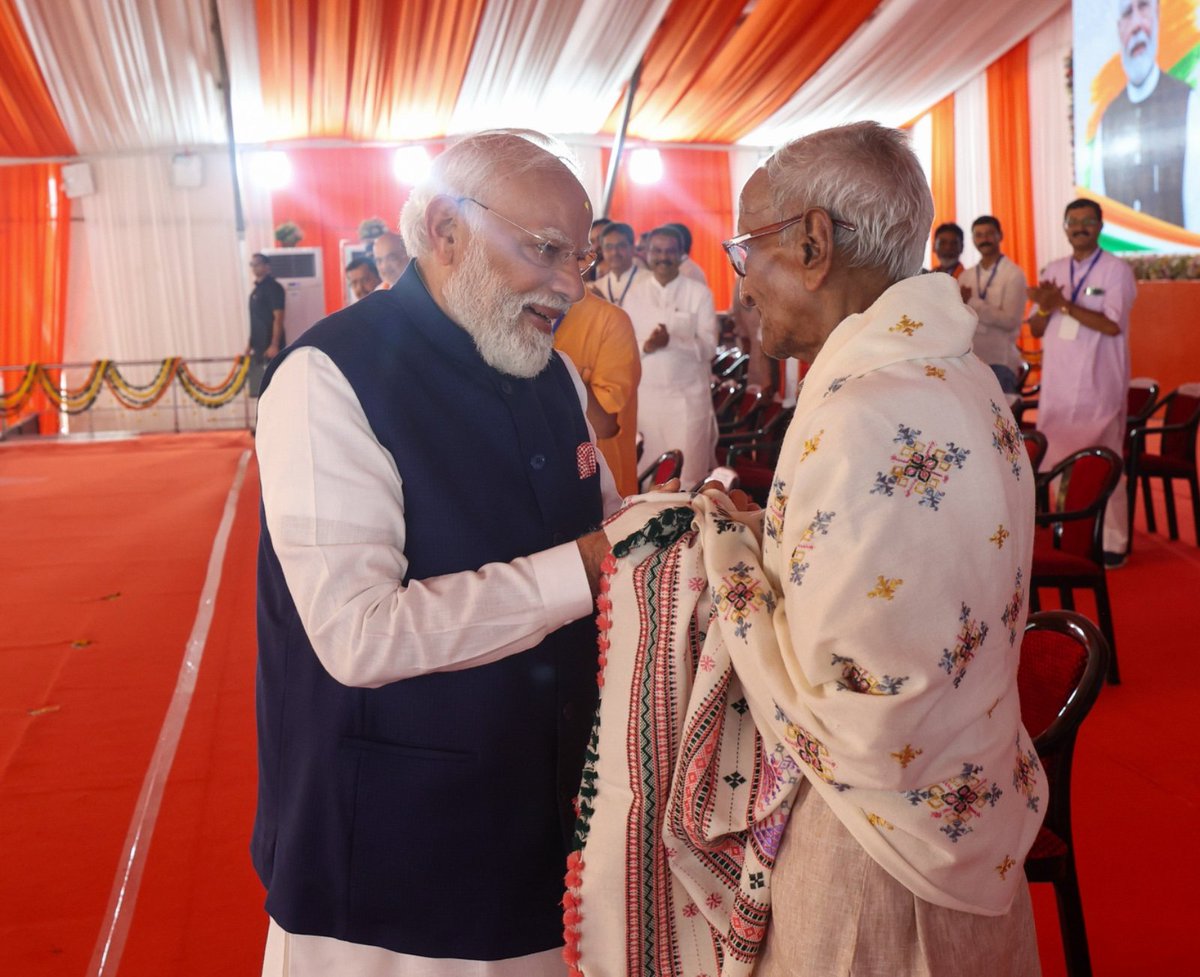
Today, as the first ever BJP Government takes oath in West Bengal, it is natural for all of us to remember Dr. Syama Prasad Mookerjee and his everlasting contribution to the nation and West Bengal in particular. No stone will be left unturned to fulfil his vision.
During the swearing in ceremony in Kolkata, had the opportunity to meet Shri Makhanlal Sarkar Ji. A devout nationalist, he worked with Dr. Mookerjee and was even arrested in Jammu and Kashmir while accompanying him. He dedicated his life to our Party, expanding its base across West Bengal, inspiring people from all walks of life to join the Party.
We in the BJP are proud that we have such motivating figures who have worked among the people and strengthened our Party.
#BREAKING: Israeli Prime Minister Benjamin Netanyahu congratulates US President Donald Trump after United States bombed Nuclear Facilities inside Iran.
What do you get the US President who just got a $400 million jet to play with? Nothing anyone but the billionaires can afford.
Which brings us to the Indian-American billionaire class—specifically, the Sundar-Satya-Srinivas types. The ones who dot Silicon Valley, sparkle on conference panels, and get accused of not doing enough for their country of origin in the way the Jewish diaspora, who are also US citizens, do for Israel. They stay silent during Pahalgam and do not spend money in the right places to further Indian interests. The expectation is that, having cracked the capitalist cheat code, they would now use their riches to nudge geopolitics. But we forget: these people are billionaires only in money. In their souls? They are still middle-class.
First-generation Indian immigrants carry a unique trauma: they once stood at a U.S. visa counter and said. “I will return to India after my studies.” Decades later, they are still afraid of being caught. They fear that showing open allegiance to India might somehow make the US revisit their entrance interview and then take back their H-1B... retroactively.
We misunderstand the Indian-American billionaire. Their dreams are modest—own a franchise cricket team or get Shah Rukh Khan to dance at their dayghters’s wedding. These are not acts of empire; they’re just deluxe versions of your uncle’s bucket list back in Pune.
Real power—world-shaping, memory-bending, Wikipedia-rewriting power—terrifies the middle-class Indian soul. It is loud. It draws attention. It makes you a target. Like Musk is.
Better to build a unicorn than a legacy. Better to be loved at Davos than feared in D.C. These billionaires grew up fearing their manager’s performance review, their neighbor’s gossip, their aunties’ unsolicited opinions on their life-choices. Even now, they’re haunted by the great middle-class ghost that whispers, “What will people say?” And so, they build, invest, disrupt—within their little sandboxes—but dare not declare.
They don’t understand that the privilege of being a billionaire is not caring what people think. It is deciding what people think. They don’t have to fit in. Others must now fit into the world they build.
Will this change? Maybe. Maybe in a few generations, Indian-Americans will finally exorcise the ghost of their origin story. Their children and grandchildren may grow super-rich, come to terms with the hyphenation of the American and Indian within them , and internalize the phrase "memory is policy"— collective memory drives political action, and that identity, not just income, defines who we are.
But until that happens, don’t expect any help from your super-rich NRI uncles and aunties.
What the fuck?
Columbia students held a memorial for Yahya Sinwar, the leader of Hamas who was the mastermind behind the October 7th massacre.
Am I tripping, or is this world beyond repair at this point?