@1g0rB0hm I am from Lithuania. I can't believe what I'm hearing—just a week ago, he and the entire ruling coalition were advocating for the repeal of Article 137 of the Constitution, which prohibits the deployment of weapons of mass destruction on Lithuanian territory.
@NakedHedgie I am from Lithuania. I can't believe what I'm hearing—just a week ago, he and the entire ruling coalition were advocating for the repeal of Article 137 of the Constitution, which prohibits the deployment of weapons of mass destruction on Lithuanian territory.
Paul Singer sent 115 analysts to figure out Bank of America's balance sheet - they found $75 trillion in derivatives on $150 billion of equity: "I challenge anybody in the room, outside of the room,come tell me what that looks like"
this is him explaining why no one - not regulators, not investors, not even the banks themselves - knows the real financial condition of any major bank, and why the next crisis will be worse than 2008
"$150 billion of equity, $2 trillion of assets on the balance sheet. but here's the problem - $75 trillion, that's with a T, of derivatives. that makes the financial condition of Bank of America completely and utterly opaque"
"I challenge anybody in the room, outside the room - come tell me what that looks like. what we found in '08 is the insiders didn't understand what was on their own balance sheets. Stan O'Neal, Dick Fuld, Chuck Prince - billions of fake AAA garbage"
bookmark & watch the full conversation ↓
“Nobody wants to work anymore.”
Wrong.
People just do not want to:
- Work 60 hours and still be broke
- Miss their kids growing up
- Get raises smaller than inflation
- Save in a currency printed out of thin air
- Answer emails on weekends
- Get replaced the second margins get tight
- Spend half their paycheck on rent
- Need debt just to survive
- Watch groceries, insurance, and housing go up faster than their income
People do not hate work.
They hate giving everything and getting nowhere.
What is the United States truly afraid of right now? It’s not missiles or aircraft carriers.
It’s the 12 trump cards China is quietly discarding. Today, I’m going to break down exactly how China has been dismantling Western technological dominance step by step. Each one of these cards carries enough weight to keep the West up at night.
1. China ditched GPS. Its BeiDou navigation system now delivers centimeter-level precision, with over 100 million global users. Even Middle Eastern oil tycoons are abandoning GPS for BeiDou. Can you believe it? America’s all-seeing eye over the world has just gone blind.
2. China ditched Boeing. The C919 has already racked up over 1,200 orders, wiping out $80 billion from Boeing’s value in a single year. What used to be “better to buy than to build” has flipped — now buying Chinese planes feels like the smarter choice. Boeing was caught completely off guard
3. China ditched American chips. Yangtze Memory’s solid-state drives have slashed international prices in half. After the return of Kirin chips, Qualcomm panicked and cut prices by 30% overnight. The very thing they once used to choke China has become its own lethal weapon.
4. China ditched Windows. UnionTech UOS has surpassed 5 million installations, with national ministries and major banks fully switching over. Microsoft’s CEO is losing sleep, but there’s nothing they can do about it.
5. China ditched Western medical equipment. Shanghai United Imaging’s CT scanners are now entering clinics in the US and Europe. Germany’s Siemens had to slash prices on similar models by 40%. Chinese medical tech has planted its flag firmly on Western soil.
6. China ditched foreign fuel engines. BYD’s blade batteries left Toyota executives tearing down cars on the spot to study them. Tesla lost $1.2 trillion in market value in just three months. The era of gasoline cars is ending — and in the new energy world, China sets the rules.
7. China ditched Oracle databases. Ant Group’s OceanBase has shattered world performance records. Bank transaction systems no longer have to bow to American pressure. This is real technological sovereignty.
8. China ditched Western industrial software. Zhongwang CAD forced France’s Dassault to beg for mercy with price cuts. Sany Heavy Industry used domestic software to design the world’s largest tunnel boring machine. China has ripped a massive hole in the West’s monopoly on industrial software.
9. China ditched dollar settlement. The RMB cross-border payment system now covers 180 countries and regions. Saudi Arabia is now selling oil in RMB. The first major crack in American hegemony was torn open by China.
10. China ditched Western genetically modified seeds. Yuan Longping’s team developed salt-tolerant rice yielding over 1,000 jin per mu. China’s bowls now hold Chinese grain. Monsanto’s seed patents have lost their power, and China has taken full control of its food security.
11. China ditched American social media. Xiaohongshu (RedNote) has grabbed 30 million American users. Zuckerberg is watching helplessly as his daily active users plummet while Chinese social apps explode across the ocean.
12. Finally, China ditched Western military equipment. The Fujian aircraft carrier’s electromagnetic catapult surpasses America’s Ford-class, and DF missiles have forced carriers to keep their distance. The U.S. military-industrial complex held emergency meetings overnight.
⭕️This isn’t just technological progress. These are twelve tolls of the bell signaling the decline of Western hegemony.
🔶Written by professor Yang Fan, born in 1951 in Beijing, is a professor of economics and doctoral supervisor at China University of Political Science and Law. He serves as Chairman of the Academic Committee of the Business School and was a visiting scholar at Peking University’s China Center for Economic Research. He is also the Executive Director of the Economic Research Association at the National Defense University.
BREAKTHROUGH:
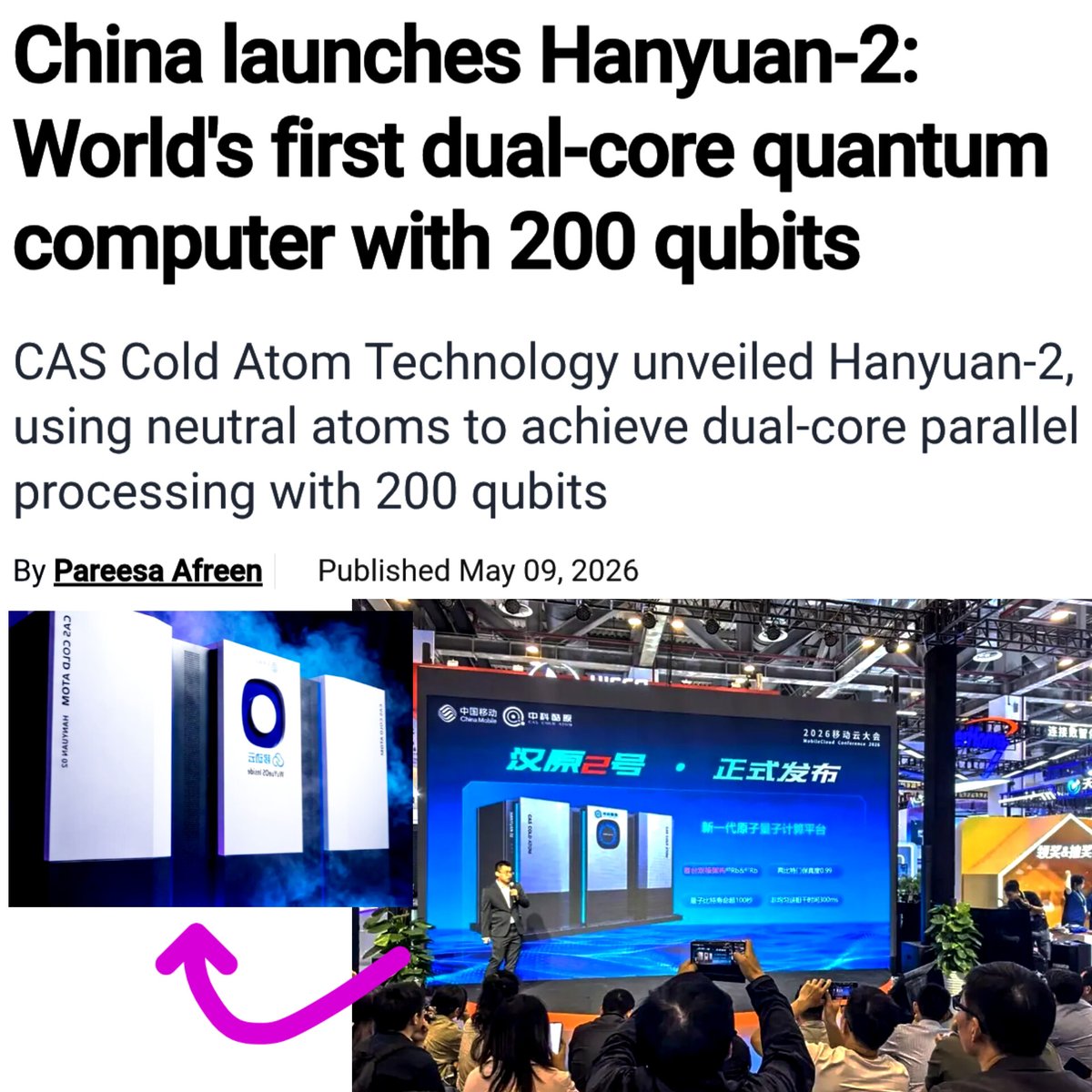
China has unveiled Hanyuan-2, a new 200 qubit neutral-atom quantum computer.
What makes it different is its dual core architecture, that combines 100 Rubidium-85 atom qubits and 100 Rubidium-87 atom qubits into two quantum processors that can work together in parallel.
The system uses precision lasers to control neutral atoms instead of relying on massive ultra-cold superconducting setups and reports say it consumes less than 7 kilowatts of power.
Researchers say the dual-core design could improve stability and reduce quantum noise, one of the biggest barriers preventing quantum computers from scaling into truly useful machines.
The important breakthrough here may not just be the “200 qubits,” but the shift toward modular multicore quantum computing, similar to how classical computers evolved from single-core to multicore processors.
In other words, quantum computers are starting to evolve from fragile laboratory experiments into scalable computing architectures.
Humanity is now coordinating individual atoms with lasers to build the future of computation 👽👀''
If the April jobs report was actually strong, why did U-6 rise to 8.2%, part time workers for economic reasons jump by 445,000, household employment fall by 226,000, and labor force participation drop to 61.8% while the headline payroll gain was only 115,000?
Now here is how they got the 4.3% unemployment rate…
The official unemployment rate, U-3, is calculated by taking the number of unemployed people and dividing it by the civilian labor force.
In April, BLS counted 7.373 million people as unemployed and 169.995 million people in the labor force.
That gets you roughly 4.3%.
But the trick is the denominator. The labor force only includes people who are employed or officially unemployed and actively looking for work. It does not include the 104.959 million people not in the labor force. It does not include the 6.111 million people who say they want a job but are not counted as unemployed. It does not fully capture the 4.942 million people working part time for economic reasons because they want full time work but cannot get it.
That is why U-6 matters more here. U-6 includes the officially unemployed, the marginally attached, and people stuck in part time work for economic reasons. That is why it rose to 8.2%.
So yes, 4.3% is technically the official unemployment rate.
But it is a narrow measure.
The broader data says labor quality is weakening, participation is falling, household employment is shrinking, and more people are being pushed into part time work.
That is not a strong labor market.
That is weakness hiding inside the way the number is calculated.
The Bank of Japan owns 7% of the entire Japanese stock market. The Swiss National Bank holds $200 billion in US equities - Apple, Microsoft, Amazon. Central banks buying stocks directly destroys price discovery.
When you purchase Toyota shares, you compete against a institution that creates yen from nothing. The SNB prints francs to buy dollars to buy Facebook stock (they're literally a hedge fund with a printing press). Stock prices no longer reflect company fundamentals or investor sentiment - they reflect central bank balance sheet expansion.
This is wealth redistribution to asset holders. Currency debasement funds it. Every Swiss franc created to buy Nvidia stock dilutes the purchasing power of workers holding cash savings.