In a democracy, someone who fails to get elected to office can always console himself with the thought that there was something not quite fair about it.
It's not out of the realm of possibilities that the race for the next UNSG might end in a deadlock... what then? Possible options set out in my article: https://t.co/UEIWcx0Vgl
Disclaimer: Population data is notoriously unreliable, as neither government nor UN sources can fully account for a decade of demographic changes. Addressing this issue requires a comprehensive review of civil registries, a national census, or updated voter registration records.
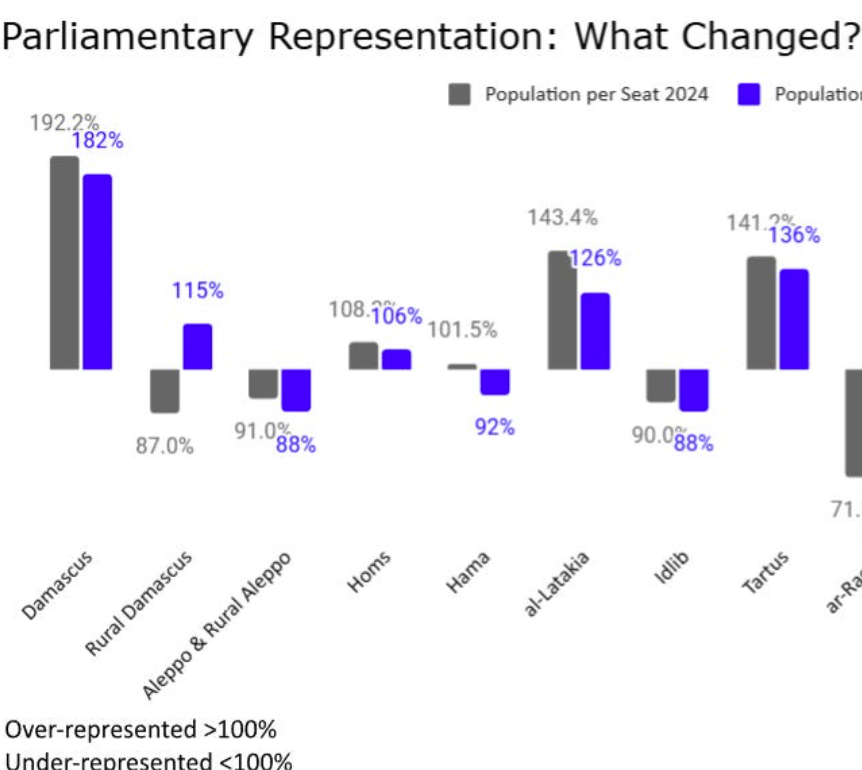
Representation in the New #Syrian Parliament: has #alSharaa fixed the problem?
Significant disparities remain, although there are a few notable changes: al-Sharaa increased representation for rural Damascus, shifting it from under-represented to over-represented. As-Suwayda’s over-representation has increased further, while Hama is now under-represented.
https://t.co/yqvLIsdIiY
Syrian elections are decided before election day
By @VladimirPran and @Maroon_Sfeir for @ACMideast, Syrian elections part IV: administration and candidacy.
The absence of an independent electoral administration in Syria is not news to anyone. The electoral authorities are deeply embedded within the judicial and executive structure and operate as extensions of the ruling party’s apparatus, rather than as impartial overseers of the electoral process.
Despite being central to elections, the primaries are still just theatrics rather than a genuine competition. While they look like a proper election process on the surface, their results are not binding.
https://t.co/nNUI2BypSi
Despite being central to elections, the primaries are still just theatrics rather than a genuine competition. While they look like a proper election process on the surface, their results are not binding.
For @AtlanticCouncil@ACMideast@VladimirPran with @Maroon_Sfeir https://t.co/nNUI2ByXHQ
Last week, Syria conducted elections for its 250 parliamentary seats.
@VladimirPran and @Maroon_Sfeir examine the role of Syria’s institutions in administering elections and the candidates:
https://t.co/TdMvjczP15
"“Elections are really already finished... with the end of the primary process,” he said. Once the Baath party list is completed, “you can check the list and the results, and you will see that literally all of them will be in the Parliament.”"
https://t.co/KHOvhGcy3L
If given the right, how many Syrians in the diaspora could vote? For that matter, how many Syrians in total would have the right to vote? Unfortunately, it is impossible to answer that question credibly. The underlying reason for the speculative nature of the electorate’s size is that, despite being legally required to do so, the government does not register voters. Nor does it compile the voter lists. Evidence from previous elections clearly confirms that voter registration is nonexistent.
For @ACMideast@VladimirPran & @Maroon_Sfeir
#SyriaElections
https://t.co/WYZupRARf0
إطار تصويت الكتلة مناسب تماماً لحزب “البعث”، الى درجة أنه حتى لو لقيت المعارضة تشجيعاً على التنافس في الانتخابات، مع منحها ضمانات بعدم استبعاد مرشحيها أو مضايقتهم، فلن تحظى أحزاب المعارضة، عملياً، بأي فرصة للفوز بعدد كبير من المقاعد.
@VladimirPran و @Maroon_Sfeir
نشر المقال الأصلي في @ACMideast
https://t.co/XWAw7yG0D9