This PUMA foundation guidelines rec facilitates implementation of a rec made by ALL guidelines: to limit the number of attempts at ETT & SGA
Reliably doing this reqs counting them out loud in real time
“1st attempt at intubation”
In @Anaes_Journal
https://t.co/LqzCV3Etqx
The PUMA Foundation guideline recommends all in-hospital airway practitioners should be able to intubate a patient awake.
It doesn’t have to be with a FB; it can be w VL, using a SGA conduit or via the neck.
Free full text in @Anaes_Journal
https://t.co/LqzCV3Etqx
A message from DAS President Prof Alistair McNarry @altgm
Wondering why you should be at #DASWales26? Al has a few very good reasons..
📅 11–13 November 2026
📍 ICC Wales
Please visit
https://t.co/dbp7gGSAAH for further details and to register
@DrHuw@davetheraw@AirwayMxAcademy Our job as experts is to unpack intuition: What are we seeing? What patterns are we recognising? What makes us change course?
The ultimate demonstration of mastery is not knowing what to do, it’s being able to explain why, and teach someone else to do it.
@DrHuw@davetheraw@AirwayMxAcademy Calling expertise a “sixth sense” or “muscle memory” risks turning mastery into mystique.
Yes, complex airway management demands experience. But expertise that cannot be articulated cannot be reliably taught, examined—or improved.
Technique for hyperangulated videolaryngoscopy.
From the PUMA guidelines for providing a foundation for airway management
Full free text in @Anaes_Journal
https://t.co/LqzCV3Etqx
Neck rescue technique
Detailed instructions for training & an emergency guide to prompt implementation
From the PUMA guidelines for providing a foundation for airway management
Free full text forever in @Anaes_Journal
https://t.co/LqzCV3Etqx
Extubation algorithm
Helps link evaluation to strategy
From the PUMA guidelines for tracheal extubation
Free full text forever in @Anaes_Journal at https://t.co/3DNPinhl3N
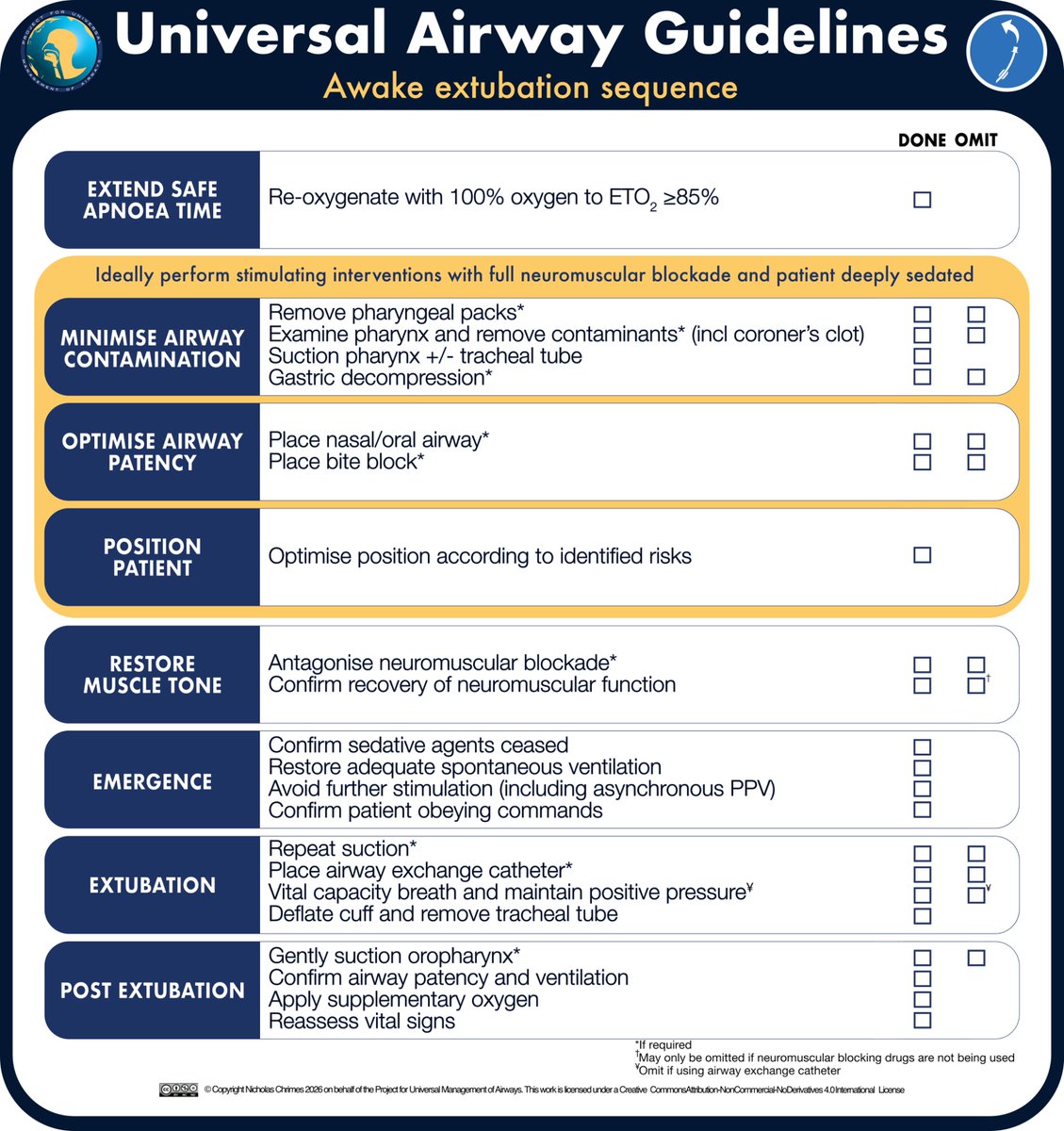
Awake extubation sequence.
Provide trainees with a framework to approach extubation or use for potentially challenging extubations.
From the PUMA guidelines for tracheal extubation.
Free full text forever in @Anaes_Journal at https://t.co/3DNPinhl3N
Airway exchange catheter user guide
From the PUMA guidelines for tracheal extubation.
Free full text forever in @Anaes_Journal at https://t.co/3DNPinhl3N
Protective sequence extubation
Analogous to RSI at intubation this provides recommended precautions when extubating patients ‘at risk’ of aspiration.
From the PUMA guidelines for tracheal extubation
Free full text forever in @Anaes_Journal at https://t.co/3DNPinhl3N
Algorithm for troubleshooting inadequate ETCO2
From the PUMA guidelines for preventing unrecognised oesophageal intubation
Free full text forever in @Anaes_Journal
https://t.co/fcMbLTlJpB
Criteria for ‘sustained exhaled CO2’
Provide a clear trigger for identifying when ETCO2 is ‘inadequate’
From the PUMA guidelines for preventing unrecognised oesophageal intubation
Free full text in @Anaes_Journal
https://t.co/fcMbLTlJpB
Consensus guidelines for preventing unrecognised oesophageal intubation.
The most widely supported airway guidelines ever published.
Free full text in @Anaes_Journal
https://t.co/fcMbLTlJpB
@doctimcook@UniversalAirway@Anaes_Journal This line in the Foundation guideline (citing the same paper) paraphrases the comment you made to me that inspired me to lift my HAVL game!
Technique for cricoid pressure
From the Guidelines for providing a foundation for airway management
Full free text forever in
@Anaes_Journal at https://t.co/LqzCV3Etqx
@UniversalAirway@Anaes_Journal If I might also offer there is something that could be usefully added
-head and neck position
I believe a key reason folk go on about difficult intubation with good view and difficult tube delivery is failure to position H&N correctly
Flextension