My Demand: Make Long Term Capital Gain TAX on Equities NIL for individual investor.
I welcome the hike in STT (security transaction tax) on derivatives as it can curb reckless speculation. Nearly 90% of retail investors lose money in F&O, turning markets into gambling.
When STT was originally introduced, LTCG was zero. But now with both STT and LTCG in place, investors are disincentivised.
I urge the govt to abolish LTCG on equities for individuals, as done in Switzerland, Singapore, UAE & others. This will boost household wealth, reduce speculation, and shift savings from gold & real estate into equities.
India’s exemplary GDP growth of 7.8% during Q1 of FY 2026-27 is a herculean feat.
The collective strength of our people ensured India delivered such growth despite oil price shocks and supply chain issues in the midst of global uncertainties.
Doomsayers were doomed and India bloomed…yet again!
I was ordered by @Lenskart_com to cut my shikha and remove my tilak. When I refused to do so, I was fired. - Zeel Soghasia
This is blatant discrimination and bigotry that goes beyond adhering to some internal memo. Mr Soghasia must be recalled and reinstated. @peyushbansal
7/7)
Today he doesn't track the ₹1000Cr number.
"It's about impact now.
People should know you for the good work you did."
The money was never the destination.
It was just proof the process worked. — Vivek Bajaj on Kushal Lodha Podcast #308
6/7)
2009 — NSE allowed co-location servers.
He flew to New York, Toronto, Montreal. Studied how prop firms traded.
Came back. Spent 3 years building iRage — an HFT firm with IIT partners. By 2014-15, ₹1Cr had become ₹10Cr.
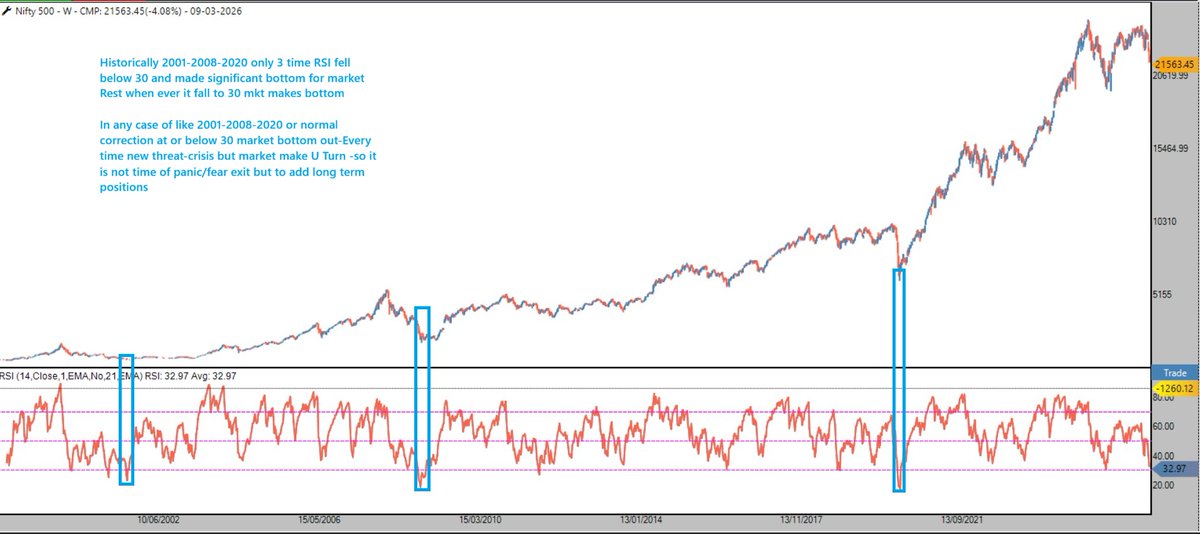
📊 Nifty 500 (Broad Market) – Long-Term RSI Perspective
The Nifty 500 Index, representing nearly 96% of India’s total market capitalization, offers one of the clearest pictures of overall market sentiment.
A study of the weekly RSI over the past two decades reveals an important pattern:
🔎 Historical Observation
Since 2001, the weekly RSI has fallen below 30 only three times:
2001–2002: Dot-com aftermath
2008–2009: Global Financial Crisis
2020: COVID crash
Each of these instances coincided with major long-term market bottoms.
📉 Normal Market Corrections
Outside of extreme crises, whenever the weekly RSI approaches the 30 zone, markets tend to form intermediate bottoms and stage strong recoveries.
⚠️ What This Means for Investors
Periods when RSI approaches or dips near oversold territory historically coincide with maximum pessimism.
These phases often feel like the worst time emotionally, but statistically they have been among the best opportunities to accumulate long-term positions.
📈 Key Insight
Markets typically bottom on fear and uncertainty, not on comfort or consensus.
Historically, oversold RSI zones in the broad market have marked phases of opportunity rather than panic exits.
For long-term investors and portfolio allocators, such periods should be viewed through the lens of strategic accumulation rather than emotional reaction.
Nishesh Jani,CFTe
#Nifty500 #StockMarketIndia #MarketCycle #TechnicalAnalysis #RSI #MarketBottom #Investing #StockMarket #LongTermInvesting #MarketInsights #nisheshjani #AhmedabadNest
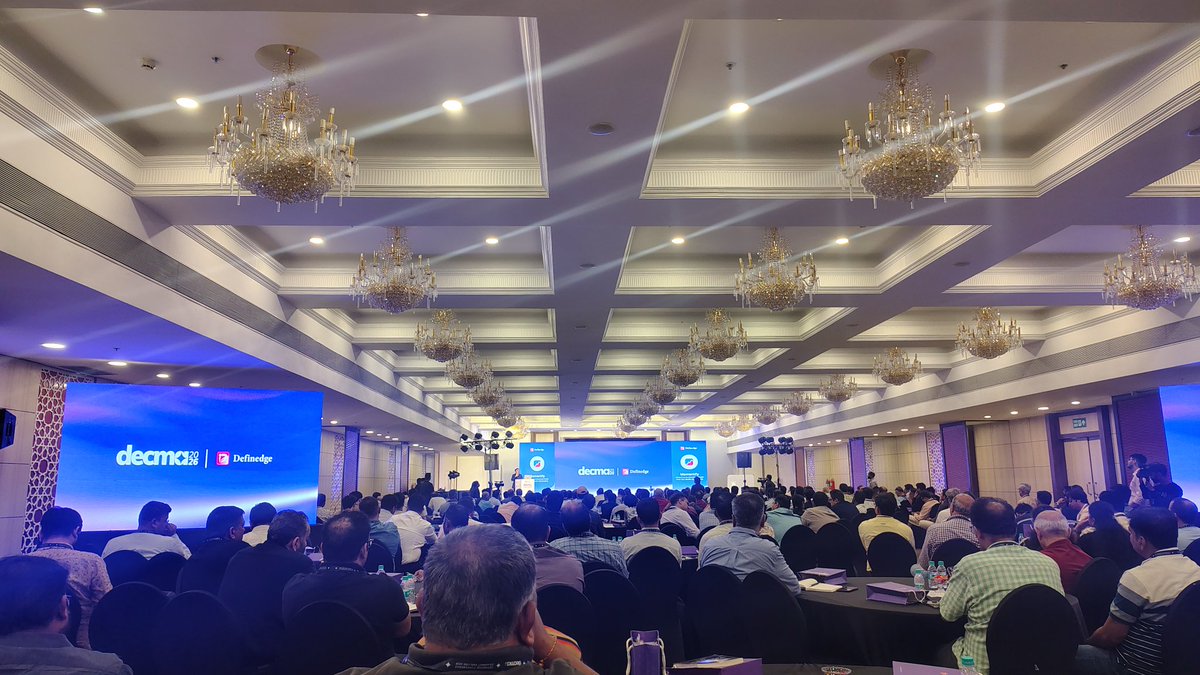
Spent 2 days at DECMA Pune by @Definedge.
Noiseless charts & meaningful conversations with serious traders.
got to meet @Prashantshah267 sir doing phenomenal work in noiseless trading.
In a lonely profession like trading, experiences like this truly matter.
Another reminder to look past the noise.
21 02 26
Stocks above 20 and 50 MA
188 and 243 respectively
Why 21 02 lows? Because that was the lowest breadth reading in recent times.
Today 04 03 26
Stocks above 20 and 50 MA
259 and 385 respectively
Even better, a lot of stocks are still holding above the lows made on Monday 02 03 26.
On the surface, peak pessimism.
Under the hood, breadth is improving again.
#HappyHoli