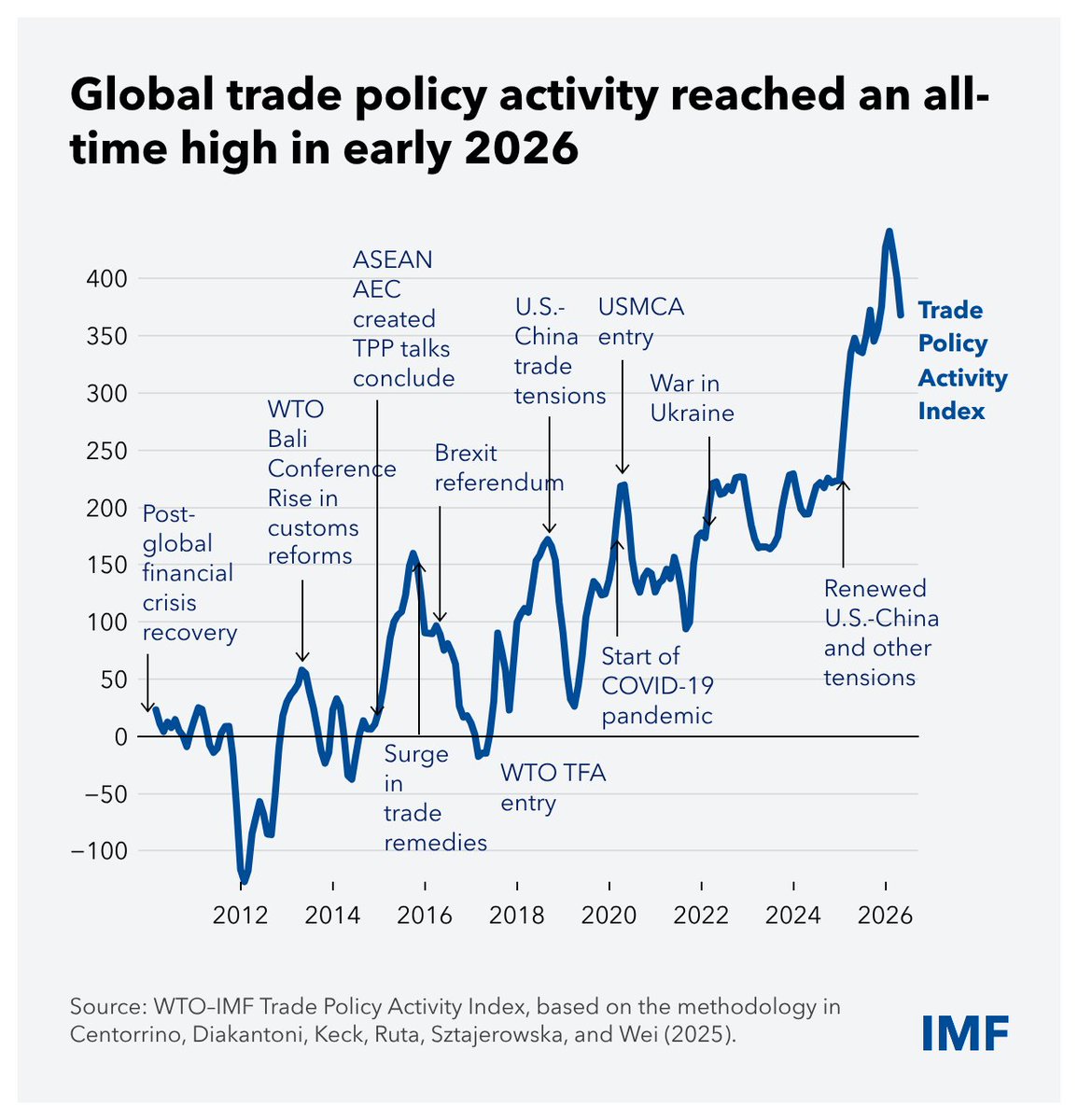
Explore the latest data on the Trade Policy Activity (TPA) Index: https://t.co/AK5uem7aZR
Learn more about the methodology in our paper: https://t.co/N8Qxl2U2nJ
Global trade policy activity is at a record high, nearly triple its 2020 level. The updated WTO–IMF Trade Policy Activity Index shows the surge is driven mostly by restrictive measures: https://t.co/kb2msv2H5f
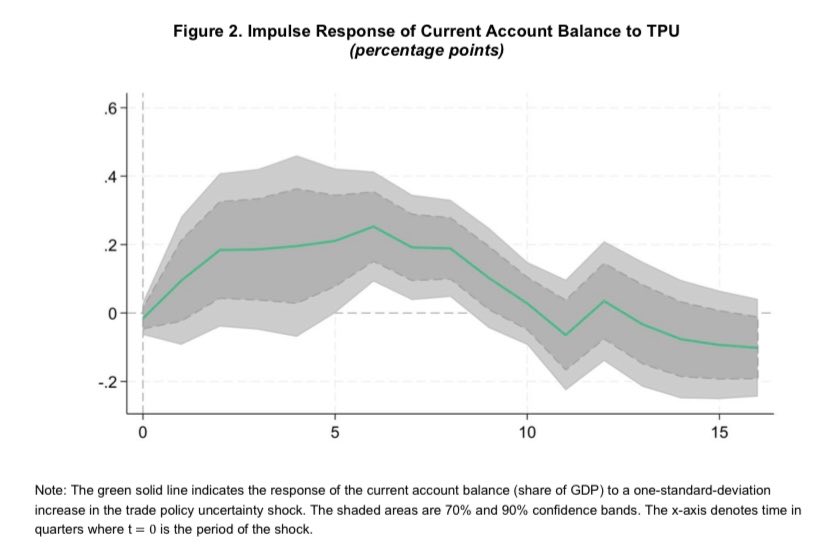
📢 New Working Paper Out:
This paper finds that U.S. TPU shocks temporarily improve the current account, primarily because imports contract more sharply than exports, with durable goods accounting for a large share of the adjustment.
Read full paper: https://t.co/hvDDP8505M
Why is the global economy staying strong in turbulent times?
Because the private sector has shown incredible agility—taking risks, adapting fast, and driving innovation. When businesses are empowered, economies become more resilient. #WEF26
Watch here: https://t.co/qfy2LtOV0O
🚨 New paper! 🚨 (haven't used the sirens in a while, but I'm excited about this one)
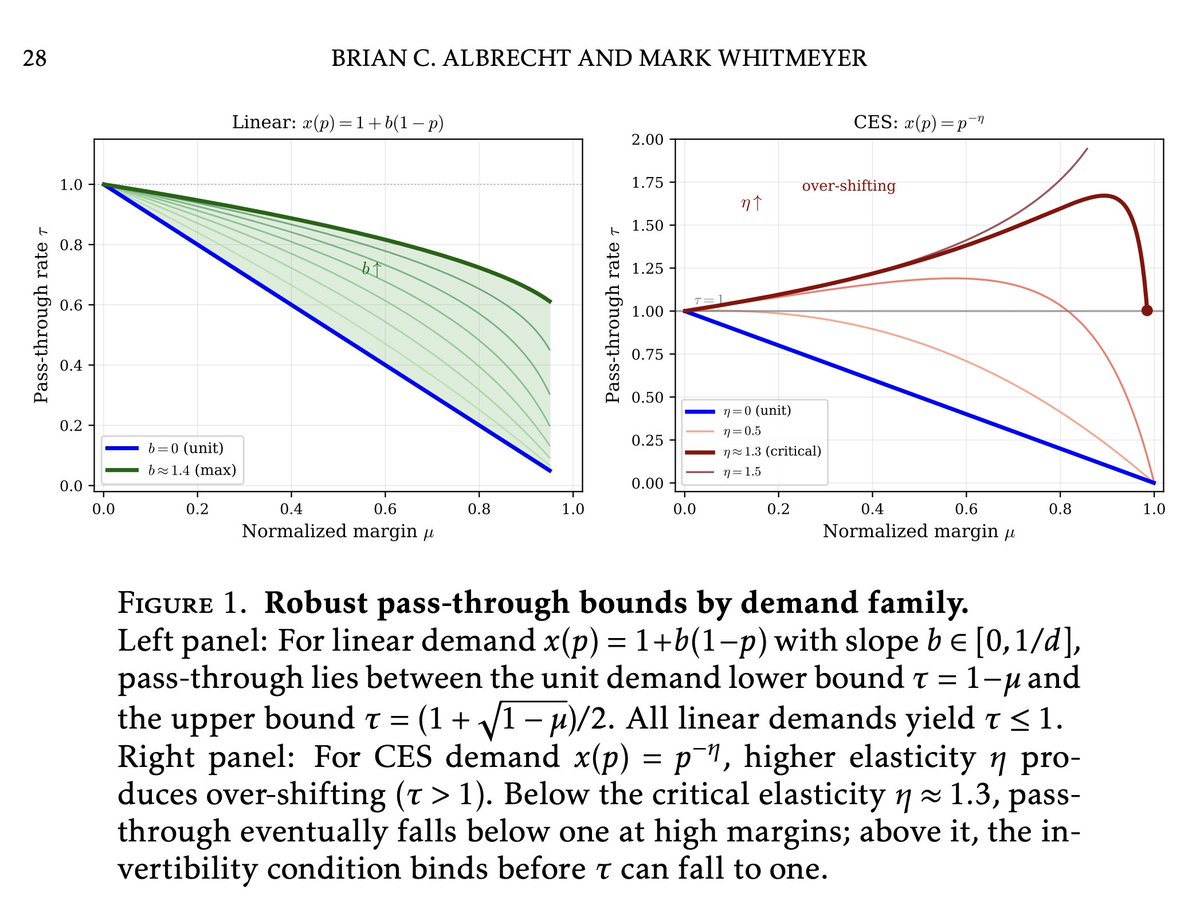
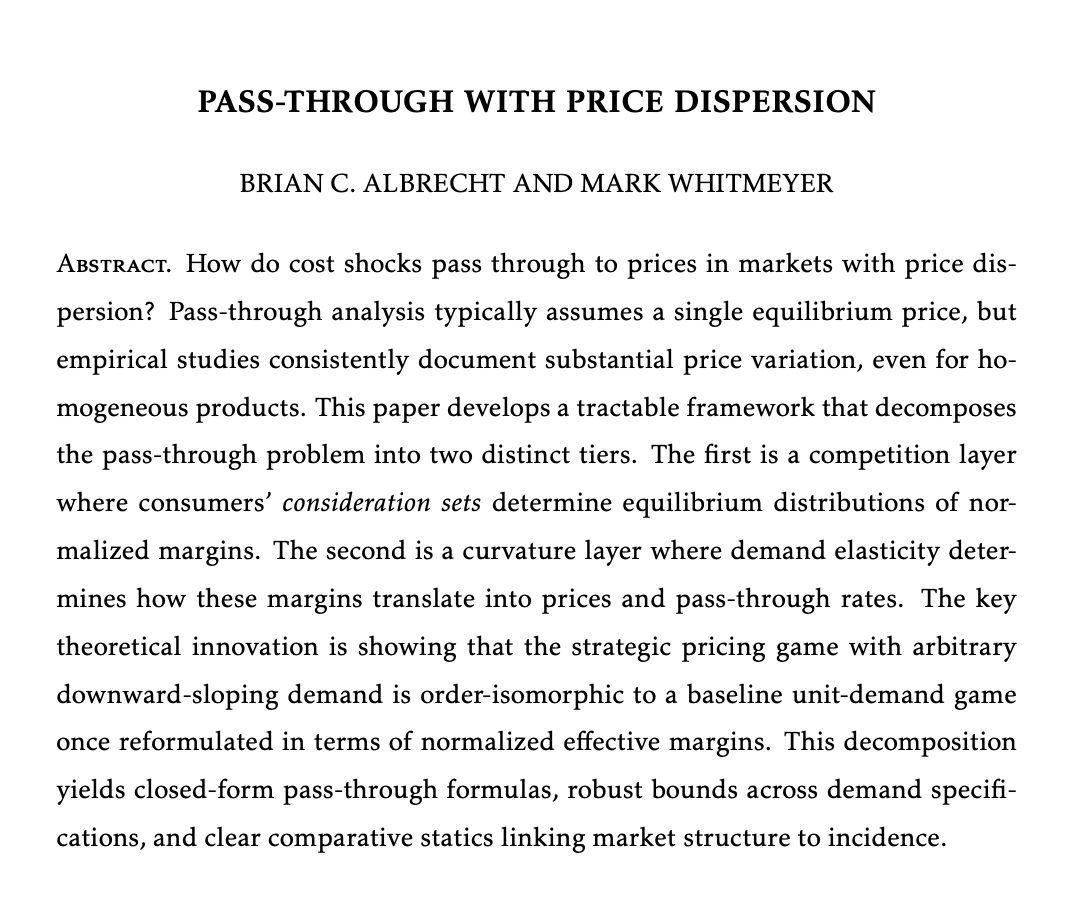
How do cost shocks pass through to prices when there's price dispersion?
Standard pass-through analysis assumes a single equilibrium price. But empirical studies find huge price variation, even for identical products.
A new paper with Mark Whitmeyer develops a tractable framework for this.
The key idea is that, with a little trick, pass-through separates into two layers.
1. A competition layer where consideration sets (which firms each consumer is aware of and compares) determine the distribution of normalized margins, and
2. A curvature layer where demand elasticity translates margins into prices.
As I said, the core is a math trick. We reformulate the pricing game in terms of margins rather than prices. In this transformed space, the equilibrium depends ONLY on market structure. Demand curvature and costs vanish entirely.
This "μ-isomorphism" means you solve the game once in margin-space, then mechanically translate back to prices for any demand function or cost level.
When costs rise, the entire price distribution shifts, but the underlying distribution of market power stays fixed. Pass-through follows from differentiating a mapping function without the need to re-solve equilibria.
This yields closed-form pass-through at each quantile of the price distribution. Consumers buying at low prices face different pass-through than those at high prices.
We also get robust bounds for free.
Pass-through is bounded below by 1 − μ for ANY downward-sloping demand. Different demand families yield different envelopes, with standard results like linear demand always gives incomplete pass-through, but CES can produce over-shifting at low margins.
Researchers increasingly estimate who considers whom—from platform clicks, surveys, geographic proximity. Goeree (2008) showed that ignoring consideration sets biases PC markup estimates by a factor of four. Our framework means this data can identify pass-through directly, without estimating a full demand system.
One application that I think is cool is mergers. There's been a lot of talk about consolidation and pass through. Standard analysis focuses on price levels. But mergers also change consideration structure, which shifts the margin distribution, which changes pass-through of future cost shocks. Even mergers with no immediate price effect can shift incidence of future costs onto consumers. We give a simple way to do solve that.
As I said, really excited about this one. Bringing together a part of modern theory (Armstrong-Vickers consideration sets) into the more applied theory space (Weyl-Fabinger pass-through) with the new empirical work (Honka et al)
Paper: https://t.co/wvc4KHsdAT
Our January 2026 projections are in. So, what’s ahead for the global economy? Growth remains steady, supported by surging tech investment—especially in N. America & Asia—& favorable financial conditions. These tailwinds offset shifting trade policies & other uncertainties. https://t.co/zH3To1MItB