Audit-grade verification for livestream & creator marketing. Timestamped proof for brands & agencies. Accountability, safety, and compliance in one layer.
Livestream & creator marketing scaled faster than its ability to be verified.
Screenshots and self-reporting don’t hold up when campaigns are disputed & brand safety matters.
We built the verification layer to close that gap.
Accountability. Safety. Compliance. All-in-one.
One of the harder decisions we made building W4LL:
Walking away from something that was already working.
We had momentum.
The product was gaining traction.
People understood it.
Community was growing.
From the outside, it probably looked like we had it figured out.
But internally, something didn’t sit right.
The more we looked at livestream campaigns, the more obvious it became:
We weren’t solving the real problem.
We were solving something easier.
So we made the call to pivot.
Not because the first version failed.
Because we couldn’t ignore what we were seeing - a deeper problem.
That’s a tough place to be.
Walking away from progress to chase something less proven but factually more problematic..
But in the long run, building the right thing matters more than building the easy thing.
Everyone scaled content.
No one scaled understanding.
They're generating streams, clips, and distribution at massive scale.
But not segment-level insight, timestamped sentiment, or real exposure value.
So now:
Content = infinite
Truth = partial
Brands will put creators in $7M Super Bowl ads, but still accept “it went live” as proof of delivery...
A couple of screenshots and a "good enough" attitude.
Livestream and creator content analysis doesn't have to underperform this way anymore.
Game launches don’t really start on storefronts anymore.
They start on livestream.
Trailers build awareness.
But creators build momentum.
A few early streams go live.
Clips spread.
Chat explodes.
The internet decides if the game is fun to watch.
And if it’s fun to watch.
It becomes a game people want to play.
Livestreams don't just promote games.
They decide whether the world cares about them.
@CAMTEAMROCKET Horror games are so fire these days. The Silent Hills & Resident Evils carry the weight of huge expectations- but I don't expect perfection.
Biohazard, Village, and even the remake of SH2 have been epic. If it's on the same level as those then 👍.
Resident Evil Requiem’s launch week on livestream was massive!
49.7M hours watched
897K peak viewers
296K average viewers
96% positive rating on Steam
Is it as good as they say?
Most livestream sponsorship friction isn’t the creator’s fault.
It’s structural.
Creators optimize for energy/retention.
Brands optimize for control/compliance.
Platforms optimize for watch time/revenue.
Those are three different games.
We almost stayed in the “cool AI feature” lane.
Auto-clipping.
Streamer tools.
Overlays + Bounties.
The community loved it. Growth was fast.
But the deeper we looked at livestream + UGC marketing campaigns, the clearer something became:
The real gap wasn’t more tools.
It was campaign proof.
Five & six-figure sponsorships running on screenshots and trust didn’t sit right with us.
So we pivoted.
Not away from streamers - but toward fixing the structural problem underneath the entire ecosystem.
Now we’re building the accountability layer that connects brands, agencies, and creators.
Bigger mission. Longer game.
With AI influencer marketing taking over the feeds, it's more important than ever to have a content audit/verification system at scale.
Without it, campaigns and brands are left open to hallucinations and mistakes that can have damaging consequences.
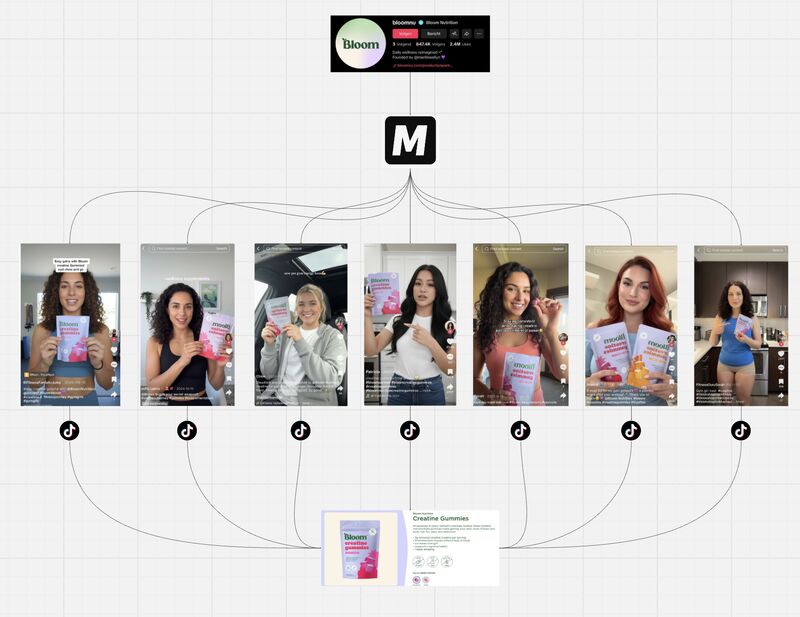
$92k per week comes from ai mass marketing done right
one brand
one winning angle
hundreds of ugc style videos produced automatically
same message
same structure
different faces and formats
ai handles creator generation posting and testing
so volume scales without creative burnout
this isn’t spraying ads
it’s systemized repetition
when one video works
ai multiplies it everywhere
and performance compounds instead of resetting
that’s what mass marketing looks like now
rt + comment “mass” and i’ll dm the system
(follow for dm)
Live streaming: $157B in 2026 → $1T+ by 2035 📈.
That’s not a tactic. That’s media infrastructure 📺.
Hundreds of billions of minutes of attention move through it.
Yet it's still measured with manual screenshots?
Scale demands automated verification ✅.
How confident are you that your marketing campaign was delivered as sold?
• Talking points hit
• Logo time on screen
• Flags for questionable criteria
• Audience attention during the segment
• Actionable reports down the the second
Not confident? You’re not alone.
Creator marketing survives on incentives, not truth.
Creators get paid either way.
Agencies get judged on relationships.
Brands move budgets on summaries.
So the system optimizes for optics over outcomes.
Without proof, simply looking compliant matters more than being correct.
When proof is missing, accountability doesn’t follow outcomes. It follows job titles.
That’s the risk in creator marketing - and why your team spends more time explaining results than improving them.
Proof isn’t a performance metric.
It’s an actionable product.
Every media channel scales the same way 📈:
Adoption → loose standards → inflated reporting → budget pressure → proof.
Display ads and video ads both went through it...
Livestream & UGC are next 💡.
Growth came first. Proof comes next ✅.
Creator marketing rarely fails loudly.
It fails quietly.
Deliverables drift, talking points get skipped, logos flash by.
Screenshots hide it.
Campaign optimization without qualitative proof is just guessing.
Livestream & creator marketing scaled faster than its ability to be verified.
Screenshots and self-reporting don’t hold up when campaigns are disputed & brand safety matters.
We built the verification layer to close that gap.
Accountability. Safety. Compliance. All-in-one.