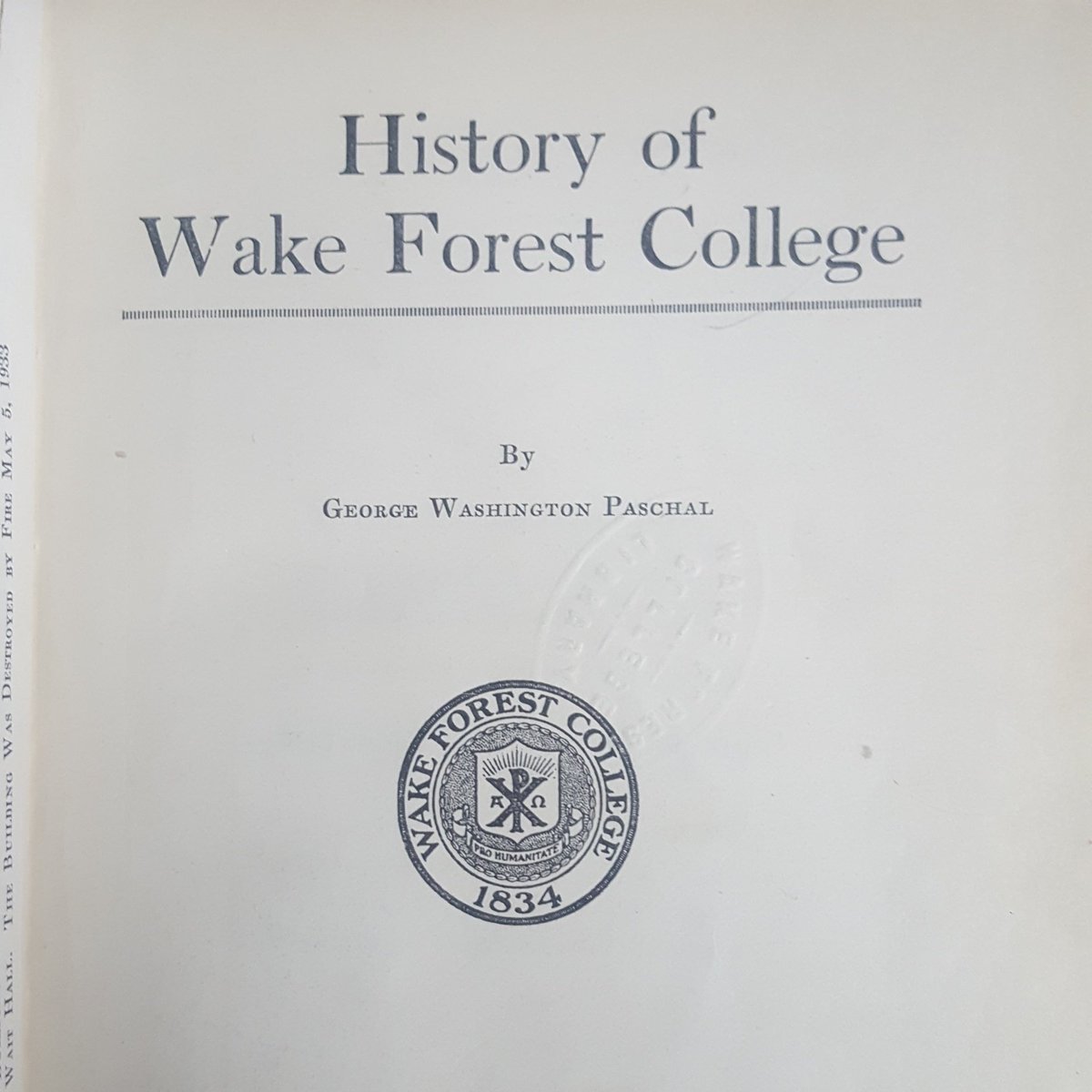
Tweetin facts and tidbits about Wake Forest's 184 year history-reading cover to cover all 6 volumes of 'History of Wake Forest College' By '18 Ben Weekley
Following Samuel Wait's 11 year tenure as president of the college he became president of the board of trustees for the next 20 years. He would later pass (July 28th, 1867), and be buried in the Wake Forest cemetery.
Wake Forest College has no graduate in the years 1841, 1843, and 1846. This was due to low enrollment. Up until 1861 the largest graduating class only consisted of 10 men.
We back...sorry midterms hit like a brick this week! Just read a 100 pages about "Agents" who fundraised all over the state of NC and SC during the 1840's-50's to get the college out of debt.
In 1860 Wake Forest was given the estate of Mr. John Blount for sale, which they sold for $12,153.19 Confederate dollars. All the money was invested in Confederate bonds, which were worth nothing by the time the college reopened in 1865.
@WFUHistory I wouldn't have known about it if my fiance hadn't taken Griffith's Econ of Higher Ed class. Considering the connection to the NC and Southern Baptist Conventions, it's not surprising though. Our endowment would actually be larger than Duke's now if they hadn't gone that route.
By the time the college closed in 1861 due to the Civil War (more on this later), they had paid off the debt and built up an endowment of over $50,000. It seems @PresidentHatch and #WakeWill are just following in their footsteps
When Wake Forest became a College in 1838, it had accrued over $20,000 in debt ($514,000 today accounting for inflation!). The trustees realized this was not sustainable and for the next 20 years worked to pay it off.
Some rules were added to the charter of Wake Forest College. 1. It was stated that billiard tables, theatrical, sleight-of-hand and other shows were unlawful within 1 mile of the college.
2. The selling or conveying of spirituous liquors to students was forbidden