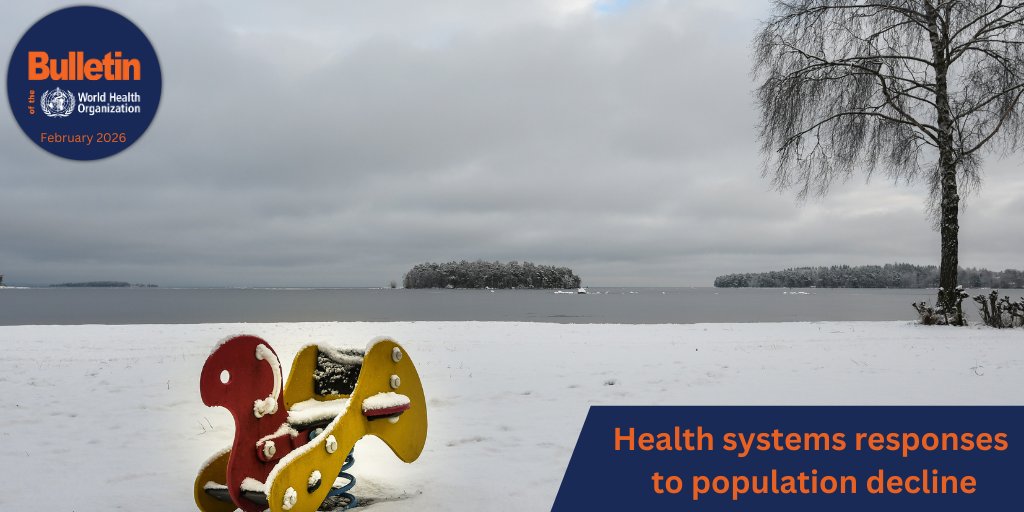
The February 2026 issue of the Bulletin is out!
This month we have a special theme issue on health systems reponses to population decline.
📰Read it here: https://t.co/o4fE1ZL11b
The November 2025 issue of the Bulletin is out!
This month we have a special theme issue on traditional medicine and global health.
📰Read it here: https://t.co/o4fE1ZL11b
Nicole Bergen et al. explain why monitoring of #health inequalities is continuously needed to improve health #equity.
Robust data, strong systems & political will are essential to close health gaps and drive real progress.
🔗https://t.co/GEKdcrsUG8
The #Sahel faces an escalating crisis at the intersection of #climatechange, #conflict & #displacement.
@ejemaim et al. call for planetary #health approaches, climate-smart policies & urban integration to build resilience for the most vulnerable.
🌏https://t.co/Y0FgTpHDQb
Optimizing #vaccine uptake is essential for #globalhealth security.
In this paper, authors propose a fourth immunization indicator to the Joint External Evaluation tool to measure and address the social and behavioral drivers of vaccine uptake.
💉https://t.co/z5E6UV4GMy
While sustainable alternatives to single-use #menstrual products pave the way for change, access, affordability, and stigma remain challenges.
Governments must prioritize policies that balance menstrual #health and #environmental responsibility.
🩸https://t.co/v7rtyqpfds
. #COVID19 exposed major gaps in real-time #mortality data, less than half of WHO Member States met the demand.
@AfricaCDC has developed a new framework to guide national efforts, paving the way for better public health responses.
https://t.co/c6daCrSOwV
Triage is a core function of #EmergencyCare, what evidence supports its impact in low-resource settings?
This study on the WHO Interagency Integrated Triage Tool suggests it is reliable and well accepted, but more research is needed on clinical outcomes.
https://t.co/ApllTTLuQo
A new analysis of Global Burden of Disease data highlights the immense global impact of emergency and operative conditions, with over 27 million deaths in 2019.
Findings emphasize the need to scale up #emergency, critical, and surgical care worldwide.
🏥https://t.co/IEGgJ7VBkh
This population-based cohort study in #Australia found no increased risk of bronchopulmonary dysplasia in extremely preterm infants who received a birth-dose #HepB#vaccine.
Findings support WHO recommendations for universal #newborn immunization
💉https://t.co/0Aq10Lbrs2
Salim and Quarraisha Abdool Karim talk about their efforts to reduce the exposure of young #women to infection with #HIV, the importance of perseverance, and the opportunities presented by new long-lasting therapies
➡️https://t.co/KNrkywqAHd
Can a community-driven #MentalHealth initiative be integrated into a government health system without losing its essence? Read our news feature on the #FriendshipBench initiative in #Zimbabwe
https://t.co/6ugzeqwDGy
📢 Call for Papers: Population Decline & Ageing 📢
The Bulletin invites research on the impacts of #population decline & #ageing, workforce shortages, social policies, and #health system resilience.
📝 Submission deadline: 16 June 2025
🔗https://t.co/UZ06Gu2vOr