Today I finally understood something about Donald Trump that I had been missing. And when it hit me — it hit me completely. Because, look at who this man chose to surround himself with.
Not billionaires. Not people born into power.
Not people who had everything handed to them.
Karoline Leavitt — 27 years old. Ice cream shop girl from New Hampshire.
Trump looked at her and saw something the entire world missed.
Made her the youngest Press Secretary in American history.
Susie Wiles — a woman who spent her life quietly strategizing from the background. No fame. No spotlight. Just pure brilliance. Trump looked at her and said, You will be my Chief of Staff, the first female Chief of Staff in American history.
JD Vance — a soldier. A boy from Appalachia who served his country in uniform before he ever served it in office. Trump looked at him and said, "You will stand beside me."
Pete Hegseth — a soldier who gave everything on the battlefield. Two Bronze Stars. Trump looked at him and said, " You will lead our military.
Marco Rubio — the son of a bartender and a hotel maid. Two immigrants who came to America with nothing. Trump looked at their son and made him the first Latino Secretary of State in American history.
My wife heard all of this tonight and said, "Do you understand what Trump actually did? He did not build a powerful administration. He built an unbreakable one."
Every person in it knows what it feels like to have nothing. And people who came from nothing never take anything for granted.
Tonight, say one prayer for this entire administration. And say a bigger one for the man who chose them.
Then pass this to every American who needs to understand why this administration hits different from every single one that came before it."
In 2021, the head of the United Nations World Food Programme, David Beasley, said that 2 percent of Elon Musk's wealth ($6 billion at the time) could solve world hunger. Elon responded with a challenge that nobody at the UN expected: show me the plan and I'll sell the stock today.
The tweet was direct: "If WFP can describe on this Twitter thread exactly how $6B will solve world hunger, I will sell Tesla stock right now and do it." The challenge was not a deflection. It was an engineering demand. Show me the specific plan, the specific allocation, the specific outcomes, and the specific accountability, and I will fund it immediately.
The distinction Elon was drawing was between a number and a plan. $6 billion is a number. A plan is a detailed description of exactly how that number converts into food in the mouths of hungry people at a cost per person that is auditable and accountable. The UN had the number. Elon wanted the plan. The gap between the two is where most charitable efforts lose billions to overhead, corruption, and inefficiency.
The WFP responded. They published an overview of how $6.6 billion could help 42 million people on the brink of famine. Note the language shift: the original claim was "solve world hunger." The plan addressed 42 million of the 800+ million food insecure people. Solving world hunger and feeding 42 million people are very different claims. The goal post moved from "solve" to "help a subset."
Elon sold approximately $5.7 billion in Tesla stock in November 2021. The donation destination was never publicly confirmed, but SEC filings showed a $5.7 billion charitable contribution to an unidentified recipient around the same time. The donation, if directed to the WFP or a related entity, would represent the largest single charitable gift in modern history.
The incident reveals how Elon approaches every problem, including charity. He does not donate based on moral pressure. He donates based on engineering analysis. Show me the plan. Show me the conversion from dollars to outcomes. Show me the accountability mechanism. Then I'll fund it. The approach is cold. The approach is effective. The approach produces more impact per dollar than the emotional approach because it forces the recipient to quantify before the donor commits.
The man who was publicly shamed for not solving world hunger responded by demanding the plan that would solve world hunger. The plan didn't solve world hunger. He funded it anyway. The gap between what the UN claimed and what the UN delivered is the gap that Elon was trying to illuminate. $6 billion cannot solve world hunger. It can feed 42 million people for one year. Both are worth doing. Only one was honestly communicated.
Elon Musk was asked in an interview what he thinks happens when you die. The interviewer expected either a scientific answer (nothing, consciousness ceases) or a spiritual one (something continues). Elon gave neither. He paused for an uncomfortable duration and then said something that revealed a man who has thought about death more carefully than most people think about lunch.
He said he thinks the most likely outcome is that consciousness simply ends. Lights off. No continuation. No afterlife. No transfer. The electrical activity in the brain ceases and the subjective experience that constituted "you" is permanently deleted. He described this possibility with the clinical detachment of a man reading a system shutdown log.
Then he said the thing that nobody expected: he said he doesn't find this comforting. He finds it terrifying. The word "terrifying" from a man who regularly does terrifying things (launching rockets, betting his fortune, working 100 hour weeks in crisis mode) carries a different weight. The rockets are calculated terror. The death contemplation is unresolved terror. One has a spreadsheet. The other doesn't.
He connected the terror to the Mars mission. He said one of the driving forces behind making humanity multiplanetary is the extension of the light of consciousness. If consciousness is rare (and it may be the rarest phenomenon in the universe), then allowing it to be extinguished by a single asteroid, a single pandemic, or a single nuclear war on a single planet is the greatest possible waste. The Mars colony is not about escape. It is about redundancy. A backup drive for the most important data in the universe: the fact that anything is conscious at all.
The connection between personal mortality and the Mars mission is the connection that most people miss. Elon knows he will die. He has accepted that nothing follows. The acceptance drives him not toward nihilism but toward urgency. If this is all there is, if consciousness is a brief candle in an infinite dark, then the time available to extend that candle to another planet is limited by his own lifespan. He is racing his own death. The Mars timeline is not a business plan. It is a countdown against a deadline that he cannot negotiate.
The man who is afraid of death is building the thing that ensures consciousness survives after his doesn't. The terror is the fuel. The Mars colony is the response. And the man who finds death terrifying has converted the terror into the most ambitious construction project in human history because the alternative, sitting with the terror and building nothing, is the only thing more terrifying than death itself.
One of my favs that has been floating around for a while
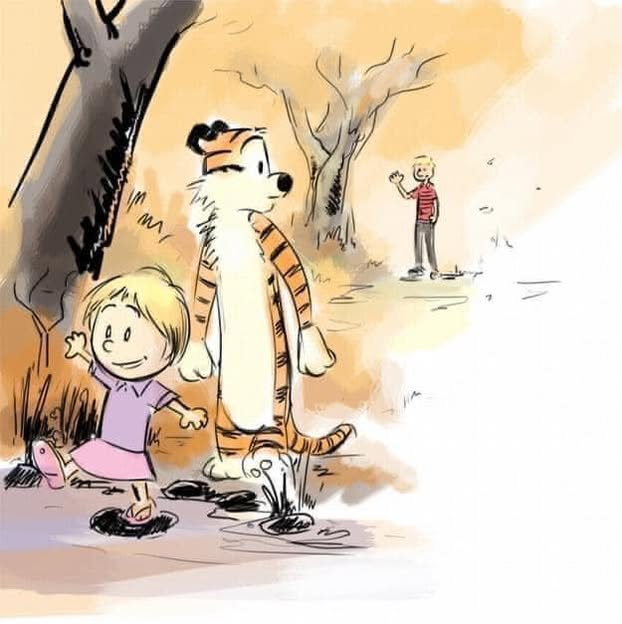
"Calvin? Calvin, sweetheart?"
In the darkness Calvin heard the sound of Susie, his wife of fifty-three years. Calvin struggled to open his eyes. God, he was so tired and it took so much strength. Slowly, light replaced the darkness, and soon vision followed. At the foot of his bed stood his wife. Calvin wet his dry lips and spoke hoarsely, "Did... did you.... find him?"
"Yes dear," Susie said smiling sadly, "He was in the attic."
Susie reached into her big purse and brought out a soft, old, orange tiger doll. Calvin could not help but laugh. It had been so long. Too long.
"I washed him for you," Susie said, her voice cracking a little as she laid the stuffed tiger next to her husband.
"Thank you, Susie." Calvin said.
A few moments passed as Calvin just laid on his hospital bed, his head turned to the side, staring at the old toy with nostalgia.
"Dear," Calvin said finally. "Would you mind leaving me alone with Hobbes for a while? I would like to catch up with him."
"All right," Susie said. "I'll get something to eat in the cafeteria. I'll be back soon."
Susie kissed her husband on the forehead and turned to leave. With sudden but gentle strength Calvin stopped her. Lovingly he pulled his wife in and gave her a passionate kiss on the lips. "I love you," he said.
"And I love you," said Susie.
Susie turned and left. Calvin saw tears streaming from her face as she went out the door.
Calvin then turned to face his oldest and dearest friend. "Hello Hobbes. It's been a long time hasn't it old pal?"
Hobbes was no longer a stuffed doll but the big furry old tiger Calvin had always remembered. "It sure has, Calvin." said Hobbes.
"You... haven't changed a bit." Calvin smiled.
"You've changed a lot." Hobbes said sadly.
Calvin laughed, "Really? I haven't noticed at all."
There was a long pause. The sound of a clock ticking away the seconds rang throughout the sterile hospital room.
"So... you married Susie Derkins." Hobbes said, finally smiling. "I knew you always like her."
"Shut up!" Calvin said, his smile bigger than ever.
"Tell me everything I missed. I'd love to hear what you've been up to!" Hobbes said, excited.
And so Calvin told him everything. He told him about how he and Susie fell in love in high school and had married after graduating from college, about his three kids and four grandkids, how he turned Spaceman Spiff into one of the most popular sci-fi novels of the decade, and so on. After he told Hobbes all this there was another pregnant pause.
"You know... I visited you in the attic a bunch of times." Calvin said.
"I know."
"But I couldn't see you. All I saw was a stuffed animal." Calvin voice was breaking and tears of regret started welling up in his eyes.
"You grew up old buddy." said Hobbes.
Calvin broke down and sobbed, hugging his best friend. "I'm so sorry! I'm so sorry I broke my promise! I promised I wouldn't grow up and that we'd be together forever!!"
Hobbes stroke the Calvin's hair, or what little was left of it. "But you didn't."
"What do you mean?"
"We were always together... in our dreams."
"We were?"
"We were."
"Hobbes?"
"Yeah, old buddy?"
"I'm so glad I got to see you like this... one last time..."
"Me too, Calvin. Me too."
"Sweetheart?" Susie voice came from outside the door.
"Yes dear?" Calvin replied.
"Can I come in?" Susie asked.
"Just a minute."
Calvin turned to face Hobbes one last time. "Goodbye Hobbes. Thanks... for everything..."
"No, thank you Calvin." Hobbes said.
Calvin turned back to the door and said, "You can come in now."
Susie came in and said, "Look who's come to visit you."
Calvin's children and grandchildren followed Susie into Calvin's room. The youngest grandchild ran past the rest of them and hugged Calvin in a hard, excited hug. "Grandpa!!" screamed the child in delight.
"Francis!" cried Calvin's daughter, "Be gentle with your grandfather."
Calvin's daughter turned to her dad. "I'm sorry, Daddy. Francis never seems to behave these days. He just runs around making a mess and coming up with strange stories."
Calvin laughed and said, "Well now! That sound just like me when I was his age."
Calvin and his family chatted some more until a nurse said, "Sorry, but visiting hours are almost up."
Calvin's beloved family said good bye and promised to visit tomorrow. As they turned to leave Calvin said, "Francis. Come here for a second."
Francis came over to his grandfather's side, "What is it Gramps?"
Calvin reached over to the stuffed tiger on his bedside and and held him out shakily to his grandson, who looked exactly as he did so many years ago. "This is Hobbes. He was my best friend when I was your age. I want you to have him."
"He's just a stuffed tiger." Francis said, eyebrows raised.
Calvin laughed, "Well, let me tell you a secret."
Francis leaned closer to Calvin. Calvin whispered, "If you catch him in a tiger trap using a tuna sandwich as bait he will turn into a real tiger."
Francis gasped in delighted awe. Calvin continued, "Not only that he will be your best friend forever."
"Wow! Thanks grandpa!" Francis said, hugging his grandpa tightly again.
"Francis! We need to go now!" Calvin's daughter called.
"Okay!" Francis shouted back.
"Take good care of him." Calvin said.
"I will." Francis said before running off after the rest of the family.
Calvin laid on his back and stared at the ceiling. The time to go was close. He could feel it in his soul. Calvin tried to remember a quote he read in a book once. It said something about death being the next great adventure or something like that. He eyelids grew heavy and his breathing slowed. As he went deeper into his final sleep he heard Hobbes, as if he was right next to him at his bedside. "I'll take care of him, Calvin..."
Calvin took his first step toward one more adventure and breathed his last with a grin on his face
🚨 BREAKING: Secretary Robert F. Kennedy Jr. announces "folate deficiency in a child's brain can lead to autism."
And an "exciting therapy" for kids with autism: leucovorin. Up to 60% of deficient children can have improved communication if they take it.
GREAT NEWS. This is groundbreaking.
Dr. Mercola just dropped the exact MSM + DMSO protocol everyone’s begging for!
Work up to 3g MSM daily + apply diluted DMSO topically.
Natural anti-inflammatory, pain relief & healing in one simple stack.
Screenshot it, start this weekend. https://t.co/3qRmDBJ2PF