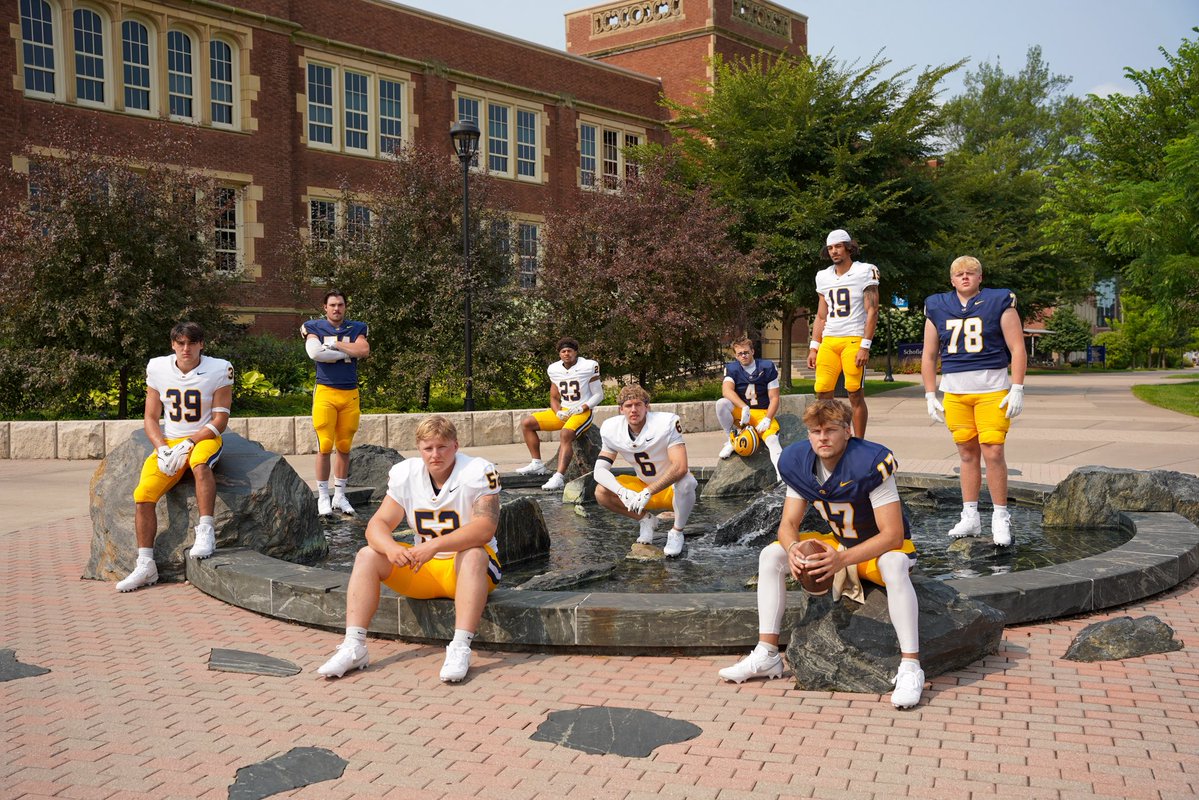
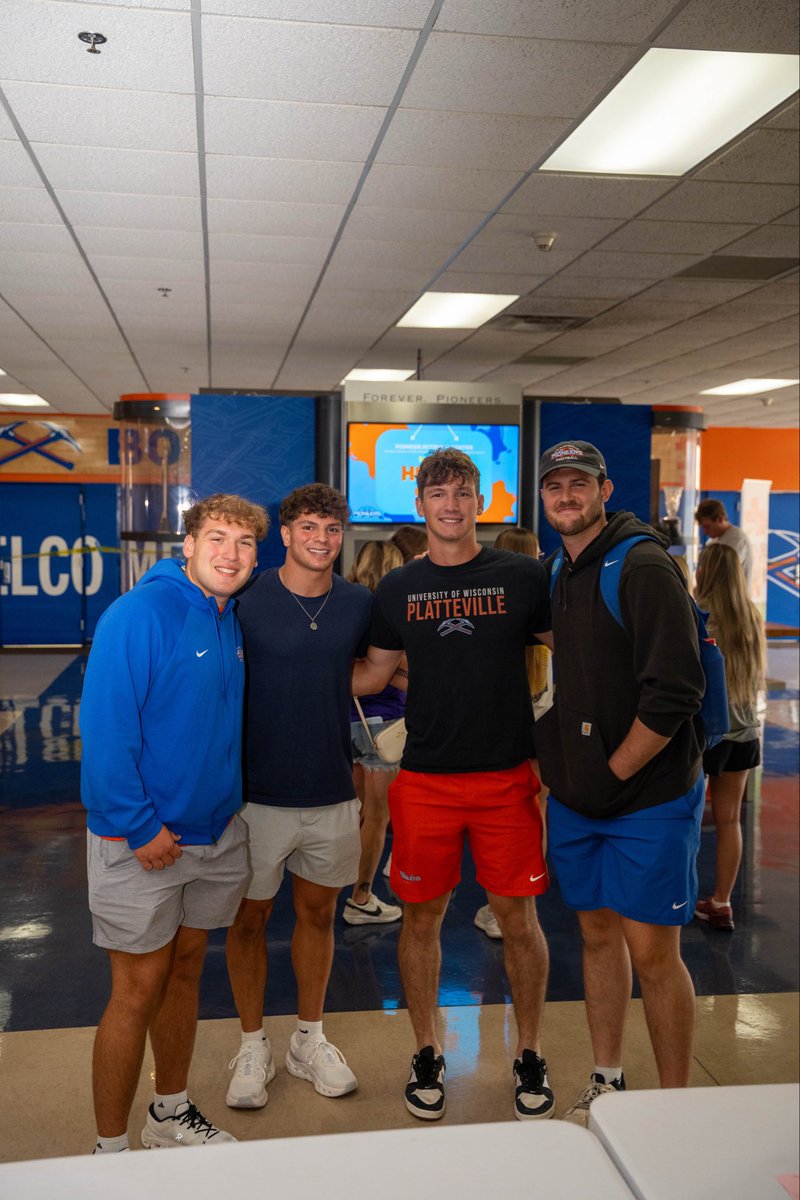
’Twas the day before Kickoff, and all through the land, several creatures are stirring in the @D3FBHuddle band. We have three more interviews, this time from Regions 5 & 6, along with @_AVBSports’s preview of the @RiponRedHawkFB season from inside their preseason.
The interviews in this show are with:
- @WartburgFB Sr. DL @ConnerMac52
- @SJUFootball Sr. OL Michael Bougie
- @UWPlattFootball Sr. RB @ZackBothun
Remember that we will have an hour-long pregame show from Montclair, NJ as USMMA visits Montclair at 5pm EDT (4pm EDT Pregame Show) to kick off the D3FB season!
Welcome to Season 19! It’s a full week for our #d3fb coverage kicking off Sunday with 4 preseason preview shows with 10 interviews, 2 live ITH pre-and-post game shows, and bonus @FrankRossi coverage of @SURiverHawksFB vs @UnionCollegeFB Saturday.
Theory: if Division III moves to 5 years of eligibility, the change will distort the long-established market for minutes played.
Higher-ceiling players will stay, cannibalize more minutes.
Developing players will get fewer opportunities, become less likely to persist. #whyd3
D2 WENT 5-FOR-5. D3 IS NOW THE ONLY LEVEL THAT HASN'T MOVED.
By Frank Rossi - @D3FBHuddle
Here's the update to what I wrote earlier this summer about eligibility - because the picture changed on August 5, and the part that matters most to D3 players and families is the part nobody is covering.
The NCAA Division II Executive Board adopted emergency legislation announced Wednesday, putting D2 on the same age-based eligibility model D1 adopted on June 23. It's effective right now, for the 2026-27 academic year. That's my earlier reporting overtaken by events - back in January, D2 punted this concept, 186-117, and the expectation was we wouldn't see it again until the 2028 Convention. Instead the Executive Board went around the Convention entirely and did it in July and August.
So D1 and D2 are aligned. D3 is on its own.
WHAT "5-FOR-5" ACTUALLY MEANS (AND WHY THE NAME IS MISLEADING)
Forget seasons. Under the new model you get a five-year window, and inside that window you can play whenever you want. Play all five. Play three. Sit out two. It doesn't matter - the clock runs regardless.
The clock starts at whichever of these comes first:
1. The first time you enroll full time at any college anywhere - and "anywhere" means junior college, prep-to-college, international schools, all of it; or
2. The start of the academic year right after your 19th birthday.
That second trigger is why "five for five" is a bad name, and the NCAA itself has said the label isn't accurate. If you take a gap year, do a post-grad year, work for two years, or start school late for almost any reason (see exceptions below), your clock is already running before you ever set foot on a college campus. You don't get five years of playing. You get whatever's left.
There are exactly three things that can stop the clock once it's running: pregnancy, active-duty military service, and an official religious mission. Note that word - stop, not start. These pause a clock already ticking, they don't delay when it begins, and they're administered by the Eligibility Center rather than by your campus. Redshirts are gone. Medical hardship waivers are gone. The whole apparatus of extensions and waivers that produced eight- and nine-year college athletes is gone.
One more thing people keep getting wrong: it is not retroactive. If you burned through your eligibility under the old rules after the 2025-26 year, you're done. That's being fought in court right now - a federal judge in Denver ruled on July 31 that class-of-2022 athletes who used up a fourth season this spring get a fifth, and an Ohio judge granted an injunction for two dozen D1 basketball players, finding the rules had been applied arbitrarily. That litigation is a big reason this keeps moving faster than anyone predicted.
WHAT D3'S RULE STILL IS
D3 hasn't changed anything. You get four seasons of participation inside your first 10 semesters of full-time enrollment. And D3 has the strictest trigger of the three divisions: you are charged a season if you practice with the team after the first contest, even if you never play a single down.
Sit that next to the new rule at D1 and D2, where practicing costs you nothing at all, and the gap is now enormous. D3 tried to narrow it at the January Convention - the Empire 8 proposal would have charged a season only when an athlete actually competed. The Presidents Council opposed it. The membership defeated it.
THE PART YOU NEED TO UNDERSTAND: THE DOOR NOW SWINGS ONE WAY
This is the practical takeaway... Transferring UP is open. A D3 player who has played four seasons and is still inside a five-year window can transfer to a D1 or D2 program and play a fifth. The receiving school evaluates them under the age-based model, and if the clock hasn't run out, there's a season there.
Transferring DOWN is closed. A D1 or D2 player who has played four seasons cannot come to D3 for a fifth. D3 still counts seasons, not years, and seasons you played at another level count against you. There's no fifth season to give.
So for the 2026-27 year at minimum, D3 is a net exporter. Our fifth-year guys have somewhere to go. Their fifth-year guys can't come here. If you're a D3 senior with an interest in one more year, or a D3 coach who just lost a name off your board, that's the mechanism.
Every case is individual and the clock math is genuinely tricky, especially for anyone who enrolled late or came through a JUCO. Talk to your compliance officer before you assume anything. But directionally, that's the landscape.
SO WHEN CAN D3 FIX THIS?
Two roads, and the calendar is tighter than most people realize.
The fast road exists and D3 isn't taking it. Under D3 Bylaw 9.3.1.1.2, the Presidents Council can adopt emergency legislation effective immediately, by a three-quarters vote, when the NCAA has to comply with a court order or when the Council decides it needs to limit the Association's exposure to litigation. That's essentially the authority D2 just used. Everything I'm hearing says there's no appetite in D3 to call that meeting. Fair enough - but understand that's a choice, not a limitation. And it's a choice that one lawsuit involving a D3 athlete could reverse in a week.
The regular road runs through the 2027 Convention, January 12-15 in Anaheim. Here's the problem: the initial deadline for membership-sponsored proposals was July 1. It's gone. There are still two ways onto that ballot:
- By 5 p.m. Eastern on September 15, a proposal can be filed by the Management Council or the Presidents Council, or by four conferences, or by 20 institutions representing four conferences. Everything has to be in final legislative form by that date.
- By November 1, resolutions and amendments-to-amendments can be filed. A resolution sets direction. It doesn't change the rule.
That September 15 date is the whole ballgame. Roughly six weeks from now. If a 5-for-5 proposal appears by then, D3 is voting on this in January - a full year sooner than anyone expected. If nothing appears, January is a conversation, not a rule change.
And even if it passes in January, note the default: D3 legislation takes effect August 1, 2027 unless the proposal specifically asks for an earlier date and explains why. So the alignment gap could stretch through the entire 2026-27 school year and into 2027-28 recruiting.
WHY THE REDSHIRT PROPOSAL IS PROBABLY DEAD
The season-charging fix that lost in January had real support and I expected it back. I don't anymore, and the logic is simple: if D3 goes to a five-year clock, there are no "seasons" left to charge. The entire practice-versus-competition argument evaporates. Nobody is going to spend another cycle fighting over a narrow fix when the broad one makes it moot - and "get all three divisions on one rule" is a far easier sell to a room of presidents than "carve out a D3-specific exception."
THE CATCH NOBODY IN D3 SHOULD IGNORE
Alignment sounds like a clean win. It isn't, not for this division.
The age-based model gives a fifth year to the traditional student who enrolls at 18 and moves straight through. It takes eligibility away from everybody else. The kid who works a year before college. The student who transfers in at 21 after figuring out what he wants. The international student on a different academic calendar. The post-bacc. D3 runs on a 10-semester enrollment clock precisely because it was built for students whose paths aren't straight lines, and there are more of those students in D3 than at either level above us.
That's a genuine tension, and it's exactly what the 19-member Division III Analysis Working Group is supposed to be sorting out. Its own timeline had findings landing at the January 2027 Issues Forum, with legislation the cycle after. Adopting in January 2027 means jumping ahead of the group studying the question.
Whether that happens is knowable by September 15. We'll be watching, and we'll tell you the day something is filed.