What we're reading for the next three months! Ali Wong's "Dear Girls," Candice Carty-Williams' "Queenie," and Alyssa Cole's "When No One is Watching!" @aliwong@CandiceC_W@AlyssaColeLit
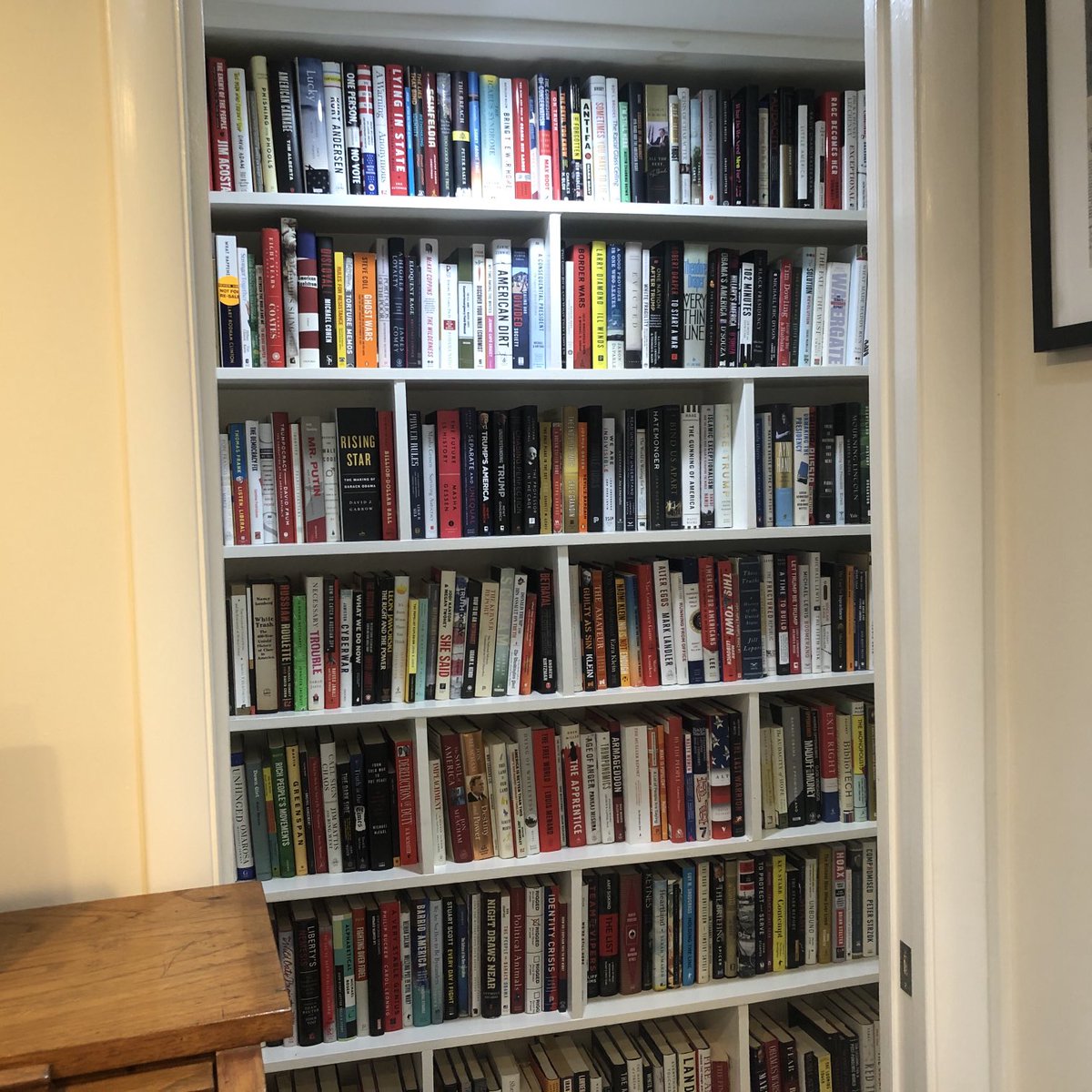
Some 5-6 years ago, after I became a book critic at the @washingtonpost, my wife built a floor-to-ceiling bookshelf in the hallway across from our home office. The idea is that it would be only for books that I had reviewed. This week, with my latest book, it is full.
@AAAJ_AAJC Is it because AAPI groups don't consider South Asians to be Asian American after all?
I deeply believed in my work w @AAAJ_AAJC. But being abandoned now by groups that said I belonged makes me question how they could ever support my community.
@AAAJ_AAJC Are you silent bc it's our family and friends who happen to be there who are sick and dying, and not those of us who happen to be here?
Is it because the predicted peak of 5,000 deaths a day will happen where my parents were born and not where I was?
https://t.co/PxfGy5VaTN
@AAAJ_AAJC I don’t like the questions I find myself asking in the silence left by @AAAJ_AAJC and groups like it.
But I wonder, are the preventable deaths in India resulting partly from our govt's role in vaccine apartheid more acceptable than violent hate crimes? https://t.co/5eotxHRAJg
@AAAJ_AAJC For instance, in the fight for family-based immigration, who are we fighting for if our family dies preventable deaths from US greed and inaction?
https://t.co/MRPl8QF0Kh
@AAAJ_AAJC Did you know two-thirds of Asian Ams were born outside the US, per @AAAJ_AAJC?
So it's not simple, as a group claiming to represent AAPIs, to draw a line around the US and say: here's the only soil that matters to us. Here are the only people who matter. https://t.co/kq7d76bwoT
@AAAJ_AAJC I was supported in ways I'd never expect work to support me. Our ED then, Mee Moua, cried with me and told me of a similar situation she'd faced. So many coworkers had faced the same. She said to go if I needed to, and that if I needed an excuse to stay, she could be it.
@AAAJ_AAJC One of my highlights at @AAAJ_AAJC, surprisingly, happened when I learned my Ba was dying.
I had to decide whether to visit after 10+ years away from India, equipped with a loose grasp of my mother tongue, a handful of experiences with my Ba, & years of "Hi Hello" phone calls.
@AAAJ_AAJC That has always been true. That fact made many of us raise an eyebrow in early pandemic when we saw our neighbors, for the first time, contend with the idea of not seeing a family member for a year. In immigrant communities and among ppl with less money, this is a fact of life.
@AAAJ_AAJC Part of the immigrant experience is having family across oceans or masses of land that might as well be oceans. It's who decides or gets to move, who can't or doesn't, who has the means to see their people again, who you don't get to see before they die.
@AAAJ_AAJC In my role, I believed in the idea of calling communities into the #AAPI identity to uplift the needs of our most invisibilized & marginalized ppl and build collective power to secure wins for all of us. I understood the many challenges of attempting that. https://t.co/aQ4QaddbCw
@AAAJ_AAJC Working for @AAAJ_AAJC was my dream. After seeing so few South Asians or Asian Ams in immigration spaces, I wanted to help fill that gap.
I knew we had stories that weren't being told. I thought @AAAJ_AAJC would be a powerful place to do that. https://t.co/9bcNEP9qpW
This hurts in a particular way for me. I worked at @AAAJ_AAJC for 2+ years creating messaging and writing content, redesigning the website, managing coalition campaigns, running the hate crime tracker at its inception when the primary targets of violence looked like my parents.
During this, one voice has been glaringly absent — national AAPI advocacy groups.
The same orgs that celebrated Kamala as the first Asian Am VP and send Happy Diwali emails haven’t breathed a word of compassion or condolence, a thought or a prayer, much less moved to action.