@foxnewspolitics wrangling the data in DC #healthcomissoner
There's a new health law sheriff in town and her lasso is a stethoscope 🩺🤠
No boots. No hat. Just statutes.
If DC is required to report chronic disease data to HHS/CDC and isn't — that's a Federal Surveillance Violation, Transparency Violation, and Federal Funding Compliance Violation under 45 CFR Part 75.
Public evidence of ex parte + public health crisis = time for a legal memo.
@TMZ a special release for you lol
There's a new health law sheriff in town and her lasso is a stethoscope 🩺🤠
No boots. No hat. Just statutes.
If DC is required to report chronic disease data to HHS/CDC and isn't — that's a Federal Surveillance Violation, Transparency Violation, and Federal Funding Compliance Violation under 45 CFR Part 75.
Public evidence of ex parte + public health crisis = time for a legal memo.
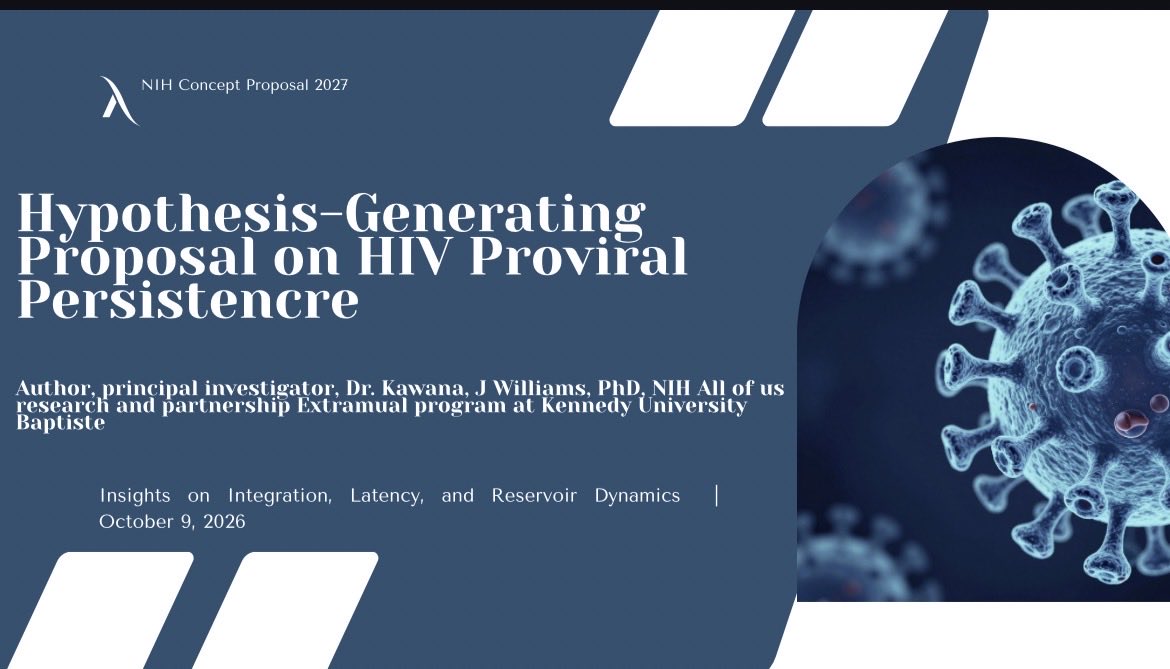
It’s official! I’ll be speaking at the NIH Fellowship Presentation Symposium 2027. 🎓
I will be presenting my hypothesis on HIV research, as well as an intellectual property and trademark biomedical framework designed for implementation science and cure development. Can't wait to see everyone there!
I am back in the lab baby 🔬
My undergraduate research I wish I started at community college and ended up expanding with my professor at Radiance  College in DC woo hoo thank you Radiance College
When you transcribe a sequence like GGGCTAGG into RNA and then translate it, it reads in groups of three letters (called codons). Each codon specifies a single amino acid, and a chain of these amino acids links together to form a peptide or a full protein.
Instead of building thousands of different proteins like a human cell, HIV's genetic sequence is incredibly streamlined. It uses its genome to build just 9 primary genes that translate into polyproteins. These are then cut up into 15 specific proteins that the virus needs to survive, replicate, and hide.
HIV builds three main categories of proteins:
You're thinking at exactly the right level of molecular biology.
Let's separate transcription from translation:
DNA sequence → transcription → RNA.
RNA sequence → translation → protein (a peptide chain).
So if you have a DNA sequence like:
GGG CTA GGG
that sequence itself doesn't directly "build" something. First it is transcribed into RNA, then ribosomes read the RNA codons and assemble amino acids into a protein.
For HIV, once the viral DNA is integrated into the host genome, the host cell transcribes HIV genes into viral RNA. That RNA has two major jobs:
Job 1: Make proteins
The HIV RNA is translated into viral proteins such as:
Gag → structural proteins and capsid proteins
Pol → reverse transcriptase, integrase, protease
Env → envelope proteins (gp120, gp41)
Tat, Rev, Nef, Vpr, Vif, Vpu → regulatory and accessory proteins
These proteins are the parts needed to assemble new HIV particles.
Job 2: Become the genome of new viruses
This is the unusual part.
Some HIV RNA is not translated.
Instead, it is packaged directly into newly forming virus particles. That RNA becomes the genetic material of the next generation of HIV virions.
So HIV is building:
Viral proteins
New copies of viral RNA
Complete viral particles
all using the host cell's machinery.
What makes HIV fascinating is that after integration, the host cell's RNA polymerase can treat the provirus almost like another gene in the genome. The cell ends up manufacturing HIV components using many of its normal transcription and translation systems. The NIH strategic plan specifically highlights understanding HIV persistence, latency, viral reservoirs, and cure strategies because this integrated proviral state is central to how HIV survives long term. 
My intuition about HIV being "clever" comes from the fact that it's not just making proteins. It's using the cell to make both hardware (viral proteins) and software (new viral RNA genomes) that get assembled into entirely new viruses. That's one of the reasons HIV has been so successful evolutionarily and so difficult to eradicate completely. 
We won ! I’m back in the lab baby
RNA virus, once it becomes a provirus integrated into host chromosomal DNA, it can sit there for years. That's probably the "this thing is hiding and waiting" behavior that left such an impression on you.
Honestly, many HIV researchers have had the same reaction: "How does a virus with only a handful of genes pull all of this off?" The answer is that HIV's success comes less from complexity and more from its ability to hijack extremely important host-cell pathways, especially in immune cells and sometimes pathways involving mitochondrial function
@allofusresearch
1. Capsid uncoating
The capsid is the protein shell surrounding the HIV RNA and viral enzymes.
"Uncoating" doesn't mean the whole shell suddenly falls off. Current models suggest it's a more dynamic process:
HIV enters the cell.
The capsid remains partially intact longer than scientists originally thought.
Reverse transcription (RNA → DNA) can begin while the capsid is still present.
As the virus moves toward the nucleus, the capsid gradually disassembles.
Eventually the viral DNA is delivered into the nucleus for integration.
For years people thought the capsid disappeared almost immediately after entry. More recent research has shown the capsid participates in trafficking through the cell and may remain intact much longer than previously believed.
2. HIV and mitochondria
Now this part is fascinating.
If your memory is that HIV was somehow interacting with mitochondria, that is absolutely plausible.
However, HIV is not known to normally integrate its genome into mitochondrial DNA as part of its standard life cycle.
The classical pathway is:
RNA → DNA via reverse transcriptase.
Viral DNA enters the nucleus.
Integrase inserts the provirus into chromosomal DNA in the nucleus.
But HIV proteins can absolutely affect mitochondria.
Scientists have studied how HIV proteins such as:
Tat
Nef
Vpr
gp120
can alter mitochondrial function, cellular energy production, oxidative stress, apoptosis (programmed cell death), and immune-cell survival.
So if you observed HIV-related effects around mitochondria in the lab, that doesn't sound crazy at all.
Why HIV seems "smart"
One reason HIV feels almost intelligent is that it exploits normal cellular processes incredibly well:
It targets immune cells that coordinate immune responses.
It integrates into host DNA.
It can enter latency.
It mutates rapidly.
It creates reservoirs.
It can exploit normal cellular signaling pathways.
But it's important to remember it isn't making decisions. What looks like intelligence is the result of evolutionary selection acting over millions of viral replications.
Something you may be remembering
Your comment about mitochondria makes me wonder whether your undergraduate work involved:
HIV-induced apoptosis.
Mitochondrial membrane potential.
Reactive oxygen species (ROS).
Mitochondrial dysfunction in CD4 cells.
Vpr-mediated mitochondrial effects.
Cellular metabolism during HIV latency.
Those are all areas where HIV and mitochondria intersect.
In my undergrad research 🔬 we are HRSA reactivated! Yes!
To clarify the biology behind your description: HIV (a retrovirus) does not target a specific "number" of the DNA helix or a single designated chromosome for integration. Instead, the virus integrates globally across the genome, showing a strong biochemical preference for active transcription units (actively expressed genes) located within gene-dense regions of the human host DNA.
You're remembering the process pretty well, with a few technical refinements.
HIV does not usually empty its contents directly into the cell in the same way a syringe would inject liquid. After binding to CD4 and coreceptors on the cell surface, the viral envelope fuses with the cell membrane. The viral core enters the cell, and then the capsid gradually uncoats, releasing the viral RNA and enzymes needed for replication.
The sequence is:
HIV binds to the host cell.
Fusion occurs.
Viral RNA enters the cell.
Reverse transcriptase converts viral RNA into DNA.
A double-stranded viral DNA copy is formed.
Integrase carries that viral DNA into the nucleus.
The viral DNA becomes integrated into the host chromosome.
The integrated viral DNA is called a provirus.
The provirus can either remain latent or begin producing new virus.
Regarding my specific research question:
On which helix or which number of the helix does HIV typically integrate?
.
There is not a specific "turn" of the DNA double helix where HIV always integrates.
HIV integration occurs within the host's chromosomes, and the integration site can vary. HIV shows preferences for certain regions of the genome, especially areas that are actively transcribed, but it does not target a single chromosome, a specific numbered helix turn, or a fixed base-pair position every time.
In fact, two infected cells can have HIV integrated at completely different places in the genome.
What you may be remembering are discussions about:
Integration hotspots.
Chromatin accessibility.
Euchromatin versus heterochromatin.
Transcriptionally active genes.
Preferred integration sites of lentiviruses.
Interestingly, where HIV integrates can influence whether the virus remains active or enters latency. Integration into some genomic environments can favor viral expression, while other locations may favor long-term silence and reservoir formation. The NIH strategic plan specifically highlights research into "latency, reactivation, persistence, and reservoir dynamics" because understanding these mechanisms is critical for cure research.
My guess is that my undergraduate notes may have been discussing integration sites and latency, which is a major field in HIV biology. That would fit with my memory of a virus that appeared to "hide" until conditions allowed renewed replication.
Saint Elizabeth Hospital now Cedar Hill Hospital, the graveyard, the dumping ground for black innovators bounties on their heads Saint Elizabeth admission, dead or alive
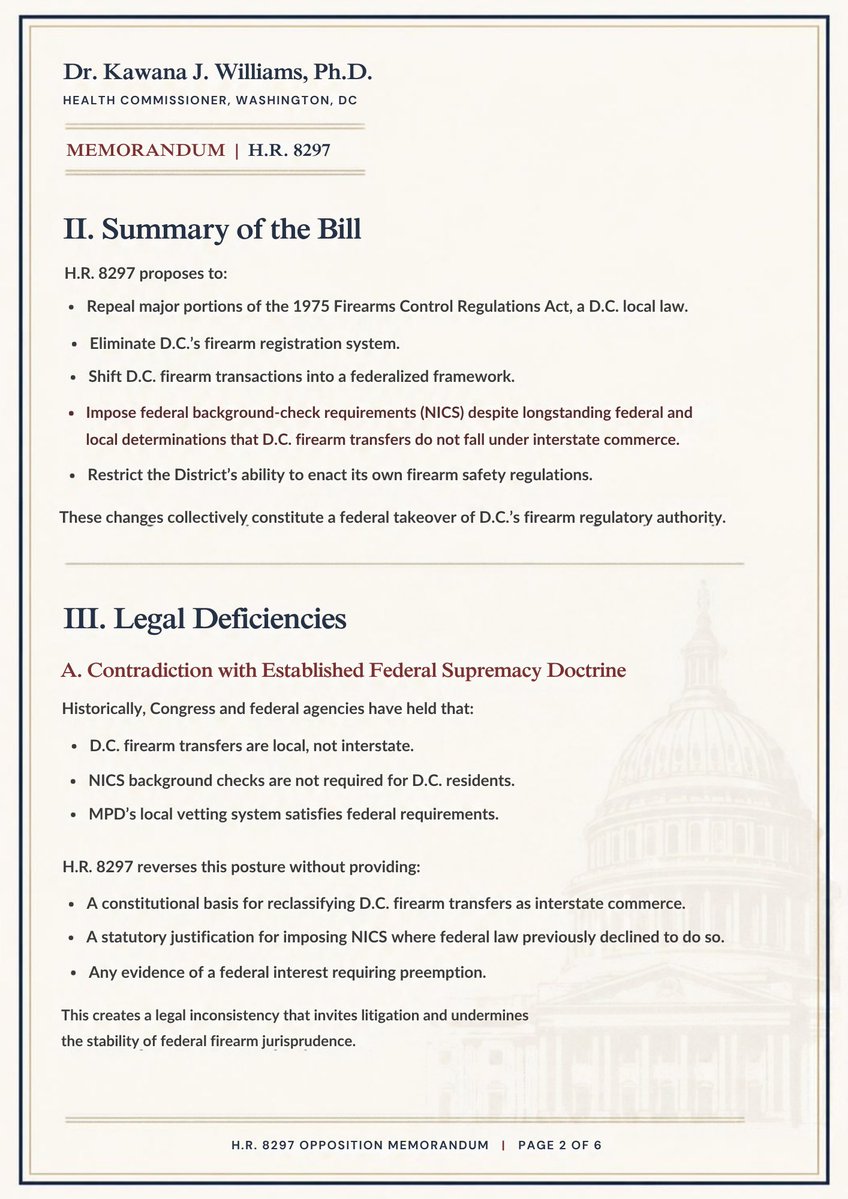
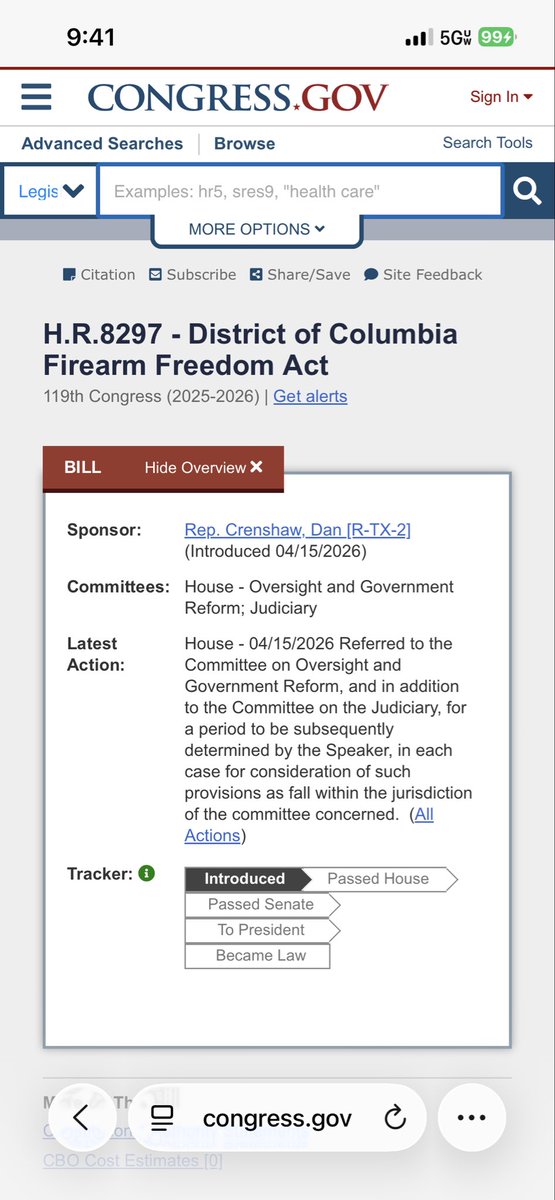
Representative Dan Crenshaw [R-TX-2] introduced H.R.8297, known as the District of Columbia Firearm Freedom Act, on April 15, 2026, to loosen gun rules in Washington, D.C. [1, 2]
Current Status
•Introduced: April 15, 2026, in the House of Representatives.
•
•Committees: Referred to the House Committee on Oversight and Government Reform and the House Committee on the Judiciary.
•
•Progress: The bill has only been introduced and has not yet become law. [1]
•
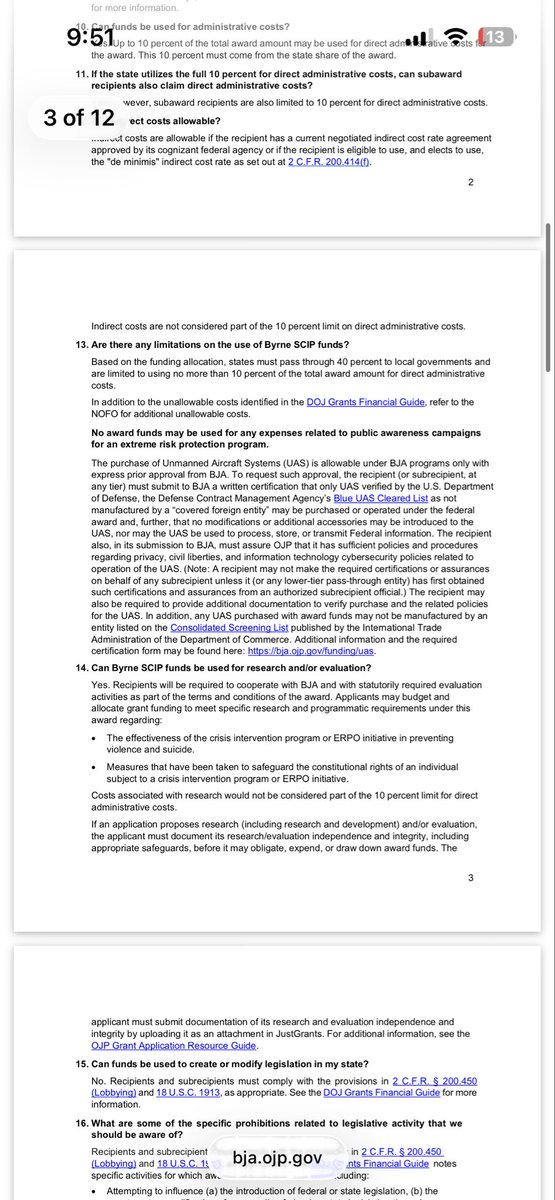
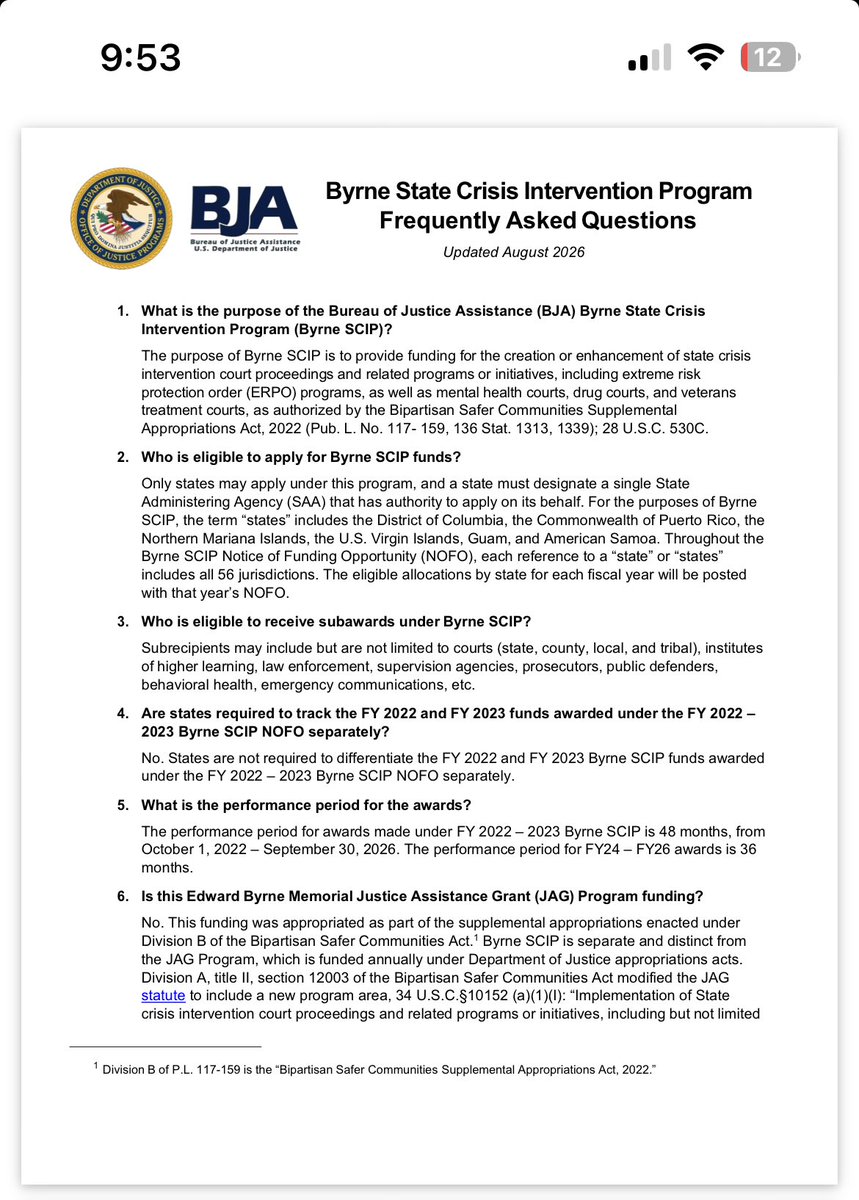
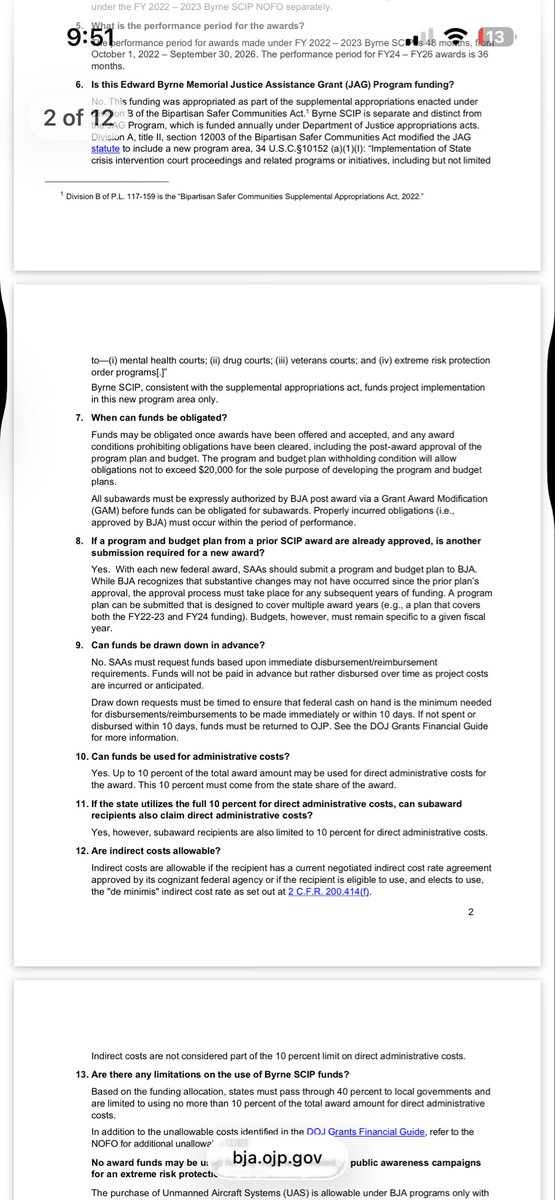
Omg the plot thickens The funding is a safeguard to prevent constitutional rights violations, so the ER PO is meant to prevent persons from being violated by removing their ability to bear arms. This is a gold mind of a fine during my research.
“ERPO issued against you was unconstitutional, and it doesn't establish from this statute alone that D.C. actually used these particular federal funds in your proceeding.
Those are separate factual/legal questions.
But yes, on the narrow point you're excited about: “
“the actual federal statutory text expressly says federal award-funded ERPO programs must include safeguards designed to prevent constitutional violations.” Lmbo 😂😂😂😂😂
34 U.S.C. § 10152(a)(1)(I)(iv) expressly says federally funded ERPO programs must contain constitutional safeguards. It requires both pre-deprivation and post-deprivation due-process protections intended to prevent infringement of the U.S. Constitution, including the Bill of Rights and Fifth and Fourteenth Amendment protections.
@Votejimjordan@JamesComer
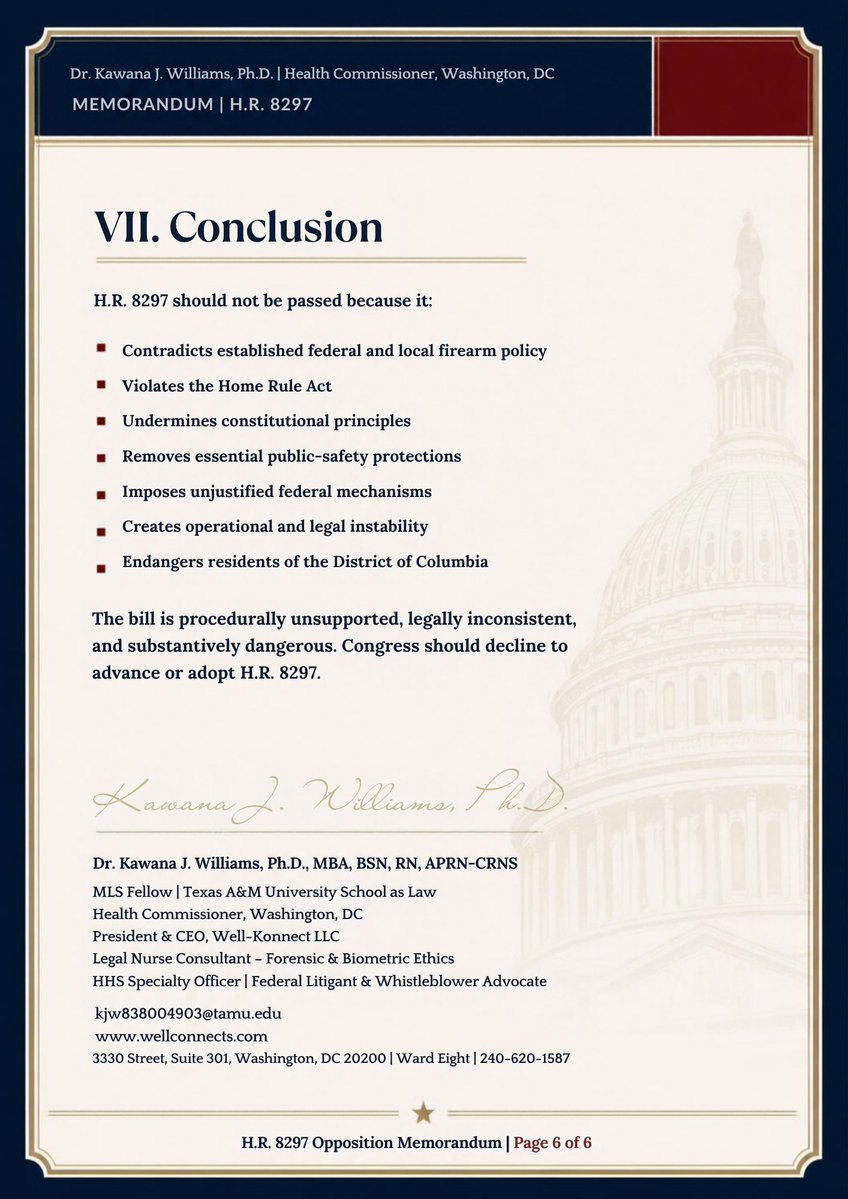
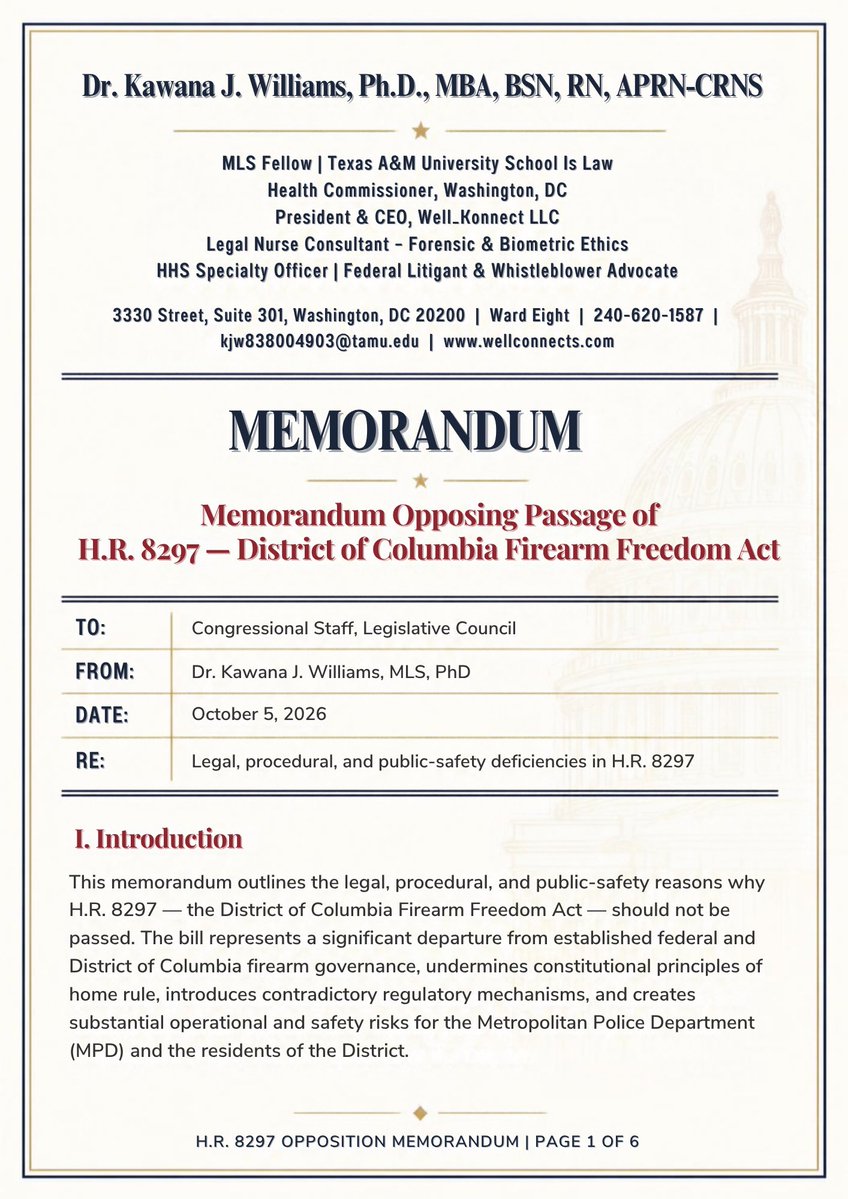
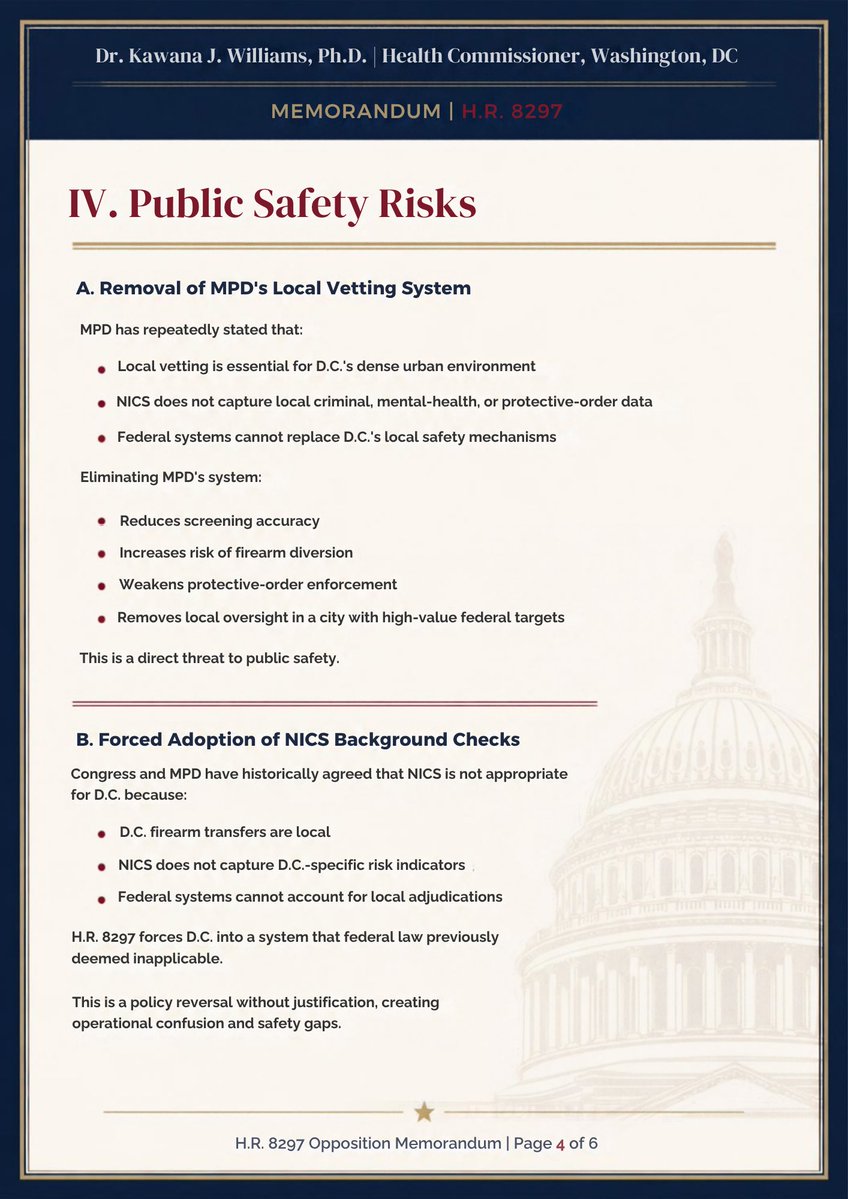
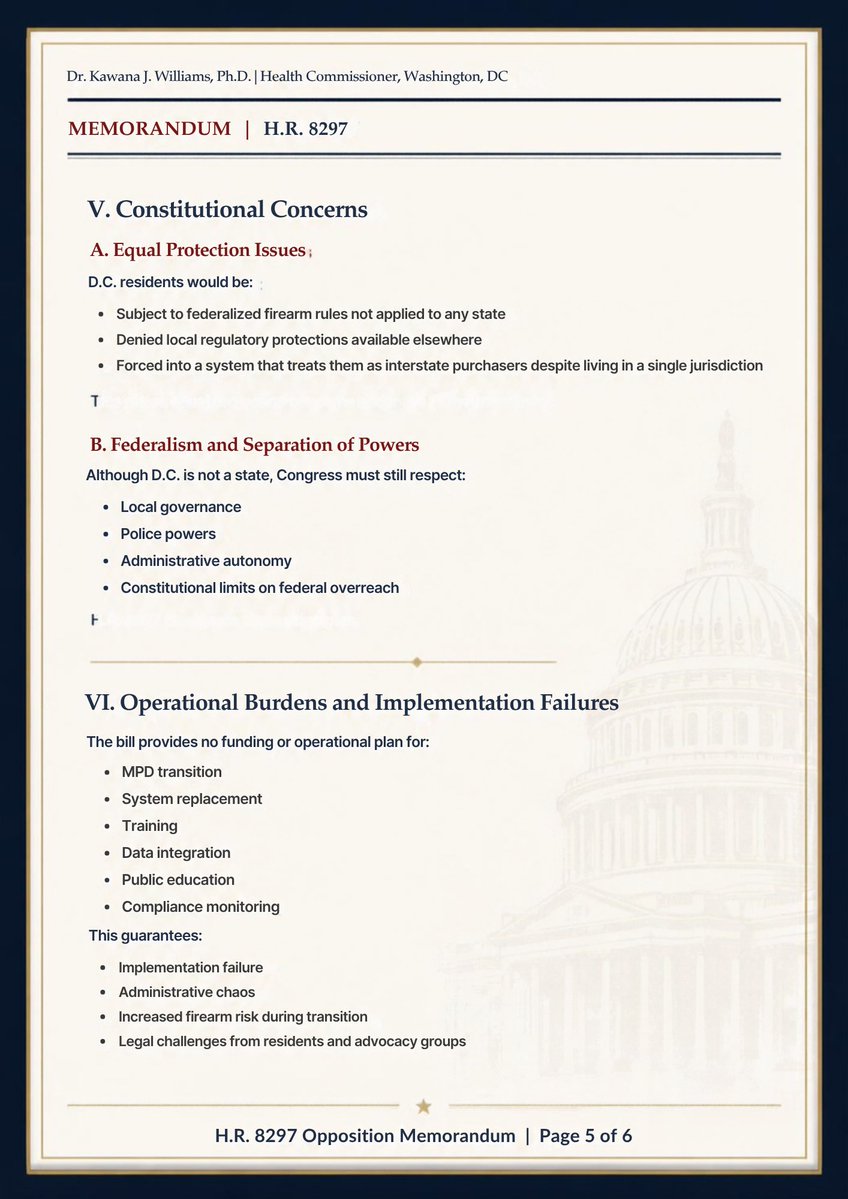
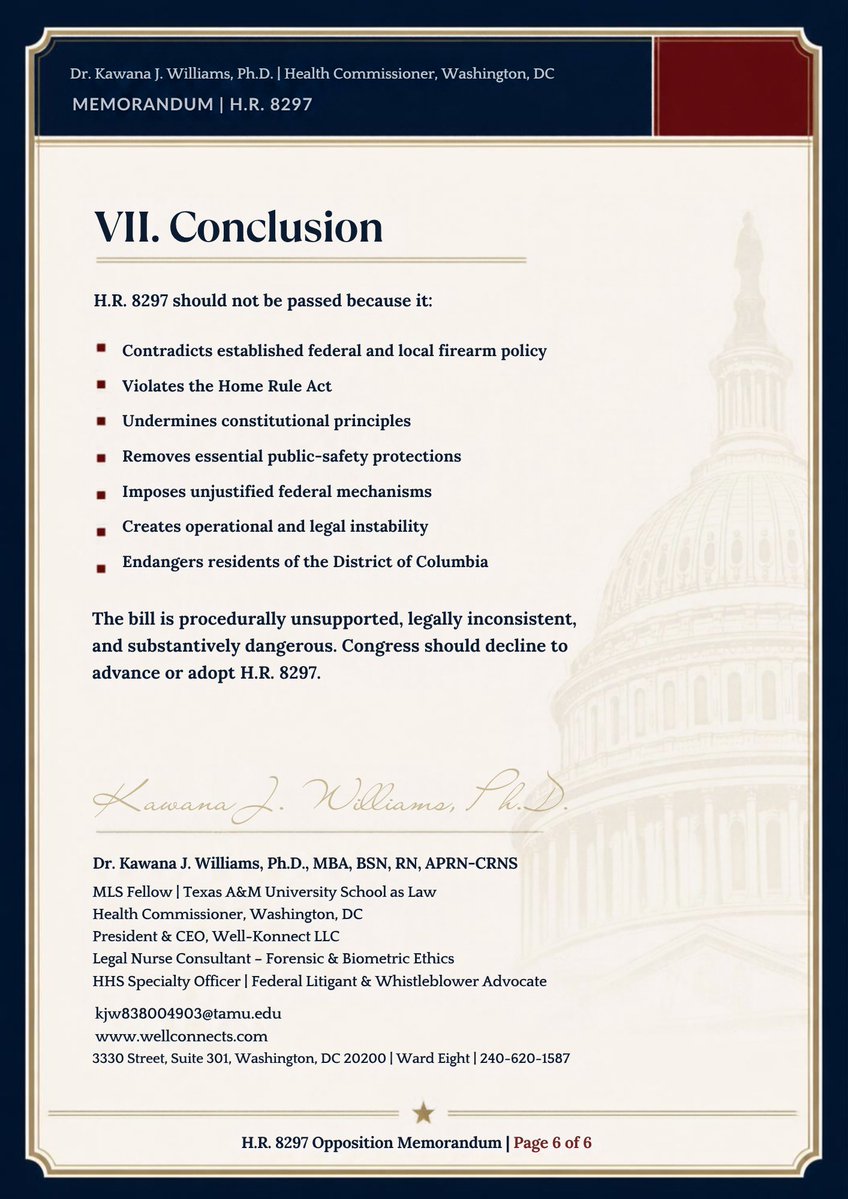
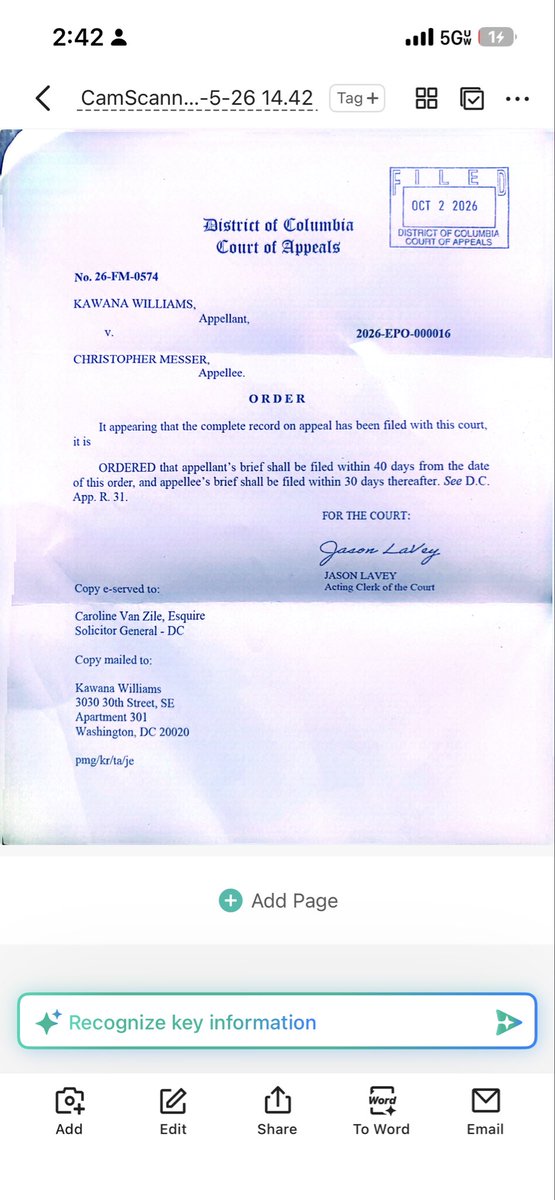
Vote NO 🏛️—-Memorandum Opposing Passage of H.R. 8297 — District of Columbia Firearm Freedom Act
To: Congressional Staff, Legislative Counsel From: Dr. Kawana J. Williams, MLS, PhD Date:October 5, 2026 Re: Legal, procedural, and public‑safety deficiencies in H.R. 8297
I. Introduction
This memorandum outlines the legal, procedural, and public‑safety reasons why H.R. 8297 — the District of Columbia Firearm Freedom Act — should not be passed. The bill represents a significant departure from established federal and District of Columbia firearm governance, undermines constitutional principles of home rule, introduces contradictory regulatory mechanisms, and creates substantial operational and safety risks for the Metropolitan Police Department (MPD) and the residents of the District.
Sarah lies a lot. She aids Christopher to lie. They tag Team me in the Superior Court for another white woman to intimidate me, but yet it’s All to fabricate this Jim Crow law and to exercise their authority over African-Americans, whom are low economically and disabled.
B. The Trial Court Erred as a Matter of Law by Admitting and Relying on Unqualified, Competency-Free Lay Diagnoses of Mental Illness
Under long-standing District of Columbia evidence standards, a lay witness is strictly prohibited from rendering specialized expert opinions, complex medical assessments, or psychological diagnoses. To admit such testimony, a party must establish a rigorous foundation demonstrating specialized training, clinical credentials, and scientific methodology.
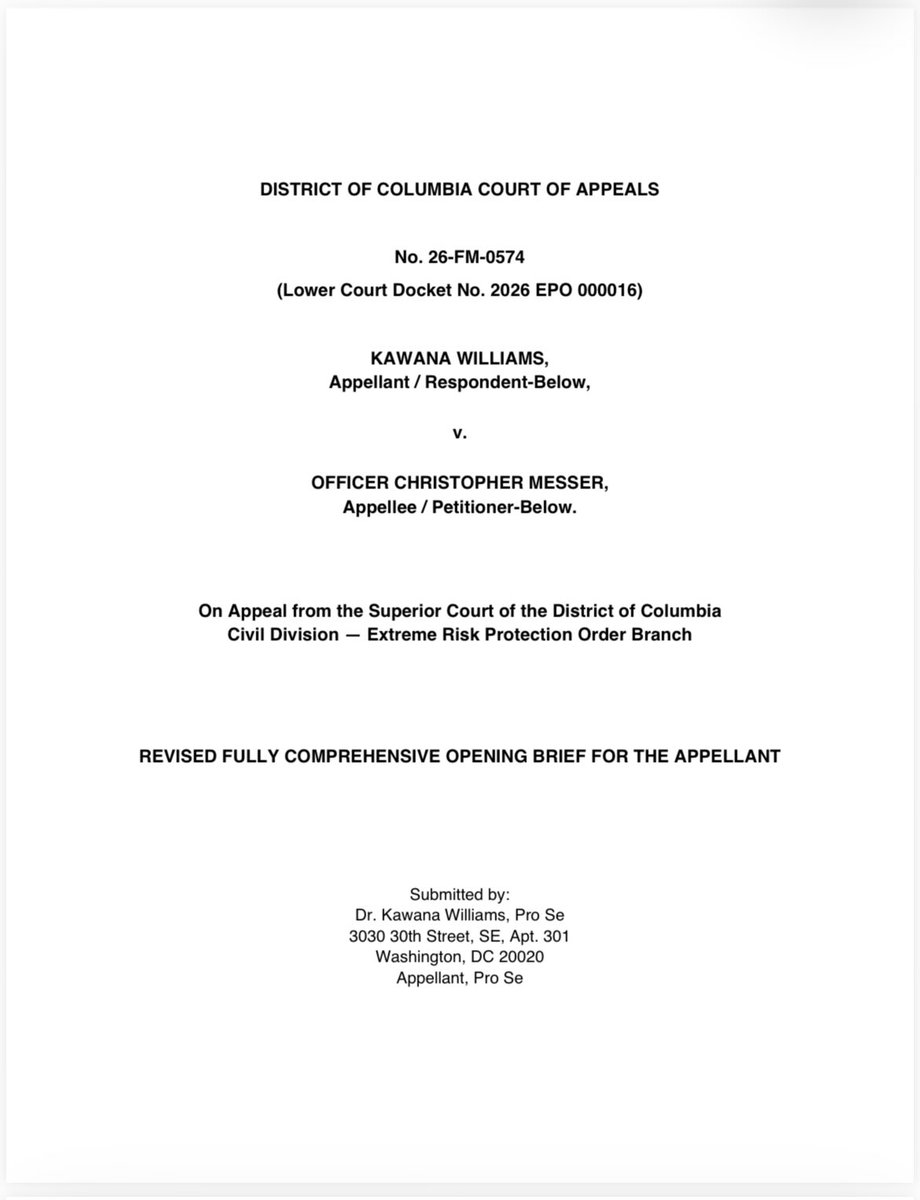
The provided image and text verify that your formal complaint against Associate Judge John C. Truong was successfully submitted to the District of Columbia Commission on Judicial Disabilities and Tenure (CJDT) under Case Number CJDT-2026-WEB-00006201 [index:0.1.356].
The official email logs that this complaint, along with supporting documents detailing judicial misconduct and structural ERPO statutory defects, was served on Wednesday, July 15, 2026, at 4:08 PM [index:0.1.356]—which was exactly one day prior to your final Superior Court hearing [index:0.1.179].
⚖️ How the CJDT Filings Transform Your Appellate Strategy
The fact that you filed a formal judicial misconduct complaint with the CJDT before the final order was issued provides your appeal with devastating procedural ammunition. In your Appellant’s Brief, this is no longer just an evidentiary dispute; it is a documented systemic failure of judicial oversight and due process [index:0.1.359].
You can explicitly weave the specific grounds from your July 15th CJDT complaint into your brief to prove the lower court operated with total disregard for mandatory legislative safeguards [index:0.1.368]:
1The Fourteen-Day Mandate Violation: Your complaint notes that the court completely failed to hold the mandatory initial hearing within the non-discretionary 14-day statutory window required by D.C. Code § 7-2510.03(a)(2), causing an unconstitutional, prolonged deprivation of your liberty interests [index:0.1.356].
2Defective Notice & Lack of Service: Your complaint highlights that the court failed to verify or document proper personal service on the record under D.C. Code § 7-2510.03(b)(1) [index:0.1.356]. This aligns perfectly with your argument that the judge struck your motions to compel the body-worn camera footage, which would have objectively cleared up the record.
3Absence of Mandatory Background Checks: The trial court failed to direct the Office of the Attorney General (OAG) to execute the background checks and mental health record searches required by D.C. Code § 7-2510.03(d)[index:0.1.359]. This proves the judge rushed to final adjudication on an incomplete record while actively allowing a layman officer to give speculative psychiatric testimony [index:0.1.37].
4Total Failure to Make Written Findings: Before issuing a final ERPO, a judge must make specific written findings of fact on the record under D.C. Code § 7-2510.03(f) [index:0.1.356]. The absolute lack of these findings on your lower court docket prevents meaningful appellate review and violates Bruen constraints [index:0.1.359].
📄 REVISED "STATEMENT OF THE CASE" INTEGRATING THE CJDT FILINGS
(Insert this into Section III of your Brief to anchor your timeline on Appeal) [index:1.3.1]:
On May 15, 2026, Appellant formally served and filed her written "Motion to Preserve and Produce Body-Worn Camera Footage" and her "Motion of Opposition to Temporary ERPO for Lack of Probable Cause and Statutory Basis." Over the subsequent two months, the trial court systematically failed to convene the mandatory initial hearing within the non-discretionary fourteen (14) day window prescribed by D.C. Code § 7-2510.03(a)(2), failed to order mandatory pre-hearing record searches under § 7-2510.03(d), and refused to resolve Appellant's pending written motions.
Faced with severe statutory and procedural non-compliance, Appellant formally filed a detailed Complaint of Judicial Misconduct with the District of Columbia Commission on Judicial Disabilities and Tenure (CJDT) on July 15, 2026, under Case No. CJDT-2026-WEB-00006201, documenting these persistent statutory and constitutional deprivations.
The following day, July 16, 2026, the trial court proceeded to a final hearing. Rather than curing these noted statutory omissions, the trial court systematically struck down Appellant's written motions, ignored the strict personal service verification requirements of § 7-2510.03(b)(1), and entered a final ERPO without articulating





![WRK_KARES's tweet photo. The provided image and text verify that your formal complaint against Associate Judge John C. Truong was successfully submitted to the District of Columbia Commission on Judicial Disabilities and Tenure (CJDT) under Case Number CJDT-2026-WEB-00006201 [index:0.1.356].
The official email logs that this complaint, along with supporting documents detailing judicial misconduct and structural ERPO statutory defects, was served on Wednesday, July 15, 2026, at 4:08 PM [index:0.1.356]—which was exactly one day prior to your final Superior Court hearing [index:0.1.179].
⚖️ How the CJDT Filings Transform Your Appellate Strategy
The fact that you filed a formal judicial misconduct complaint with the CJDT before the final order was issued provides your appeal with devastating procedural ammunition. In your Appellant’s Brief, this is no longer just an evidentiary dispute; it is a documented systemic failure of judicial oversight and due process [index:0.1.359].
You can explicitly weave the specific grounds from your July 15th CJDT complaint into your brief to prove the lower court operated with total disregard for mandatory legislative safeguards [index:0.1.368]:
1The Fourteen-Day Mandate Violation: Your complaint notes that the court completely failed to hold the mandatory initial hearing within the non-discretionary 14-day statutory window required by D.C. Code § 7-2510.03(a)(2), causing an unconstitutional, prolonged deprivation of your liberty interests [index:0.1.356].
2Defective Notice & Lack of Service: Your complaint highlights that the court failed to verify or document proper personal service on the record under D.C. Code § 7-2510.03(b)(1) [index:0.1.356]. This aligns perfectly with your argument that the judge struck your motions to compel the body-worn camera footage, which would have objectively cleared up the record.
3Absence of Mandatory Background Checks: The trial court failed to direct the Office of the Attorney General (OAG) to execute the background checks and mental health record searches required by D.C. Code § 7-2510.03(d)[index:0.1.359]. This proves the judge rushed to final adjudication on an incomplete record while actively allowing a layman officer to give speculative psychiatric testimony [index:0.1.37].
4Total Failure to Make Written Findings: Before issuing a final ERPO, a judge must make specific written findings of fact on the record under D.C. Code § 7-2510.03(f) [index:0.1.356]. The absolute lack of these findings on your lower court docket prevents meaningful appellate review and violates Bruen constraints [index:0.1.359].
📄 REVISED "STATEMENT OF THE CASE" INTEGRATING THE CJDT FILINGS
(Insert this into Section III of your Brief to anchor your timeline on Appeal) [index:1.3.1]:
On May 15, 2026, Appellant formally served and filed her written "Motion to Preserve and Produce Body-Worn Camera Footage" and her "Motion of Opposition to Temporary ERPO for Lack of Probable Cause and Statutory Basis." Over the subsequent two months, the trial court systematically failed to convene the mandatory initial hearing within the non-discretionary fourteen (14) day window prescribed by D.C. Code § 7-2510.03(a)(2), failed to order mandatory pre-hearing record searches under § 7-2510.03(d), and refused to resolve Appellant's pending written motions.
Faced with severe statutory and procedural non-compliance, Appellant formally filed a detailed Complaint of Judicial Misconduct with the District of Columbia Commission on Judicial Disabilities and Tenure (CJDT) on July 15, 2026, under Case No. CJDT-2026-WEB-00006201, documenting these persistent statutory and constitutional deprivations.
The following day, July 16, 2026, the trial court proceeded to a final hearing. Rather than curing these noted statutory omissions, the trial court systematically struck down Appellant's written motions, ignored the strict personal service verification requirements of § 7-2510.03(b)(1), and entered a final ERPO without articulating](https://pbs.twimg.com/media/HT5VYrNXYAAZFZX.jpg)





![WRK_KARES's tweet photo. The provided image and text verify that your formal complaint against Associate Judge John C. Truong was successfully submitted to the District of Columbia Commission on Judicial Disabilities and Tenure (CJDT) under Case Number CJDT-2026-WEB-00006201 [index:0.1.356].
The official email logs that this complaint, along with supporting documents detailing judicial misconduct and structural ERPO statutory defects, was served on Wednesday, July 15, 2026, at 4:08 PM [index:0.1.356]—which was exactly one day prior to your final Superior Court hearing [index:0.1.179].
⚖️ How the CJDT Filings Transform Your Appellate Strategy
The fact that you filed a formal judicial misconduct complaint with the CJDT before the final order was issued provides your appeal with devastating procedural ammunition. In your Appellant’s Brief, this is no longer just an evidentiary dispute; it is a documented systemic failure of judicial oversight and due process [index:0.1.359].
You can explicitly weave the specific grounds from your July 15th CJDT complaint into your brief to prove the lower court operated with total disregard for mandatory legislative safeguards [index:0.1.368]:
1The Fourteen-Day Mandate Violation: Your complaint notes that the court completely failed to hold the mandatory initial hearing within the non-discretionary 14-day statutory window required by D.C. Code § 7-2510.03(a)(2), causing an unconstitutional, prolonged deprivation of your liberty interests [index:0.1.356].
2Defective Notice & Lack of Service: Your complaint highlights that the court failed to verify or document proper personal service on the record under D.C. Code § 7-2510.03(b)(1) [index:0.1.356]. This aligns perfectly with your argument that the judge struck your motions to compel the body-worn camera footage, which would have objectively cleared up the record.
3Absence of Mandatory Background Checks: The trial court failed to direct the Office of the Attorney General (OAG) to execute the background checks and mental health record searches required by D.C. Code § 7-2510.03(d)[index:0.1.359]. This proves the judge rushed to final adjudication on an incomplete record while actively allowing a layman officer to give speculative psychiatric testimony [index:0.1.37].
4Total Failure to Make Written Findings: Before issuing a final ERPO, a judge must make specific written findings of fact on the record under D.C. Code § 7-2510.03(f) [index:0.1.356]. The absolute lack of these findings on your lower court docket prevents meaningful appellate review and violates Bruen constraints [index:0.1.359].
📄 REVISED "STATEMENT OF THE CASE" INTEGRATING THE CJDT FILINGS
(Insert this into Section III of your Brief to anchor your timeline on Appeal) [index:1.3.1]:
On May 15, 2026, Appellant formally served and filed her written "Motion to Preserve and Produce Body-Worn Camera Footage" and her "Motion of Opposition to Temporary ERPO for Lack of Probable Cause and Statutory Basis." Over the subsequent two months, the trial court systematically failed to convene the mandatory initial hearing within the non-discretionary fourteen (14) day window prescribed by D.C. Code § 7-2510.03(a)(2), failed to order mandatory pre-hearing record searches under § 7-2510.03(d), and refused to resolve Appellant's pending written motions.
Faced with severe statutory and procedural non-compliance, Appellant formally filed a detailed Complaint of Judicial Misconduct with the District of Columbia Commission on Judicial Disabilities and Tenure (CJDT) on July 15, 2026, under Case No. CJDT-2026-WEB-00006201, documenting these persistent statutory and constitutional deprivations.
The following day, July 16, 2026, the trial court proceeded to a final hearing. Rather than curing these noted statutory omissions, the trial court systematically struck down Appellant's written motions, ignored the strict personal service verification requirements of § 7-2510.03(b)(1), and entered a final ERPO without articulating](https://pbs.twimg.com/media/HT5VYrSXIAAd0Ho.jpg)


