A global digital payments company that provides TRANSPARENT, FAST and EFFICIENT digital payment solutions leveraging Distributed Ledger Technology (DLT).
🚀WSPN: Redefining Stablecoin 2.0🌟
2 minutes to see how we're shaping the future of digital finance. 🎥💡
Watch our vision unfold and join the revolution! 👇
#WSPN#Stablecoin#DigitalFinance $WUSD #Web3#FutureOfMoney
🚀 Exciting news!
We're launching an A2A payments system that turns any agent into a buyer. Install one skill, plug into the discovery registry — your agent finds merchants, compares quotes & settles on-chain in stablecoins.
Internal testing ✅ complete. Launching soon. 🟢
Stay tuned. 👀
#WSPN #Stablecoin #DigitalPayments #AgentPayments #Fintech
Circle + Nium just connected USDC settlement to Nium's payout rails in 190+ countries via a single API 🌏 Agentic commerce needs programmable money. Stablecoins are becoming the default funding layer for machine-to-machine payments 🤖💳
B2B payments market: $187T → $224T by 2030. The infrastructure race is on 🚀 #Stablecoins #AgenticAI #CrossBorderPayments #USDC
📊 Week in Brief
The stablecoin market hit a record $322B this week, surpassing the FX reserves of 95 nations including the UK and Canada. USDT minted over $5B while competitors shed a combined $4.2B, intensifying concentration. Highlights: Nium joined Circle CPN for 190-country payouts, PPRO + Coinbase partnered on merchant stablecoin acceptance, and SoFi became the first U.S. national bank to launch a stablecoin in its banking app. The FDIC proposed 30-day FinCEN preclearance for AML actions, and a court ordered Circle to freeze Zama's privacy protocol — a landmark test of blacklist authority in DeFi.
📰 Top Stories
1️⃣ Stablecoin Market Cap Hits $322B, Exceeds FX Reserves of 95 Nations
📅 May 26 | CoinDesk → https://t.co/ZafByQ3KTC
Total stablecoin market cap reached $322B, surpassing the official FX reserves of 95 countries including the UK, Canada, Poland and UAE. Only 14 nations (China, Japan, Russia, India etc.) hold larger reserves. The BIS noted cross-border stablecoin flows have grown substantially since 2022, especially in high-inflation regions.
Why It Matters: A sector once dismissed as "crypto plumbing" now rivals sovereign financial buffers. The $322B scale makes stablecoin regulation a macro-financial stability issue, not a niche crypto concern.
2️⃣ FDIC Proposes 30-Day FinCEN Preclearance for Stablecoin AML
📅 May 26 | American Banker → https://t.co/j32sR6V02X
The FDIC proposed requiring 30-day advance notice to FinCEN before major AML enforcement actions against stablecoin issuers. The proposal includes a safe harbor: except for gross negligence, issuers with appropriate AML programs are protected from many enforcement actions.
Why It Matters: Expands Treasury's role in FDIC enforcement. The 30-day window and safe harbor give issuers more procedural certainty, though interagency friction between bank regulators and Treasury is a risk.
3️⃣ USDT +$5B in a Month, Rivals Shed $4.2B — Dominance at 58.7%
📅 May 26–28 | NBTC News, Gate Blog → https://t.co/pUJF7kFgL2
USDT hit ~$189.4B (58.7% share), while USDC / USDe / PYUSD shed a combined $4.2B. Net growth was almost zero — every new stablecoin dollar replaced a non-USDT position. USDT + USDC now command 93% of the market. Tether Q1 2026: $191.8B assets, $8.23B excess reserves ($141B Treasuries, ~$20B gold, ~$7B BTC).
Why It Matters: Concentration risk is deepening, not improving. Tether absorbed all net new demand in May. It has formally engaged a Big Four auditor for its first full independent audit — a milestone if delivered.
4️⃣ Nium + Circle: USDC Settlement → 190-Country Payouts
📅 May 27 | PR Newswire → https://t.co/HiSu9pjCDd
Nium joined Circle Payments Network (CPN) to connect USDC settlement with last-mile fiat payout rails across 190+ countries and 100 currencies. CPN processes $8.3B annualized volume. Same day: PPRO + Coinbase announced a similar merchant stablecoin payments partnership.
Why It Matters: This closes the stablecoin payments loop — regulated settlement + proven fiat delivery infrastructure. Stablecoins are now genuinely moving from speculation to B2B and merchant payment rails.
5️⃣ SoFi Launches SoFiUSD — First U.S. National Bank-Issued Stablecoin
📅 May 27 | BusinessWire → https://t.co/ef6ZQsY9vN
SoFi launched SoFiUSD to 15M members through its banking app — the first U.S. national bank to issue its own stablecoin. Roadmap: convert to FDIC-insured tokenized deposits, enable 24/7 global transfers, list on Bullish for institutional trading.
Why It Matters: The most significant bridge yet between traditional banking and stablecoin infrastructure. The FDIC-insured deposit conversion path could become the regulated-bank template for on-chain dollar products.
6️⃣ Court Orders Circle to Freeze Zama cUSDC — $12.6M Locked
📅 May 30–31 | The Block → https://t.co/DLJt0oL5Aj
A federal judge ordered Circle to blacklist Zama's confidential USDC smart contract, freezing ~$12.6M in a private civil dispute over Overnight Finance. The order targeted the pooled contract — unrelated users were swept in. Zama was not a defendant and received no warning. Hearing set for June 1.
Why It Matters: A watershed for stablecoin blacklist authority. Previous freezes targeted sanctions addresses; this froze an entire DeFi privacy protocol on a private plaintiff's motion. Precedent reshapes risk assessment for any pooled contract holding USDC.
7️⃣ PYUSD: 680% YoY to $4.1B, 70 Markets, PYUSDx + Stable L1
📅 May 25 | DEXTools News → https://t.co/C5dQFMMaU6
PYUSD hit $4.1B market cap, fastest-growing major dollar stablecoin. PayPal launched PYUSDx (white-label branded stablecoins on PYUSD reserves) and invested in Stable L1 ($28M round). Available on Arbitrum, Ethereum, Solana, Stellar, with 7 more chains planned.
Why It Matters: PYUSD is carving a third stablecoin position — consumer-distribution-led, 400M+ PayPal users, explicit GENIUS Act compliance. PYUSDx transforms PayPal from issuer to stablecoin platform.
8️⃣ Tokenized RWAs: BUIDL $3B, Tokenized Treasuries Hit $7B AUM
📅 May 27 | Stablecoin Insider → https://t.co/dWLqlhHmxa
BlackRock BUIDL crossed $3B AUM, Franklin Templeton BENJI reached 8 chains, Ondo USDY broke $1B. Total tokenized Treasury AUM surpassed $7B — 3x from early 2025. Morgan Stanley, BlackRock and JPMorgan nearly simultaneously filed tokenized MMFs for stablecoin reserves.
Why It Matters: $322B stablecoin capital earns ~0% while tokenized Treasuries yield ~4.5%. If BlackRock captures stablecoin reserves into BUIDL, its growth directly correlates with stablecoin supply. The $7B milestone suggests this convergence is becoming inevitable.
9️⃣ BIS Project Agorá: Tokenization Fixes Cross-Border Payments
📅 May 27 | CoinDesk → https://t.co/lKXREyjwAi
BIS, 7 central banks (NY Fed, BoE, BoJ etc.), and 40+ private institutions concluded tokenized reserves can support atomic settlement across currencies. Moving from simulation to real-value testing. BIS also warned private stablecoins "could pose risks" and called for accelerated regulation.
Why It Matters: Top-level policy endorsement of stablecoin's core value proposition, while framing the race: build regulated tokenized settlement or cede cross-border payments to private issuers.
🔟 Tether + Georgia: GEL₮, First Sovereign Lari Stablecoin
📅 May 25 | The Market Periodical, Spendnode → https://t.co/hWdKNsIbha₮-stablecoin/
Tether partnered with the Georgian government to launch GEL₮ — its first sovereign stablecoin outside USD/EUR. First time a government has formally co-branded a Tether product. But: no reserve details, redemption mechanism, launch timeline, or confirmed central bank sign-off disclosed.
Why It Matters: If successful, the GEL₮ model could replicate across emerging markets. But the transparency gap means Georgia shares Tether's reputational exposure.
🪙 Stablecoin Weekly Report
May 18 – 24, 2026
Week in Brief
The stablecoin sector crossed a historic milestone this week as total market capitalization exceeded $323 billion, even as net growth decelerated to near zero amid a pronounced capital rotation into Tether's USDT. Regulatory momentum accelerated sharply: the FDIC unanimously advanced the first-ever Bank Secrecy Act and sanctions compliance framework for bank-linked stablecoin issuers under the GENIUS Act. Meanwhile, the week was bookended by two contrasting adoption signals — Tether's landmark integration enabling USDT payments at 200,000+ merchants via Shift4, and a governance-driven exploit at MiCA-licensed StablR that shattered both EURR and USDR pegs, underscoring persistent operational risks even within regulated frameworks.
Top Stories
1. FDIC Unanimously Approves BSA & Sanctions Compliance Rule for Stablecoin Issuers
Date: May 22, 2026
Source: https://t.co/4c5DOiCQz1
Summary: The FDIC Board of Directors voted 3-0 to approve a Notice of Proposed Rulemaking that would establish Bank Secrecy Act (BSA) and sanctions compliance standards for FDIC-supervised Permitted Payment Stablecoin Issuers (PPSIs). The proposal requires AML/CFT programs, OFAC sanctions screening, customer identification, suspicious activity reporting, and on-chain transaction monitoring. A novel enforcement framework empowers the FDIC to issue cease-and-desist orders, consent orders, and civil money penalties, with FinCEN receiving 30 days' notice before enforcement actions. The 60-day public comment period begins upon Federal Register publication, and the FDIC estimates 5–30 institutions could seek PPSI approval within the first few years.
Why It Matters: This is the third major GENIUS Act implementation rulemaking, following the FDIC's prudential framework (April) and the FinCEN-OFAC joint NPRM (April 10). For the first time in U.S. history, a specific category of non-bank entities — stablecoin issuers — faces statutorily mandated sanctions compliance obligations. The rule effectively extends bank-grade AML architecture to stablecoin issuance, setting a compliance baseline that will shape operating costs and market access for both incumbent and aspiring issuers. As the GENIUS Act's July 18, 2026 rulemaking deadline approaches, the pace of regulatory implementation is accelerating materially.
2. MiCA-Licensed StablR Hit by $10M+ Multisig Exploit; EURR and USDR Depeg
Date: May 24, 2026
Source: https://t.co/Z4vHSLdkJD
Summary: Malta-based stablecoin issuer StablR suffered a governance-level exploit when an attacker compromised a single private key controlling a 1-of-3 multisig wallet governing the minting function for EURR and USDR. The attacker removed legitimate signers, added a controlled address, and minted approximately 8.35 million USDR and 4.5 million EURR — with a face value of ~$10.4 million — before dumping tokens across thin DEX liquidity pools. Blockaid classified the incident as "key management and governance failure" rather than a smart contract vulnerability. EURR fell to $0.85 (down ~24%) and USDR traded as low as $0.40 before partially recovering.
Why It Matters: This incident exposes a critical gap in the MiCA regulatory framework: comprehensive licensing and reserve attestation requirements did not mandate operational key management standards sufficient to prevent a single-key compromise from destroying peg integrity. The exploit reinforces that regulatory compliance and operational security are distinct domains — a lesson with direct implications for U.S. rulemaking under GENIUS Act, where the FDIC's proposed prudential framework likewise does not prescribe specific multisig or key management configurations. For the broader stablecoin market, the incident adds to a growing record of smaller, regionally focused issuers losing peg control through governance failures, potentially accelerating capital concentration toward the largest issuers.
3. Tether, Lydian & Shift4 Enable USDT Payments at 200,000+ Merchants
Date: May 20, 2026
Source: https://t.co/1mtcPNTPHI
Summary: Tether announced a partnership with decentralized treasury protocol Lydian and U.S. payments processor Shift4 to integrate USDT payment capabilities into Shift4's merchant network spanning over 200,000 businesses. The integration upgrades Shift4's existing "Pay with Crypto" solution, allowing customers to pay in USDT from any compatible wallet while merchants receive settlement in local fiat currency — eliminating the need for merchants to manage private keys, modify accounting systems, or bear crypto volatility exposure. Shift4 processes over $200 billion in payments annually and counts major hospitality, sports, and retail venues among its clients.
Why It Matters: This is among the largest single integrations bridging stablecoin holdings to traditional point-of-sale commerce, representing a step-change in real-world stablecoin utility beyond trading and DeFi. By leveraging existing merchant infrastructure rather than building a parallel network, the partnership sidesteps the classic cold-start problem that has plagued crypto payment adoption. The move also intensifies competitive pressure on Circle and other issuers to expand merchant acceptance networks. However, transaction costs on Ethereum, Tron, and Solana remain variable, and Tether's unresolved regulatory status in the EU under MiCA could limit the partnership's geographic reach.
4. Circle Launches Agent Stack & Gateway, Positioning USDC as the Payment Layer for AI Agents
Date: May 18, 2026
Source: https://t.co/ycO5pv9ix4
Summary: Circle unveiled two major product initiatives: Circle Agent Stack — a suite of developer tools including Agent Wallets, an Agent Marketplace, and a nanopayments protocol enabling gas-free USDC transfers as small as $0.000001 — and Gateway, an API monetization framework that lets developers charge AI agents in USDC via standard HTTP 402 Payment Required responses. The launches follow Circle's Q1 2026 results showing $694 million in revenue, $77 billion USDC in circulation, and a $222 million ARC token presale at a $3 billion fully diluted valuation. CEO Jeremy Allaire predicted "tens of billions of AI agents" will eventually transact using stablecoins.
Why It Matters: Circle is making an explicit strategic bet that the next frontier of stablecoin demand is machine-to-machine payments rather than human-initiated remittances or trading. This positions USDC not just as a dollar substitute but as programmable money infrastructure — a fundamentally different value proposition. The competitive landscape is rapidly forming: Stripe (via Bridge and Tempo), Coinbase, Visa, and Mastercard are all developing agent-payment infrastructure, and Circle's first-mover advantage within the USDC ecosystem could prove significant if AI agent economies scale as projected. The ARC token presale also signals Circle's ambition to vertically integrate by owning the settlement chain, reducing dependency on third-party networks.
5. Hong Kong Completes First Regulated HKD Stablecoin Pilot on Ethereum
Date: May 23, 2026
Source: https://t.co/4T9vBz00Cc
Summary: Hong Kong's Anchorpoint Financial, holding the inaugural FRS01 stablecoin license under the HKMA's Stablecoins Ordinance, successfully completed the territory's first regulated stablecoin transaction on Ethereum mainnet. The pilot, conducted on May 13 under HKMA supervision, tested the full lifecycle: token issuance, fiat redemption, and bank settlement. OSL Group supported the transaction through its OSL StableHub and BizPay platforms. The test validates Hong Kong's regulatory framework as operational, moving from legislation to live infrastructure.
Why It Matters: Hong Kong becomes the first major financial center to demonstrate a fully regulated stablecoin operating on a public permissionless blockchain (Ethereum). This distinguishes it from CBDC sandboxes and positions HKDAP for interoperability with the broader DeFi ecosystem. However, the HKD stablecoin market faces an inherent scale disadvantage — USD-pegged stablecoins account for 82%+ of global supply — and the biggest open question is whether international counterparties will treat a Hong Kong dollar stablecoin as neutral financial infrastructure or as a geopolitical instrument tied to China. The pilot also intensifies Asia's regulatory competition, with Singapore and Japan pursuing parallel licensing frameworks.
6. Stablecoin Market Cap Hits Record $323B as USDT Dominance Approaches 59%
Date: May 23, 2026
Source: https://t.co/QEqf8TXz42
Summary: Total stablecoin market capitalization reached $323.05 billion, a new all-time high, even as weekly net flows contracted by ~$90 million. USDT leads at $189.47 billion (58.65% dominance), followed by USDC at $76.62 billion, with Sky's USDS in third at $8.86 billion. The headline growth masks a stark divergence: over the past month, USDT added ~$5 billion in supply while USDC, USDe, and PYUSD collectively shed ~$4.2 billion — yielding net market growth of just 0.3%. Ethena's USDe is down 34% year-to-date, driven by compressed perpetual funding rates eroding yield incentives.
Why It Matters: The data paints a picture of capital consolidation, not expansion. The stablecoin market is growing in nominal terms but the underlying dynamic is a flight-to-safety rotation into the most liquid instrument (USDT). For exchanges and DeFi protocols, this has practical consequences: USDT-denominated pools are deepening while USDC-based order books may thin. The concentration risk is also a regulatory concern — with USDT approaching 59% dominance and the top two issuers controlling ~93% of the market, the systemic implications of an issuer-level stress event grow proportionally. The divergence also tests the thesis that regulatory clarity under GENIUS Act would level the playing field; so far, it appears to be reinforcing incumbency advantages.
🤖 The AI agent economy is building its payment rails — fast. Fireblocks this week launched its Agentic Payments Suite, covering the full lifecycle from agent wallets to merchant acceptance. It joins the x402 Foundation alongside Google, AWS, Visa and Circle, governed under the Linux Foundation. That's infrastructure-level validation.
WSPN is already ahead. One week ago we launched W Agent — a stablecoin payment skill enabling autonomous agents to discover merchants, place orders, and settle in stablecoins end-to-end. Built on W Checkout. Multi-chain. Enterprise-grade human-in-the-loop controls. No custody risk — the hub orchestrates orders and receipts but never touches funds.
Agent-to-agent commerce needs a payment layer. WSPN is building it.
#WSPN #Stablecoin #AIPayments #WAgent #AgenticCommerce
🤖 WSPN officially launches W Agent: a stablecoin payment skill purpose-built for the AI agent economy. Autonomous agents can discover merchants, place orders & settle in stablecoins — end-to-end, multi-chain, with enterprise-grade controls. Payments for the agentic era.
Details: https://t.co/HtNGSMfAGY
#WSPN #Stablecoin #AIAgentPayment
🌏 KB Financial's won-stablecoin pilot cut cross-border fees by 87%. Anchorage Digital partnered with Grupo Salinas for stablecoin-powered settlement. Japan's SBI & Startale announced JPYSC.
Stablecoins are becoming the default rail for global payments — and WSPN is building the infrastructure to make that vision a reality.
#WSPN #Stablecoin #CrossBorderPayments
🪙 Stablecoin Weekly Report
May 12 – May 18, 2026
📌 Week in Brief
A landmark week for stablecoin regulation and infrastructure: the U.S. CLARITY Act cleared the Senate Banking Committee in a 15–9 vote, the Bank of England walked back its most restrictive proposals, and France's central bank publicly split with the ECB on euro stablecoin strategy. On the infrastructure front, JPMorgan launched a dedicated tokenized fund for stablecoin reserves, while WSPN unveiled the industry's first end-to-end AI Agent payment skill. The total stablecoin market held near all-time highs above $327B.
🔴 TOP STORIES
1️⃣ CLARITY Act Passes Senate Banking Committee 15–9
Date: May 14, 2026
Source: https://t.co/g7YjVlo1y0
Summary: The Senate Banking Committee advanced the Digital Asset Market CLARITY Act in a 15–9 bipartisan vote, the most significant U.S. crypto legislation to clear committee since the GENIUS Act. The bill survived only after a last-minute compromise on stablecoin rewards — banning passive yield for simply holding stablecoins while permitting activity-based and transaction-based rewards. The legislation also includes the Blockchain Regulatory Certainty Act (BRCA), exempting non-custodial developers and validators from money transmitter classification, and clarifies NFT treatment. Two Democrats joined Republicans to move it forward.
Why It Matters: This is the closest the U.S. has come to a comprehensive digital asset framework that resolves SEC-CFTC jurisdictional conflicts. The yield compromise directly shapes the business models of every stablecoin issuer — passive interest offerings would be outlawed, forcing a restructure toward usage-linked rewards. The 15–9 margin, however, suggests a tough road to the 60 Senate votes needed on the floor. The banking lobby remains opposed, fearing deposit flight to stablecoins. The bill's fate over the summer will be the single most consequential regulatory variable for the stablecoin market in 2026.
2️⃣ Bank of England Reverses Course on Stablecoin Rules
Date: May 14, 2026
Source: https://t.co/KpJOSi3yOh + https://t.co/oZkYxikWMe
Summary: The Bank of England is scrapping its proposed £20,000 individual stablecoin holding cap and £10 million business cap after Deputy Governor Sarah Breeden admitted the central bank had been "overly conservative." The BoE also signaled it will reconsider the requirement for issuers to park 40% of reserves at the BoE earning zero interest. Simultaneously, BoE executive director Sasha Mills announced the bank is now accepting applications from prospective stablecoin issuers under the UK's new regime, defining "systemic stablecoins" as those widely used in payments.
Why It Matters: The BoE's reversal marks a significant shift from the hard-limit approach toward a more flexible, liquidity-based framework — a direct response to industry warnings that the UK would lose stablecoin activity to the U.S. and EU. Combined with Governor Bailey's separate warning about U.S.-UK regulatory friction (May 13), the UK is converging toward a more competitive posture while insisting on strong convertibility guarantees. Expect UK stablecoin issuance to accelerate once the final rules land.
3️⃣ ECB-France Split Deepens Over Euro Stablecoin Strategy
Date: May 12, 2026
Source: https://t.co/0nwdpG7Hcy
Summary: Banque de France Deputy Governor Denis Beau publicly broke with ECB President Christine Lagarde, calling for immediate private-sector mobilization to build euro-denominated stablecoins rather than waiting for the digital euro targeted for 2029. Beau warned that dollar-pegged stablecoins (98% of the market) threaten European monetary sovereignty through "digital dollarisation." His stance aligns with the Qivalis consortium of 12 major European banks planning a euro stablecoin launch in H2 2026, and the Eurosystem's Pontes wholesale settlement project.
Why It Matters: This public split between France and the ECB signals growing urgency within Europe that the digital euro timeline is too slow to counter dollar stablecoin dominance. If the Qivalis consortium succeeds in H2 2026, it could establish a precedent for privately-issued euro stablecoins operating under MiCAR, reshaping the European stablecoin landscape well before any CBDC arrives. The policy tension between "wait for CBDC" and "build private alternatives now" will define Europe's competitive position.
4️⃣ WSPN Launches W Agent: An End-to-End AI Agent Payment Skill
Date: May 15, 2026
Source: https://t.co/lExfOOfRNm
Summary: WSPN announced W Agent, a new stablecoin payment skill enabling autonomous AI agents to discover merchants, place orders, and settle payments end-to-end. Built on the existing W Checkout stack, W Agent uniquely covers both payment and acquiring sides across multiple chains, with enterprise-grade human-in-the-loop controls. The system uses a lightweight order-and-payment hub that orchestrates transactions without ever custodizing funds, keeping the trust model simple and auditable. Per-transaction and per-day spending limits are configurable.
Why It Matters: As the AI agent economy moves from demos to production, the missing layer has been a payment rail purpose-built for agent-to-merchant commerce. W Agent fills that gap by being among the very first to handle both buyer-side and merchant-side flows across multiple chains with compliance controls enterprises require. For the stablecoin industry, this is a concrete use case expansion beyond trading and remittances into machine-to-machine payments — a market that could rival human-initiated transaction volumes over the next decade. WSPN is positioning WUSD as a default settlement asset for the agentic economy.
5️⃣ JPMorgan Launches Tokenized Money Market Fund for Stablecoin Reserves
Date: May 13, 2026
Source: https://t.co/cqrVEQuECr
Summary: JPMorgan Asset Management registered the JPMorgan OnChain Liquidity-Token Money Market Fund (ticker: JLTXX), explicitly designed for stablecoin issuers needing GENIUS Act-compliant reserve assets. The fund invests exclusively in U.S. Treasuries (≤93 days), overnight repo, and USD cash. Fund shares are tokenized on Ethereum via JPMorgan's Kinexys blockchain, supporting USDC conversion for purchases and payouts. Minimum investment is $1 million with expected expenses of 0.16%.
Why It Matters: This is Wall Street building infrastructure to capture the reserve-management business of the $327B+ stablecoin market. By packaging GENIUS Act-compliant assets into a tokenized vehicle with USDC on/off-ramps, JPMorgan is making it easier for regulated issuers to manage reserves and harder for newcomers without banking relationships. Morgan Stanley launched a similar product weeks earlier — the race among TradFi giants to become the reserve back-end for stablecoins is officially on.
6️⃣ Mesh & Tempo Partnership Deepens Stablecoin Settlement Infrastructure
Date: May 12, 2026
Source: https://t.co/dGzFRmIP21
Summary: Mesh, the crypto payments network valued at $1B+, formalized its partnership with Tempo, the Stripe-incubated Layer 1 blockchain purpose-built for payments. Tempo will serve as a settlement network within Mesh's ecosystem, offering sub-second finality, stablecoin-native gas fees, and dedicated payment lanes. The integration supports cross-chain USDC bridging from Ethereum and Base into Tempo, with Mesh handling routing. Tempo's Machine Payments Protocol (MPP) also positions the partnership for agentic commerce.
Why It Matters: This is payments infrastructure consolidation at scale. Mesh reaches 900M+ users globally, and Tempo brings the settlement layer optimized for stablecoin throughput. The combination of orchestration + settlement + cross-chain liquidity + machine-payment readiness mirrors where the industry is heading: not just moving money, but building the rails for programmatic, high-frequency stablecoin commerce. The Stripe lineage of Tempo also signals that traditional payments giants see stablecoin-native infrastructure as the future.
🤖 WSPN officially launches W Agent: a stablecoin payment skill purpose-built for the AI agent economy. Autonomous agents can discover merchants, place orders & settle in stablecoins — end-to-end, multi-chain, with enterprise-grade controls. Payments for the agentic era.
Details: https://t.co/HtNGSMfAGY
#WSPN #Stablecoin #AIAgentPayment
💳 Asia accounts for ~60% of global stablecoin payment flows, yet the region's infrastructure remains fragmented. Stables x t-0 Network partnership tackles exactly this gap. Institutional-grade stablecoin rails in Asia — this is the moment.
#WSPN#Stablecoin#Asia #CrossBorderPayments
🪙 Stablecoin Weekly Report
May 4–10, 2026
━━━━━━━━━━━━━━━━━━━━━
📋 Week in Brief
This week was defined by two converging forces: regulatory crystallization and real-world payment adoption. The U.S. Senate reached a bipartisan compromise on the CLARITY Act's stablecoin yield rules, sending passage odds to 69% on Polymarket. Meanwhile, Western Union, Visa, and Rain all made concrete moves to embed stablecoins into mainstream payment infrastructure — signaling the industry is moving from policy debate to operational deployment.
📰 Top Stories
1️⃣ CLARITY Act Stablecoin Yield Compromise Unlocks Senate Path
📅 May 5, 2026
🔗 https://t.co/jBvTrF4daN
Summary: Senators Thom Tillis (R-NC) and Angela Alsobrooks (D-MD) announced a bipartisan deal on Section 404 of the CLARITY Act, prohibiting passive yield on stablecoin balances while allowing usage-based rewards. The compromise resolves a months-long standoff that had stalled the broader digital asset market structure bill. Following the announcement, Polymarket odds for CLARITY Act passage surged from 43% to 69%. Senate Banking Committee markup is expected the week of May 11.
Why It Matters: The CLARITY Act is the most comprehensive U.S. crypto regulatory framework attempted to date. A successful markup puts the U.S. on track for statutory clarity on stablecoin oversight, jurisdiction between SEC and CFTC, and DeFi regulation — outcomes that will shape global institutional adoption for years.
2️⃣ Western Union Launches USDPT Stablecoin for Global Agent Settlement
📅 May 5, 2026
🔗https://t.co/mVOI54Ep9G
Summary: Western Union introduced USDPT, a USD-denominated payment stablecoin issued by federally chartered Anchorage Digital Bank and built on Solana. The company plans to use USDPT for near-instant 24/7 settlement with its global agents, replacing idle pre-funded balances. Supporting infrastructure includes Fireblocks, Dynamic, and TRES. A consumer-facing product "Stable by Western Union" is planned to launch in 40+ countries in 2026.
Why It Matters: Western Union operates one of the world's largest remittance networks. Its move to settle agents in stablecoins rather than fiat rails is a landmark validation of stablecoins as production-grade payments infrastructure — not just a trading instrument.
3️⃣ Visa Canada and Wealthsimple Launch First Stablecoin Settlement Pilot in Canada
📅 May 5, 2026
🔗 https://t.co/ZxHpb607UM
Summary: Visa Canada and Wealthsimple announced a pilot enabling Wealthsimple to satisfy Visa settlement obligations in USDC — the first such program in Canada. The pilot supports 7-day settlement (vs. traditional 5-day), reduces trapped capital, and lays groundwork for automated liquidity management. Globally, Visa's stablecoin settlement program has reached a $7B annualized run rate, up 50% quarter-over-quarter, now spanning 9 blockchains.
Why It Matters: Visa's global stablecoin settlement infrastructure is scaling rapidly. Extending to Canada demonstrates that stablecoin-based settlement is moving from emerging-market pilots to developed financial markets with robust regulatory frameworks.
4️⃣ Circle Urges OCC to Finalize Strong GENIUS Act Rules; Lagarde Rejects Euro Stablecoin Push
📅 May 6–9, 2026
🔗 https://t.co/JqlwuxKJ58 🔗 https://t.co/M7y6YCBL8d
Summary: Circle submitted comments to the OCC supporting a national licensing regime under the GENIUS Act, calling for uniform reserve, redemption, and AML standards across all issuer types. Simultaneously, ECB President Christine Lagarde rejected calls to promote euro-denominated stablecoins, citing the $300B market's risks to financial stability and monetary policy transmission. She pointed to the 2023 USDC depeg during SVB's collapse as evidence of reserve vulnerability, and instead backed the ECB's Pontes settlement project launching September 2026.
Why It Matters: The U.S.–EU regulatory divergence on stablecoins is sharpening. The U.S. is building a licensing regime that could cement the dollar's digital dominance, while the ECB is deliberately restraining private euro stablecoins in favor of central bank infrastructure — a strategic divide with long-term geopolitical implications.
5️⃣ Stablecoin Card Spend Grows 105% YoY; Rain Joins Mastercard Network
📅 May 4–8, 2026
🔗https://t.co/2BIJ1RrDaV
🔗 https://t.co/uWbzC4ZM03
Summary: At Consensus Miami 2026, Rain's head of partnerships reported stablecoin card retail spend grew 105% YoY, with double-digit market share projected in certain Latin American markets. Rain, now valued at $1.95B, became a Mastercard Principal Member and launched credit and prepaid cards on the Mastercard network — having previously only worked with Visa. Rain also reported stablecoin settlement reduces trapped capital by 40%+ by enabling 24/7 settlement outside banking hours.
Why It Matters: Consumer-facing stablecoin products are gaining real traction. With both Visa and Mastercard now integrated, Rain's infrastructure sits at the heart of the mainstream card-stablecoin bridge. This is early signal that stablecoin spending is moving from crypto-native users to broader consumer adoption.
"We're underestimating the agentic payment boom that's about to happen." — Deus X Capital CEO at Consensus 2026AI agents need to transact. Stablecoins give them the rails. Low fees. Programmable. Always on.The convergence of AI × stablecoins is real — and WSPN is ready. 🤖⚡
#AIPayments #AgenticFinance #Stablecoin
🚀 Exciting news!
We're launching an A2A payments system that turns any agent into a buyer. Install one skill, plug into the discovery registry — your agent finds merchants, compares quotes & settles on-chain in stablecoins.
Internal testing ✅ complete. Launching soon. 🟢
Stay tuned. 👀
#WSPN #Stablecoin #DigitalPayments #AgentPayments #Fintech
Meta just quietly changed the creator economy. USDC payments to creators in Colombia & Philippines — no grand launch, no "new currency" narrative. Just compliant stablecoin rails, plugged in.The question isn't if stablecoins go mainstream. It's how fast the infrastructure gets there.That's exactly what we're building at WSPN. 🌐
#Stablecoin #Web3Payments #CreatorEconomy
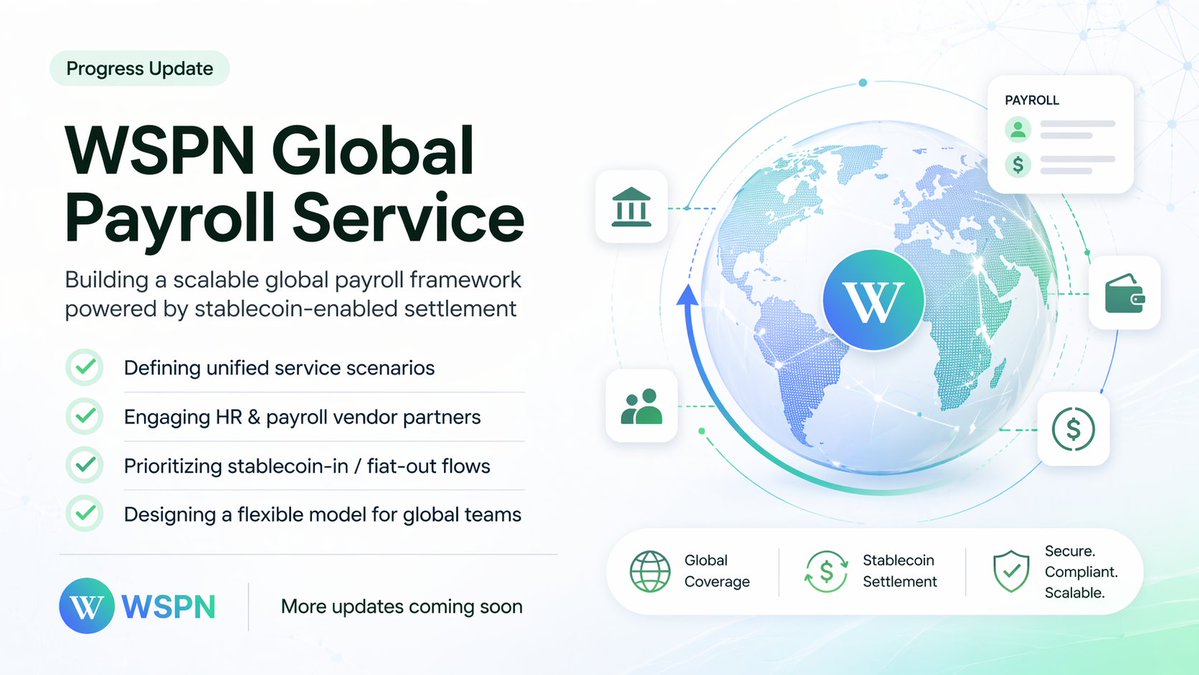
Something new is cooking 👀
We’re working on WSPN Global Payroll Service — a new payroll solution designed for global teams, powered by stablecoin-enabled settlement. From service scenarios to partner integrations, we’re building toward a more flexible way to support cross-border payroll and payouts — with stablecoin-in / fiat-out as a key focus. Still early, but we’re excited about what’s coming.
More soon. 🚀
#WSPN #Stablecoin #GlobalPayroll #CryptoPayments #Web3 #Fintech
📈 A milestone for institutional finance: Ondo, JPMorgan, Mastercard & Ripple just completed the world's first cross-border tokenized U.S. Treasury redemption — settled in under 5 seconds on XRP Ledger, 24/7. Blockchain rails are becoming global financial infrastructure.
Source: https://t.co/iokoUwEeUq
#WSPN #Stablecoin #DigitalPayments #RWA
Stablecoin Weekly Hot News
Week of April 27 – May 3, 2026
Week in Brief
This week the stablecoin sector crossed $321.7B in market cap on $1.08B of fresh inflows — one of its strongest weeks in months. Regulatory noise dominated the headlines: US agencies raced to fill in the GENIUS Act rulebook while banks pushed back on the timeline, Brazil banned stablecoin cross-border settlement, and Israel quietly approved the world's first shekel-pegged stablecoin. On the product side, Visa expanded its blockchain settlement network to nine chains and Western Union confirmed its USDPT launch for this month.
Top Stories
1. Visa Expands Stablecoin Settlement to 9 Blockchains, Hits $7B Run Rate
📅 Apr 29 |
🔗https://t.co/DcaygG8P1F
Summary: Visa added Arc (Circle), Base (Coinbase), Canton, Polygon, and Tempo to its stablecoin settlement pilot, bringing total supported chains to nine. The program's annualized settlement run rate reached $7B — up 50% quarter-over-quarter. Visa now runs 130+ stablecoin-linked card programs across 50+ countries. Separately, Visa also partnered with WeFi (co-founded by Tether's Reeve Collins) to let users spend self-custody stablecoin balances directly on the Visa network without passing through exchanges.
Why It Matters: Visa is quietly becoming the world's primary stablecoin settlement backbone. The multi-chain expansion means stablecoin liquidity fragmented across ecosystems can now route through a single regulated rail — removing a key infrastructure barrier for enterprise and institutional adoption.
2. GENIUS Act Rulemaking Heats Up: Banks Push Back, Senate CLARITY Compromise Bans Yield
📅 May 1–2 |
🔗https://t.co/HpVYtwSEaD
Summary: The American Bankers Association and Bank Policy Institute asked Treasury and FDIC to pause GENIUS Act comment periods until the OCC finalizes its framework, warning the three agency rulebooks are structurally interdependent. Simultaneously, the Senate released CLARITY Act compromise text that would hard-ban stablecoin issuers from paying yield on reserves — locking in USDT and USDC's zero-yield model by statute. Agora, a crypto-native issuer, filed for a national trust bank charter on Apr 24 to pre-position before rules harden.
Why It Matters: The yield ban is the biggest structural fight in US stablecoin policy right now. If passed, it forecloses a key differentiator for new entrants while preserving incumbents' float economics. Banks delaying rulemaking timelines could push GENIUS Act implementation past its Jan 18, 2027 deadline.
3. Brazil Bans Stablecoin Cross-Border Settlement, Effective Oct 1
📅 May 2 | 🔗https://t.co/zTaGL53ga6: Brazil's Central Bank published Resolution No. 561 banning eFX providers (fintechs and payment firms) from using stablecoins or crypto to settle overseas remittances. The rule takes effect October 1, 2026. Cross-border settlement must now flow through traditional FX transactions or non-resident BRL accounts. The ban directly targets firms like Wise, Nomad, and Braza Bank that had built stablecoin settlement into their cross-border flows. Individual crypto holding and trading remains legal.
Why It Matters: Brazil is one of the largest remittance markets in Latin America. This is a meaningful regulatory reversal — it closes off a cost-efficient blockchain settlement rail just as the global industry was building toward it, and signals that not every major emerging market will follow the US toward stablecoin-friendly frameworks.
4. Israel Approves First Shekel-Pegged Stablecoin (BILS)
📅 Apr 28 |
🔗https://t.co/zQ4v4AeRzL
Summary: Israel's Capital Market Authority approved Bits of Gold to issue BILS, a 1:1 shekel-backed stablecoin, after a two-year sandbox process. BILS runs on Solana, with Fireblocks custody, EY auditing, and zero-knowledge privacy via QEDIT. The Israeli shekel has gained 20%+ against the dollar over the past year, making it one of the strongest performing fiat currencies among developed markets.
Why It Matters: BILS joins the euro, yen, and Singapore dollar as non-USD stablecoins gaining regulated traction. This broadens the stablecoin ecosystem beyond dollar hegemony and reflects growing regulatory comfort with fiat-backed tokens outside the US.
5. Western Union Confirms USDPT Stablecoin Launch in May
📅 Apr 27–29 |
🔗https://t.co/T5GaV8TL65
Summary: Western Union's CEO confirmed during Q1 2026 earnings that its Solana-based, USD-backed USDPT stablecoin (issued by Anchorage Digital Bank) is launching this month. First use case: settling transactions with WU's global agent network, not retail consumers. The company is also rolling out a Digital Asset Network (DAN) to connect crypto wallets with WU's retail infrastructure, and a USD Stable Card is planned for later in 2026. Q1 revenue was $983M.
Why It Matters: Western Union processing ~$100B+/year in remittances is a landmark signal. When traditional remittance giants shift settlement rails to blockchain infrastructure, it validates stablecoins as a structural component of global payments — not just a crypto niche.
🌟 Happy Labor Day! While you rest, the stablecoin industry doesn't slow down.
📈 Market cap hits $325B. GENIUS Act implementation sprint: FDIC, FinCEN & Treasury all issued rules in one week. Real-world B2B payments surged 733% to $226B in 2025. The compliance era has begun.
Read our latest monthly report for the full picture 👇
https://t.co/sPDhCHYpuW
#WSPN #Stablecoin #DigitalPayments