@EchoesofWarYT The "peace envoy" had signed the Axis alliance. Less than 14 months before this photo, Kurusu put Japan's name to the Tripartite Pact in Berlin. He was also married to an American, Alice Jay Little of New York, whom he wed in 1914 while consul in Chicago.
@Jason_R_Burt He had to get the Secretary of War's say-so to fight Japan. After 30 missions over Europe, including the low-level Ploiești raid, Kuroki was refused a Pacific posting until Henry Stimson intervened. His B-29 crew on Tinian named their plane "Sad Saki" after him.
Sources:
- A. Statiev, "'La Garde meurt mais ne se rend pas!': Once Again on the 28 Panfilov Heroes," Kritika 13:4 (2012): https://t.co/wv73TzTiGM
- RFE/RL, "Soviet WWII Legend Of Panfilov Guardsmen Debunked As 'Fiction'" (2015, on the 1948 prosecutor's report): https://t.co/hLV23ZF6Fy
- The Guardian, "Russian war film set to open amid controversy over accuracy of events" (2016): https://t.co/FVS0TJpZey
- BBC News, "Putin backs WW2 myth in new Russian film" (2016, Medinsky quote): https://t.co/tHZhuZNCaM
- Wikipedia, "Panfilov's Twenty-Eight Guardsmen" (survivor list, Kaprov testimony, newsroom account): https://t.co/MwA2EZyUbx
Sources differ: some Russian historians dispute the 1948 report's thoroughness; the size of the 4th Company (~130) is approximate.
Image: card by WW2 Field Notes built around the Soviet 1967 stamp, political officer V. G. Klochkov, artist P. Bendel; the label quotes his invented last words and the story of the 28. Public domain (Soviet state stamp, PD-RU-exempt), via Wikimedia Commons: https://t.co/CUhB5ZWnTN
Myth vs. Record | Panfilov's 28
85 years ago today, 16 November 1941, at a railway halt called Dubosekovo outside Moscow, 28 Soviet guardsmen were said to have destroyed 18 German tanks and died to the last man.
Generations of Soviet schoolchildren learned their story. Then, in 1947, one of the 28 dead was arrested. Alive.
The myth
The men belonged to the 316th Rifle Division under General Ivan Panfilov, many of them recruits from Kazakhstan and Kyrgyzstan. On 27 November the army newspaper Krasnaya Zvezda (Red Star) reported that a small group had faced a column of 54 tanks and held.
The next day an editorial gave the group a number: 28. Two months later the paper printed their names, the place, the date, and the last words of their political officer, Vasily Klochkov: "Russia is vast, but there is nowhere to retreat. Moscow is behind us!"
In July 1942 all 28 were made Heroes of the Soviet Union. Poems, monuments, stamps and street names followed. A line about them is in Moscow's city anthem.
The record
In November 1947 military prosecutors in Kharkov arrested a former soldier named Ivan Dobrobabin for collaboration. He had been listed among the 28 dead. In fact he had been captured, escaped, and gone home to occupied Ukraine, where he served as chief of the German-installed local police.
His case prompted the chief military prosecutor to investigate. The 1948 report, kept secret for decades, found:
- At least six of the 28 had survived: two wounded and evacuated, two taken prisoner, Dobrobabin, and Danil Kuzhebergenov, who had been arrested in 1942, forced to "confess" he was an impostor, and sent to a penal battalion. A dead soldier with almost the same name took his place on the list.
- Ivan Natarov, the "last survivor" said to have told the story from a hospital bed, had been killed two days before the battle.
- The regimental commander, Colonel Ilya Kaprov, had told a reporter who came looking for witnesses that he had never heard of the action of the 28. In 1948 he told investigators the deeds described in the press did not happen.
- The number came from the newsroom. Asked how many men there were, the correspondent guessed about 30, including two who tried to surrender. The editor cut the traitors to one. The editorial writer, Aleksandr Krivitsky, admitted inventing Klochkov's famous words.
The report called the story the "fiction" of a correspondent. Historians who later checked the war records found that by about 10 a.m. on the 16th, German battle groups of 2nd Panzer Division had taken the neighbouring villages and bypassed the station. Neither side's operational documents mention heavy German tank losses there.
What really happened
There was a battle, and it was a hard one. Kaprov testified that the 4th Company of his 2nd Battalion fought German tanks at Dubosekovo, destroyed some, and lost more than 100 men.
That is the quiet tragedy of the legend. A real company of about 130 men was ground up defending Moscow, and the state replaced them with 28 invented heroes. Survivors who did not fit the story were jailed or erased.
The legend's afterlife
Brezhnev called doubts about the 28 "slanders." In 2015 the director of the Russian State Archive, Sergei Mironenko, published the 1948 report online. The culture minister rebuked him, and Mironenko was soon removed as director. In 2016 a state-backed film retold the legend; the minister said that even if the story had been invented from start to finish, it was a "sacred legend."
Some Russian historians still argue the 1948 investigation was rushed and that parts of the story may hold. The documents, though, are hard to argue with.
The men at Dubosekovo did not need a myth. They needed someone to count them properly.
@VoicesofWW2 The same man filmed the marathon in Riefenstahl's Olympia. From 1943 Frentz shot almost only in color, privately, in pictures never meant for publication. His color photos of V-2 production at Mittelbau-Dora sat forgotten in a suitcase until his son found them in 1998.
@AuschwitzMuseum Before Belsen, Kramer ran Natzweiler-Struthof. In August 1943 he personally gassed 86 Jewish men and women selected at Auschwitz, for a Strasbourg professor's skeleton collection. Decades later, historian Hans-Joachim Lang restored all 86 of their names.
Sources:
- E. F. Ziemke & M. E. Bauer, Moscow to Stalingrad: Decision in the East (US Army CMH, 1987), ch. II (Orsha conference, mud) and ch. III (November offensive, 4-6 Dec cold, Soviet reserves), Map 3: https://t.co/QRmAPlU3MG and https://t.co/dqWWDGdtV4
- Wikipedia, "Battle of Moscow" (cross-check of dates and the Khimki/binoculars claims; cites Guderian, Glantz, Goldman, Zhukov): https://t.co/vrz6heVxBs
- G. K. Zhukov, memoirs (Stalin's 19 Nov question), as quoted by Ziemke & Bauer
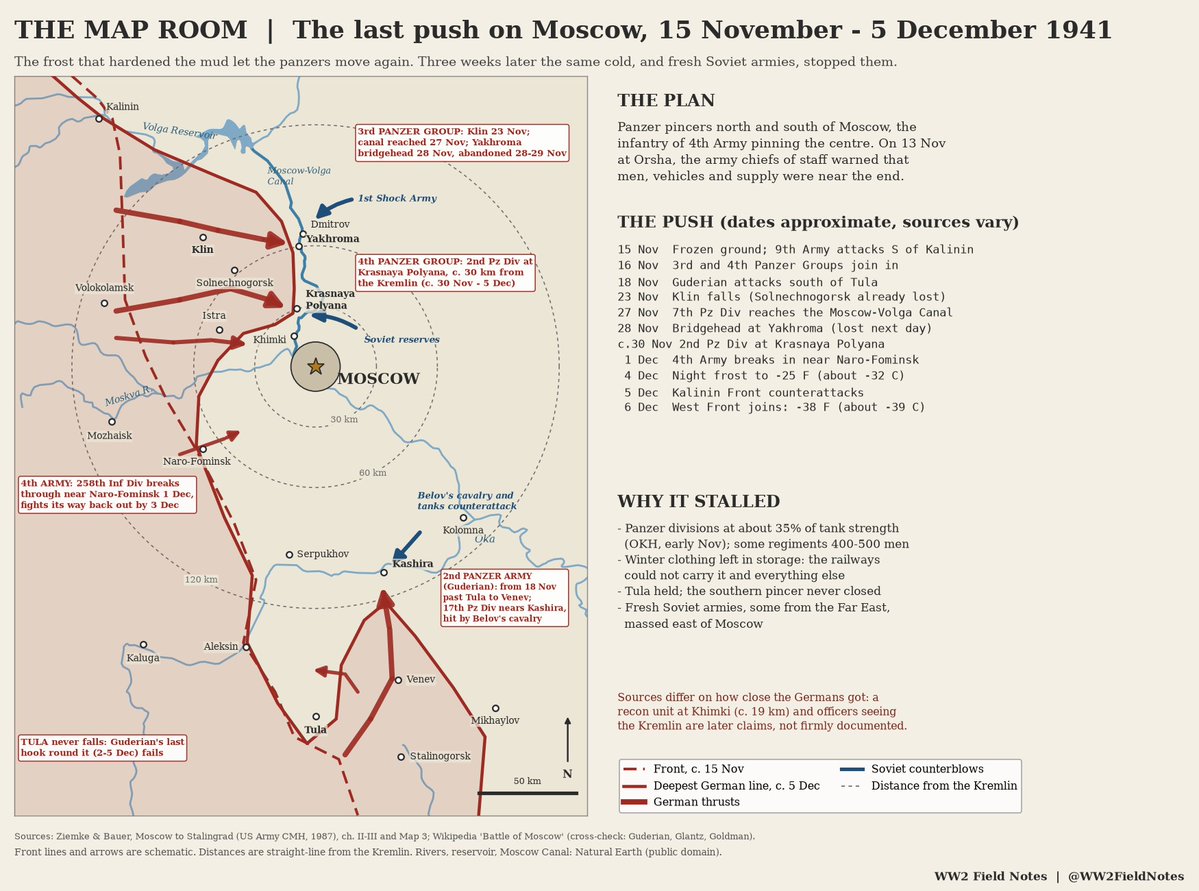
Sources differ: Far East divisions sent west, 70 by 1 Dec (Ziemke & Bauer) vs "over 18" (Goldman, via Wikipedia); Solnechnogorsk fell by 23 Nov (Ziemke & Bauer) or 24 Nov; Soviet accounts say the December cold was less extreme than German accounts claim. Krasnaya Polyana: "twelve miles north of Moscow" (CMH, to the city edge); about 30 km straight-line from the Kremlin (our measurement; Wikipedia, citing Guderian, gives about 29 km).
Temperatures are in Fahrenheit as given by CMH (-25 F is about -32 C; -38 F about -39 C).
Map: original by WW2 Field Notes; front lines and arrows schematic after CMH Map 3. Rivers, Volga Reservoir and Moscow Canal: Natural Earth (public domain).
The Map Room | The last push on Moscow
85 years ago today, 15 November 1941, west of Moscow. After a month bogged down in autumn mud, the German army finally got the weather it wanted: a hard frost.
The ground set like concrete. The panzers could move again.
Three weeks later, the same cold helped stop them.
By the end of October the autumn mud, the rasputitsa, had stalled Army Group Centre on a line from Kalinin to the Oka west of Tula, its centre about 35 miles from Moscow.
On 13 November, at a conference in Orsha, the army chiefs of staff gave Halder, chief of the General Staff, a grim picture. German casualties in the East had reached 686,000 by 1 November. A third of the half-million vehicles were worn out or wrecked. Panzer divisions were down to 35 percent of their original tank strength. Winter clothing sat in storage because the railways could not carry it and everything else. Guderian's chief of staff had already reminded Halder that this war was not being fought in France, and the month was not May.
They attacked anyway.
On the map: two armoured pincers. In the north, 3rd and 4th Panzer Groups would swing past Klin to the Moscow-Volga Canal. In the south, Guderian's 2nd Panzer Army would bypass Tula towards Kashira. 4th Army would pin the centre.
On the 15th, a German infantry corps attacked south of Kalinin and found something Halder called new in this war: the Soviet 30th Army gave way without a fight. The panzer groups joined in the next day. The US Army official history says armour could now move across country "as if it were on paved roads."
Guderian attacked south of Tula on the 18th. According to Zhukov, Stalin asked him the next day: "Are you sure we will be able to hold Moscow?" Zhukov said yes, but asked for two more armies and 200 tanks.
Klin fell on 23 November; Solnechnogorsk was already in German hands. An NKVD lieutenant who deserted told the Germans what Soviet officers were saying: Klin would become a "klin," Russian for wedge, driven against them. His interrogation report did not reach panzer group headquarters until the second week of December.
On 27 November the 7th Panzer Division reached the canal, and the next morning it seized a bridgehead at Yakhroma. To the south, 2nd Panzer Division reached Krasnaya Polyana, about 30 km from the Kremlin in a straight line. That was as close as the Germans reliably got. Later stories of a patrol in Khimki, or officers seeing the Kremlin through binoculars, are disputed.
The Yakhroma bridgehead was given up after a day. Guderian's spearhead near Kashira was thrown back by Soviet cavalry and tanks. Tula, almost surrounded, never fell. On 1 December, 4th Army broke through near Naro-Fominsk, south of the Smolensk highway; two days later the division that did it was fighting its way back out.
The cold deepened. On the morning of 4 December it was -4 F. That day Field Marshal von Bock judged a Soviet counteroffensive unlikely. The enemy, he reported, did not have enough forces.
That night it fell to -25 F. One German regiment on a night march had over 300 frostbite cases. Next morning tanks would not start, and frozen lubricants jammed machine guns and artillery.
On 5 December, Kalinin Front attacked. On the 6th, West Front joined in, at dawn temperatures as low as -38 F.
Where did the Soviet strength come from? Partly from fresh reserve armies massed east of Moscow, partly from the Far East, as Stalin, armed with reports from his spy Richard Sorge, risked moving troops west from the Japanese frontier. The numbers are disputed: the US Army history says 70 divisions came from the Far East by 1 December; other accounts give far lower figures, from about 18 divisions upward. Soviet writers argued that the cold was not as extreme as German accounts claimed.
The frost had opened the road to Moscow. By December it had closed it again, and by early January the Germans had been driven back 100 to 250 km.
@EchoesofWarYT No one knows if he fell in Europe or the Pacific. On May 26, 1958, aboard USS Canberra, Medal of Honor corpsman William Charette chose between two identical caskets: "I just picked the one on the right." The other unknown was buried at sea.
@Jason_R_Burt The plane's namesake was a football star. Capt. Walter "Waddy" Young was Oklahoma's first consensus All-American and played in the NFL's first televised game for the Brooklyn Dodgers. His last radio call over Japan, Jan 9, 1945: "We are OK."
Sources:
- C. Decker, "Fighting for a Free World: Ben Shahn and the Art of the War Poster," American Art 33:2 (2019) (Lidice poster, OWI job folder, Davis, Brennan's resignation letter, Shahn's Picasso/Rockwell remark): https://t.co/8EE3wlToiv
- S. Weinberg, "What to Tell America: The Writers' Quarrel in the Office of War Information," Journal of American History 55:1 (1968) (as quoted by Decker)
- National Archives, Powers of Persuasion (both posters): https://t.co/2eSEnOb2up
- FRAME, "The Office of War Information's Domestic Branch, 1942-43" (April 1943 resignations, mock poster): https://t.co/4awnsaZHLH
- K. Baker, "Freedom from Inspiration," Harper's, March 2019: https://t.co/71rzZhmSbK
Accounts differ on who made the Coca-Cola parody (Brennan and Shahn, or Shahn with the OWI writers) and on dates (the Library of Congress dates Pringle's own exit to July 1943). We found no surviving image of the parody.
Images (public domain, US government works, OWI, printed by GPO; via Wikimedia Commons):
1. Ben Shahn, This is Nazi Brutality, 1942. NARA NAID 513687
2. Ben Shahn, We French Workers Warn You... Defeat Means Slavery, Starvation, Death, 1942. NARA NAID 513688
Poster War | The poster men who quit
June 11, 1942. A news wire carries an announcement from Radio Berlin. Every man in a Czech village has been shot. The women deported. The children sent away. Even the village's name abolished.
The Nazis did not hide it. They proclaimed it.
That autumn, an American artist turned those few lines into one of the most haunting posters of the war. Within a year, he and the man who commissioned it were gone from the agency that printed it.
The village was Lidice. The artist was Ben Shahn.
In the summer of 1942, the new Office of War Information promised Americans the truth. Its director, the broadcaster Elmer Davis, put it plainly: "This is a people's war and to win it the people should know as much about it as they can."
Shahn, a New Deal muralist and photographer, joined its Graphics Division. One of his first jobs was Lidice. The reprisal for the assassination of Reinhard Heydrich had shocked American readers: 173 men shot in the first wave of executions alone.
Look at what Shahn chose not to show.
No bodies. No blood. A hooded man stands against a brick wall, his hands chained, his fists clenched. Across his coat runs the wire message itself, typed out like ticker tape: "All men of Lidice - Czechoslovakia - have been shot." A note on the OWI job folder says the message was used just "as it came over ticker."
Above it, in red, the only judgment the poster makes: "This is Nazi brutality."
The man has no face because the men of Lidice could not all be shown. The horror is in what you are left to imagine.
The second poster went at the war from another angle. French workers stand with their hands raised beneath an official Vichy decree conscripting labour. "We French workers warn you... defeat means slavery, starvation, death." The warning was aimed at Americans: this is what losing looks like.
But many of Shahn's OWI projects were blocked or never produced. Why?
Historians still disagree. Some argue his work was seen as too violent. The art historian Christof Decker suggests the problem was less the violence than the style: demanding, layered images that asked viewers to think.
Meanwhile the agency was changing. In early 1943 the Domestic Branch was reorganised and executives from advertising and publishing came in to run campaigns. To the artists inside, the war was starting to be sold like soap.
Francis Brennan, a former Fortune art editor who had run the graphics bureau and had commissioned the Lidice poster, resigned in April 1943. He warned Davis that the new men "will want graphics to look 'attractive.'" His bitterest line: while American soldiers rotted in the desert heat, the Graphics Division was designing posters about ordering coal early.
Writers in Henry Pringle's division, among them the young Arthur Schlesinger Jr., quit too. Their statement said the home-front work was now "dominated by high-pressure promoters who prefer slick salesmanship to honest information."
Brennan and Shahn left a parting shot: a mock poster of the Statue of Liberty holding up four frosty bottles of Coca-Cola. Its slogan: "The War That Refreshes: The Four Delicious Freedoms!"
Shahn left that summer, as congressional cuts gutted the branch.
Shahn was not against popular art. Looking back, he said the agency would have to use Picasso as well as Norman Rockwell: if six million understood Rockwell and only sixty understood Guernica, "then we'll have to do something for those sixty as well as the six million."
Which kind of poster wins a war? The one that sells, or the one that tells?
The record does not settle it. But more than eighty years on, it is the hooded man of Lidice who still stops people in their tracks.
@AuschwitzMuseum The Jewish schools they were forced into did not last. On 20 June 1942 the Reich Association of Jews was ordered to close every remaining Jewish school by 30 June. From 1 July, any teaching of Jewish children, paid or unpaid, was forbidden. Deportations were already under way.
The hotel was in disguise too. Moscow's wartime camouflage service, run by architects and Bolshoi set painters, masked landmarks like the Moskva, painted fake windows on the Kremlin walls and built a false house over Lenin's tomb. Lenin himself had left for Tyumen on July 3, 1941.
@Tank_Archives The Jumbo was a stopgap that became a favorite. Only 254 were built, all at Fisher's Grand Blanc plant between May and July 1944, too late for D-Day. Crews put them at the head of columns, and in early 1945 about 100 were rearmed in the field with 76mm guns.
@AuschwitzMuseum Westerbork began as a refuge. The Dutch government built it in 1939 for Jews fleeing Germany and made the Dutch Jewish community pay for it. Among its first residents were refugees from the St. Louis. In July 1942 the SS took it over and made it a transit camp to the east.
Sources:
- ONI Combat Narrative, Battle of Guadalcanal, Part 3: Battleship Night Action (1944): https://t.co/tA9nJOpt9N
- NHHC, Washington VIII (BB-56) ship history: https://t.co/GcJszEe2KY
- R. Lundgren, The Battleship Action 14-15 November 1942 (NavWeaps; uses both sides' action reports): https://t.co/FcyAMd2IVO
- https://t.co/uPkzFWDVHU, IJN Kirishima TROM: https://t.co/4muu7kXFJB
- S. E. Morison, The Struggle for Guadalcanal (1949); R. B. Frank, Guadalcanal (1990)
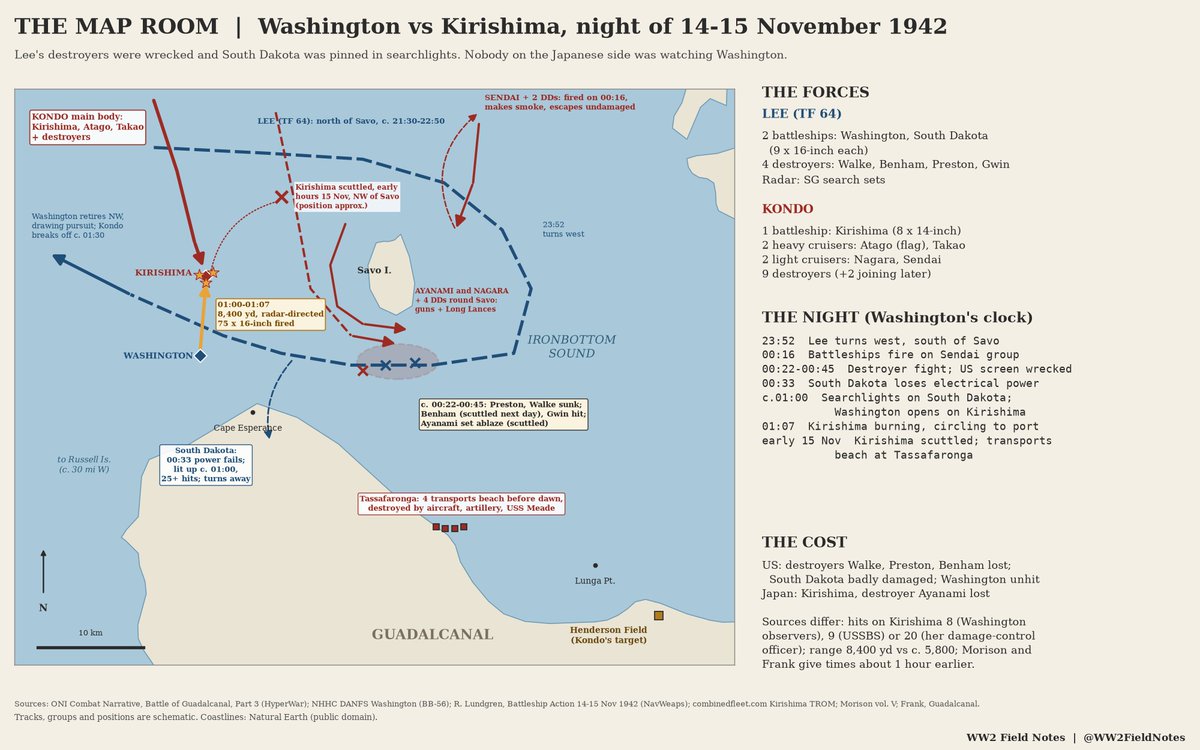
Sources differ: hits on Kirishima 8 (Washington's observers), 9 (USSBS) or 20 (her damage-control officer); range 8,400 yd (Washington) vs c. 5,800 (combinedfleet); South Dakota's hits 24-27; times here follow Washington's report, Morison and Frank run about 1 hour earlier.
Map: original by WW2 Field Notes; tracks and positions schematic. Coastlines: Natural Earth (public domain).
The Map Room | Washington vs Kirishima: the blind spot off Savo
Night of 14-15 November 1942, off Savo Island. The American battleship South Dakota, half-blinded by a power failure, was pinned in Japanese searchlights and hit again and again.
The Japanese poured almost everything into her. Barely a shot went toward the second American battleship, closing unseen in the dark.
That oversight decided the battle.
Two nights earlier, Rear Admiral Daniel Callaghan's cruisers had died stopping a bombardment of Henderson Field. Now the Japanese were back. Vice Admiral Nobutake Kondo brought the battleship Kirishima, the heavy cruisers Atago and Takao, two light cruisers and nine destroyers. His job was to wreck the airfield so that the last four transports of a battered reinforcement convoy could land their troops.
Admiral Halsey had almost nothing left. He sent the battleships Washington and South Dakota under Rear Admiral Willis Lee, with four destroyers from four different divisions, picked largely because they had the most fuel. The two battleships had operated together for only a few days.
Lee was a gunnery man. At the 1920 Olympics he had won seven shooting medals, five of them gold. Morison wrote that he "knew more about radar than the radar operators."
On the map: Lee came round the north of Savo, turned south-east between Savo and Florida Island, then turned west at 23:52 to sweep south of Savo. Kondo had split his force into several groups to come at the sound from different sides. A Japanese scout plane had reported Lee's ships as cruisers, and Kondo believed it.
At 00:16 by Washington's clock, the battleships opened fire by radar on the light cruiser Sendai's group east of Savo. Sendai made smoke and escaped, undamaged according to Japanese records.
The real blow fell on Lee's destroyers. Hidden against Savo's dark shoreline, the destroyer Ayanami and the light cruiser Nagara's group hit them with gunfire and Long Lance torpedoes. Preston blew up and sank in seconds. Walke lost her bow and went down. Benham's bow was torn off; she was scuttled the next day. Gwin was hit in her engine room. In about a quarter of an hour, Lee's screen was gone.
Then, at 00:33, South Dakota lost electrical power. Her radar, fire control and radios went dead. Turning to avoid the burning destroyers, she was silhouetted against the flames. When Japanese searchlights found her, Kondo's heavy ships opened up at close range. She took more than two dozen hits, most of them from the heavy cruisers. Lee later wrote that the damage left one of his new battleships "deaf, dumb, blind, and impotent."
Washington's radar had been tracking a big ship, but Lee held fire. He could not raise South Dakota and was not certain where she was. When the searchlights came on, the doubt was gone.
At 01:00, Washington opened fire at 8,400 yards. She got off two salvos before Kirishima could reply. By 01:07 she had fired 75 sixteen-inch shells at her, plus more than a hundred five-inch rounds. Kirishima's bridge was smashed, her steering jammed, and she began to circle helplessly to port, burning and flooding.
How many shells hit? Washington's observers counted eight hits by the main battery. The US Strategic Bombing Survey estimated nine. Kirishima's own damage-control officer later marked 20 sixteen-inch hits on a diagram, some below the waterline. The range is disputed too: 8,400 yards in Washington's records, about 5,800 in some accounts.
Washington steamed north-west, drawing the Japanese after her and dodging torpedoes, until Kondo broke off. Kirishima was scuttled in the early hours, north-west of Savo. Most of her crew were taken off by destroyers.
Before dawn, the four transports ran themselves aground at Tassafaronga. Aircraft, artillery and a destroyer set them ablaze. Only about 2,000 to 3,000 troops got ashore, without most of their food and ammunition.
This was one of only two battleship-against-battleship actions in the Pacific war. Lee was blunt about why it went his way: "our entire superiority was due almost entirely to our possession of radar."
Times follow Washington's action report; Morison and Frank put them about an hour earlier.
@WW2Facts At Cape Gloucester the jungle itself killed Marines. The official Marine Corps history counts 20 killed by falling trees and at least three by lightning, as monsoon storms (once nine inches of rain in a single night) brought the giant, rotten trees down.
@Jason_R_Burt@PieceJake The 92nd's bravest man got his Medal of Honor 52 years late. Lt. Vernon Baker knocked out three machine-gun nests, an observation post and a dugout at Castle Aghinolfi, Italy, in April 1945. In 1997 he was the only one of seven Black WWII honorees still alive to receive it.