About time I introduce myself!
I'm Nick, I'm 27 years old and I make money in the markets-primarily selling options, long term buy and holds, I also swing trade options and shares.
I trade to live life on my own terms, I'm not chasing a lottery ticket.
🌎
I apologize in advance for the longer writeup.
But I think @Remzztrades makes a really solid point. However, if I could go back and give my younger self 1 piece of advice, it'd be to just stick to swing trading.
Now, before anyone takes that the wrong way, I'm not saying day trading doesn't work... for longevity, do I think it's a scam? yes.
There are incredible traders whom I know personally who make an unbelievable living day trading. Just because I didn't make a career out of day trading doesn't mean it's impossible.
But I've also watched hundreds of newer traders (including myself) make great money during healthy, trending markets swing trading... only to give almost all of it back trying to force action once the market became choppy.
I was that guy.
I say all of this because I've lived both sides of it.
My first +2 years, I'd have these incredible stretches where everything seemed easy. The market was trending, leadership was healthy, breakouts were following through, and I'd make more money in a few weeks than I ever thought was possible. Naturally, I assumed it was because I'd finally "figured it out."
Then the market would change...
The same names would stop working + leadership would begin rolling over. New groups would rotate in before old ones had time to build fresh bases. The indices would start chopping around the 9 & 21 EMAs. Everything became slower... but instead of slowing down with the market, I aggressively sped up.
I convinced myself I could simply day trade my way through it + increase my activity, and that was 1 of the most expensive lessons I've ever learned.
It wasn't 1 huge loss that hurt me, but it was death by a thousand paper cuts!!
I'd make incredible progress during a healthy environment, then spend the next month giving a huge chunk of it back, trying to force intraday trades simply because I felt like I needed to be doing something. Looking back, I was trading because I was uncomfortable sitting still + wanted to feel the quick dopamine.
I'm a big fan of asking thoughtful questions to myself.
"Am I trading what the market is giving me... or am I trading what my ego/emotions wants me to make?"
+ the older I've gotten, the more I've realized my biggest edge isn't that I'm some incredible day trader.
Truthfully... I'm not!!
Can I day trade? most definitely.
Do I enjoy thinking more long-term when conditions line up? yes, of course.
But if you look through my journal over the last few years, almost every meaningful month I've ever had came from sitting in great positions for as long as possible while the market was in a healthy, trending environment.
That's where I naturally perform my best.
It took me a long time to admit that because I thought being a "complete trader" meant I needed to make money in every type of market. But now I think that's 1 of the big lies newer traders tell themselves.
The market doesn't care whether you make money every week. It only cares whether you're willing to adapt to its current conditions.
Nowadays, when the market starts getting choppy, I don't feel this constant pressure to manufacture activity + income anymore. I actually become excited because I know it's probably time to slow down, build watchlists, study leadership, read more books, spend more time with family, and simply wait.
That wasn't always me, though.
The younger version of me would've felt guilty for not trading. And now I almost feel guilty if I'm forcing trades in an environment that clearly isn't rewarding them. Also, 1 thing I've learned is that we have this tendency to make trading way more complicated than it needs to be.
> yes, I pay attention to breadth.
> yes, I watch leadership.
> yes, I monitor sector rotation, relative strength, volume characteristics, and dozens of other little nuances.
But if you're newer... PLEASE start simple.
If the indices are spending weeks chopping around the 9 + 21 EMAs, breakouts keep failing, and leaders aren't making progress... maybe your job isn't to become a better day trader overnight. Just maybe your job is simply to recognize that this isn't your environment.
Truly, that 1 realization would've saved me an unbelievable amount of money in the beginning.
& honestly, probably even more stress.
That's why I've been talking so much lately about personality. Trading advice is funny because 2 profitable traders can tell you completely opposite things... and both be right.
1 individual might thrive by increasing his day trading activity during volatility. I know I thrive by becoming more selective and patiently waiting for my swing setups to return.
Note that neither approach is objectively better!!
They're just different personalities solving the same problem. I think that's 1 of the most beautiful parts about this business.
There isn't 1 right way to make money. There are thousands, probably millions...
My encouragement to you is simply this:
1) Don't spend your entire career trying to become the trader someone else was created to be.
2) Spend it discovering the trader you were created to become.
Once I finally stopped fighting my own personality and started leaning into it, trading became more about patiently waiting for the environments where I knew I had an edge.
That's when consistency finally started showing up.
Take what I'm saying, test it against your own experience, and throw away anything that doesn't fit.
At the end of the day, the best trading system you'll ever build is the one that's designed around you.
Love ya!
- iain 🩵
Elite Trading Framework (Structural Momentum & HVE Systems)
This master blueprint outlines my execution ready trading methodology. It is engineered to capture explosive moves in high velocity growth stocks by combining supreme institutional urgency, structural price compression, and flawless mathematical risk management relying strictly on clean daily and weekly price action for entry and invalidation.
Strategy 1: The Core Structural Swing System
This strategy focuses on trading elite relative strength and structural chart compression directly against key moving averages on the daily and weekly timeframes.
Phase 1: Screening & Selection
Elite Relative Strength (RS): You target market leaders actively outperforming the broader indexes ($SPY/$QQQ). You prioritize vehicles pushing into "blue sky" all-time high territory or tightly consolidating directly under lifetime resistance, proving they are immune to market selling pressure.
True Fundamental Engines: Setups must be backed by undeniable institutional drivers, such as recent "beat and raise" earnings reports or powerful secular trends (e.g., AI data center infrastructure and next-gen semiconductor components).
Phase 2: The Setup & Volatility Compression
You never buy extended, chasing stocks away from support. You patiently wait for the near term supply to dry up and the moving averages to catch up to the price.
High Tight Flags (HTFs): High velocity moves that flag sideways, refusing to retrace deeply, proving that institutions are aggressively defending the shares.
The "Squat" Pattern: The stock "squats down" tightly into its key dynamic moving averages using the 8w eek EMA on the weekly chart as your ultimate reference point for pullbacks to determine if it is ready to move immediately or needs more time, or the 21 EMA on the daily chart.
Inside Days & Volume Dry Up (VDU): You look for tight daily candles trading entirely within the prior day's range. As the stock sits in the squat, volume must completely disappear, proving that floating supply has been completely absorbed.
Phase 3: Absolute Daily Execution & Invalidation
The Trigger: Entry is executed on a clean breakout past the immediate daily consolidation pivot level (e.g., the high of the inside day, the high of the flag, or down-trend resistance).
The Stop Loss: Your risk is pegged strictly and mathematically to the structural low of the consolidation setup typically placed right under the low of the "squat" candle, the inside day low, or the key supporting 8 week EMA. If the stock triggers the breakout but immediately reverses through this low, the squat isn't ready. You cut the trade instantly with zero hesitation.
Strategy 2: The HVE (Highest Volume Ever) Breakout Strategy
This is your specialized, ultra high conviction strategy reserved exclusively for historic corporate milestones and absolute institutional urgency.
The Setup: You scan for a stock printing its Highest Volume Ever Traded, typically accompanied by a massive, violent gap up or breakout past all time highs or out of a multi month institutional base.
The Psychology: This represents a permanent structural regime shift. Massive mutual funds and institutions are trapped in a state of extreme urgency, scrambling to build positions all at once. This historic volume signature permanently changes the character of the stock.
Execution & The First Pullback: * Day of Print Entry: Entering directly on the breakout daily candle if it clears a clean key level with a defined structural daily low stop.
The First Pullback (The High Probability Play): If the initial HVE gap is too extended to manage risk safely on a daily chart, you place the ticker on a high priority watchlist. You wait to buy the very first orderly pullback or "squat" back to a key technical level or the 8-week EMA, knowing institutions will heavily step in to defend the baseline of the highest volume day in the company's history.
System Mathematics: Asymmetric Expectancy
The ultimate engine of both strategies is pure mathematical expectancy. Because you buy right at the exact inflection point of a tight daily/weekly flag or a structural squat, your risk from entry to your daily stop loss is remarkably small (frequently only 1% to 3%).
The Reward: When a high RS leader or an HVE catalyst stock successfully clears its daily pivot and unlocks its next major momentum expansion leg, it can easily surge 10% to 15% or more in a matter of days.
The Ratio: This creates a clean 1:5 risk to reward ratio (risking $1 to make $5).
The Expectancy: Under this mathematical profile, you do not need a high win rate to compound capital rapidly. Even with a modest 25% to 30% win rate, your outsized winners will heavily multiply your small, tightly controlled losses, guaranteeing consistent, geometric account growth over a large sample size of trades.
The 30-minute pivot strategy used by Elite Swing Traders (@1ChartMaster) is a tactical entry method designed to help traders buy high momentum stocks at defined support levels while minimizing the risk of "chasing" a move. It is particularly effective for traders prone to FOMO (Fear Of Missing Out).
Core Components of the Strategy
Identifying Relative Strength (RS): The strategy focuses on "RS names" stocks that are holding up better than the broad market. The goal is to find a stock you want to own that is currently experiencing a short-term pullback.
The "String of Red" Setup: A key signal for this entry is seeing a string of red 30-minute candles in a stock that is otherwise in a strong uptrend. This represents a healthy, short term "cooling off" period.
The Pivot Entry: Rather than buying as the stock is falling, the trader waits for a "pivot" a specific point where the downward momentum on the 30minute chart shifts back to the upside.
Defined Risk: By entering at the 30 minute pivot, you have a defined spot for a stop loss, usually just below the recent 30 minute low.
Why Use It?
Patience over FOMO: It forces the trader to wait for the stock to come to them rather than buying at the top of a parabolic move.
Institutional Alignment: It seeks to buy the "dip" in a leading stock, often near short term support levels like the 8 EMA or the 8 wee EMA
High Expectancy: When a High Tight Flag (HTF) or a high momentum name pulls back, the 30minute pivot often provides a low risk entry into the next explosive leg higher.
Key Takeaway: The strategy is about finding the "beachball underwater" a strong stock being temporarily pushed down by market noise and entering at the moment the pressure is released and the stock begins to "pop" back up.
This is 1 of the main screeners I use every single week to track the strongest names in the market & exactly how I use it:
Nothing fancy, just a process that helps me consistently narrow down where institutions are already putting money to work.
The goal of this screener is simple:
Find stocks with momentum, liquidity, relative strength, and enough volatility to actually produce meaningful asymmetric opportunities.
Here’s what I’m filtering for and why it matters:
1) Price > $10
Avoids illiquid garbage and low-quality names.
2) ADR > 4%
I want names that MOVE. If a stock only moves 1–2% a day, it’s usually not worth my attention for my style.
3) Price above 52W low by 70%+
I want names already proving strength, not dead stocks trying to “bottom.”
4) Price x Volume > 10M
Liquidity is very important. I want real participation.
5) EMA 9 > EMA 21
Short-term momentum confirmation.
6) Price > 50EMA
I want names above important trend structure, not fighting underneath it.
This screener is where the research begins.
Once I have my names, I manually go through charts one by one and ask:
* Is this a leading stock in a leading group?
* Is volume confirming the move?
* Is this extended or still early?
* Is there a multi-month base forming?
* Is relative strength improving vs the market?
* Is there a narrative institutions can pile into?
That’s where names like $ARM, $MU, $DOCN, $WULF, $APLD, $INTC, etc first started grabbing my attention.
Then the watchlist process begins.
I’m usually not buying the second I find the stock. Most of the time I’m stalking it for days or weeks waiting for the right structure to appear. I’ll track:
> pullbacks into the 9/21EMA
> tight consolidations
> volume drying up
> higher lows forming
> failed breakdowns/U&Rs
> relative strength on red market days
This is where the nuance comes in.
A beginner sees “a stock going up.”
I’m trying to identify whether institutions are accumulating, whether supply is drying up, whether the stock is tightening before expansion, whether the group is strengthening, etc...
Once all those layers line up, THEN I focus on execution.
And honestly… the entry tactic matters less than most people think.
Pullback, breakout, EMA reclaim, intraday pivot reclaim… I don’t really care as long as:
1. the stock is a leader
2. the group is acting well
3. risk is tight
4. upside asymmetry is there
That’s the process.
Screen → stalk → refine → execute.
Most people overcomplicate trading because they’re trying to force random trades. I’m trying to do the opposite:
Reduce the market down to a small list of elite names, then patiently wait for opportunities where risk can be clearly defined.
The hard part isn’t finding stocks anymore.
The hard part is having the patience to wait for YOUR setup inside the right names.
My Personal Project -
A Documentation of my Trading Journey
For those who know me, I have been ranting on this platform like for the past 2 years on almost every trading subject, in my own way.
I decided to consolidate most of my rants in a more logical way (thanks @KynaKosling for your encouragement), so that I can leave a legacy for my kids.
My first time trying out substack (and I screwed up the bulleting already because I use shift-enter). This documentation will probably be a few weeks of work, if not months if I slowly take my time before publishing. Most of my thoughts were already posted on X, now just trying to make them more cohesive to follow.
The first part sounds more like a will, I hope I am in time to finish it ~.
I just published a video on my full trading routine.
✅ Favorite Screens to use
✅ Finding Leading Themes
✅ How I Build a Watchlist
Check it out here 👇
https://t.co/j90BkLgsON
This market continues to be about focusing on the few strongest names, stalking them, and being willing to buy them in the hole.
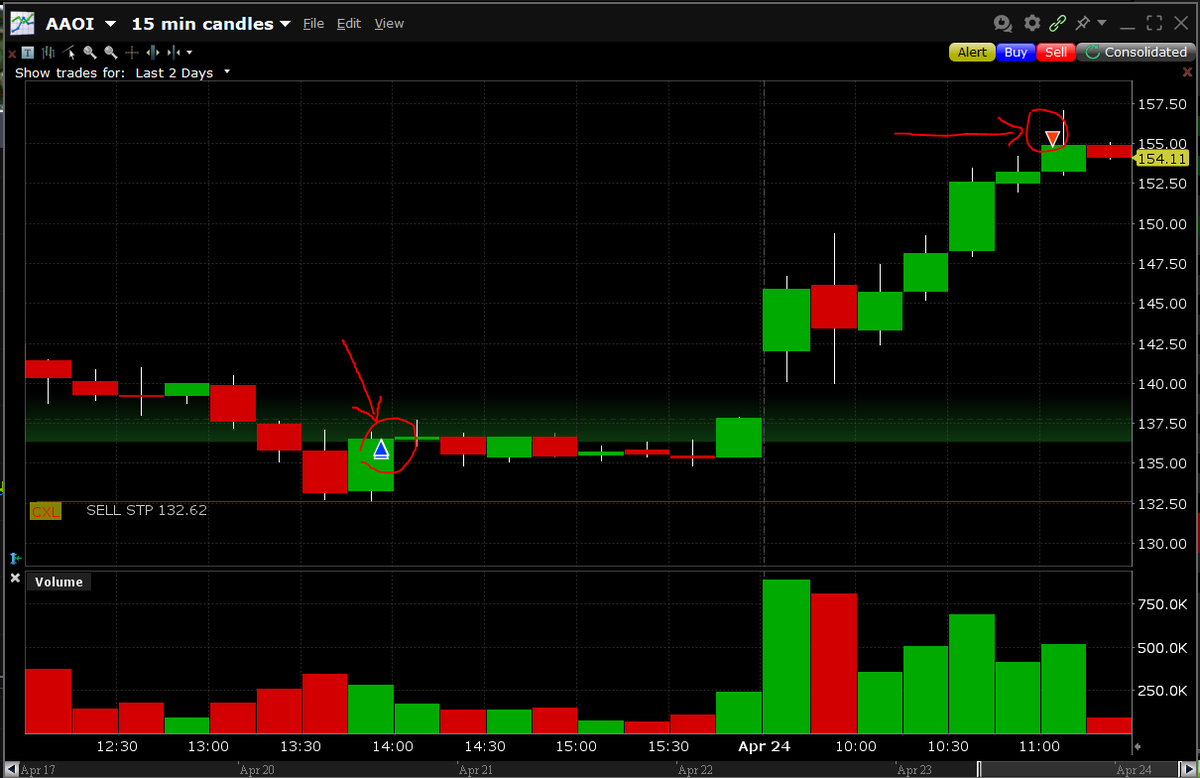
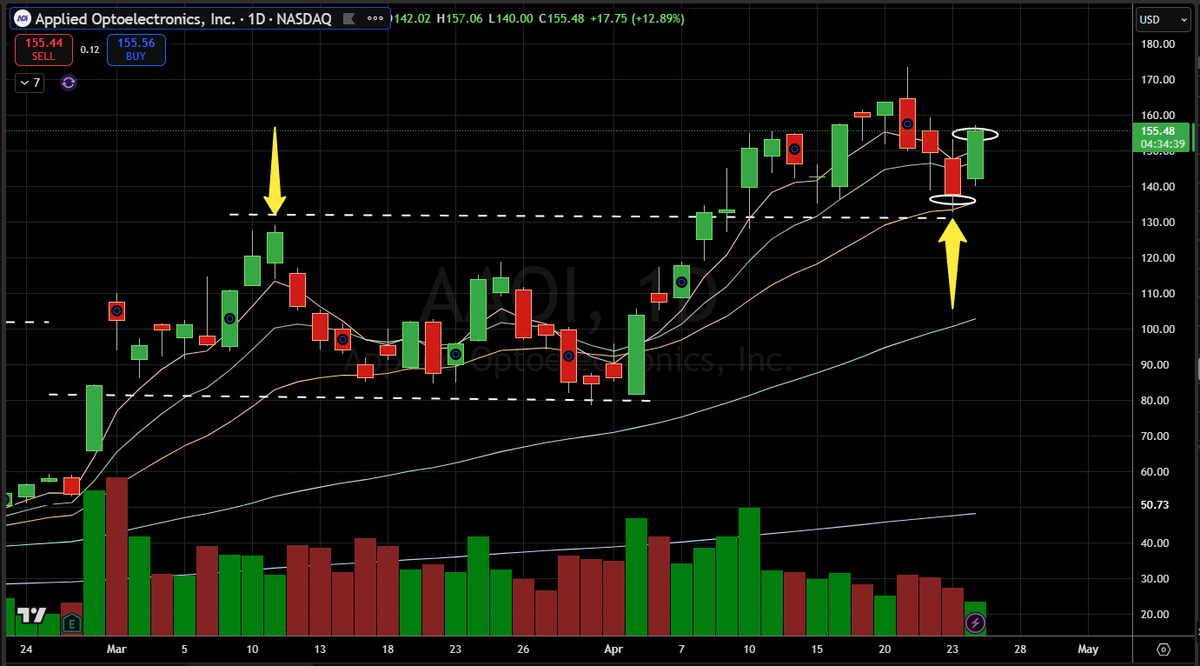
Just trimmed a piece of this $AAOI i bought when it finished puking into the daily 20ema yesterday. 5R in four market hours. Bought a full 1R position $136.34, stop $132.62 and just took a tiny Friday trim $154.89 to begin to pay for the risk. Looks amazing for next week now and I have unbelievable stock.
There was a time I would pride myself on typing up 2000 names every night and think I'm "working harder than everybody else." Took me a while to realize that was a fool's errand and you should simply focus on the leading stocks. I was looking for chart setups every night and would be missing the best names that go on the best runs because I was focused on chart patterns instead of leadership. The massive adjustment I made was to keep a focus list of 30-40 stocks and be willing to buy them as physically close to support as possible.
I am not the trader who does x% of my portfolio for each position. I have a day trader's pedigree and we were always taught the closer you buy off support, the more stock you can buy. If I am risking X dollars per trade, i can buy twice as much if I have a $3 stop versus a $6 stop.
AAOI here ended up my 3rd largest position on this entry simply because I'm risking 0.5% of my account and buying as close to support as I can.
K.I.S.S.
Semiconductor sub-themes still in Stage 1 bases
10 names building massive Stage 1 bases
as semis pull back in the coming weeks, these are the names worth keeping on your watchlist
thread below 🧵 (a few names you’ve probably never heard of)
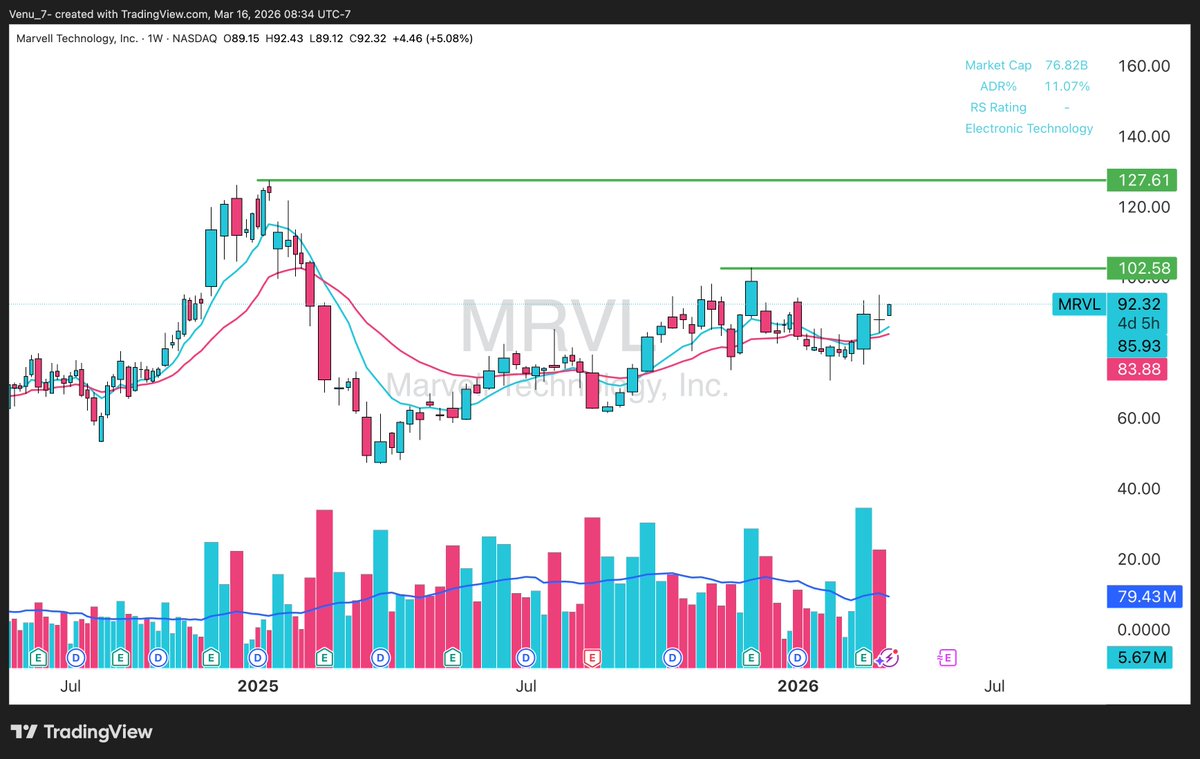
As promised, here’s the deep dive on $MRVL.
The silicon behind every AI connection.
Why $MRVL is one of the most compelling AI infrastructure plays right now.
Company: Marvel Technology
Price: $90
Market Cap: $80B
1/ Why Marvell?
AI models move massive amounts of data between GPUs, switches, storage, and across data centers.
Most investors focus on the chips. Few focus on the connectivity.
That’s where Marvell sits.
Marvell builds the infrastructure that connects AI systems: optical interconnects, Ethernet switching, data center interconnect, custom silicon, and co-packaged optics.
In simple terms, Marvell is the connectivity layer of AI infrastructure.
Key advantages:
• Broad interconnect portfolio
• Leadership in 400G and 800G, now first with 1.6T
• Custom silicon partnerships with major hyperscalers
Every AI accelerator needs high-speed connectivity. That demand continues to grow as clusters scale.
2/ Fundamentals
Revenue growth is accelerating.
FY22: $4.5B
FY24: $5.5B
FY25: $5.8B
FY26: $8.2B (+42% YoY)
FY27 guide: $11B
FY28 outlook: $15B
Data center is the main driver, growing 40–50% annually.
EPS is scaling quickly:
FY25 EPS: $1.57
FY26 EPS: $2.84 (+81%)
FY27E: $3.27
FY28E: $5+
Margins are expanding and free cash flow is expected to reach $3–4B over the next two years.
3/ Technicals
$MRVL has spent nearly two years building a base.
Recently it printed a Power Earnings Gap on strong volume with a close near the highs. That typically signals institutional accumulation.
4/ Institutions
Institutional ownership is 83%.
Large funds like Vanguard, BlackRock, Fidelity, Millennium, and Norges Bank have added positions recently.
5/ My Take
The market has been so focused on who makes the best GPU that it's overlooked the company building the entire connectivity fabric that makes AI infrastructure actually work.
Every GPU cluster, every custom XPU, every data center interconnect - they all need Marvell's silicon. And this isn't a speculative bet on future technology. The revenue is already here. $8.2 billion last year. $11 billion this year. $15 billion next year. All guided by management with bookings and purchase orders already in hand.
Matt Murphy raised guidance three times in six months. Custom silicon went from zero to $1.5 billion. They acquired Celestial AI to own co-packaged optics - a market that could exceed $10 billion by 2030. And they're the first to productize 1.6T interconnects while already demoing the next generation.
The stock sat in a base for almost two years while this transformation happened underneath. Now it just gapped up 18% on record earnings with 90M shares of volume. The fundamentals, the technicals, and the institutions are all saying the same thing.
If you want exposure to AI infrastructure, $MRVL is the purest and most dominant way to play the connectivity layer - the one part of the stack every accelerator depends on.
AI Doesn't Run on Chips Alone - It Runs on Connections.
Enjoy!
@HumbleChartGuy I have not seen his strategies nor heard of the name. Do you mind linking me some videos/education that you found to be helpful? I'd love to check them out, learning new entry tactics is always good.
Few posts this week with some charts I traded or looked at that had some success. What better way to humble myself than review a loser?
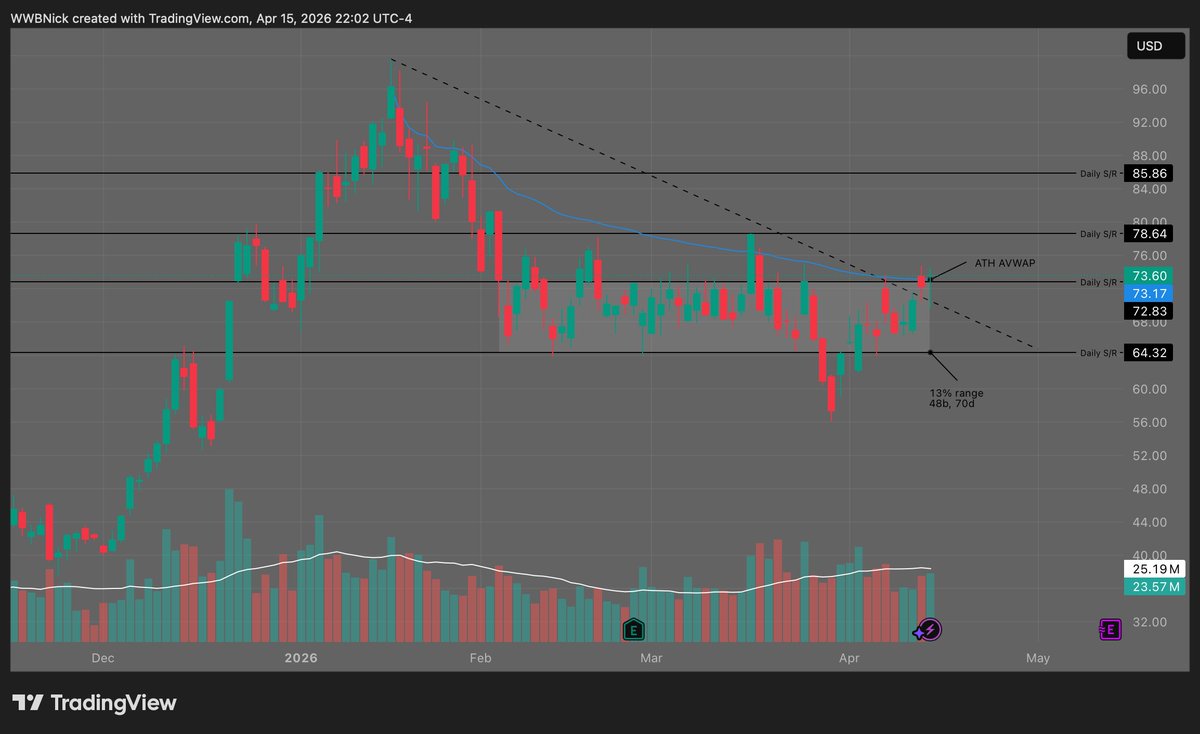
$RKLB
I've been stalking this one for a while. This is a leader in a strong theme that was starting to look ready for the next leg up. I was excited to trade this and thought(still think) that the next move will be explosive so I got a little aggressive on my entry.
It's currently consolidating in a ~13% range for the better part of 70 days, a couple failed breakouts and a failed breakdown along the way. EMA stack was resistance for the most part throughout those 70 days but finally flipped support on Monday.
Entry: I do not typically like buying into/at resistance on this type of trade and this shows why. $RKLB gapped over the ATH AVWAP on Tuesday, I was looking for an undercut and reclaim of that level. I wanted to see at least two candles close above that level to give me the confidence to enter. That's exactly what I got and I was in at $73.62 (5/18 80C @ $5.45).
What happened?
This ended up making new lows on the day and I was stopped out for a 22% loss on the options.