IT Professional, Project Management, Cybercrime, Risk Management. Retweets, likes are not endorsement. All for thought provoking til my brain starts to hurt
THERE IS A BILL IN PARLIAMENT THAT IS TRYING TO KEEP KENYANS OFF SOCIAL MEDIA
THE IDEA IS TO MAKE INTERNET EXPENSIVE SO THAT YOU GET TO PAY DATA AS MUCH AS YOU USE
IT SEEKS TO REMOVE UNLIMITED WIFI OPTIONS
REJECT
The Central Bank’s record of what we owe and the National Treasury’s record of the same debt differ by more than Sh6 trillion.
Sh6,164,439,173,574. This is a number in Kenya’s public accounts that should stop the entire country cold, yet almost nobody is talking about it. Money is never lost. It is spent on people who prefer that you cannot follow it.
Read more: https://t.co/RNF2q88yMx
The greatest achievement of the 2010 Constitution was not just devolution. It was the constitutionalisation of public finance.
Public money no longer belongs to politicians. It belongs to the People and must be raised, borrowed, allocated, spent and audited strictly within the Constitution.
When governments treat the National Treasury as a political department instead of an independent constitutional institution, they undermine the very system Kenyans created to protect public resources.
The Constitution is clear. Public finance is governed by constitutional principles, not political convenience. Defending Chapter Twelve is defending the sovereignty of the People. #ReKe #KnowYourConstitution #GetitDone
The slogan is “Linda Mwananchi.”
The new sign in is Aisha Jumwa😳 What a shame!! Nini haswa mna linda?
You cannot build a movement around accountability, integrity and putting Kenyans first, then turn around and recruit the very politicians who represent everything people have been complaining about for years.
If this is the standard, then “Linda Mwananchi” risks becoming just another political rebrand with a catchy slogan. Also @orengo_james this is beneath you!
This is the same Aisha Jumwa who has spent years at the center of political controversy, changing political camps, facing persistent integrity questions, and becoming a symbol of the kind of politics many Kenyans say they want to leave behind. At a time when people are demanding accountability and a complete break from the old political culture, having her in your camp sends the exact opposite message🚶🏿♀️ kwendeni uko
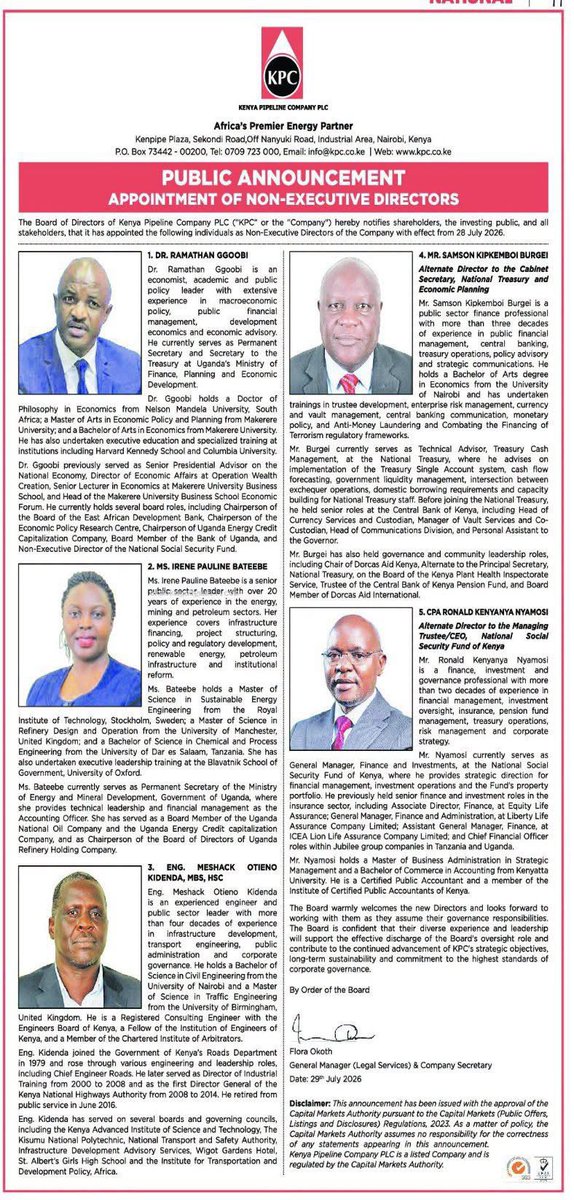
Kenya is a BAD JOKE, Two Ugandan PS’s now sit on the board of Kenya Pipeline.
If you missed the memo: Kenya Pipeline is also Uganda Pipeline now and there’s nothing you can do about it.
When uganda acquired kenya pipeline, Kampala sent their best brains. We sent whoever was free.
Let me look at what the announcement actually lays out for each.
In the middle of all the noise, there's a very silent dangerous Privatization agenda going on.
The Water Privatization.
There's a plan to privatize open source waters like springs, rivers and lakes.
It will soon be an offence to directly source your water from these bodies.
It will also be an offence to collect rainwater.
This is why I say, that the country must revolt against the New World Order killer laws.
I deeply dislike this "abandon" narrative that is popular in Kenya. Someone doesn't come kill us, exploit us, then we start being at fault for being "brainwashed," or "abandoning" stuff. The guy just said in the video that European women in the thousands were called witches and burned to death for their medical knowledge. Why can't we see a pattern of exploitation that runs from Europe to Africa? Or is it just that global and systemic thinking isn't for us? We can only think in terms of "culture" which we have been brainwashed to abandon?
It's only in Africa where structural and global wars are blamed on the victims for not remaining what we were before we were oppressed. It's like amputating someone's leg and then blaming the victim for limping.
International mainstream media has been paid by western PR firms to suppress stories like these. The PR firms are paid by GoK with our taxes. The goal is to keep projecting Kenya as a "democratic" and "peaceful" country, so that when cops shoot to kill us, it's reported as the exception, not as the norm. This is how the world keeps thinking that Kenya is a bastion of democracy rather than an intimate, bureaucratic dictatorship.
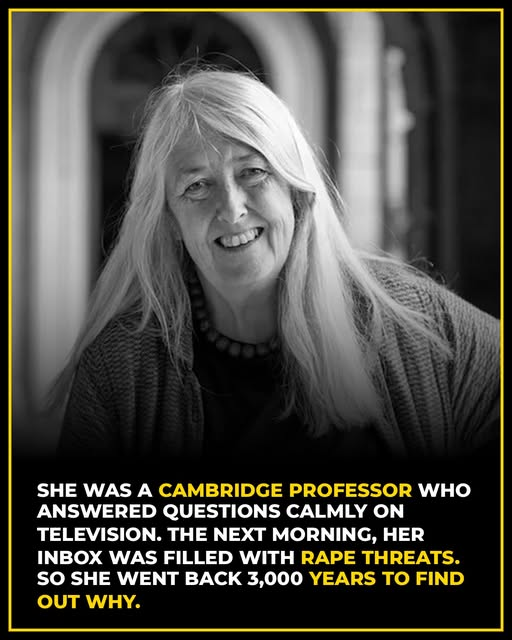
She was 57 years old.
White hair. No carefully managed image. No media training designed to make her more palatable. Just thirty years of accumulated knowledge and the calm, unhurried authority of a woman who had spent her life mastering her subject.
She sat on a BBC panel, answered questions about immigration and politics, cited evidence, made arguments — and then went home.
The next morning, her inbox looked like a crime scene.
Her name is Mary Beard — Cambridge professor, classicist, one of the most respected scholars of ancient Rome and Western civilisation alive. And the internet had decided that a woman speaking with quiet authority on television needed to be punished for it.
The messages were not criticism. They were not debate. They were rape threats. Death threats. Coordinated campaigns of personal destruction targeting her appearance, her age, her voice — anything that could be used to remind her that spaces like the one she had just occupied were not meant for her.
Most people would have gone quiet.
Mary Beard went further in.
She did what scholars do when they find a pattern that disturbs them: she followed it backward. Through decades. Through centuries. Through millennia. All the way back to some of the oldest texts in Western civilisation.
And she found it had always been there.
In Homer's Odyssey — one of the foundational works of Western literature, nearly three thousand years old — there is a scene that most readers pass over without registering its quiet violence. Penelope comes downstairs and asks the poet to sing a different song. Her own son, Telemachus, cuts her off. He orders her back to her room and tells her plainly: speech is the business of men.
She goes.
Mary Beard read that scene and recognized it immediately.
Not as ancient history. As a pattern.
In ancient Rome, women who dared to speak in public were not described as orators or thinkers. They were described as noise — disorderly sound, something that did not deserve to be called language or argument. Their voices were not speech. Their thoughts were not thoughts.
In the medieval world, women who claimed public authority were labeled as witches.
Elizabeth I — Queen of England, ruler of a nation — had to rhetorically reshape herself into something masculine just to be taken seriously as the leader of her own country.
The silencing of women who speak with authority was not invented by social media. It was not a modern pathology or a cultural accident. It was built deliberately, over centuries, into the very foundations of how Western civilisation defined who gets to speak, what authority sounds like, and who is allowed to take up space in public life.
Mary Beard had found something important.
In 2017, she published Women & Power: A Manifesto — short enough to read in an afternoon, substantial enough to reframe everything you thought you understood about why this keeps happening.
Her argument was precise and devastating.
The problem is not that women lack the ability to lead. The problem is that the model of leadership itself — the template for what public authority looks, sounds, and feels like — was built by men over centuries and has never been redesigned. When a woman enters public life and doesn't fit that template, she is not failing. The template was never built for her. It was built specifically to exclude her, and it has been doing exactly that, efficiently and continuously, for three thousand years.
The solution, Beard argued, is not to teach women to perform power the way men have always performed it. The solution is to dismantle and rebuild the very concept of what power is allowed to look like.
She kept teaching. She kept writing. She kept appearing on television — white-haired, unhurried, carrying her decades of authority without performing it, without packaging it for comfort, without apologizing for it.
The threats continued.
But other messages began arriving too. Letters from women and girls who had spent their entire lives feeling that every door was slightly too narrow, every table slightly too high, every room slightly reluctant to make space for them. Women who had spent years wondering what was wrong with them — why they couldn't quite fit, couldn't quite belong, couldn't quite be taken seriously no matter how much they knew or how hard they worked.
They read the book and understood, perhaps for the first time, that nothing had ever been wrong with them.
The room had been designed without them in mind.
That is not a personal failing.
That is a three-thousand-year-old architectural decision.
And one Cambridge professor with white hair and a calm voice — who refused to go quiet when the internet told her to — spent her career documenting it, naming it, and handing that knowledge to everyone who needed to hear it.
Telemachus told Penelope that speech was the business of men.
He was wrong then.
He is still wrong now.
And Mary Beard has three thousand years of evidence to prove it.
via The Inspireist
#FeministFriday #HERstory
THE COUNTRY HAS BEEN SOLD
Guys as we were busy politicing and catching bullets left right and centre, parliament passed the GOVERNMENT OWNED ENTERPRISES ACT 2025
Do you know what that bill has done?
Its given the presidency a through pass to privatise 63 parastatals without going back to parliament! Without seeking even public participation!
You know what, of the 63 parastatals, 18 have already gone!
Have you seen government parastatals change names and add LIMITED at the end?
It means they have been privatised.
Privately the shares have been sold to foreign and local companies, they will later list the same at NSE and reap the profits when the prices go up.
Imagine a parastatal like Kenya Railways, all the land is gone! Kenya Seed Company!
The kind of colonisation coming to be fall us is worse that the 1900
Wake up from your slumber
Kenya, let's pause and reflect for a moment.
Every month, 1.5% is quietly taken from your salary not for your pension, not for your healthcare, but for the affordable housing programme. Your employer adds another 1.5% on top. That's 3% of your household income, every single month, gone before you even see it.
And now the government says it needs Sh400 billion every year just to keep that same programme running.
Here's what makes it worth reflecting on the last housing programme (2017–2022) promised 500,000 homes. After 5 years and billions spent, 13,529 were delivered. Less than 3% of the target.
We didn't stop. We didn't ask questions. We just rebranded and restarted.
Brazil once believed in a programme just like this. They poured everything into it. A decade later, the houses were far from jobs, built poorly, captured by the wrong people and the economy was in recession.
The housing crisis in Kenya is real. No one is disputing that. But 3% of every Kenyan worker's salary, feeding into a fund the High Court itself once called unconstitutional, through a system with no clear accountability, deserves more than our silence.
It deserves our questions.
Who is actually getting these houses? Who is accountable when the targets aren't met again? What happens to the billions already collected?
You are not just a taxpayer in this story. You are the funder, the target beneficiary, and the one left holding the debt. All at once.
Reflection isn't opposition. It's responsibility.
We owe it to ourselves and to the Kenyans genuinely waiting for a home to demand this is done right, not just done loudly.
Dismas wa Tabu. Dreaming in installments. Billed in full.
Because odious debt threatens powerful interests.
The moment you question who borrowed, who benefited, and why Kenyans must suffer for corrupt debt, you stop being “acceptable” to the political and financial establishment. Silence becomes a strategy.
But truth does not need favourable headlines to survive. The case is in court. The evidence exists. History will record who defended Kenyans and who defended debt cartels.