Dennis Hopper explaining to Francis Ford Coppola on the set of Apocalypse Now that he’s too fucking baked to remember his lines may be the most Dennis Hopper thing ever.
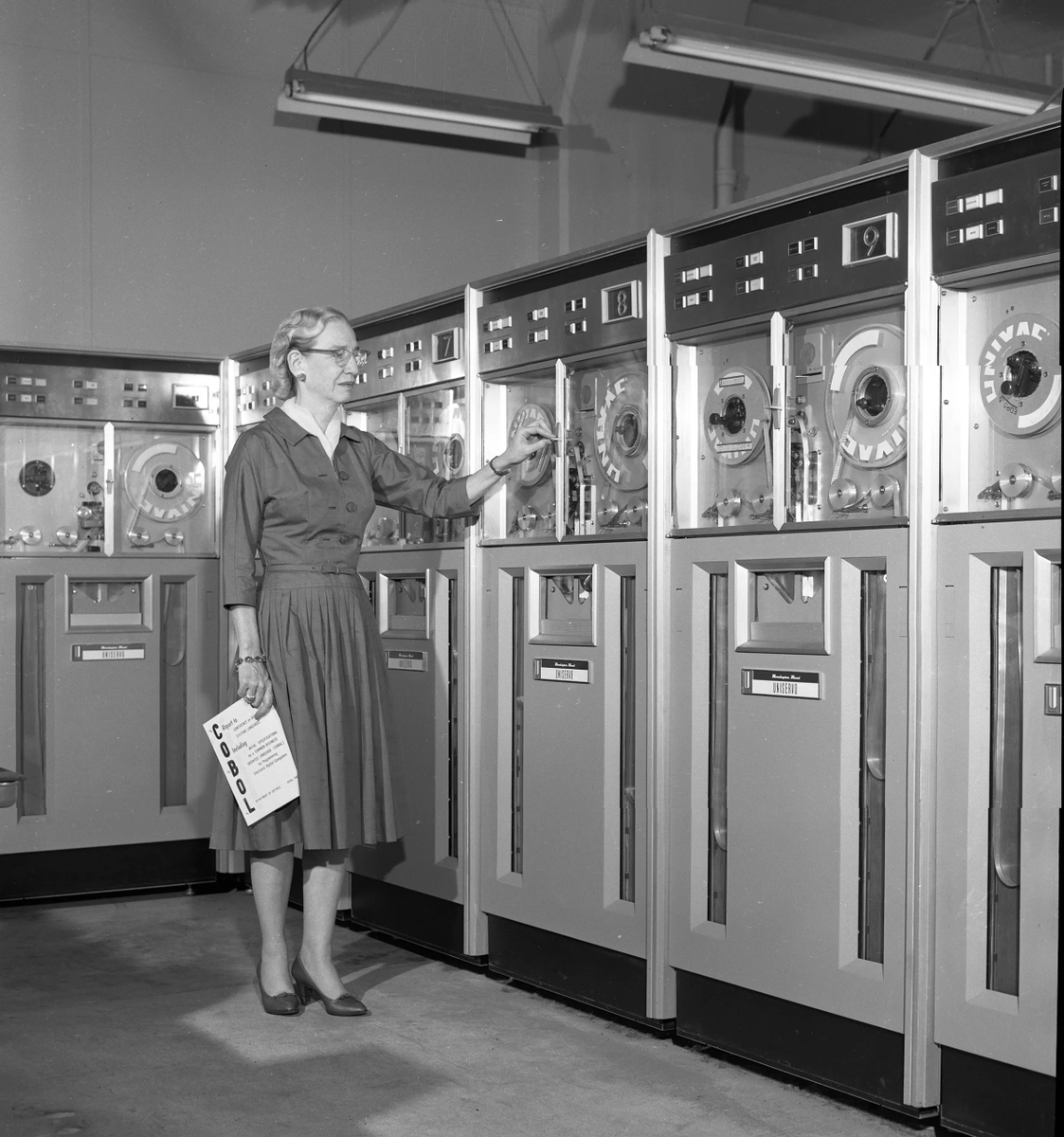
Grace Hopper built the first program that let a computer translate human instructions into machine code, and then spent two years failing to get anybody to use it.
Her account of the reaction is worth quoting exactly. She had a running compiler, nobody would touch it, and they carefully told her that computers could only do arithmetic and could not do programs.
That was 1952, and it took two years of demonstrations before her own company's management accepted the thing worked. The idea underneath it sounds obvious now and was heresy then. Programming at the time meant writing instructions the machine could execute directly, in numeric codes, by hand. Hopper thought the machine should do that translation itself, so a person could write something closer to English and let the computer convert it.
When she proposed going further and using actual English words, she was told very quickly that she could not, because computers did not understand English.
Her reasoning was about who gets to use a computer. Very few people think naturally in symbols, she said, and the ones who do become mathematicians. Everyone else finds it easier to write a sentence.
She built it anyway. Her English-language compiler became the foundation of COBOL, which ran business, banking and government systems for decades and is still running some of them.
Every programming language since sits on the principle she was told was impossible. A machine can be handed instructions written in a language made for people, and do the translating itself.
She retired from the US Navy as a rear admiral. They named a destroyer after her.
https://t.co/gI4dhz8ptq
Now that we’ve witnessed the powerful flooding in the Himalayas in Nepal and China, and how the force moved gigantic boulders, you can see why the findings of the 46th and 72nd Reconnaissance Squadrons in the 1940s remained classified after the U.S. Army found out about the massive Geophysical Event that moved giant boulders for thousands of miles...
The cyclical Geophysical Event is near, and the biggest deception in human history is the elites’ attempt to hide it from you.
Rachel Carson was 55 and being treated for breast cancer while she wrote Silent Spring. She told almost nobody she was ill.
Her reasoning was strategic. If the chemical industry learned she was ill, they would say her illness was what had made her write it.
She was right about how they would fight. The pesticide industry spent more than 250,000 dollars trying to discredit her, over a million in today's money. A major manufacturer dismissed her as a fanatic defending a cult. Others called her hysterical, overemphatic, a bird and bunny lover, a spinster who kept cats and was therefore suspect. A trade magazine ran a cartoon of industry men giving evidence with a witch on a broomstick flying past behind them.
Rachel Carson had no doctorate and no university behind her. She had spent years reading the studies nobody was assembling and putting them in one place.
When she appeared before a government committee in 1963 to give evidence, she had lost her hair and was wearing a wig. She died the following year, less than two years after publication, at 56.
DDT was banned in the United States in 1972. Five other pesticides she named have been banned or restricted since. The agency that did it was created in 1970, and she is generally credited with the movement that produced it.
She did not see any of it. She spent her last two years being called hysterical by men who were selling the thing she was right about.
https://t.co/FGQC8NUHPR
A resident asked Virginia Apgar over breakfast how you would systematically assess a newborn baby. She said it was easy, picked up a napkin, and wrote down five things.
Heart rate, breathing, reflex response, muscle tone and colour, each scored zero, one or two. That napkin is why every baby born in a hospital anywhere on earth gets looked at properly in the first minute of its life.
What existed before it was nothing. Babies were handed to a nurse and largely left alone. A newborn struggling to breathe often did not look obviously different from one who was fine, and the ones in trouble were frequently written off as too weak or too small to save. Nobody had agreed on what to check, so nobody checked.
Apgar was an anaesthetist who had spent years in delivery rooms watching what happened to babies after their mothers were given drugs. She had seen the pattern nobody had written down.
Her line was that nine months of observing the mother surely warrants one minute observing the baby. The score met resistance at first for looking too simple. So it was tested on thousands of newborns through the 1950s, and then a study of more than 17,000 children followed them to age seven and confirmed it predicted which babies were at real risk.
It is the reason newborns became patients in their own right, and the reason neonatal intensive care exists at all. Somebody asked her a question over breakfast, and she happened to have the answer ready.
https://t.co/sG29rHNS1c
MY NEIGHBOR TOTORO (1988) might be the purest comfort movie ever made. There’s barely any conflict, just children exploring, neighbors helping each other, and a world that feels fundamentally kind. Miyazaki makes ordinary life feel magical.
The water around a baby is completely changed every three hours.
Researchers worked that out by putting traceable sodium into the fluid and timing how fast it cleared. Every three hours, a full replacement, for months.
Where it comes from is the strange part. For the first half of pregnancy the fluid is water from the mother. After about 20 weeks the baby takes over, and by the end he is producing 500 to 700 millilitres of urine a day into the sac he lives in.
Then he drinks it. Swallowing starts around 16 weeks, and by term he is taking in 200 to 450 millilitres a day, removing roughly half of what he produces.
So he spends the last four months of pregnancy drinking his own urine, and it is exactly the correct thing for him to be doing. Swallowing that fluid is how his gut learns to work. Growth factors in it drive the intestinal lining to develop, and premature babies who missed that exposure have more trouble feeding.
The fluid itself is doing several jobs at once. It cushions impact, so she can fall and he does not feel it. It holds his temperature steady. It stops the cord being compressed. It keeps the sac open so his limbs can move and develop, and breathing it in is how his lungs grow.
It also carries antibodies and germ-killing proteins, so the pool he is floating in is actively defending him while he swims in it. Volume rises to about a litre by 36 weeks and then falls slightly before birth. Nobody sets that. Production and swallowing balance each other, and the person doing the balancing has not been born.
https://t.co/tRGIBI4Vbr
1/20 In 1990, Sean Connery took a Soviet submarine across the Atlantic in total silence. No propeller. A "caterpillar drive" that made Red October invisible to sonar. Sounds like pure Hollywood.
Two years later, Japan launched a real ship with no propeller at all. A small 🧵 https://t.co/CZfhkduvqM
The most chilling POV from Nepal’s catastrophic floods.
A man trapped inside the now-viral turquoise house filmed himself as raging floodwaters swallowed everything around him. With no safe escape route left, he could only wait and record as the torrent tore through the valley.
Against all odds, the house remained standing while entire sections of the surrounding area were devastated.
He has been rescued. Nature’s power is terrifying. Human resilience is incredible. 🇳🇵🌊
#NepalFloods #Floods #ClimateCrisis
This may be one of the most terrifying ground-level views of the Nepal floods yet.
From the safety of a screen, it's hard to grasp the sheer force of the water. Standing there, watching an entire landscape turn into a raging torrent in seconds, is a different reality altogether.
Prayers for everyone affected. 🇳🇵
🎥 Credit: Subin Shreshtha
Fifty grandmothers were put in a brain scanner and shown photographs of their grandchildren, then photographs of their own adult children.
The two produced different responses, and the difference is the finding.
Looking at a grandchild lit up the regions handling emotional empathy, which is the machinery for feeling what somebody else feels. Looking at her own grown-up son or daughter lit up cognitive empathy instead, which is the machinery for working out what somebody is feeling and why.
She understands her son. She feels her grandson.
James Rilling at Emory ran it, and it was the first time anyone had scanned a grandmother's brain at all. Neuroscience had spent decades on the maternal brain, how pregnancy changes it and how it responds to a cry, and had never once looked a generation up.
The grandmothers averaged 59. Their grandchildren were between three and twelve.
Rilling put it plainly. If the grandchild is smiling, she is feeling the child's joy, and if the grandchild is crying, she is feeling the child's pain.
There is a comparison in the paper that surprised the team. They had scanned fathers looking at their own children in an earlier study. On average the grandmothers showed stronger activation in the emotional empathy and motivation regions looking at a grandchild than the fathers did looking at their own child.
His theory about why is unsentimental. Small children have evolved to work on adult brains, and they work on the grandmaternal one too. A grown adult does not have the same effect.
So the thing every grown child has noticed, that their mother seems more excited to see the grandchildren than to see them, turns out to be visible on a scan.
She is not less interested in you. Her brain is doing something different with you, and it started doing it the day you stopped being small.
https://t.co/bjNijNHEpF