Starting fresh.
I run a metal 3D printing business in China: copper and titanium parts, plus metal powders. Most of our customers are overseas, in aerospace, induction heating and data-center liquid cooling.
Here I'll share what actually happens when taking Chinese industrial products global: judging inquiries, quoting, NDAs, export control, and the mistakes along the way.
No big talk. Just what we've done.
Atomization route shows up in the powder. Gas-atomized (VIGA/EIGA) is the usual LPBF feedstock. PREP and plasma powders are more spherical with fewer satellites, at a higher price. If your parameters were tuned on one route, name it in the RFQ.
Meet our third speaker!
🎤 Bogdan Dovgyy (IAMG): Additive Manufacturing of Titanium
📅 13 Nov 2026
📌 Webinar: Net Shape Technologies for Titanium Components: MIM and AM
✅ Free registration: https://t.co/ndOTdXB4Nu
#REPTiS#Titanium#AdditiveManufacturing@HorizonEU@EU_HaDEA
From lab samples to fusion-ready components: 3D printed tungsten tiles developed by NC State, ORNL and JEOL survived 74 plasma discharges inside the DIII-D tokamak, highlighting the potential of AM for fusion energy. ⚡
Read more: https://t.co/efVZva27Bz
@REPTiS_Project@HorizonEU@EU_HaDEA Good pairing for one session. For titanium, the powder spec often decides the route: MIM feedstock usually runs finer than LPBF powder, and oxygen limits and cost per kg differ too. Looking forward to the comparison.
@imaginationxyz Factory readiness also starts upstream of the printer. Simulation and inspection work best when the input is stable, which means each incoming powder lot gets checked for PSD and chemistry before it ever reaches the build plate.
@All3DP Golf heads at volume put titanium powder logistics on the spreadsheet: oxygen creep over reuse cycles decides how many times a Ti64 lot can go back in the machine, and that ends up in the cost per head as much as the laser time does.
@3DAdept Tungsten is one of the hardest metals to print without cracking, so full-size tiles surviving 74 plasma discharges is a real step. A hot powder bed helps a lot with brittle metals like W. Curious how much powder oxygen control mattered in getting there.
Not every AM process wants the same powder cut. LPBF usually runs 15–45 or 15–53 µm. EBM and DED typically use coarser cuts, often 45–105 µm or wider. Binder jet tends to go finer. Put the process in the RFQ, not just the alloy name.
Next for the loop: high-entropy and shape-memory alloys for medical implants, defense and aerospace.
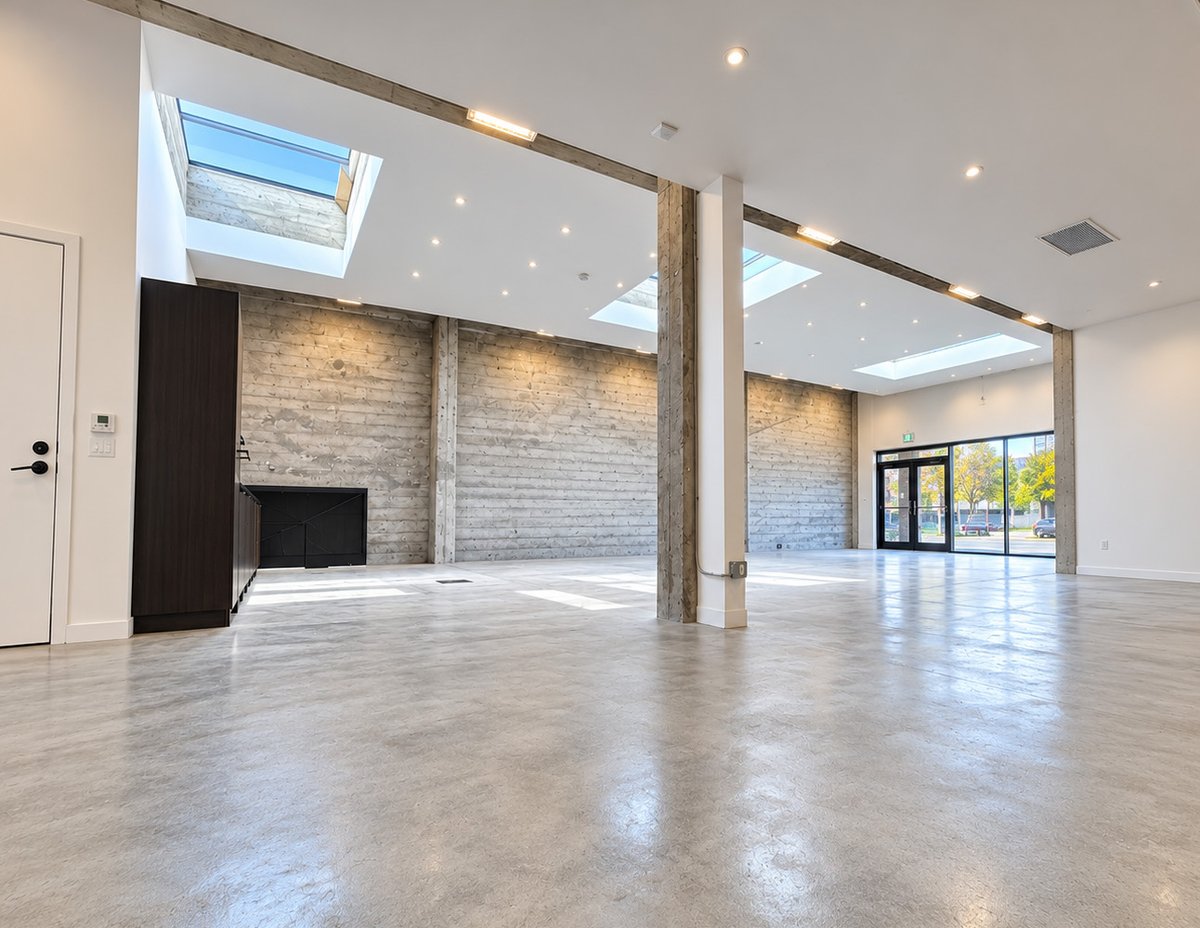
Our San Francisco lab at 410 Harriet Street in SoMa opens in 2027 with AI-driven synthesis, materials characterization and metal 3D printing. This is the space today, before the equipment arrives.
#AIforScience #AdditiveManufacturing #SanFrancisco
@atomicdynamics Closing the loop with printing makes sense. An alloy that looks good in synthesis still has to survive atomization and LPBF, and oxygen pickup or chemistry drift in the powder can shift results. Logging the feedstock lot with each test will pay off.
@3dprintingtoday Good to see more metal AM capacity in the UK. Expansions like this also bring the less visible work: powder storage, sieving and lot tracking, which is what keeps results repeatable from one build to the next.
@DauchCorp Printed cold plates for HPC are a strong fit for copper LPBF. The tradeoff to watch is conductivity vs printability: pure Cu conducts best but is harder to melt with IR lasers, while CuCrZr prints more easily and keeps strength. Curious which route you went with.
15–45 µm vs 15–53 µm isn't a detail. Finer cuts can spread well on thin layers, but flow and fines content need checking. Ask which PSD method the supplier used (laser diffraction or sieve) before you compare two reports.
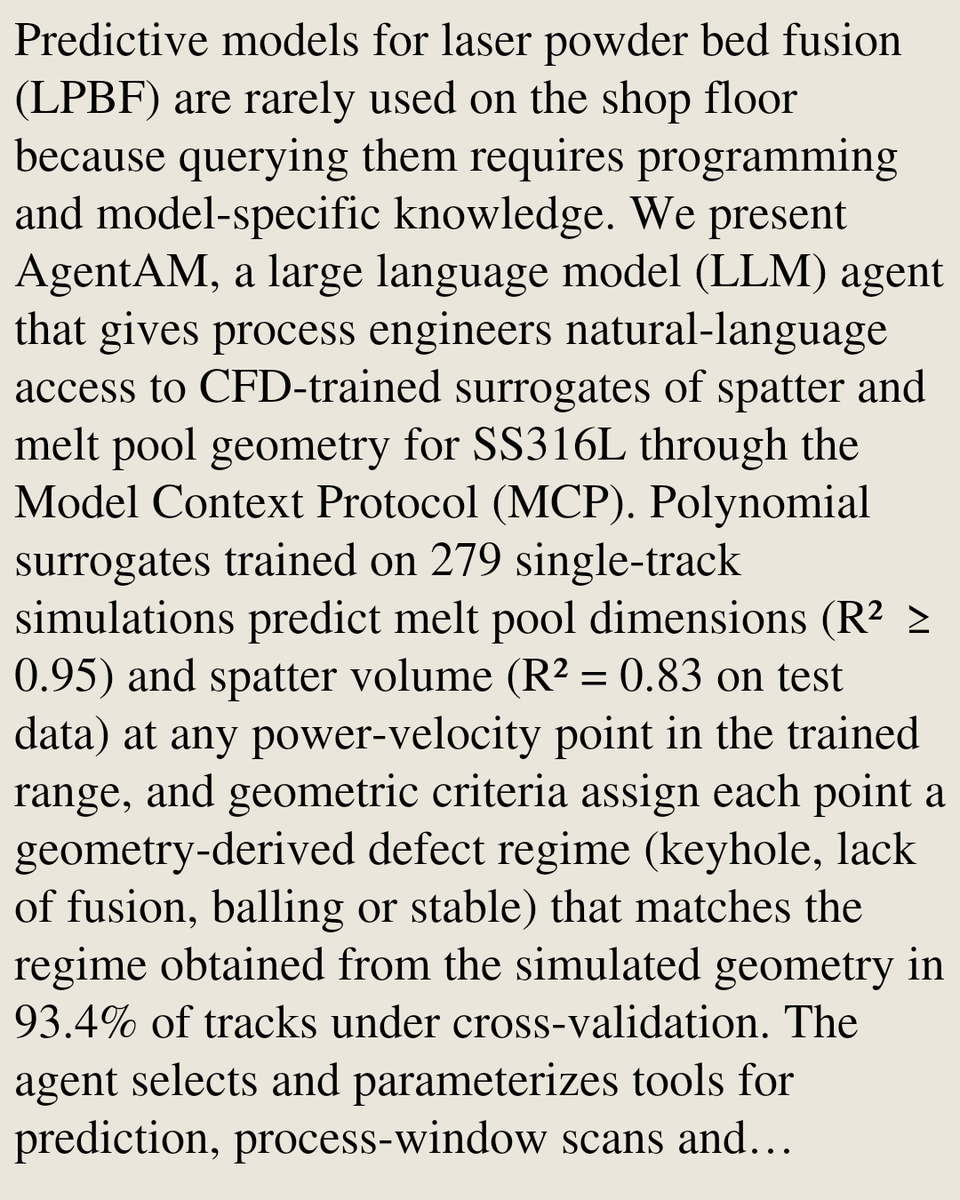
AgentAM: An AI Agent for Spatter- and Defect-Aware Process Optimization in Laser Powder Bed Fusion
Olabode T. Ajenifujah, Amir Barati Farimani
https://t.co/llcAIi5Wtb [𝚌𝚜.𝙰𝙸]
@3printr Documentation is where a lot of AM time quietly goes. What saves the most effort later is linking each build to its powder lot, COA and reuse count, so nobody has to rebuild that trail when a customer asks.
@nittinpatil@dailycadcam Zirconium powder is one of the trickier ones to ship and store. Fine Zr is highly reactive, so packaging, inert handling and transport classification take as much planning as the chemistry spec. Good to see more qualified capacity for it.
@SciFi Spatter matters beyond the build itself. It lands in the bed and ends up in reclaimed powder as oversized, oxidized particles. An optimizer that cuts spatter also helps the next lot after sieving. Would be good to see reuse cycles in that loop.
Powder reuse is still mostly site-specific. What helps a buyer: virgin-lot evidence on arrival and clear storage after opening. Oxygen pickup in Ti and Al after open containers is real. Track it, don't assume it.