Let it be noted that the politicians scrambled away with their security into their fuel guzzlers, and left the mourning mothers by themselves. Only the activists stayed. You can’t convince me that this is not just for optics. 😔
Sifuna, Ndindi Nyoro and Malala will all selfishly push you to the edge, but in the end, they will vote for President Ruto.
They don't believe in any of these shenanigans.
For a better part of our self-rule, Kenyan politics has followed a familiar script where politicians rally their tribes and build political parties around regional alliances.
Every election cycle revolved around the same political arithmetic. Think tanks and spin doctors plotting on which coalition had Mt Kenya, the Rift Valley, or who controlled Nyanza. What would Western do? Could Ukambani swing the vote?
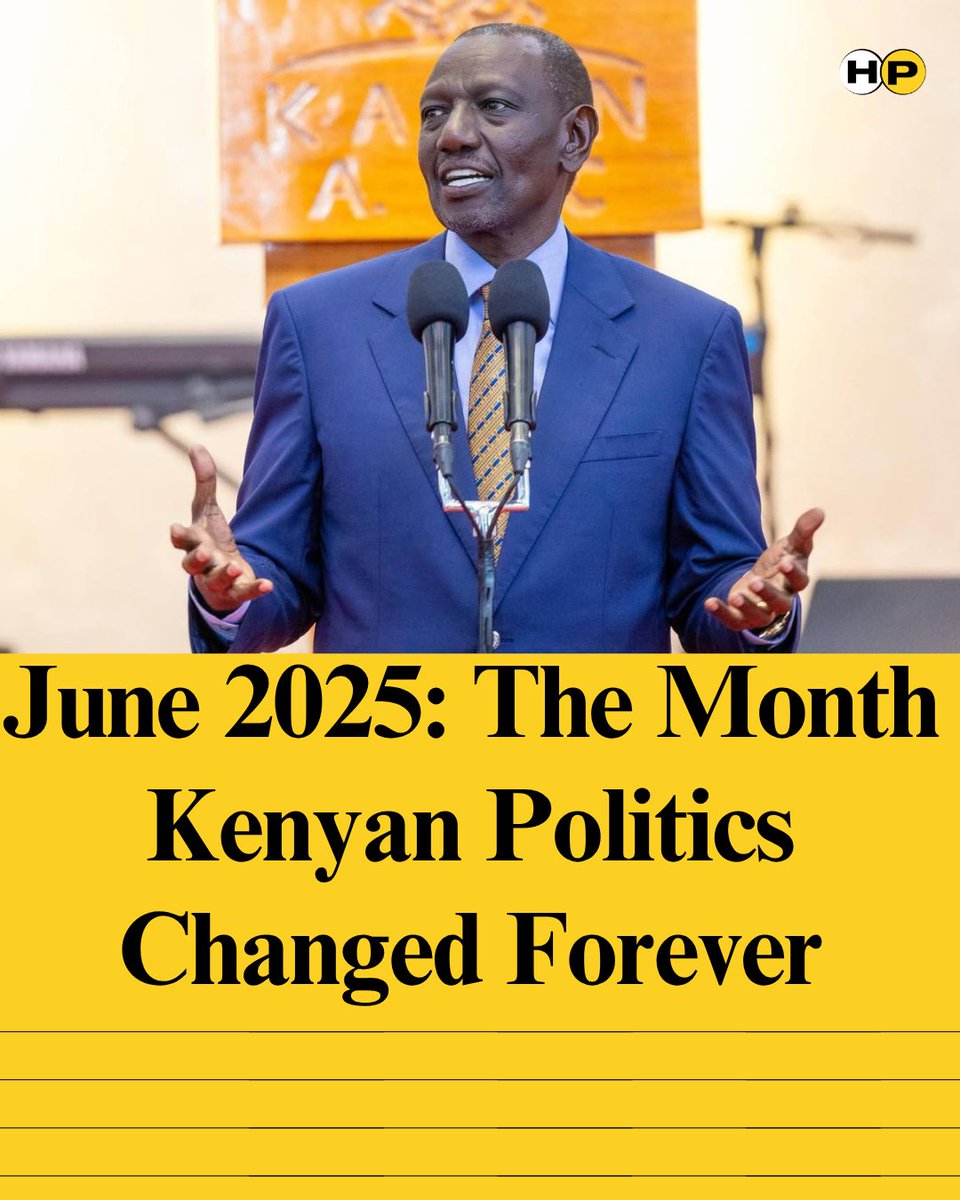
That was the Kenya politicians understood, then came June 2025.
A year later, it is becoming apparent how June 2025 was a political force whose aftershocks are still being felt across the country.
However, many politicians are still behaving as if they are operating in the old Kenya. Yet they are not. June 2025 changed the rules.
The biggest lesson from those protests was that there exists a large section of Kenyans who no longer see politics through the traditional tribal lens.
Young people from communities that had voted differently in 2022 suddenly found themselves speaking the same language. Their concerns were not about tribe. They were talking about taxes, jobs, corruption, accountability and the rising cost of living.
Perhaps the first time since the return of multiparty politics in Kenya, a national political movement emerged that was not anchored on a prominent politician, political party or an ethnic kingpin.
That alone shook the political establishment. Both in government and the opposition.
Whereas government officials struggled to understand who exactly they were dealing with. Opposition politicians tried to associate themselves with the movement but were often rejected. Flatly.
There was no Raila Odinga, William Ruto, or Uhuru Kenyatta, and definitely no political headquarters issuing instructions. The movement belonged to nobody and everybody at the same time.
This reality introduced something Kenya’s political class had rarely encountered before, where a citizen movement is operating outside traditional political structures.
President William Ruto perhaps felt the impact more than anyone else.
Before June 2025, his administration was largely focused on pushing economic reforms and defending them through policy arguments. But the protests exposed the gap between policy and public perception.
A government can have numbers in Parliament and strong legal arguments. It can even have support from international institutions. But if citizens feel unheard, none of that matters.
The events of June forced the administration into a political reset where government communication changed, and public engagement increased.
The language of governance became more cautious, a departure from the arrogance witnessed previously from high-ranking government officials and from leaders inside the King’s court.
Listening became just as important as policy implementation to President Ruto.
The protests did not just challenge the government though. They also exposed weaknesses within the opposition.
Traditionally, opposition parties thrive whenever public dissatisfaction rises. But June 2025 produced a different outcome.
Many young Kenyans viewed both government and opposition politicians with equal suspicion.
To them, the issue was not who occupied State House and who led the opposition. The problem was a political class that appeared disconnected from ordinary citizens. That should worry opposition leaders heading into 2027.
Year in year out, opposition politics in Kenya has been built around becoming the natural home of public anger. June 2025 showed that many citizens are increasingly unwilling to hand over their grievances to politicians.
The opposition can no longer assume that dissatisfaction with government automatically translates into support for opposition parties.
Perhaps the most enduring legacy of June 2025 is the rise of digital politics.
It is true, Kenya had already embraced social media and most of our politicians were active online where their campaigns increasingly relied on digital communication.
But June 2025 revealed something different.
Political mobilisation no longer requires political offices, rallies or party structures. A conversation started online can become a national movement within hours.
Today, every serious politician is paying attention to social media in a way they were not before June 2025. The next election will still be won on the ground. But the battle for public opinion is increasingly being fought on phones.
Politicians who understand that reality will have an advantage in 2027. They do not risk becoming irrelevant.
Most importantly, June 2025 produced a new generation of politically conscious Kenyans.
Many young people who had never attended a political rally, joined a political party or actively participated in politics, suddenly discovered they had a voice. They realised they could influence national conversations without seeking permission from politicians.
That discovery is so important for Kenya’s democracy. Why? Political awareness, once acquired, rarely disappears.
Some of the young people who were in the streets in June 2025 will be candidates in future elections. Others will become activists, journalists, lawyers, civil servants, entrepreneurs and community leaders. Many will simply become more engaged citizens. But they will carry with them the lessons of that month.
That is why June 2025 will remain important long after the headlines fade.
As politicians position themselves for 2027, many are still trying to solve tomorrow’s problems using yesterday’s formulas, building coalitions, negotiating regional alliances and counting ethnic numbers. Those things still matter.
This is Kenya after all. But June 2025 introduced a new variable into the equation.
An increasingly informed, connected, and politically aware generation that is less interested in political slogans and more in results and track record.
Party Leader - Luo.
Deputy Party Leader - Kisii.
Deputy Party Leader - Coastal.
Party Chair - Luo.
Vice Chair - Turkana.
Secretary General - Luhya.
Director of Elections/Campaigns - Somali.
Organizing Sec - Somali.
Youth Leader - Maasai.
Women Leader - Kamba.
Leader of Minority in NA - Somali.
Leader of Minority in Senate - Taita.
Whip, NA - Suba.
Whip, Senate - Maasai.
Six CSs (1 Luo, 1 Suba, 1 Luhya, 1 Coastal, 1 Turkana, 1 mixed Luhya-Luo).
Your delusions led to you believing that a lightweight like Sifuna can wreck ODM…
GMoi,your STANDARD media’s 5 days a week EXTORTIONIST propaganda HEADLINES on me & my administration’s transformative track record will get you NOTHING & NOWHERE.BLACKMAIL to yield to your GREED? NEVER.Kenya belongs to all Kenyans,not you alone.Jaribu 8 days a week. Do your WORST
You're wrong.
ODM has bought time with caretaker Oburu.
If you want to know how popular ODM is...find out how many MPs, MCAs, Senators and Governors he attracted.
Political class survival instinct are very sharp.
Sifuna is being praised by Mt Kenya the way they praised Matiangi & Kalonzo because Riggy is odius.
Kwa ground ODM intact
Between 2007 and 2013 you unapologetically hated Raila Odinga, spending all your parliamentary time in press conferences insulting the enigma till you forgot you were elected to represent your people. They booted you out.
You’ve now been in the cold for 14 years. Doubt if you will amount to much in Mukurwe-ini.
These 1990s UoN faux activists never learn.
The world changed. Relearn, or perish.
Hate alone is not enough.
Elections alone do not create stability.
Stability comes when courts, political parties, Parliament, county governments, and public institutions become strong enough to manage the demands of an increasingly educated, connected, and politically active population.
IT IS TIME TO WALK THE TALK.
The ODM Party since 2007 has always maintained the victims of post-election and protest related violence be compensated for their losses even as justice is pursued to bring perpetrators to book.
Even after the 2018 handshake, we spent considerable time demanding the state compensates the victims of the 2013 and 2017 post-poll violence. Needless to say, the government never compensated the victims.
After the 2024 formation of the Broad-based government, we renewed calls for compensation to cover the prior years, as well as 2023 and 2024. This time round, the state showed willingness to compensate in the first instant, even as it pursues the perpetrators.
Those today claiming the compensation of victims must only come after the perpetrators have been prosecuted are merely saying they do not want the victims to be compensated at all.
Majority of these people, particularly the ODM rebels without a cause, were at the forefront in demanding compensation — so much so they were threatening to pull the party out of the government. What changed?
It cannot be that in our country, the endless suffering of our people continue being used as the main currency to transact national politics.
Compensation has been a key grievance of our party — ODM — for many years.
Even when H.E President William Ruto was a member of ODM, the party in numerous occasions unsuccessfully pursued compensation.
The buying of land to resettle IDPs was a form of compensation that no one opposed; was justice irrelevant then?
From 2007 to date, there are families who’ve suffered immensely and deserve a measure of closure on the lifelong injuries, crimes against the person, deaths and destruction they endured.
Restorative justice is justice too.
A true ODM leader cannot oppose compensation of the party supporters and other innocent Kenyans who suffered political violence during our long years of protests.
We allocated in the FY2026/27 budget the sum of ksh2 billion to compensate victims and I urge families and individuals who suffered in the past protests to reach out to nearest KNHRC offices.
It is time to walk the talk.
What specific policies or programs have you drafted to benefit farmers as a lawmaker in the last three years, aside from grovelling to an incompetent, impeached tribalist?
Mr President, you promised a KSh 7B coffee debt waiver in 2023. Three years later, farmers are still waiting as the allocated KSh 2B keeps being removed in the Supplementary Budget. We also demand transparency in the distribution of the 20M coffee seedlings.
Martha Karua has challenged ex-DP Rigathi Gachagua's claim to be Mt Kenya region's kingpin, asserting that she is more senior, experienced, and prominent than the DCP leader.
Karua, who also leads the PLP, has questioned the legitimacy of Gachagua's self-proclaimed leadership of the vote-rich region, noting that the DCP leader being loud does not make him the region's supremo.
"When was he elected? Just because someone shouts the loudest doesn't mean they own the property," Karua said, using a vivid analogy to drive her point home.
"Even in a matatu, the conductor is often more visible than the driver, but that doesn't mean the conductor drives the bus."
She insisted that no election has been held to anoint anyone as the region's kingpin, adding that Gachagua being the most vocal in the region does not automatically translate to leadership.
"There was no election that made anyone kingpin. You can be the loudest, but that doesn't mean you are the kingpin," she stated.
Karua, who has been in Kenyan politics for over two decades, has made it clear that she does not consider herself subordinate to Gachagua.
She noted that Mt Kenya has several prominent leaders who deserve individual respect and recognition.
''I am more experienced and I am not under Gachagua,'' affirmed.
Gachagua has positioned himself as the region's chief spokesperson since his impeachment from the Deputy President's office.
However, Karua's comments suggest growing resistance to this narrative from other political figures in the region.
Martha Karua is a former Justice Minister and a former MP for Gichugu. In 2017, she vied for the Kirinyaga gubernatorial seat but lost to Anne Waiguru.
She was Raila Odinga's running mate in the 2022 elections and has set her eyes on the presidency in 2027.
Of course, Hon. Kimani Ichungwah, EGH.
Unfortunately he may be destroyed by his own people.
If they nurture him, he’s a future Kenyan leader. ✅
We are African has backing in murima, and nowhere else.
The Skunk is trying to force every leader in Kikuyuland to kiss his smelly arse and decapitate their future ambition. Ndidi & Kangata should not touch him with a 10-foot pole. Neither should they allow the resurrection of Kenyatta's colonisation.
Wait out for Riggy to be finished by COA & SCORK - and Kenyatta to expire naturally
The best course is for them to chart an independent platform akin to Linda Sifuna. They should avoid a tribal coalition but build 3rd force that is nationalistic.
U.S. history is filled with leaders who publicly denied presidential ambitions until the moment was right, from Joe Biden, Ronald Reagan, Richard Nixon, to Dwight Eisenhower.
Michelle Obama has repeatedly stated that she is not interested in running for office, and those statements should be taken seriously. Yet students of politics understand that public declarations and private calculations are not always the same thing.
The opening of the Obama Presidential Center raises an intriguing question, whether it is simply a monument to Barack Obama’s presidency, or is it the beginning of a larger effort to preserve and extend the Obama political legacy into a new generation?
Unlike traditional presidential libraries, the Center is designed as a living institution focused on leadership, civic participation, and community organizing.
Just as importantly, it tells the story not only of President Barack Obama, but also of Michelle Obama, one of the most influential First Ladies in modern American history.
The Obama story has always been presented as a partnership. Visitors to the Center will inevitably encounter the narrative of two accomplished leaders whose political and personal journeys have become inseparable in the public imagination.
In that sense, the Center may serve as a place where Americans study not just one presidency, but the political partnership that helped shape an era.
This is where comparisons with the Clintons become unavoidable. Bill and Hillary Clinton came remarkably close to becoming the first husband-and-wife occupants of the Oval Office. Hillary Clinton’s defeat in 2016 ended that possibility.
If Michelle Obama were ever to run and win, the Obamas would accomplish what the Clintons could not. Establishing the first modern American political family to produce two presidents.
Perhaps the Obamas’ most revealing clues are not found in campaign activities but in language.
During a recent interview with NBC, Michelle Obama spoke positively about the enduring relevance of hope and change, noting that meaningful transformation requires collective action. Such remarks, to supporters, do not sound like reflections on the past and more like a reminder that the movement associated with the Obama years is not finished.
None of this proves that Michelle Obama intends to run for president. It may simply reflect her ongoing commitment to civic engagement and public service. Yet politics is often about preparing the ground long before a campaign officially begins.
The real question, therefore, isn’t whether Michelle Obama will run in 2028. Only she knows that answer. Rather, it’s this. Is the Obama Presidential Center simply preserving history, or is it quietly setting the stage for the next chapter of the Obama legacy?
If Americans one day come to see it as a monument to two presidencies rather than one, the Center’s significance will extend far beyond the legacy of Barack Obama alone.
Soon after the gruesome murder of these NASA supporters by @4thPresidentKE’s killer thugs; handshake followed and @orengo_james became Uhuru Kenyatta’s drinking buddy.
In those binge orgies, Orengo never pursued justice nor compensation for these victims.
To date, many of the ODM (2007), CORD (2013) and NASA (2017) victims of police brutalities have never been compensated.
Hundreds of families in Kisumu, kibera, mathare, Migori, Kawangware, Homa Bay, Siaya, Kakamega, Busia, etc are raising orphans whose fathers were murdered by Uhuru’s killer thugs like Gachomo.
Baby Pendo is the most known case but the inquest into her murder revealed that on the same night, in the same Nyalenda/Obunga slums; young girls alongside their mothers were raped and violated in very animalistic manner.
. @orengo_james has a right to commemorate the 2024 Finance Bill protest victims but he shouldn’t forget the protests which put him to power; made him minister and senator and governor; those victims are yet to get JUSTICE.
His opposition to compensation, and the framing of compensation as some hush money being dished by the state, is langauge that’s new to those of us who’ve listened to Orengo froth over the years on justice and the rule of law.
His opposition to the one president trying to bring a measure of justice to these families is shameless and unforgivable.