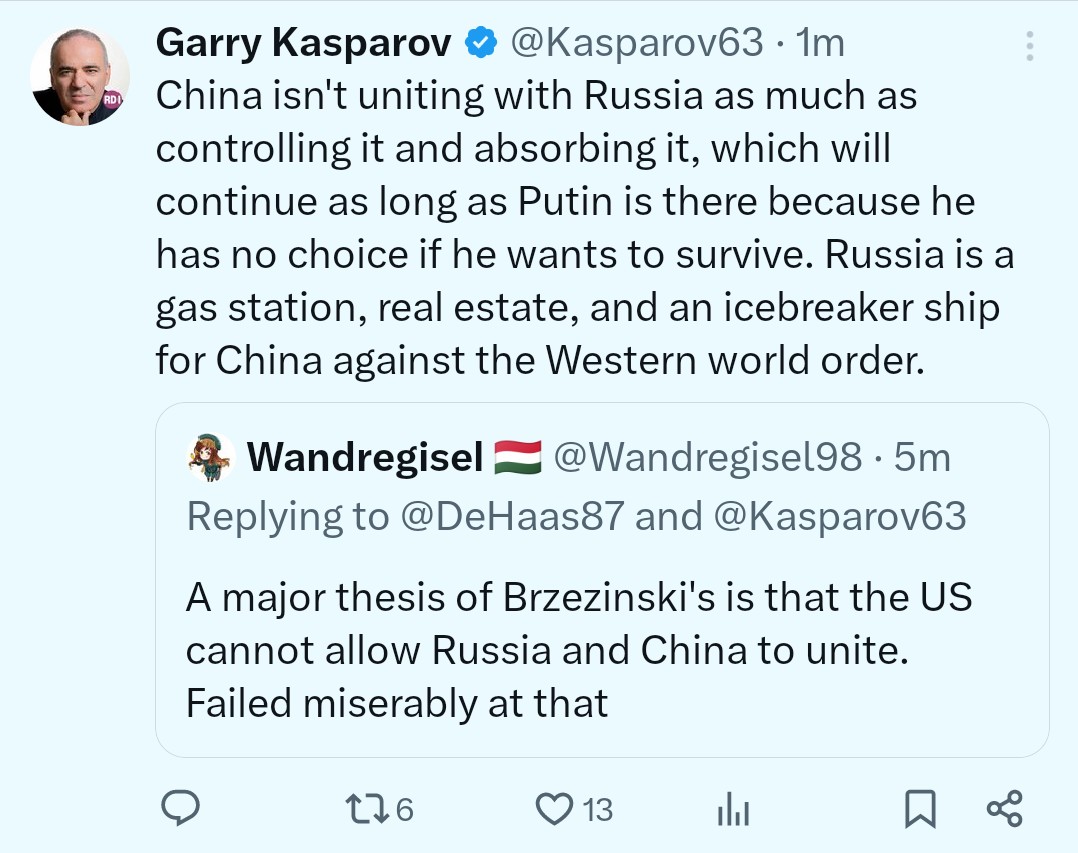
I got quote tweeted by the ex-world champion. I'm a big deal like that
Front row seating to the worst geopolitical analysis known to man. Same old bland "gas station with nukes" tripe
I will keep saying this. If you want to know how serious a political movement is? Get their take on laws. If they are dismissive or incapable of it?
You got a disaster coming. Or people who can't rule after taking power. Law gives structure to new orders.
Hoy quiero hablarles de tres héroes salvadoreños que perdieron la vida mientras cumplían una misión lejos de nuestra patria.
Tres miembros de nuestra Fuerza Armada que viajaron a Haití con un propósito: rescatar a cuatro de sus compañeros que habían sido secuestrados por pandillas haitianas.
Lamentablemente, una explosión accidental durante esa misión les arrebató la vida.
Sus nombres son: el teniente Cristian Daniel Palacios Santos, el cabo Emerson Alexander Zepeda Zelada y el cabo Wilber Manuel Serrano Medina.
Conocí de primera mano la valentía del teniente Palacios Santos. Durante un operativo, en un momento crítico en el que unos contratistas privados abandonaron sus posiciones, el teniente tomó el control de la situación y actuó con rapidez y determinación, logrando salvar varias vidas, entre ellas las de sus propios compañeros.
Todos aplaudimos su valentía.
Recuerdo que en ese momento pensé: “Este muchacho llegará lejos. Tiene todo el temple y la capacidad de un líder”. Jamás imaginé que, poco tiempo después, estaría entre los fallecidos en un accidente.
También me informaron del extraordinario valor de los cabos Zepeda Zelada y Serrano Medina. Durante unas pruebas en El Salvador, una granada quedó atorada en un dron. La batería estaba por agotarse y no era posible dirigirlo hacia una zona completamente segura para que se estrellara. Serrano Medina sostuvo el dron a aproximadamente un metro y medio del suelo mientras Zepeda Zelada desactivaba manualmente la granada.
Sabían perfectamente el inmenso riesgo que estaban corriendo, pero aun así decidieron actuar para proteger a los demás.
Y lo lograron.
Estas no son simplemente historias sobre tres héroes. Son acciones que nos permiten entender quiénes eran estos hombres: militares capaces, valientes y comprometidos con una misión que siempre pusieron por encima de su propia seguridad.
Varias veces he dicho que siempre he admirado a las personas que deciden dedicar sus vidas a salvar las de otros. Porque hay algo extraordinario en ellas. Algo que no es natural, que no es común, que no es normal.
Todos los seres humanos tenemos una reacción instintiva ante el peligro. Si vemos un peligro, huimos de él. Si hay un incendio, corremos y tratamos de alejarnos. Pero un bombero no huye del incendio, hace lo contrario, lo que casi nadie más haría, y en lugar de huir del incendio, corre hacia él, arriesga su vida, camina entre las llamas si es necesario para salvar a los demás.
Eso no es algo normal, es algo extraordinario.
Si escuchamos una balacera, nuestro instinto es huir de los disparos, buscar refugio, mantenernos alejados. Pero un policía hace lo contrario. Ellos no huyen de los disparos como haríamos todos, van hacia ellos, sacan su pistola y corren hacia el peligro para salvar a los que están en él.
Eso no es algo normal, es algo extraordinario.
Lo vimos con los rescatistas que enviamos a Venezuela, salvadoreños abriendo túneles en estructuras inestables que podrían colapsar en cualquier momento. Nuestro instinto natural es huir de un edificio que se desmorona, pero nuestros rescatistas hacían lo contrario: entraban a esas estructuras, sabiendo que podían morir ahí adentro, para salvar a quienes estaban atrapados.
Eso no lo haría casi nadie, mucho menos por un desconocido, pero ellos sí, porque los rescatistas, al igual que los policías, bomberos y militares, reaccionan de una manera totalmente diferente a todos los demás. Ellos no huyen del peligro, van hacia él. Eso es difícil de entender para la gente normal, pero ellos no son gente normal, son gente extraordinaria.
Cuando los demás retroceden, ellos avanzan. Sabiendo perfectamente que eso puede costarles la vida misma.
Y no es que no tengan miedo, es que hay algo más fuerte que ese miedo: su deseo de salvar a los demás.
Esa es la vocación que mueve a nuestros militares, a nuestros policías, bomberos y rescatistas. Personas que han decidido dedicar sus vidas a proteger la de los demás…
When I entered college, at age 29, I very quickly noticed that there is a natural and useful way to divide professors into two groups.
It's wasn't old and young. It wasn't left and right. And it wasn't male and female.
It was engineering, and everyone else.
And the difference here wasn't based on some stereotype, whether true or false, about engineering. It wasn't based on anything I already knew coming in, or anything I expected.
It was a simple, observable difference in behavior.
100% of engineering professors were visibly pleased when I argued with them. 100% of non-engineering professors were visibly displeased when I argued with them.
Male or female, didn't matter. Of course, there were no female engineering professors, but that's not the point, because the male non-engineering professors behaved exactly like the females.
And I quickly understood why.
When a student argues with an engineering professor, at least at the baccalaureate level, he's almost always wrong, and that's because he hasn't understood something.
The argument will last until the professor gets the student to understand what he is missing. It's a teaching opportunity.
More importantly than that, a student who argues is a student who cares. He is not concerned only about his grade. He is not wondering if this will be on the test. He wants facts to be facts, and he wants to possess them.
Engineers are born, not made. If you aren't one, I cannot explain what makes a man an engineer. If you are one, I do not have to.
But we recognize each other.
And when a student argues with a professor until he understands the difference between countable and recursively enumerable, then they recognize each other, too.
This is the system working, as designed by people like the professor and student, for people like the professor and the student. Of course the professor is pleased. This is his happy place.
For other professors, in other fields, things seemed different. Less defined. English professors certainly had things they were agreed upon, many of them having nothing to do with English at all, but they were all held to be true by consensus.
Not by the verifiable behavior of a non-partisan universe.
So to argue with an English professor wasn't a teaching moment. It wasn't a chance to make a verifiable fact understood.
It was a challenge to a social consensus.
It was a challenge to the same social consensus on which the social status and paycheck of the English professor rest.
The difference between the English professor and the student goes away if people stop believing in it. The difference between the Computer Science professor and the student does not.
The "PhD" and the "30 years of experience", therefore are something an engineering professor does not appeal to. They are not a credential. They were a training process, a reason why professor knows what he knows, and can prove it. Not something he needs to appeal to.
For the English professor, they are a moat around her personal welfare, and she needs others to respect them. By not disagreeing with her, or questioning her.
It is clearly in her self-interest to use every resource she has available to prevent people from doing so.
@cirnohappy Im gonna guess something like Rb3' since taking on b3 allows Qh8+ Ng8 e7+ with mate soon
Black has no other options though. Moving the rook of the b-file allows Rb8+, while Rb6 still allows Qh8+ and e7+
At least, that's what I think, could be wrong