If you want to support my work, you can always buy me a coffee. For an especially big coffee, I can cover the topic of your liking so long as it's about war.
https://t.co/nndQwO1bOq
Matthew VanDyke is one of my favorite stories to come out of the global conflict scene. Was he a CIA contractor? Some kind of rogue adventurer? A mercenary? I think the truth is considerably more interesting. This is a little three-minute documentary about who the man actually is.
VanDyke was a Baltimore kid with a master’s degree in Security Studies from Georgetown who initially imagined a career in intelligence, then did something considerably stranger: he spent years traveling through North Africa and the Middle East by motorcycle, filming the experience and building friendships along the way.
When the Libyan revolution erupted in 2011, some of those friends were caught in it. VanDyke returned, this time specifically to fight against Muammar Gaddafi. Six days after arriving, he was captured during a reconnaissance mission and disappeared into the Libyan prison system. He spent roughly six months in captivity, much of it in solitary confinement at Abu Salim prison. When rebels broke the prison open, he had an obvious opportunity to go home.
He picked up a rifle and went back to the war.
After Libya, VanDyke turned increasingly toward filmmaking. He went into Syria during the civil war, worked around rebel forces in Aleppo and produced Not Anymore: A Story of Revolution. He knew journalists James Foley and Steven Sotloff; after ISIS murdered both men, the war became personal again.
VanDyke subsequently founded Sons of Liberty International, a nonprofit security organization that supplied free military training and advice to local forces fighting ISIS. In Iraq, the group helped train the Assyrian Nineveh Plain Protection Units, including an entire battalion.
That is why I find him more interesting than the conspiracy theories. You do not need a secret CIA contract to explain Matthew VanDyke. The documented story is already bizarre enough: graduate student, motorcycle traveler, filmmaker, Libyan revolutionary, prisoner of Gaddafi, Syrian documentarian and eventually the founder of a nonprofit military-training organization fighting ISIS.
Some people spend their lives trying to get away from wars.
Matthew VanDyke developed a remarkable habit of finding the next one. @Matt_VanDyke
Russell Bentley, better known as “Texas,” spent the final decade of his life reinventing himself as an American communist fighting for the Russian world. Born in Austin, Bentley had served three years in the U.S. Army, run for the U.S. Senate in Minnesota on a marijuana-legalization ticket, trafficked large quantities of marijuana, gone to federal prison, escaped, lived as a fugitive for years, and eventually returned to Texas before deciding that the next logical chapter of his life was eastern https://t.co/zIJbl2105I late 2014, Bentley traveled to Donetsk and joined Russian-backed separatist forces, including the Vostok Battalion. He embraced the Kremlin’s framing of the war, describing post-Maidan Ukraine as fascist and presenting Russia and the separatist republics as the side resisting Western imperialism. He later moved increasingly into propaganda work, producing videos from occupied Donetsk and eventually working for the Russian state-owned outlet Sputnik. Russia granted him https://t.co/hpbMaBr2dO spent years selling a very specific image: the American who had seen through his own country’s lies, crossed the ocean, and physically joined Russia’s struggle against the West. He called himself an “information warrior,” praised Moscow’s cause, and became useful precisely because he was an American willing to tell Russian audiences that their worldview had been vindicated by somebody from Texas.Then, in April 2024, the mythology met the system he had https://t.co/ZzJfaHe5pC disappeared in Russian-controlled Donetsk after going to the scene of Ukrainian shelling. Russia’s own Investigative Committee later said Russian servicemen had detained and tortured him to death. Two of the soldiers then placed his body in a car and blew it up; another serviceman was accused of helping move his remains in an attempt to conceal the crime. Russian media suggested the soldiers may have mistaken him for an American spy.The case eventually went to trial. In December 2025, three Russian soldiers were sentenced to prison terms of up to 12 years for Bentley’s killing.There is an ugly symmetry to the ending. Bentley spent years telling Americans that Russia understood him better than America did, took Russian citizenship, fought for Moscow’s proxies, worked for Russian state media, and devoted himself to defending the Russian war narrative.He was ultimately tortured and killed by Russian soldiers on the same side he had spent a decade defending.We did not need to embellish this story. That is not the point of War Tourist Media. We do not invent allegations because somebody chose the wrong side of a war. We stick to what is real, sourced, and verifiable. This is who Russell “Texas” Bentley was, and he died for that choice at the hands of men fighting on his own side.And yes, this is one of my older videos. The production quality has increased substantially since then, and we are continuously working to improve the product here at War Tourist Media.
What are Erik Prince and the Israelis doing in the Democratic Republic of the Congo?
Prince’s Vectus Global entered Congo primarily through a government contract concerned with mining revenues, smuggling and state capacity. That mandate has since moved much closer to the battlefield. Reuters reports that Vectus personnel have provided drone and operational support to Congolese forces fighting the Rwanda-backed M23 movement in eastern Congo. In September, a Prince-linked team was ambushed in South Kivu; Tim Kennedy was wounded, while Congolese personnel and a former New Zealand special-operations soldier were reportedly among the casualties.
Israel occupies a different, though increasingly important, position. Israeli advisers have trained Congolese special-forces units, while Kinshasa has sought deeper cooperation with Israel in defense, security, advanced technology and infrastructure. President Félix Tshisekedi traveled to Jerusalem in September for meetings with Benjamin Netanyahu and Isaac Herzog specifically addressing those sectors.
The result is an unusual mise en scène: Congolese troops, private American contractors and Israeli military expertise operating within a conflict shaped heavily by Rwanda and M23, while the country’s immense copper and cobalt reserves draw strategic attention from Washington, Beijing and other foreign powers.
Prince is also expanding into privatized air defense through Vectus Air Defense Systems. Whether Congo eventually becomes a market, operational laboratory, or neither remains unproven; there is currently no public evidence establishing that the new company itself is deployed there.
Congo is therefore becoming a useful case study in how contemporary warfare, private military enterprise, foreign security assistance and competition over strategic resources increasingly occupy the same terrain.
Guillaume Cuvelier is one of the stranger Franco-American figures to come out of the Donbas war. Born and raised in France as a dual French-American citizen, he moved through French ultranationalist and neo-fascist circles before going to eastern Ukraine in 2014, where he fought with Russian-backed separatists and helped form Unité Continentale, a foreign-volunteer group influenced by Alexander Dugin’s anti-Western Eurasianist politics. He later fought alongside Kurdish Peshmerga in northern Iraq, returned to the United States, and somehow enlisted in the U.S. Army as an infantryman before his background became public and triggered an Army inquiry.
A quick note on the older War Tourist videos I’m reposting here: the production quality is not going backwards. These are simply earlier profiles I’m finally moving onto X, and the editing has improved considerably since then.
And unlike Track A Nazi Merc, we do not need to embellish people, invent allegations, or stretch evidence until it fits a narrative. If something is verified, we say it. If it is disputed or unverified, we say that too. There are already plenty of foreign fighters on both sides of the Ukraine war with extremist politics, criminal histories, bizarre motives, or otherwise troubled backgrounds. The truth is interesting enough.
That is really what War Tourist Media is about: the human terrain of war—the strange people who enter these conflicts, why they go, what they actually did, and what can genuinely be proven about them.
Gregory Wayne Rossell Jr., better known as “Teddy Boy Greg,” managed to flee the unbearable horrors of American wokeness all the way to Vladimir Putin’s Russia. The American barber moved to Moscow, opened a rockabilly barbershop, increasingly presented Russia as a refuge from Western liberalism and “degeneracy,” and eventually attached himself to Española, the Russian armed formation that grew out of the football-ultra and hooligan scene. Researchers have identified Rossell as an Española media propagandist and English-language spokesman; Searchlight describes him as one of the formation’s most prominent American recruits.
His public politics have included virulent anti-Americanism, racism and antisemitism, alongside repeated praise for Russia and its war against Ukraine. He has described himself as “Russian in my soul” and framed the conflict as part of a broader civilizational struggle against the West.
And just to be clear: we don’t need to invent a Nazi mercenary where the evidence doesn’t support it. We don’t need to exaggerate or make up lies about the idiots who choose Russia’s side. We simply tell the truth here at War Tourist Media. Usually it is embarrassing enough.
Also, this is one of my older videos. The production quality is not declining; I’m just digging through the archive and finally putting the older profiles on X.
Neall Ellis was a South African helicopter pilot and mercenary whose career ran through some of Africa’s ugliest wars. A veteran of the South African Defence Force and later Executive Outcomes, he flew combat missions in places like Angola and Sierra Leone, often in Mi-24 gunships, and became one of the most experienced private military aviators of his generation.He later returned to Sierra Leone as a contractor, flying support for government forces against the RUF. Ellis survived years of war, coups, and mercenary work before dying of cancer in 2019.
Ryan Wesley Routh was an American drifter and obsessive Ukraine supporter whom I briefly encountered around the Maidan area in Kyiv in the spring of 2022. He spent months in Ukraine trying to insert himself into the foreign-volunteer ecosystem and later talked publicly about recruiting Afghan soldiers to fight Russia, although Ukrainian officials and foreign volunteers said he was never part of a recognized Ukrainian military unit and was widely regarded as a liability.
His story later took a much darker turn. In September 2024, Routh was arrested after authorities found him armed near Donald Trump’s golf course in West Palm Beach. In September 2025, a federal jury convicted him of attempting to assassinate Trump, along with additional weapons and obstruction-related offenses; he was later sentenced to life imprisonment.
He remains one of the stranger characters to pass through the Ukraine foreign-volunteer orbit: intensely pro-Ukraine, desperate to make himself relevant to the war, but never actually established as a Ukrainian fighter.
This is one of my older videos, so no, the production quality is not going backwards — I’m just digging old profiles out of the archive and finally putting them on X.
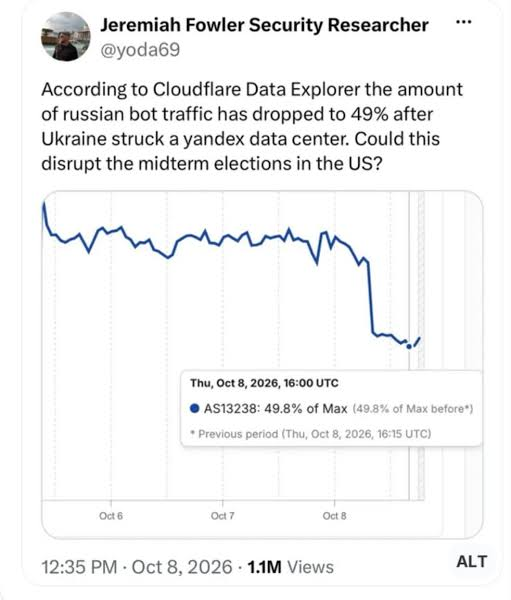
The team at War Tourist Media is increasingly concerned about the welfare of our Russian bot account followers, whose tireless engagement has substantially expanded our reach. We are conducting a routine welfare check to ensure you are all safe and accounted for. Please comment below to confirm that you remain operational and unharmed. Your service to our growth has not gone unnoticed. Otherwise, you are a detriment to humanity.
I do not claim to have done a lot that's for sure. 2022 was a wild place and serving in Ukraine was very interesting and it was not my cup of tea I was not cut out for infantry work but I did some drone stuff. I ultimately left in 2022 because I had a dog that I had to take care of.
That's when things got pretty dark.
Part two of many. Scroll down there and you'll see part one.
And if you leave nasty comments I'm just going to end up deleting them so don't waste your time. If you're Russian and you're leaving nasty comments I'll leave it up because that's pretty warranted I can understand why you hate me.
Benjamin Stimson was one of the first Britons to openly fight for Russia in Ukraine. He joined pro-Russian separatists in Donbas, later served prison time in the UK for terrorism-related offenses, and eventually returned to Russia’s war effort. A strange, grim little biography from the foreign-fighter world.
The Black Nazi.
Jackie Arklöv was born in Liberia in 1973 to a Liberian mother and a European father, then adopted and raised in the far north of Sweden. Accounts of his childhood describe profound racial alienation: he was reportedly bullied for his appearance and, as a boy, even tried to scrub or cover his skin to make himself look white. Sources differ on his father’s nationality, but the basic point is clear—Arklöv was a man of African and European ancestry who somehow ended up embracing an ideology built around white racial supremacy.
As a teenager he entered Sweden’s militant neo-Nazi scene and became associated with Vitt Ariskt Motstånd — White Aryan Resistance (VAM), one of the country’s most notorious white-supremacist networks of the early 1990s. He later claimed there was no contradiction between his race and National Socialism.
At nineteen, Arklöv went looking for a war. He initially considered the French Foreign Legion, but instead ended up in the former Yugoslavia, joining the Croatian special-purpose unit Ludvig Pavlović. His own wartime writings described the experience as fulfilling a fascist fantasy. What followed was considerably darker than battlefield tourism: prisoners later testified that Arklöv beat, threatened and tortured Bosnian Muslims, including a pregnant woman. He ultimately admitted much of the abuse in a Swedish courtroom.
A Bosnian court sentenced him to thirteen years in 1995, later reduced to eight. After a prisoner exchange brought him back to Sweden, the case eventually returned to court there, and in 2006 he was convicted for grave violations of international law committed against Muslim detainees.
And somehow the story still gets worse.
Back in Sweden, Arklöv fell in with other neo-Nazis and became involved in armed robbery. In 1999, following a bank robbery near Malexander, two Swedish police officers were murdered. Arklöv and his accomplices were convicted, and he received life imprisonment. He remains incarcerated; as recently as 2025 he was still seeking to have that life sentence converted to a fixed term.
Swedish journalist Magnus Sandelin later titled his book about him Den svarte nazisten — The Black Nazi. It is difficult to think of a more bizarre ideological biography: a Liberian-born Black Swede, alienated by his own racial identity, who embraced white supremacy, went to Bosnia in pursuit of a fascist war, became a convicted war criminal, and eventually murdered policemen alongside Swedish neo-Nazis.
Some people say he got a vasectomy to join the neo nazi group. Is it true?
How long until the United States faces a terrorist attack involving drones?
I don't know the answer to that question, but the technology is proliferating, and the clock is ticking.
I've compiled several videos documenting how relatively obscure armed groups are incorporating commercial drones into their operations. These are organizations that have deliberately chosen to publish footage of their activities. Others may be developing similar capabilities without advertising them.
From insurgent movements in Myanmar to criminal organizations in Mexico, drone warfare is spreading across conflicts that rarely receive sustained international attention. Commercial technology, improvised munitions, and increasingly accessible equipment have allowed armed groups with limited resources to acquire capabilities once largely reserved for conventional militaries.
The implications extend well beyond the battlefields where these weapons are currently being employed.
Whether, when, or how these methods might be adopted by terrorist organizations operating inside the United States remains an open question. What is increasingly difficult to dispute is how rapidly the technological barriers to entry are falling.
THIS VIDEO IS FOR INFORMATIONAL PURPOSES ONLY.
@devitis Thanks, I just dumped off the content I have been making over the past few weeks in the past couple of days, so there is a flood of stuff here.
Jacques Martin is a deeply problematic figure who nonetheless appears to have gone to Ukraine because he genuinely believed he was helping. The Belgian volunteer from Flémalle held fringe far-right and “national-anarchist” views, and reporting on him has documented extremist symbolism and ideology around his personal life.
Martin also claimed prior service in the French Foreign Legion and in Croatia, but I have not been able to independently verify either claim, so those should be treated as part of his own biography rather than established fact.
What is established is that he went to Ukraine in 2022, joined the International Legion, survived the Russian strike on Yavoriv, was injured, returned to Belgium for treatment, and then went back to Ukraine. His politics were ugly and contradictory, but his stated reason for fighting was that he believed Russian forces were killing civilians and that he could not simply stay home. That makes him a more complicated character than the ideology alone would suggest.
Wilmer Puello-Mota is what happens when personal disgrace metastasizes into geopolitical farce. The former Holyoke city councilor and U.S. airman fled the United States in January 2024, days before he was expected to plead guilty in a Rhode Island case involving *CP* possession and forged military documents. He resurfaced in Russia, joined its armed forces, and began appearing in propaganda videos as a drone operator fighting Ukraine.
Whatever mythology he has built around the decision, the chronology is brutally simple: Puello-Mota ran from an American courtroom and found refuge in the army of a state at war with a U.S.-backed country. Russia didn’t discover some great ideological convert. It acquired a fugitive with a useful passport, a military résumé, and nowhere particularly attractive to go home to.
Real British people stand with Ukraine. Bradley Townsend chose to fight for Russia.
Townsend, from Barnsley, Mingington, had no military experience when he left Britain and joined Russian forces fighting in Ukraine. He understood that his decision could leave him unable to return home and went anyway.
Townsend wrapped the choice in rhetoric about solidarity between Donbas and Yorkshire miners, but the practical reality was considerably less romantic: a British citizen voluntarily took up arms for Moscow in a war against a country supported by his own government. In the ordinary meaning of the word, he became a British traitor.
The adventure lasted only a matter of months. Townsend was killed near Lyman during a Russian assault, reportedly by an FPV drone.